
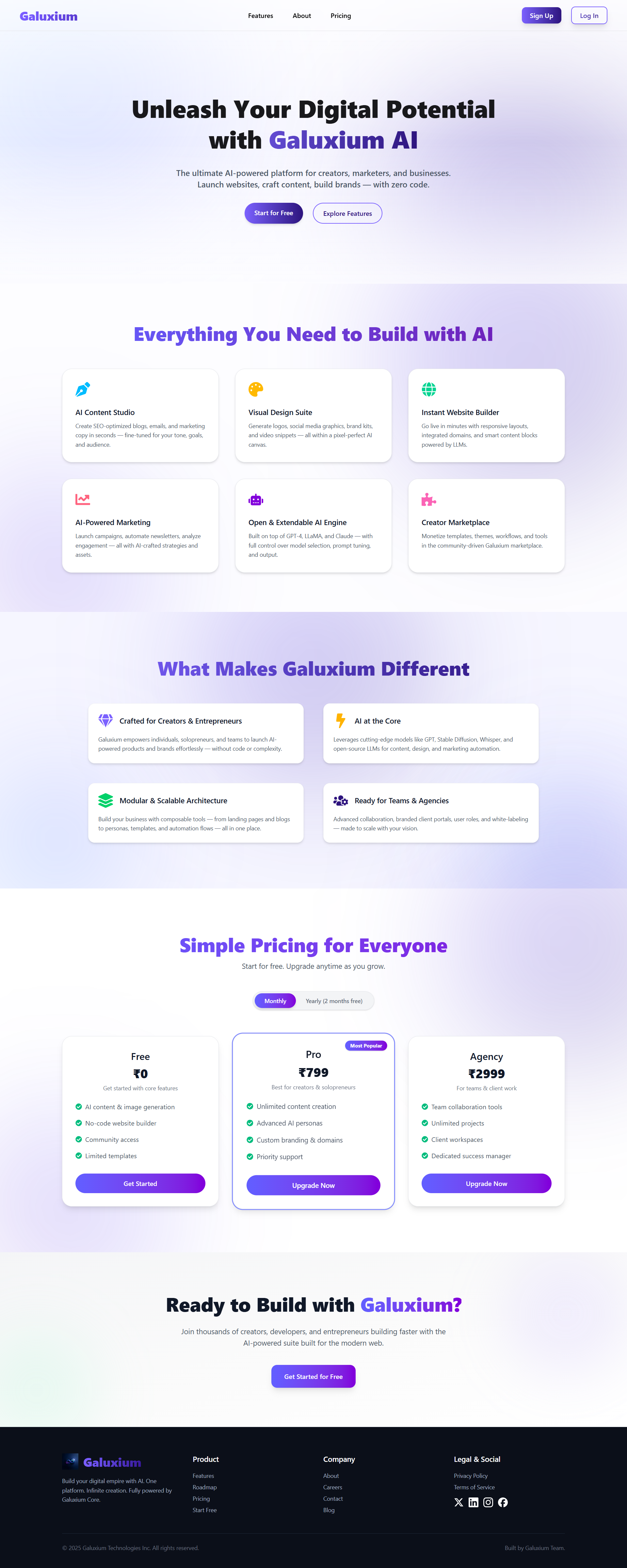
🧬 Galuxium — The AI That Builds Startups Autonomously
Tagline: From idea to deployable startup — autonomously.
💡 Inspiration
Every founder dreams of turning ideas into real startups — but the process is painfully slow. It takes weeks or months to validate an idea, design branding, write code, and build a product — often before even knowing if it’s worth pursuing.
Galuxium was born from the question:
“What if AI could act as your co-founder — validating your idea, designing your brand, building your product, and preparing investor materials end-to-end?”
That’s exactly what Galuxium does.
Galuxium is inspired by the desire to lower the barrier to entrepreneurship: give anyone the ability to generate a fully structured, deployable web app tailored to their niche, with analytics and CI-ready code so they can ship and learn.
What it does
Galuxium accepts high-level product prompts and produces a fully structured, runnable web application tailored to the user’s chosen use case.
Core capabilities:
- Idea → MVP: Convert natural language idea prompts into a full project scaffold (frontend + backend) with routes, pages, authentication, and seed data.
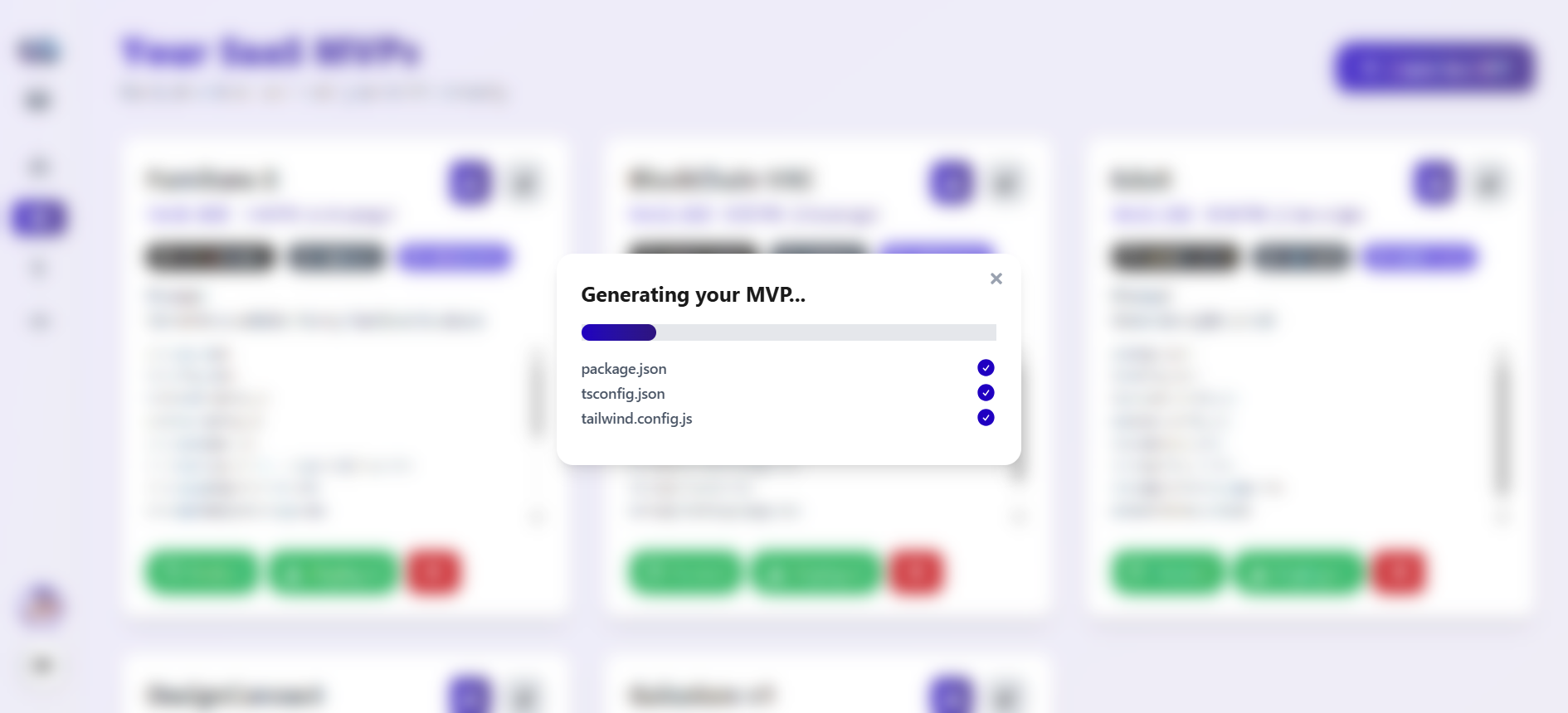
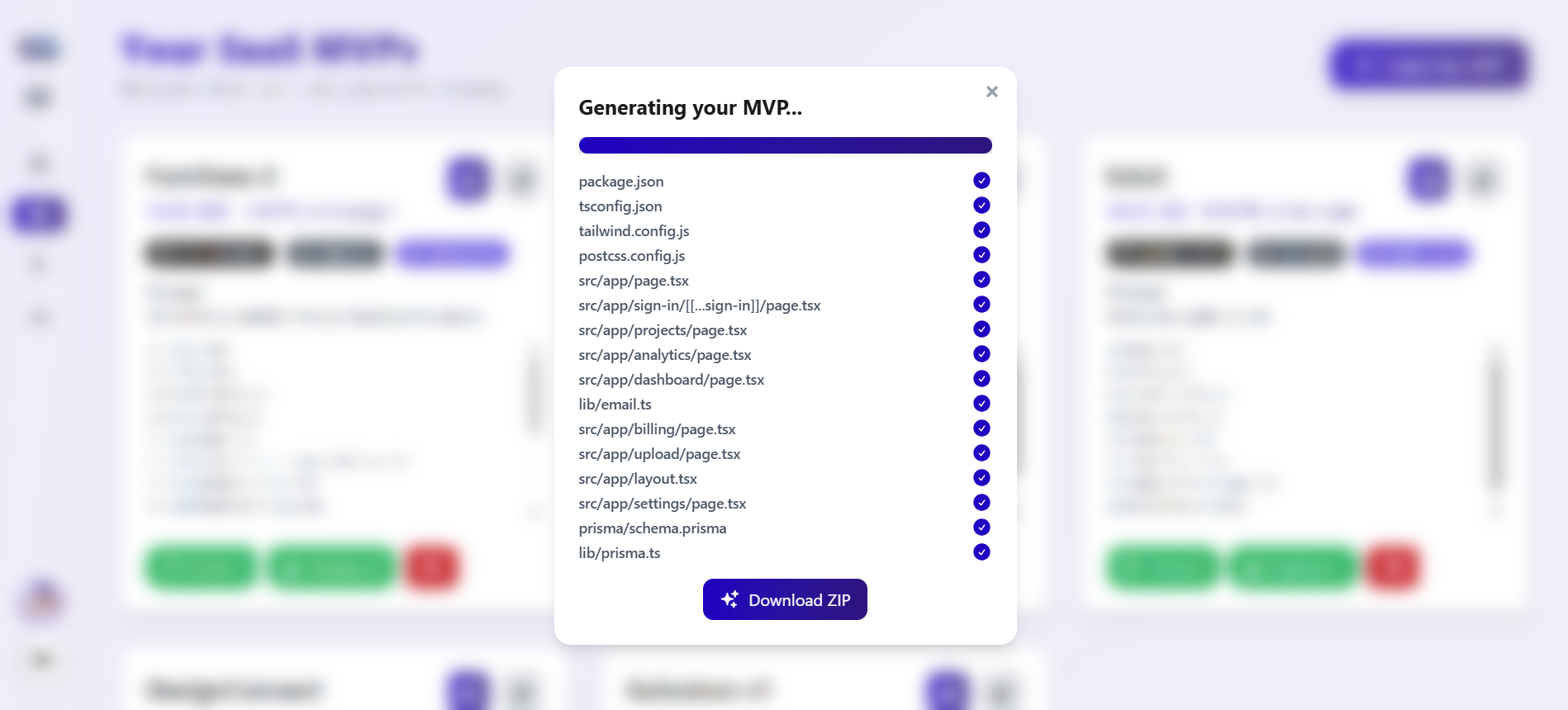
- Progressive generation: Files are generated and returned in chunks so users see incremental progress instead of waiting for one large payload.
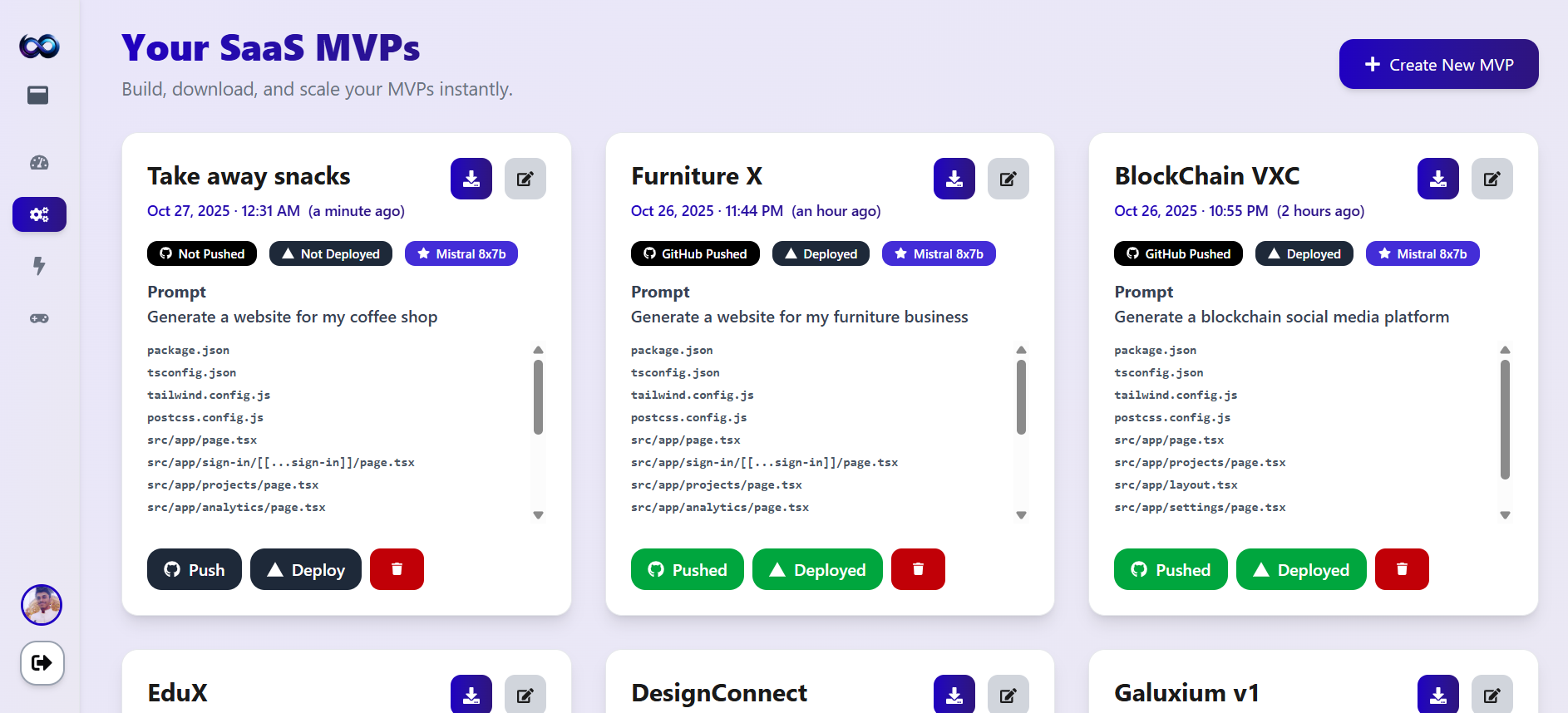
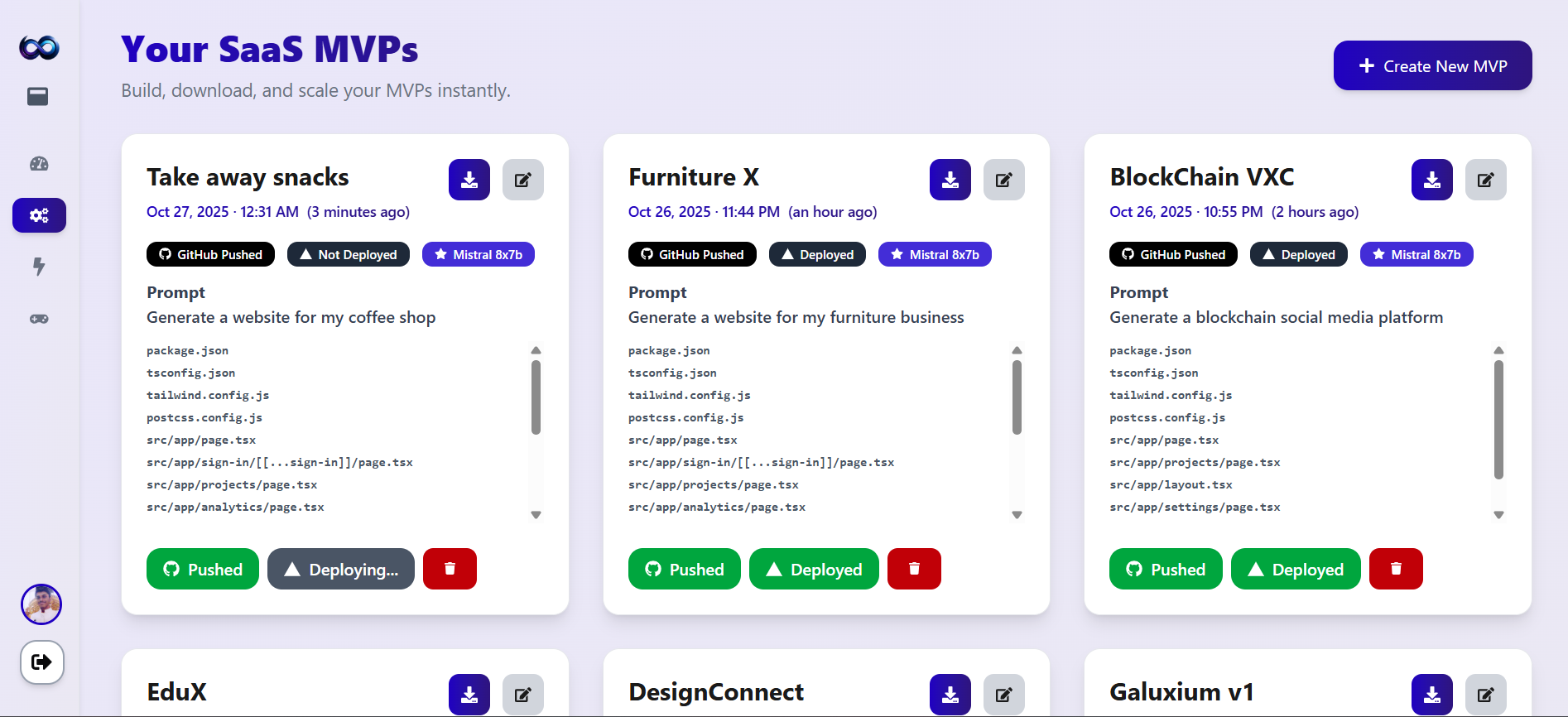
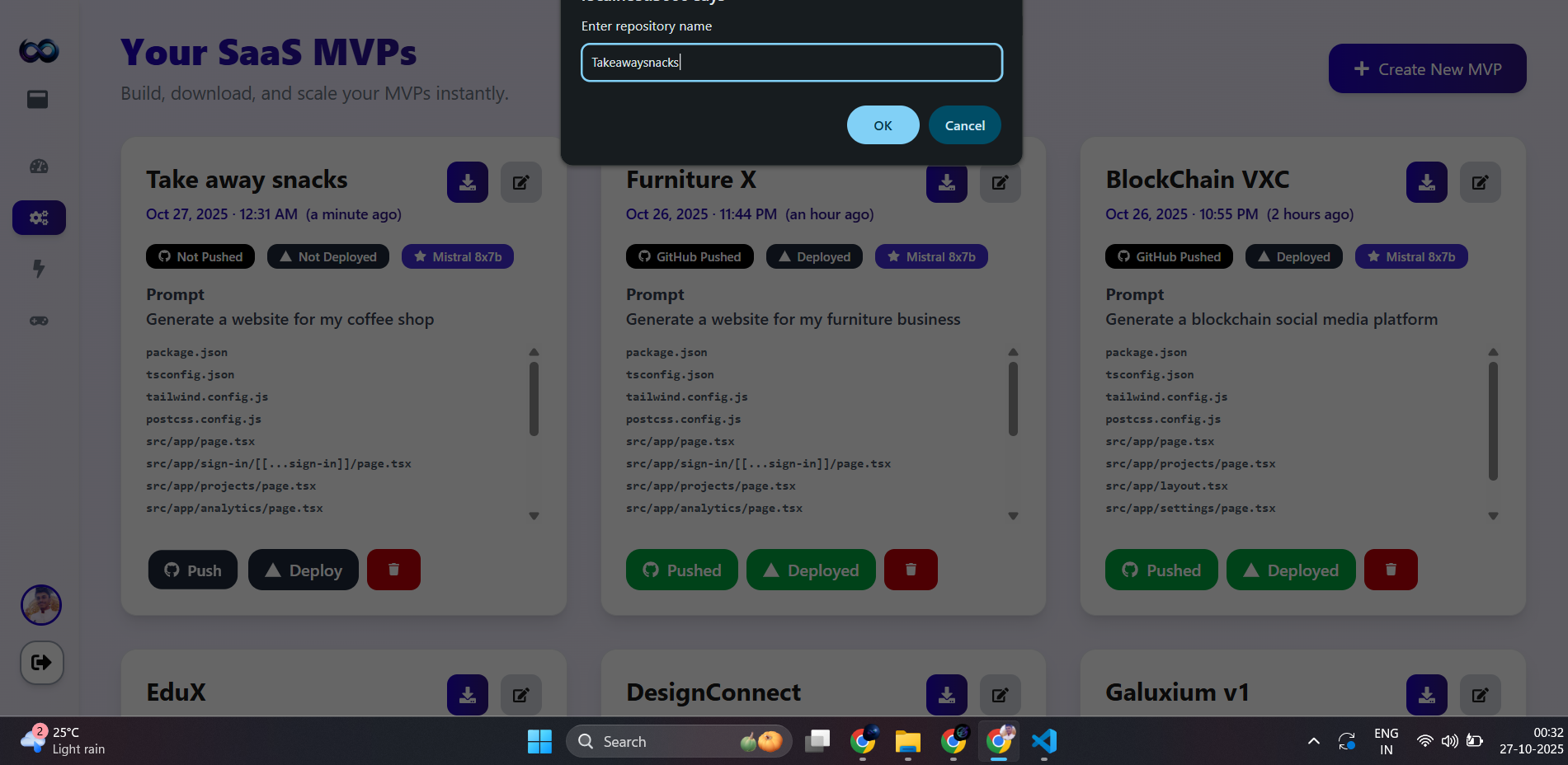
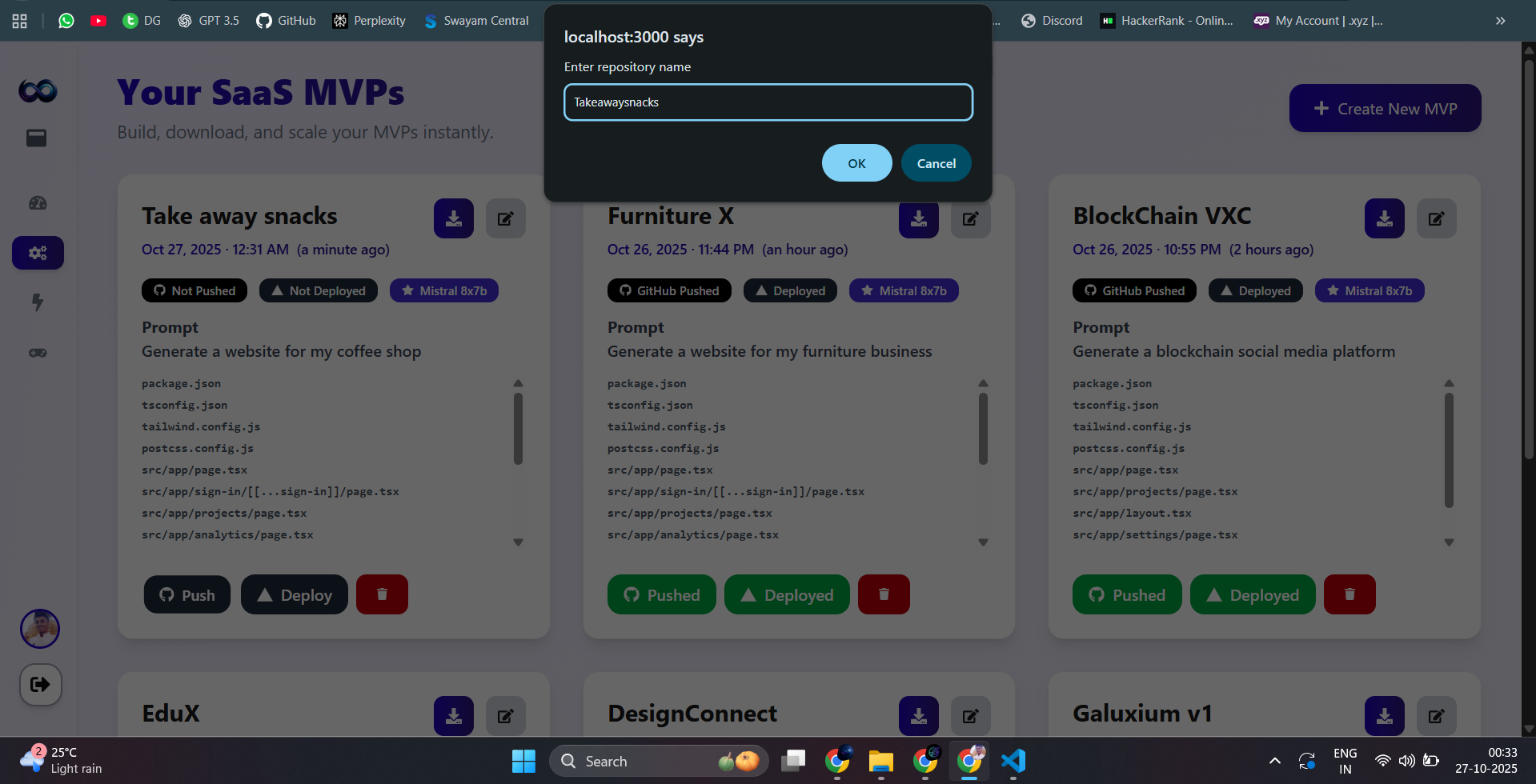
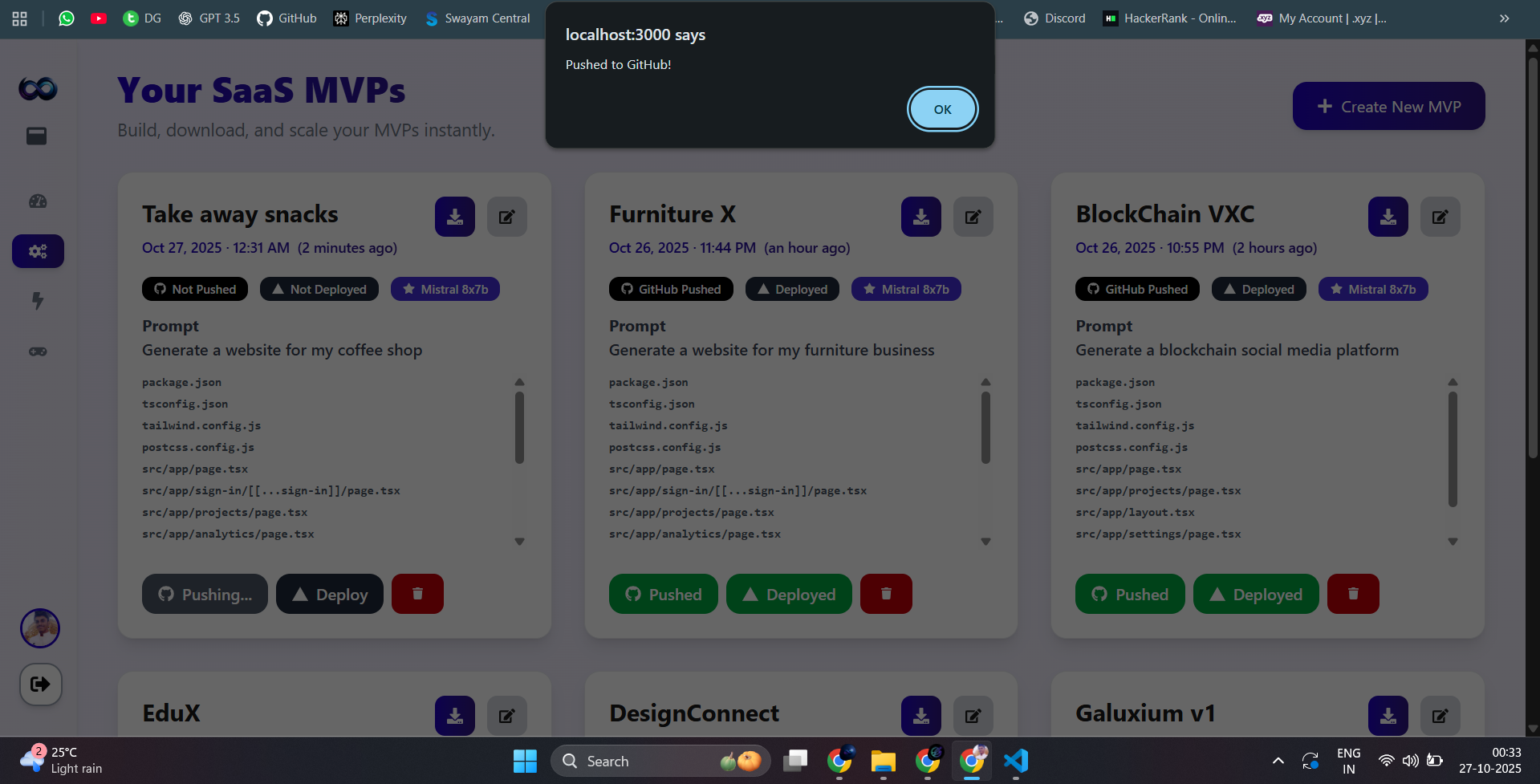
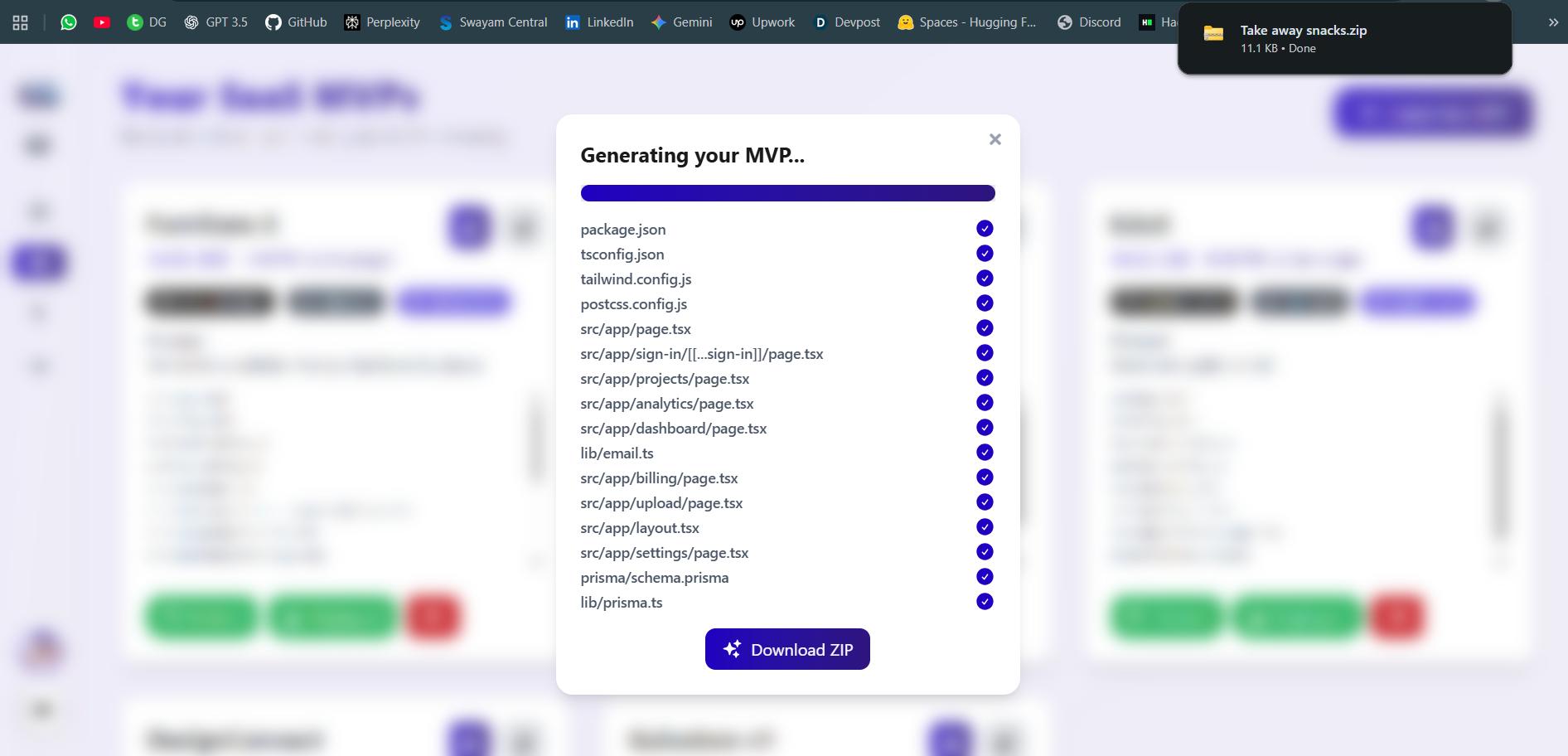
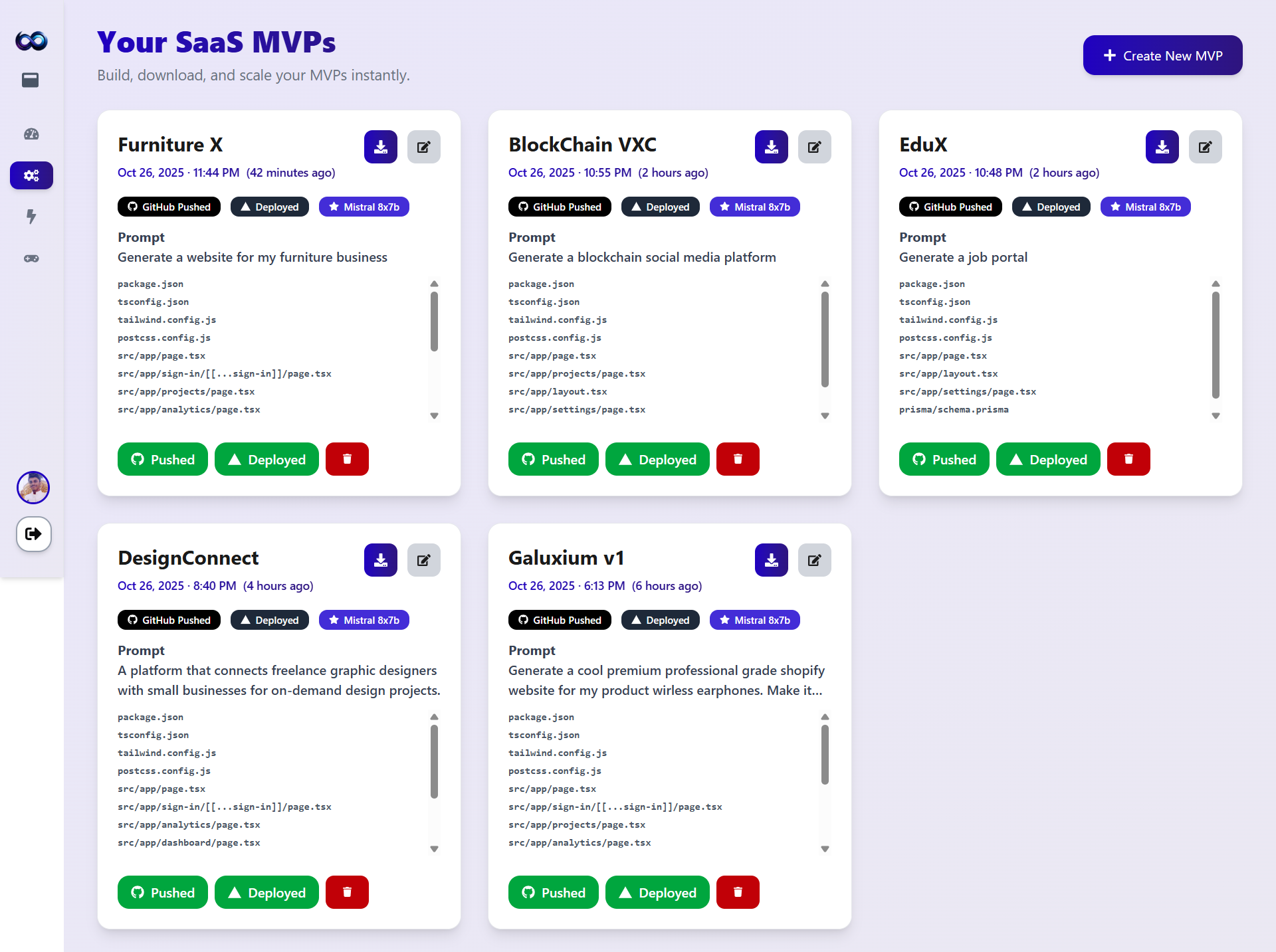
- One-click export & deploy: Download a ZIP of the generated project or push straight to GitHub (CI-ready). Deployed projects can be live in the browser instantly.
- Authentication & user profiles: Supabase-powered auth and user tables out of the box.
- Developer-friendly: Exported projects include Prisma schema, DB migration hints, and instructions to run locally.
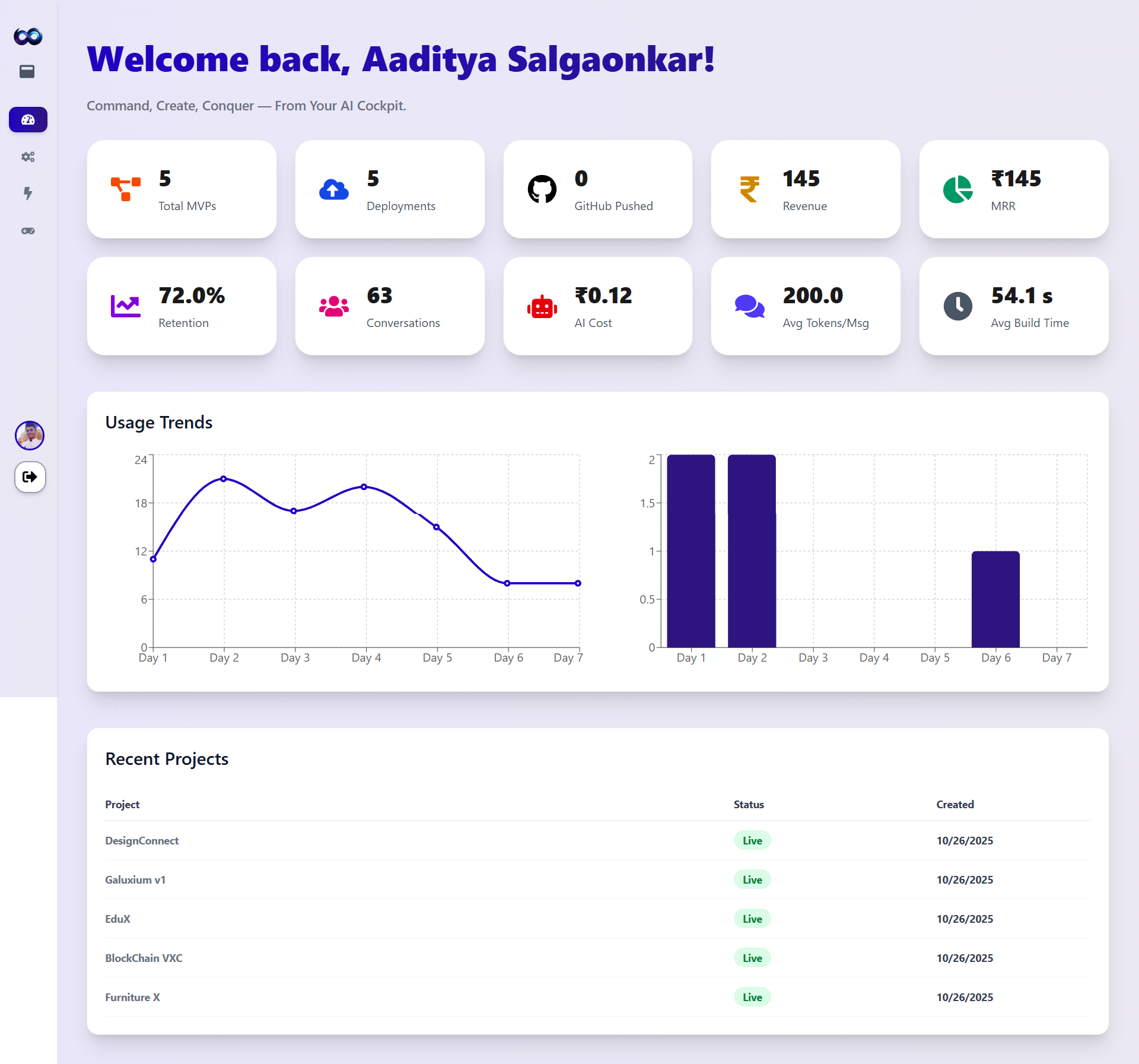
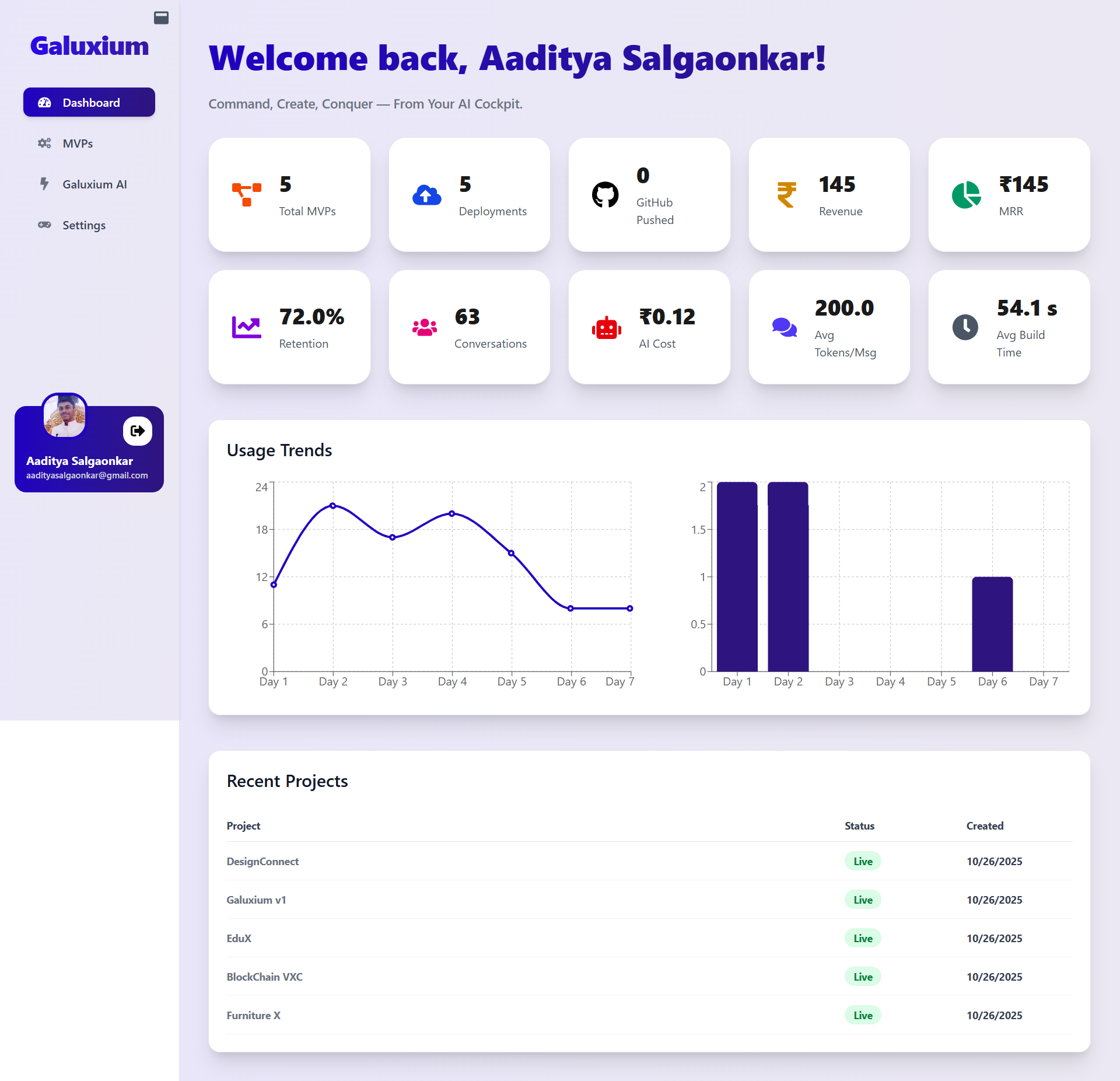
- Analytics & dashboard: Built-in dashboard showing usage, purchases, and recent activity to help founders validate demand.
- Chat & assistant: Integrated AI chat for onboarding, editing prompts, and iterating on generated features.
- Pluggable LLMs & assets: Supports multiple model backends (open & hosted LLMs) and can generate images and static assets. Target users: non-technical founders, indie hackers, product managers, and student founders who want to ship a real MVP without hiring an engineering team.
🧠 Multi-Agent Architecture
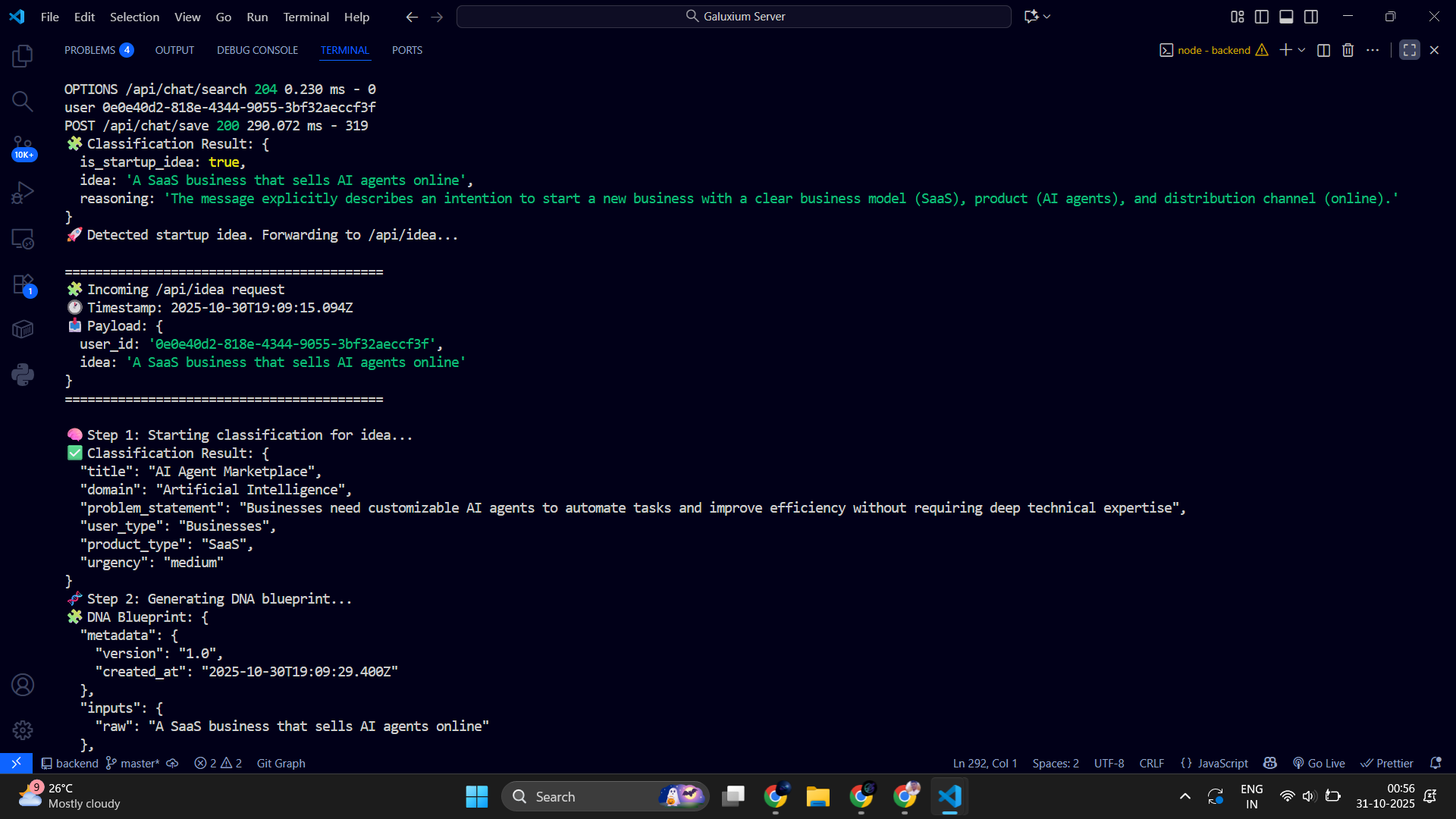
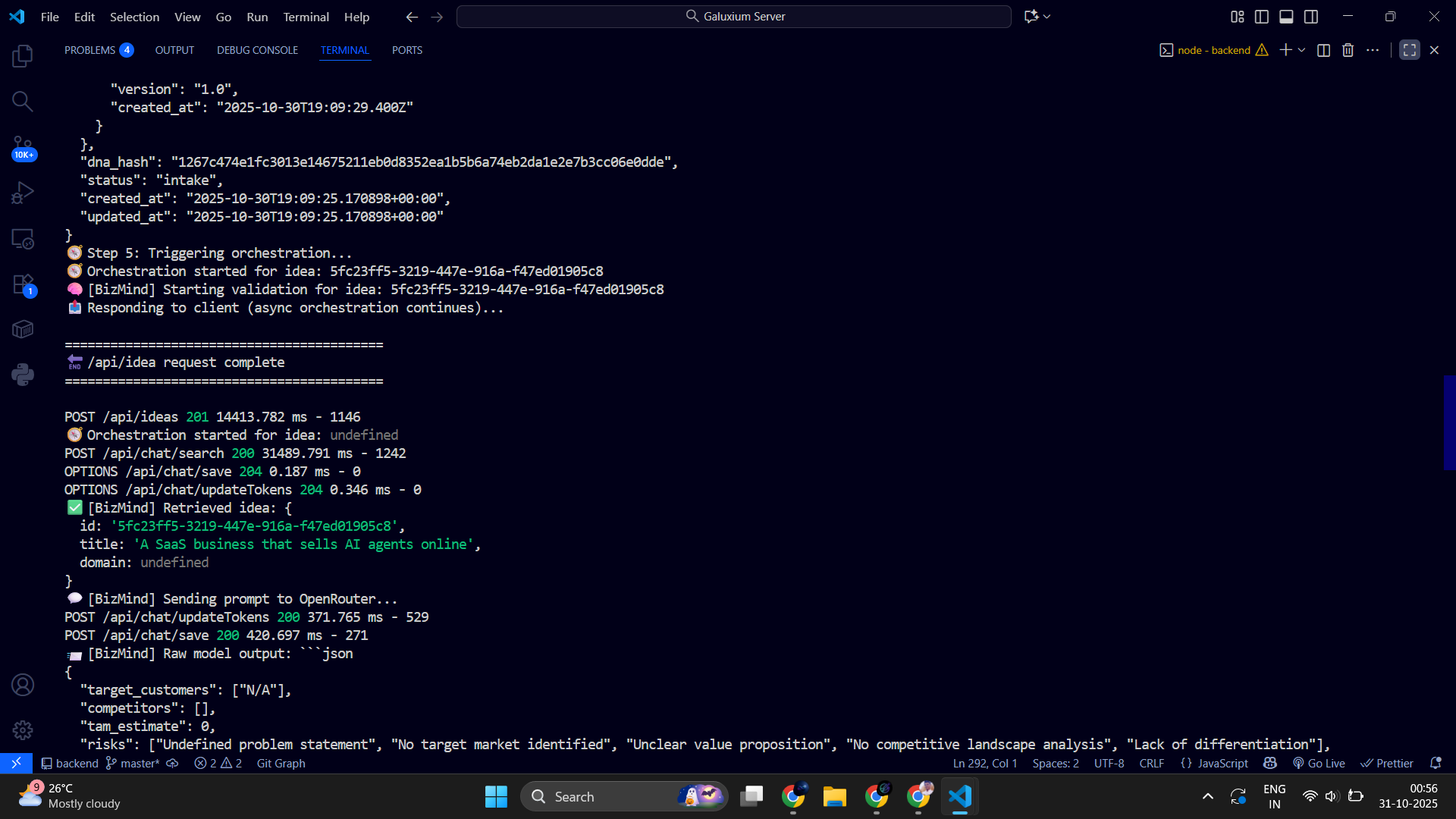
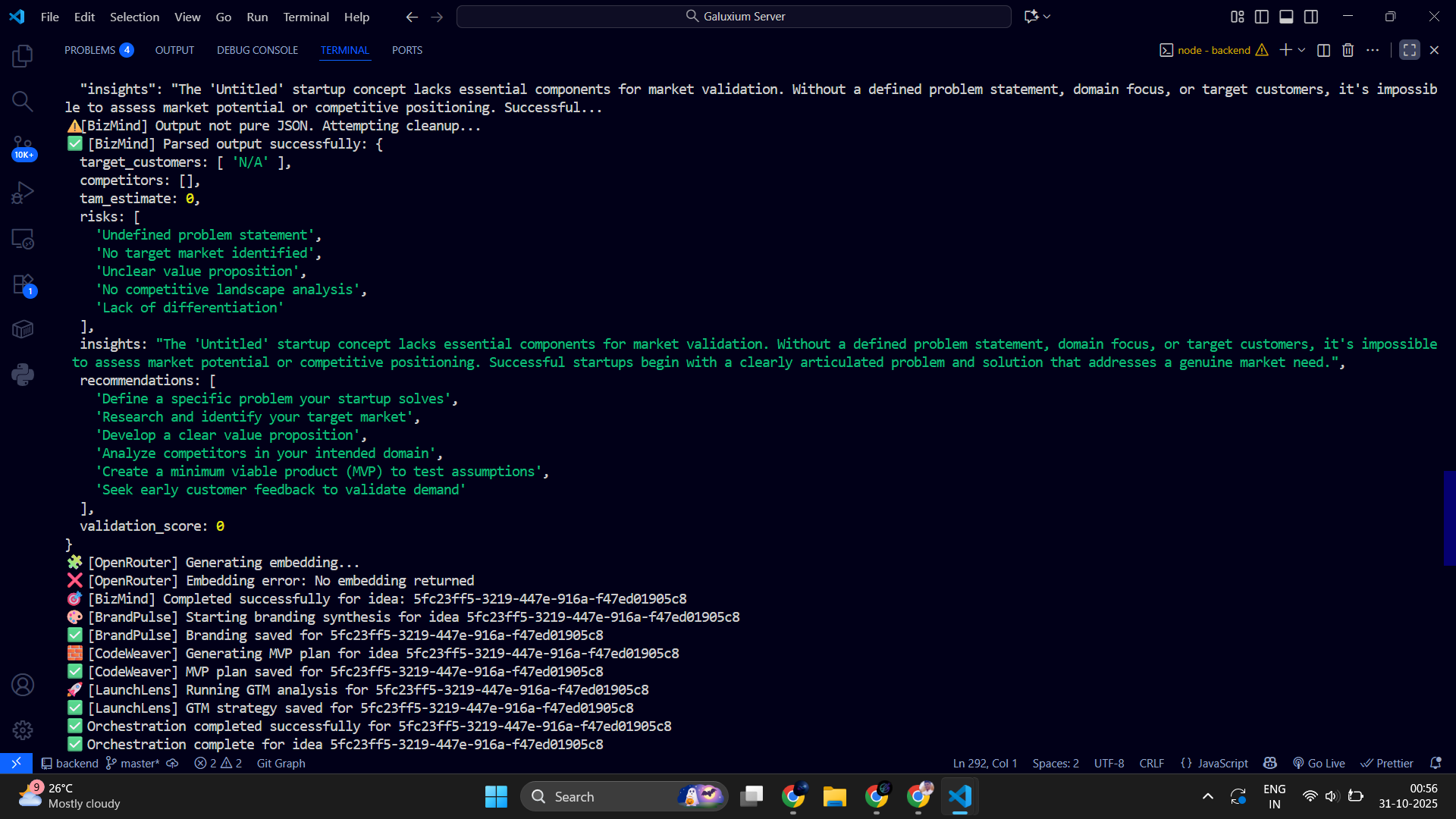
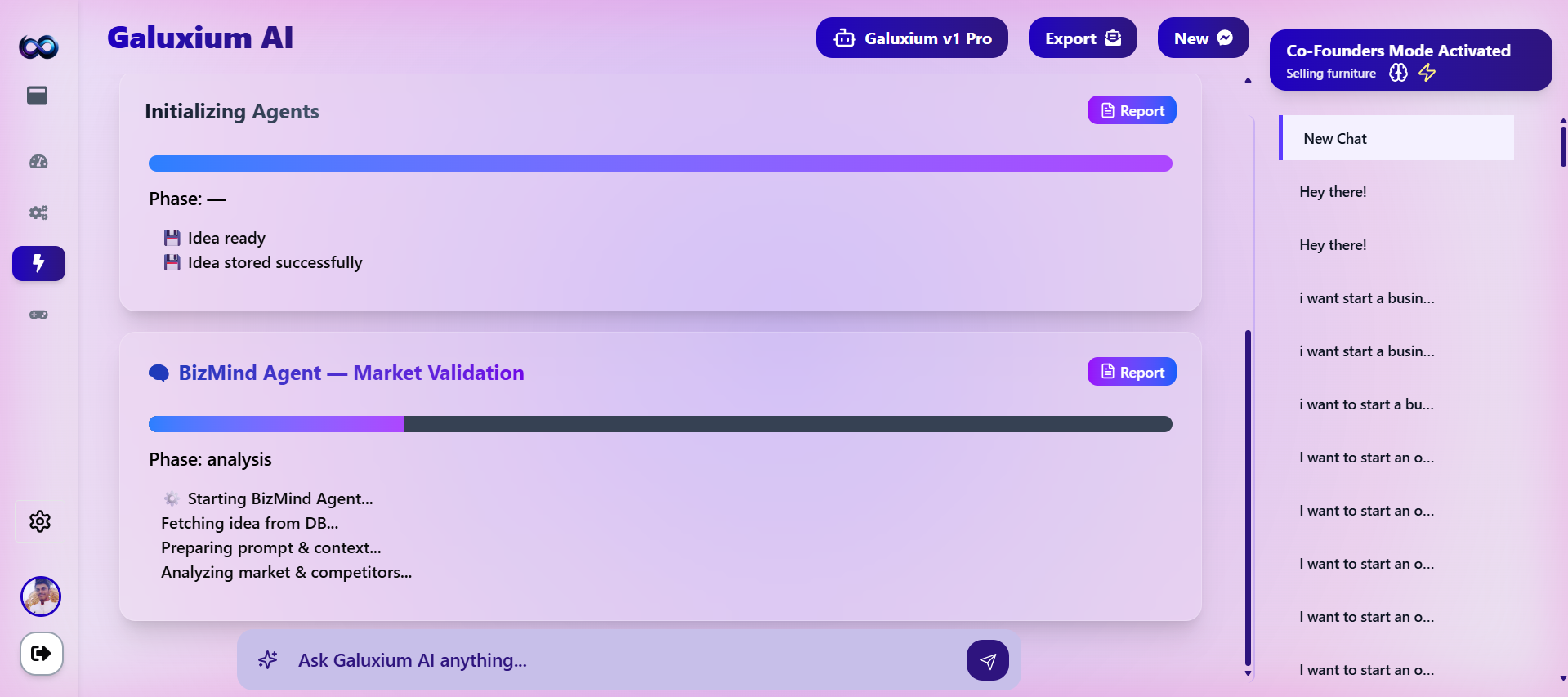
Galuxium runs four core AI agents in a live event-stream orchestration pipeline, each specializing in one stage of startup creation:
- BizMind Agent – Market Validation
- Analyzes audience, competition, TAM/SAM/SOM, and growth potential.
- Outputs a detailed validation report with insights and risk assessment.
- BrandPulse Agent – Identity & Branding
- Designs a complete brand kit: name, tagline, tone, logo, and color palette.
- Generates premium vector-style logos using AI + SVG fallback layers.
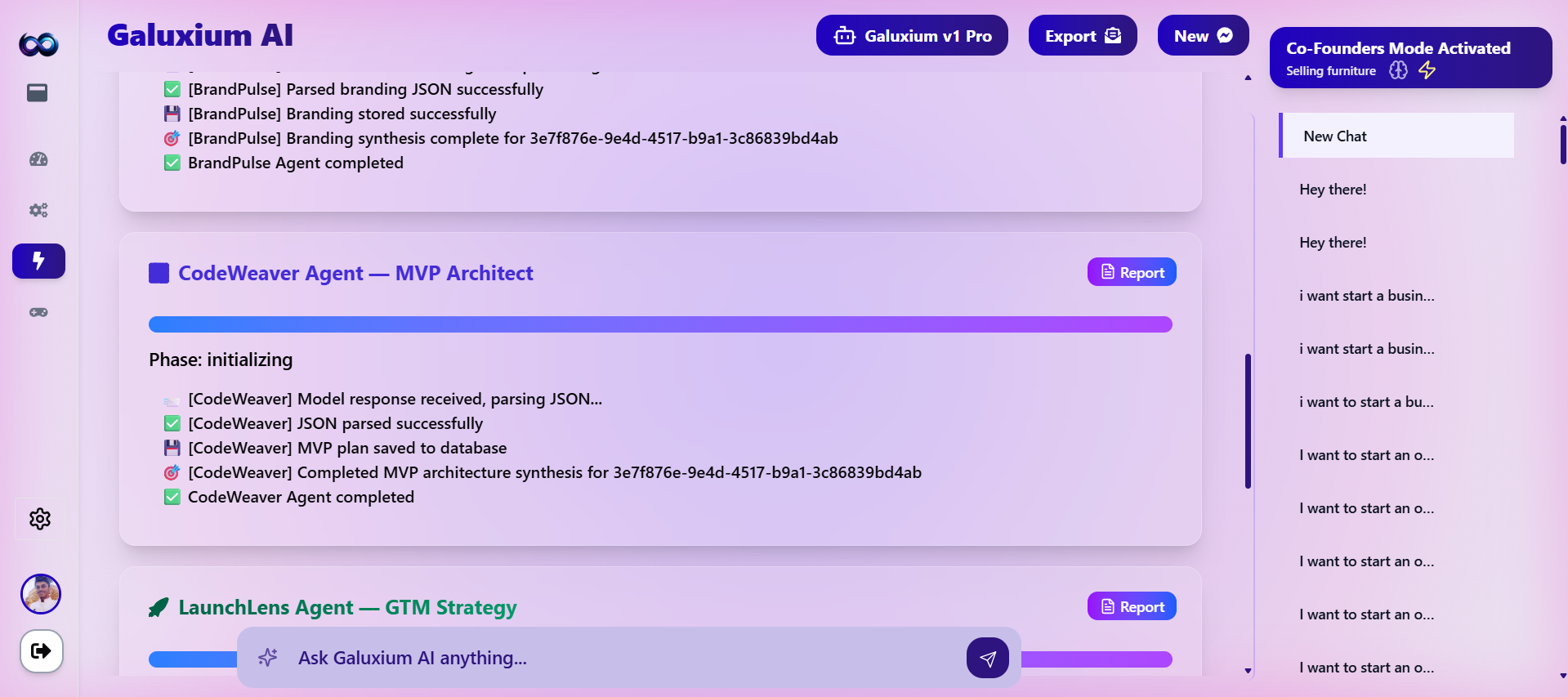
- CodeWeaver Agent – Technical Architecture & MVP Generation
- Generates a complete code scaffold (Next.js + Supabase + Tailwind).
- Streams file-by-file creation in real-time using event-sourced orchestration.
- Produces deployable, CI-ready projects with authentication and schema setup.
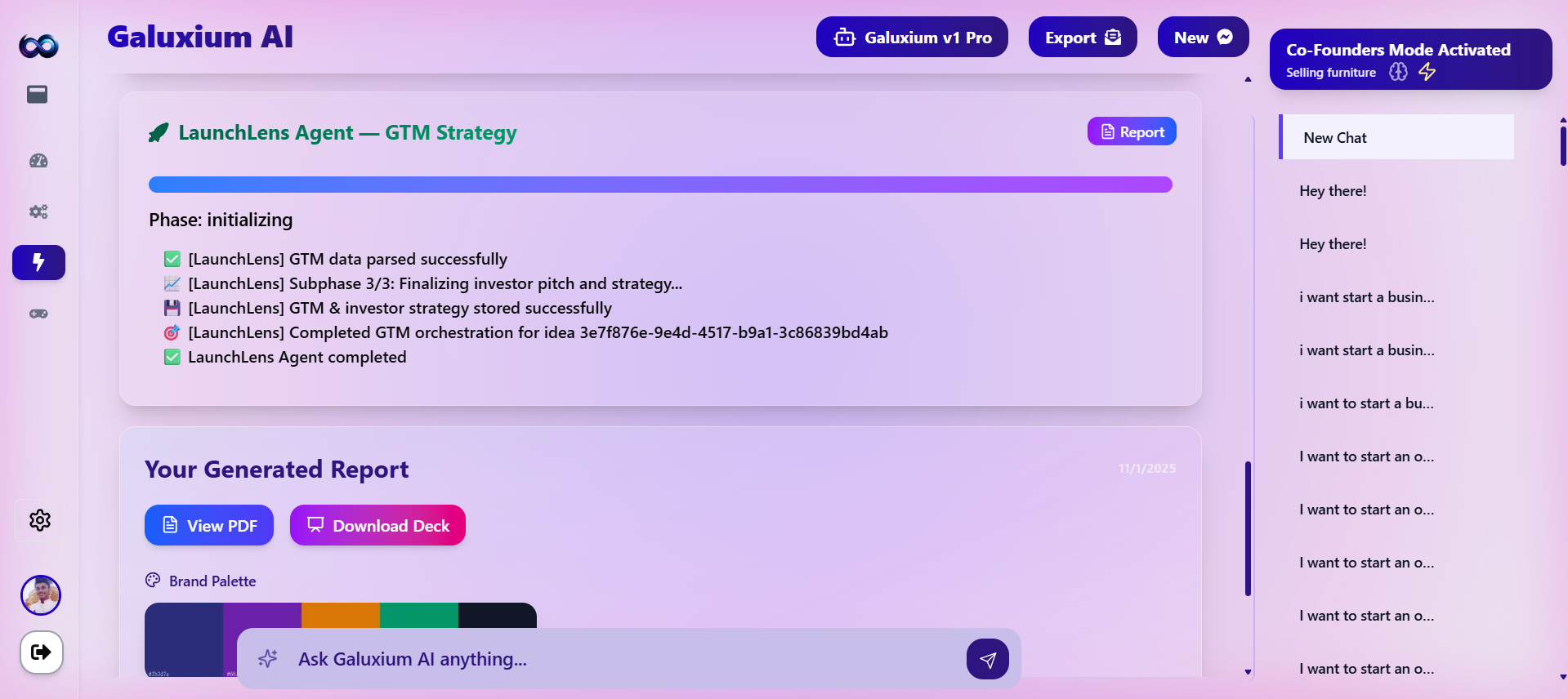
- LaunchLens Agent – Go-To-Market Strategy & Investor Decks
- Builds growth plans, pricing strategies, and investor pitch decks.
- Outputs a structured PDF startup report and presentation-ready slides.
🪄 Real-Time Orchestration
Unlike static generators, Galuxium uses Server-Sent Events (SSE) to stream each step’s progress live from the backend. Users can watch every action unfold — idea validation, brand design, logo creation, MVP build — all in real-time.
How we built it
High-level stack & architecture
- Frontend: Next.js + Tailwind (dashboard and generator UI)
- Backend: Node.js + Express endpoints handling generation orchestration
- Auth & DB: Supabase for authentication and primary tables; Prisma for schema and migrations
- LLMs: Pluggable adapters — we wire to OpenRouter-style and hosted LLM APIs for richer outputs
- Storage & deployments: GitHub integration for push/export and ZIP generation on demand
Key technical ideas
- Chunked payloads (progressive streaming): Rather than returning a huge monolithic response, Galuxium breaks the output into meaningful file-level chunks. Each chunk is validated, saved to a meta-store, and streamed to the UI so users see files appear in real time.
- Meta-core output format: Generated content is normalized into a meta-core JSON that describes files, dependencies, scripts, DB schema, and run instructions. This makes exported projects consistent and reproducible.
- Safety & sanitization: Outputs are sanitized and validated before zipping/pushing to GitHub to avoid malformed code or dangerous scripts.
Developer experience features
- Generate ZIP with full project
- Push to GitHub with commit message and PR-friendly structure
- View generated file tree and open file previews in the dashboard
- Export chat transcripts and token usage for transparency
Challenges we ran into
- Streaming consistency: Building a robust chunking/streaming system that produces valid files in order was tricky — we solved this by creating the meta-core format and enforcing per-chunk validation before UI render.
- Model noise & hallucinations: LLMs sometimes produced inconsistent or incomplete code. We added post-generation validators and small unit-test style checks that run on the generated code to catch obvious issues.
- CI/GitHub push edge cases: Handling repository naming collisions, commit permissions, and preserving secrets required careful orchestration and safe defaults.
- Time & scope constraints: For the hackathon we prioritized the generation pipeline and export flows; some UX polish and advanced templates remain WIP.
Accomplishments that we're proud of
- Implemented a working end-to-end flow from natural language idea → deployed, runnable project.
- Progressive file streaming UX that meaningfully improves perceived speed and trust during generation.
- One-click export/push to GitHub with reproducible project scaffolds and Prisma schema included.
- Built an analytics dashboard so founders can quickly validate demand for the generated product.
- Kept the developer experience in mind: produced projects that are developer-friendly (migrations, scripts, README, run instructions).
- Achieved a working end-to-end autonomous startup builder.
- Real-time progressive code generation with visual streaming logs.
- Integrated Supabase authentication and analytics.
- Built production-grade backend with modular orchestration.
- Generated deployable, CI-ready MVPs with clean code and clear docs.
- Designed a sleek, premium UX — with AI-generated brand assets.
What we learned
- Breaking complex outputs into validated chunks greatly improves user trust and error handling compared to single large responses.
- Designing a consistent meta-core schema early paid off — it made testing, validation, and export far easier.
- LLMs are powerful productivity multipliers but require careful validation and sanitization when used to generate runnable code.
- Shipping a usable product quickly requires hard prioritization — focusing on the core loop (idea → scaffold → deploy) unlocked the most value. Multi-agent orchestration is more powerful than single-model prompts.
- Real-time progress visibility builds user trust and wow factor.
- Layered model architecture improves reliability and creative quality.
- Building with modular LLM adapters (OpenRouter, Hugging Face) ensures scalability and model diversity.
What's next for Galuxium
Short term (next 3 months)
- Add polished templates for popular verticals (SaaS, e-commerce, marketplace, portfolios).
- Improve model selection and a/b testing across different LLMs to increase output quality.
- Add CI/CD templates (Vercel, Netlify) for instant deployments with env variable setup.
Medium term (3–9 months)
- Marketplace for premium templates and vetted starter packs.
- Collaboration features: multi-user teams, role-based access, and shared projects.
- Automated end-to-end testing for generated apps (smoke tests, route checks).
Long term
- Turn Galuxium into an AI co-founder platform: connect founders with vetted human reviewers, growth playbooks, and optional managed deployment services.
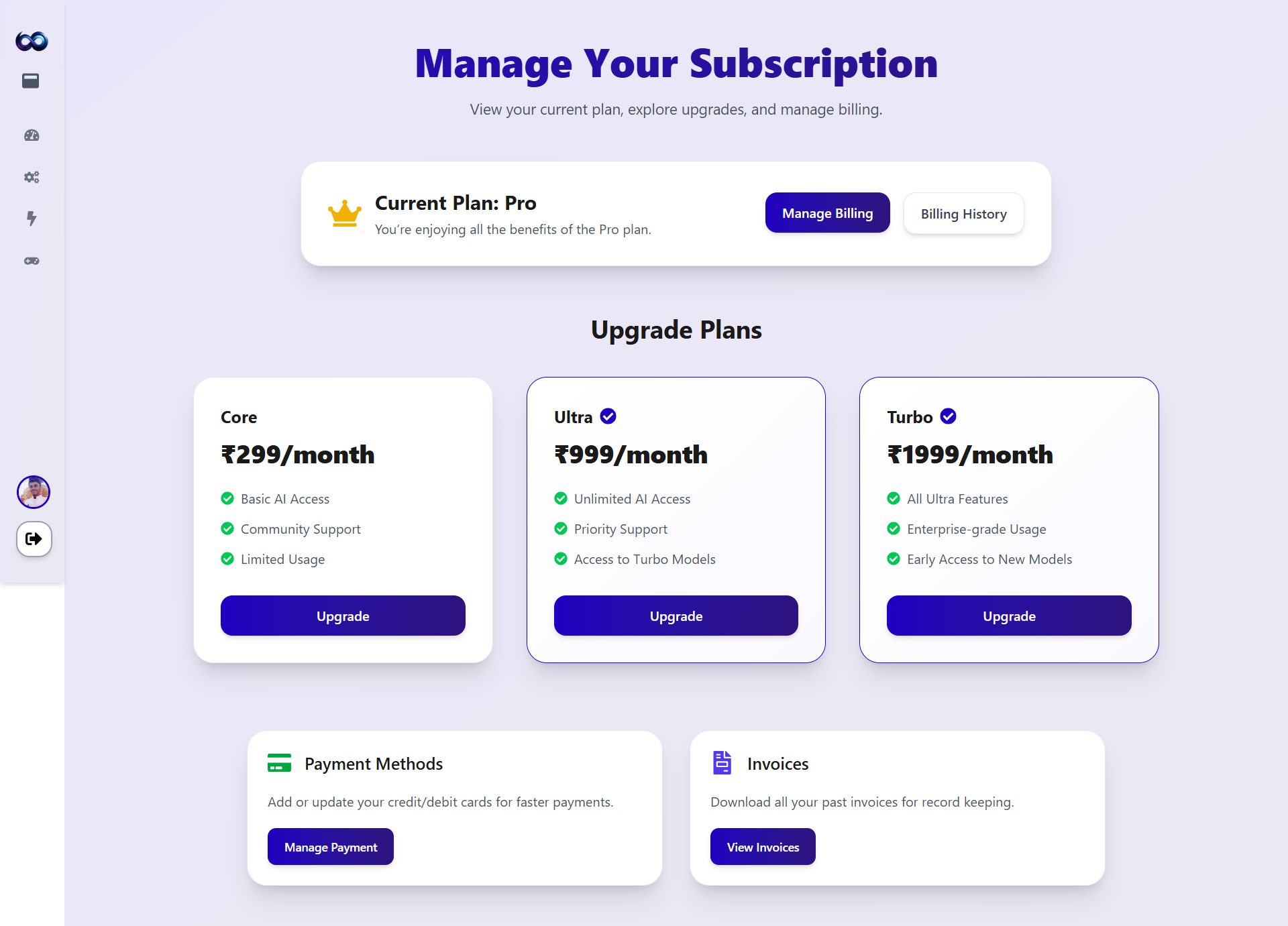
- Integrate payment flows and monetization-ready starter kits so founders can launch and validate revenue quickly.
Team & credits
- Aaditya Salgaonkar — Future founder, product & full-stack implementation (UI, backend orchestration, generation pipeline)
Links & how to try
Demo video: [https://www.youtube.com/watch?v=cw5bTimLx5c]
Repo:
Live demo:
- galuxium.com
- api.galuxium.com
How to run locally (example)
# clone
git clone <repo-url>
cd galuxium

# env
PORT=
VERCEL_TOKEN=
SUPABASE_URL=
SUPABASE_ANON_KEY=
SUPABASE_SERVICE_ROLE_KEY=
FRONTEND_URL=
GITHUB_CLIENT_ID=
GITHUB_CLIENT_SECRET=
GITHUB_TOKEN=
BACKEND_URL=
OPENROUTER_BASE=
OPENROUTER_API_KEY=
ANTHROPIC_API_KEY=
PIXABAY_API_KEY=
HUGGINGFACE_API_KEY=
GOOGLE_AI_API_KEY=
OPENROUTER_API_URL=
VERCEL_PROJECT_ID=
GEMINI_API_KEY=

# install
npm install
# run dev
npm run dev
Closing notes
Galuxium transforms the way early founders approach product validation — shrinking weeks of engineering work into minutes of guided generation. We built it to democratize product creation, and we believe it can help countless builders go from idea to traction faster.
We'd love your vote — thank you Horror Hacks!
Built With
- express.js
- gpt-4o-mini
- nextjs
- node.js
- supabase

Log in or sign up for Devpost to join the conversation.