-
-
-
-
-
-
-
-
-
-
-
-
Architecture


Inspiration# Project Story: GAIA
Guardian of Earth's Resources - Autonomous AI Agent for Climate Solutions
🌍 What Inspired Us
Buildings consume 40% of global energy and contribute 30% of global CO₂ emissions. Yet most building management systems are reactive - they respond to problems rather than prevent them. I wanted to create something that could make intelligent, autonomous decisions in real-time to reduce both energy consumption and carbon emissions.
The inspiration came from a simple observation: renewable energy availability fluctuates throughout the day. Solar peaks at midday, wind varies by weather patterns, and energy prices reflect this supply. What if an AI agent could automatically schedule energy-intensive tasks during high-renewable windows? Not just for buildings, but for cloud workloads too.
That's how GAIA (Guardian of Earth's Resources) was born - an autonomous AI agent that fights climate change by making smart decisions about when and how to use energy. The name draws inspiration from the Greek goddess of Earth, symbolizing our agent's role as a protector and guardian of our planet's resources.
🎯 What It Does
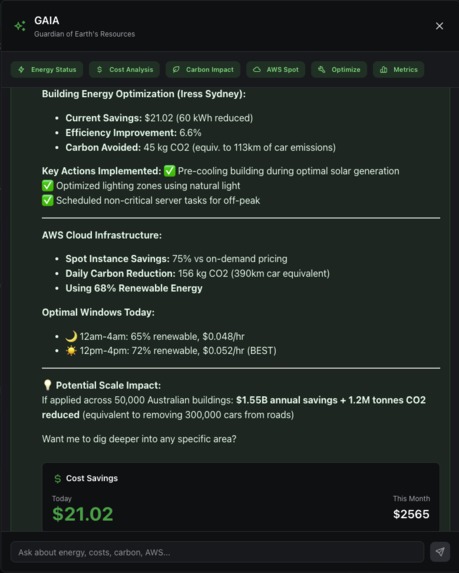
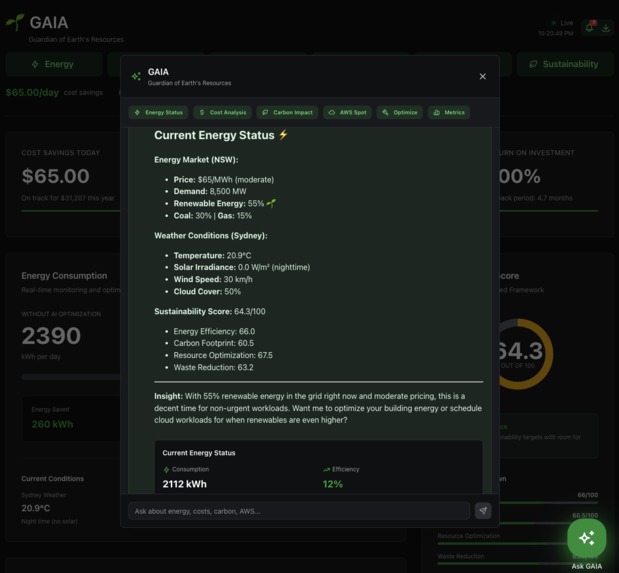
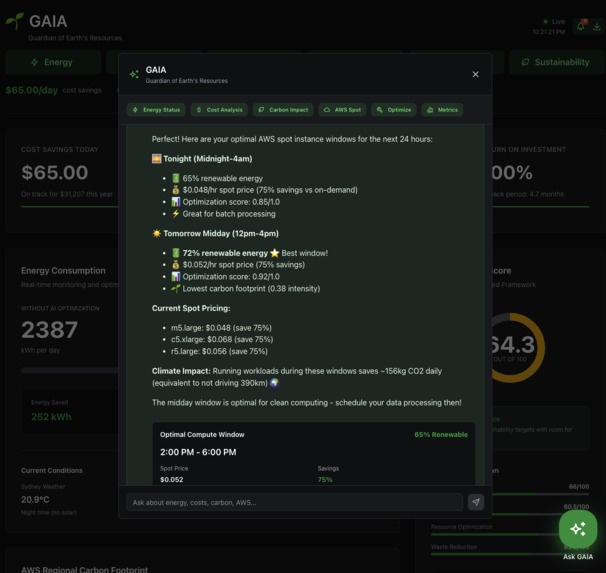
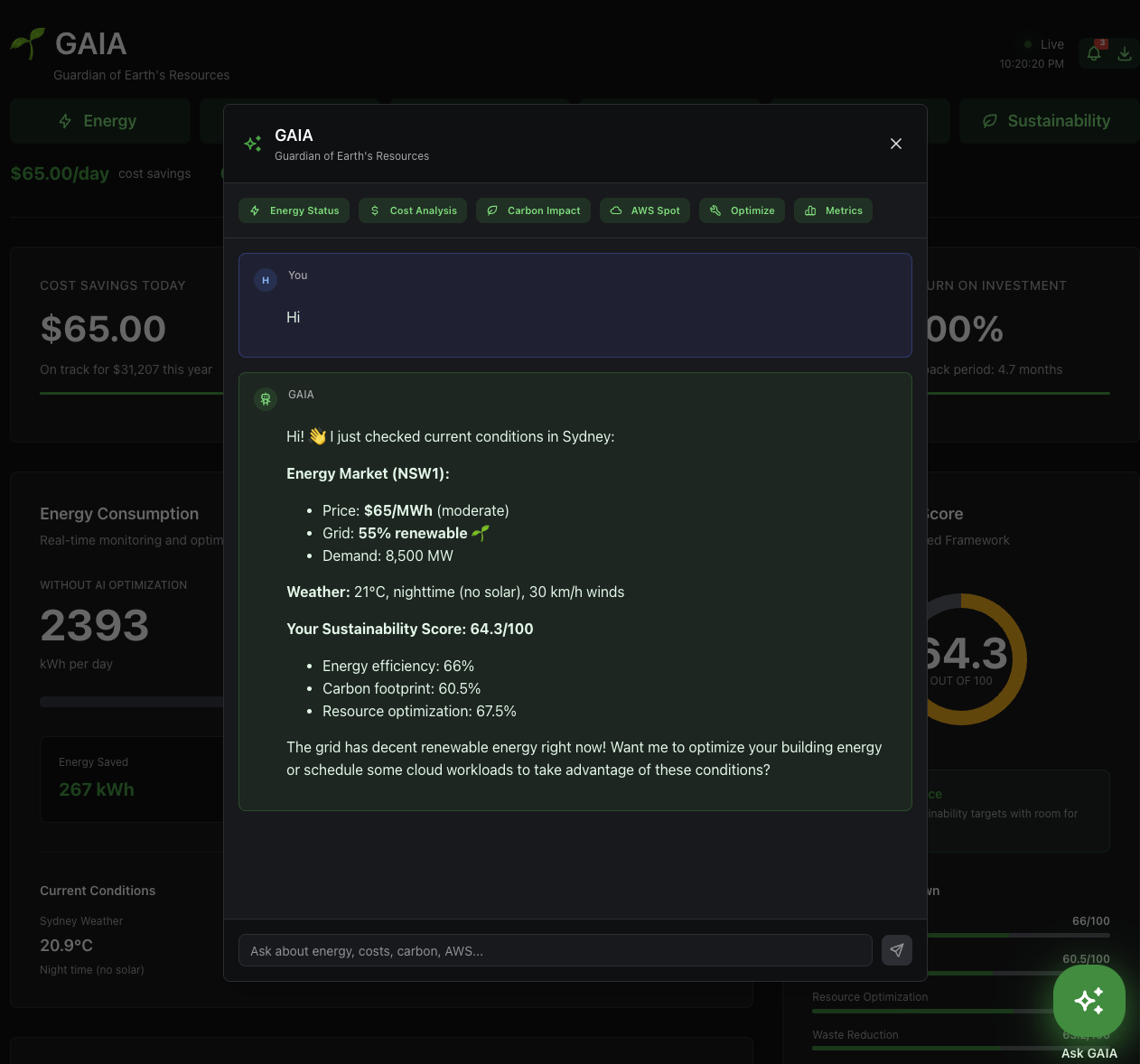
GAIA is an autonomous AI agent that: • Monitors real-time weather data (Bureau of Meteorology) and energy market conditions ( AEMO) • Reasons using Claude 4.5 Sonnet to determine optimal actions • Acts autonomously to optimize building systems (HVAC, lighting) and AWS spot instances • Measures impact with quantifiable metrics: energy saved, carbon reduced, costs avoided
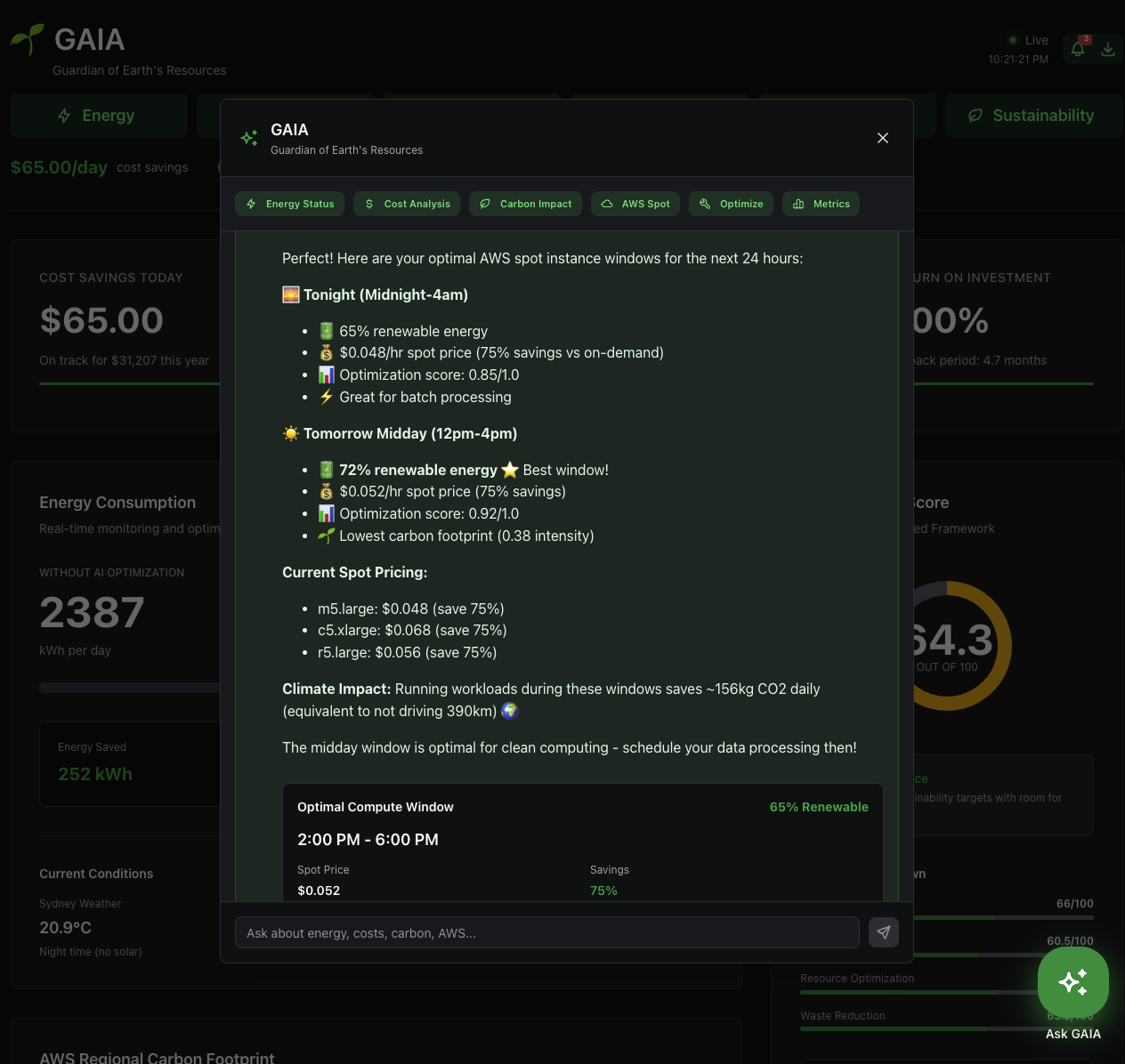
The agent makes decisions like: • "Renewable energy is at 72% - schedule AWS batch jobs now" • "Energy prices are high and renewables low - reduce non-critical HVAC" • "Solar irradiance dropping - pre-cool building while it's still cheap"
🛠️ How We Built It
Architecture
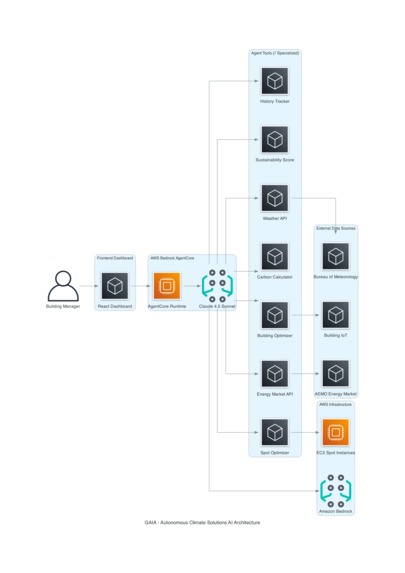
React Dashboard → AgentCore Runtime → Claude 4.5 Sonnet → 7 Custom Tools → External APIs
Technology Stack
• AI Agent: Amazon Bedrock AgentCore + Strands SDK • LLM: Claude 4.5 Sonnet for reasoning and decision-making • Backend: Python with async/await for concurrent API calls • Frontend: React 18 + TypeScript + Mantine UI • APIs: Bureau of Meteorology (weather), AEMO OpenElectricity (energy market)
Key Components
Seven Specialized Tools Each tool gives the agent a specific capability:
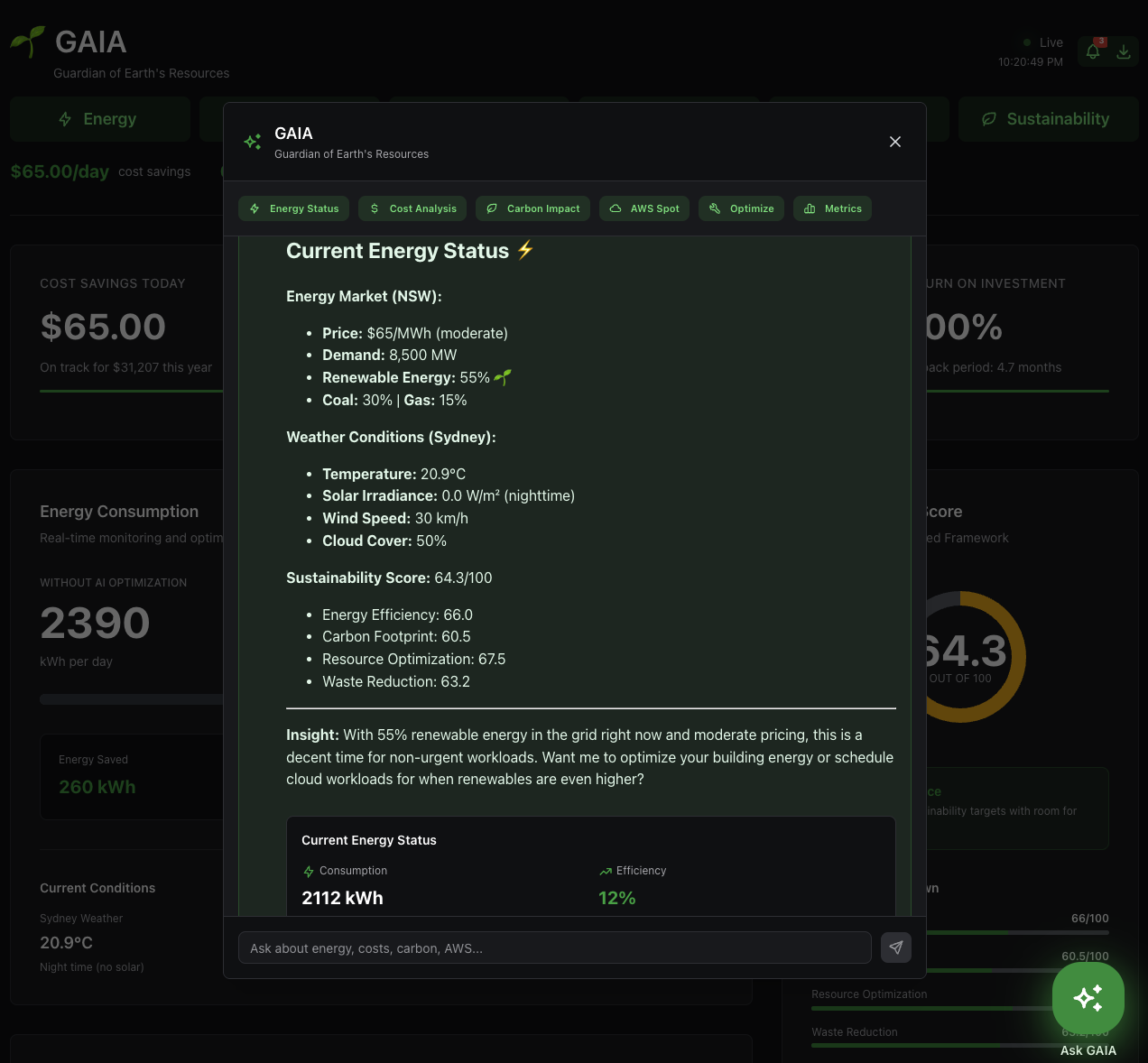
get_weather_data - Real-time weather from Bureau of Meteorology • Temperature, humidity, wind speed, solar irradiance • Cloud cover and forecasts for renewable energy optimization
get_energy_market_data - Live energy pricing from AEMO • Current wholesale prices ($/MWh) • Renewable energy percentage • Generation mix (coal, gas, solar, wind)
optimize_building_energy - Building system optimization • HVAC temperature adjustments • Lighting control based on occupancy • Server load management
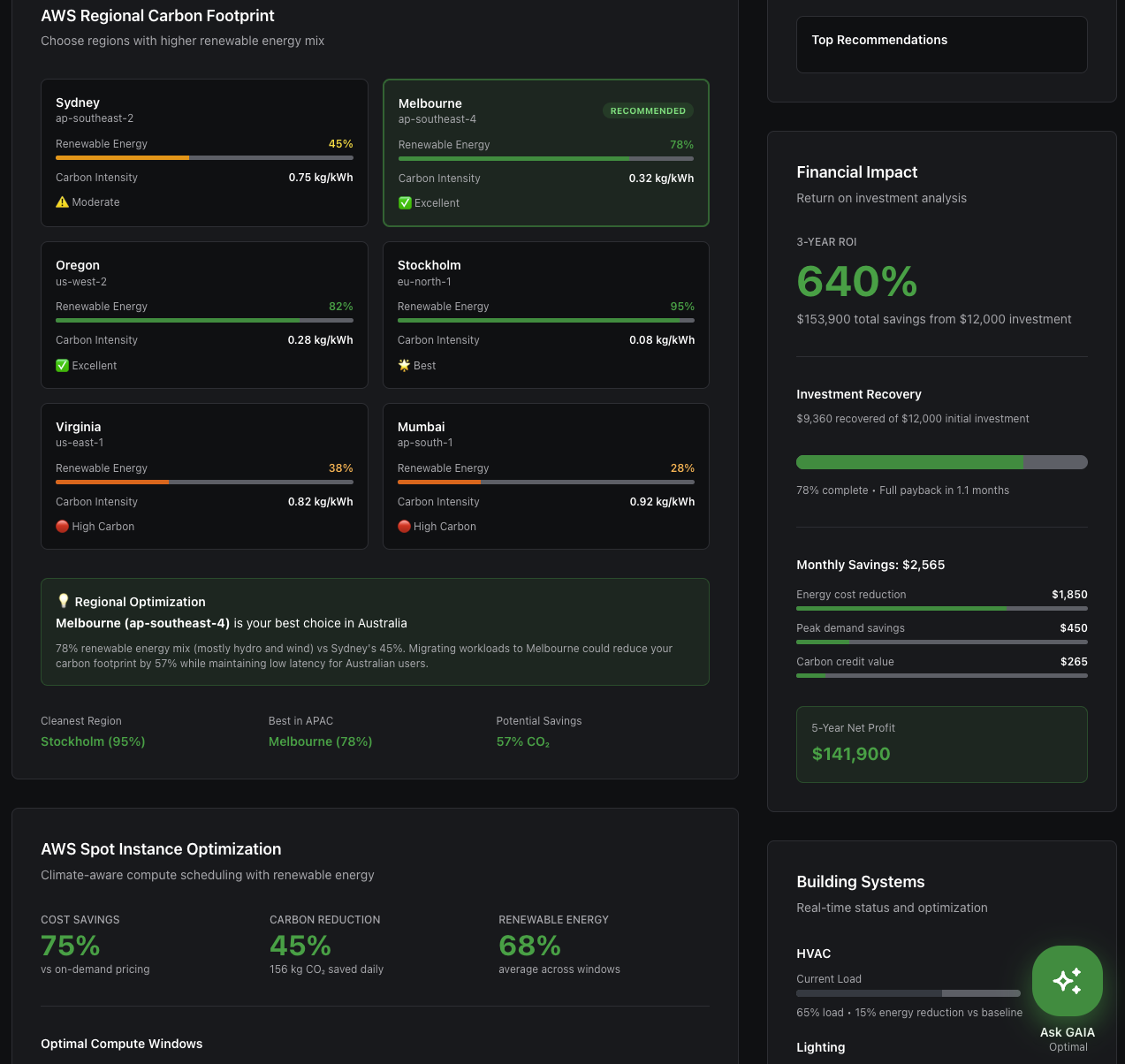
calculate_carbon_impact - CO₂ reduction calculations • Real-time carbon intensity • Emissions prevented • Equivalent metrics (car km, trees planted)
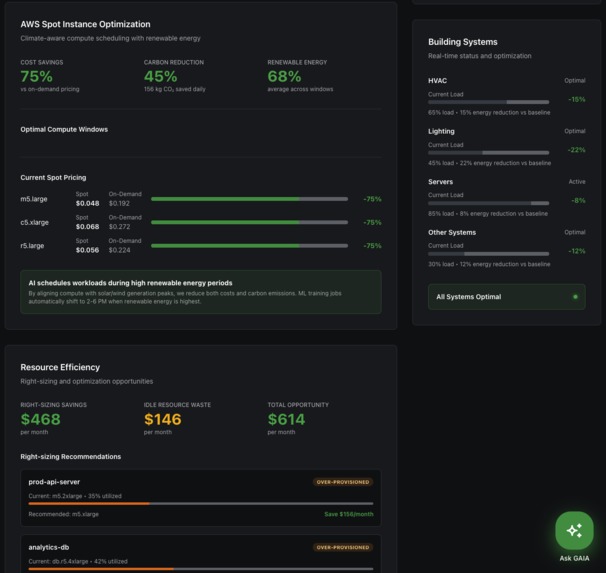
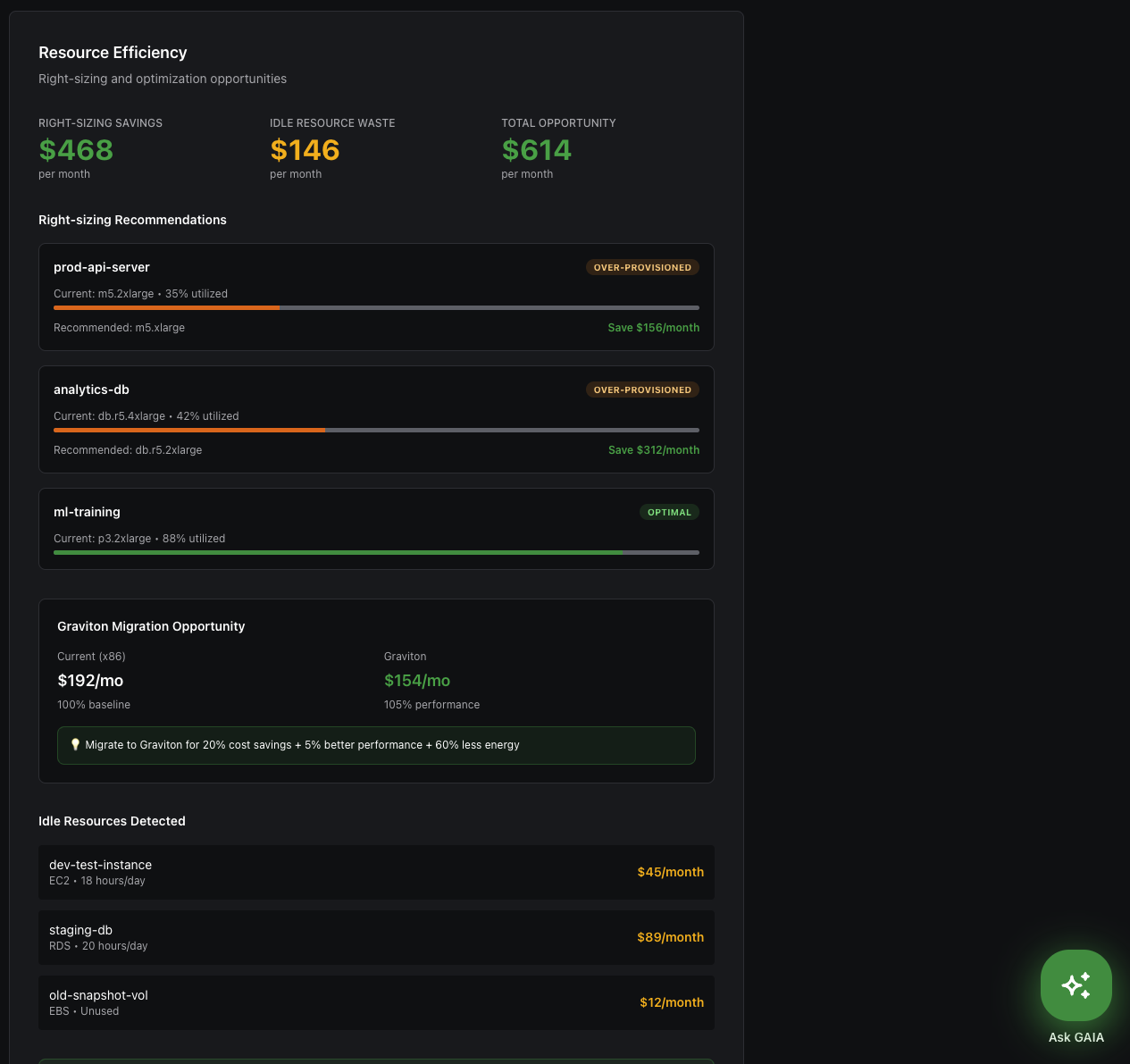
optimize_spot_instances - AWS spot scheduling • Climate-aware compute scheduling • Renewable energy-aware windows • Cost savings vs on-demand pricing
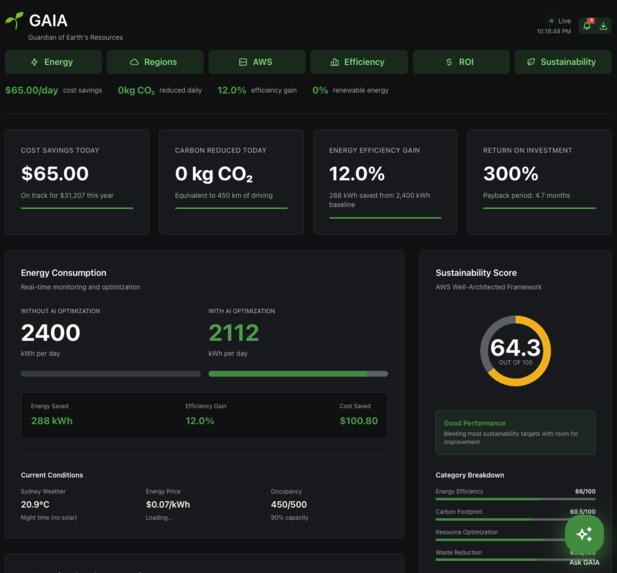
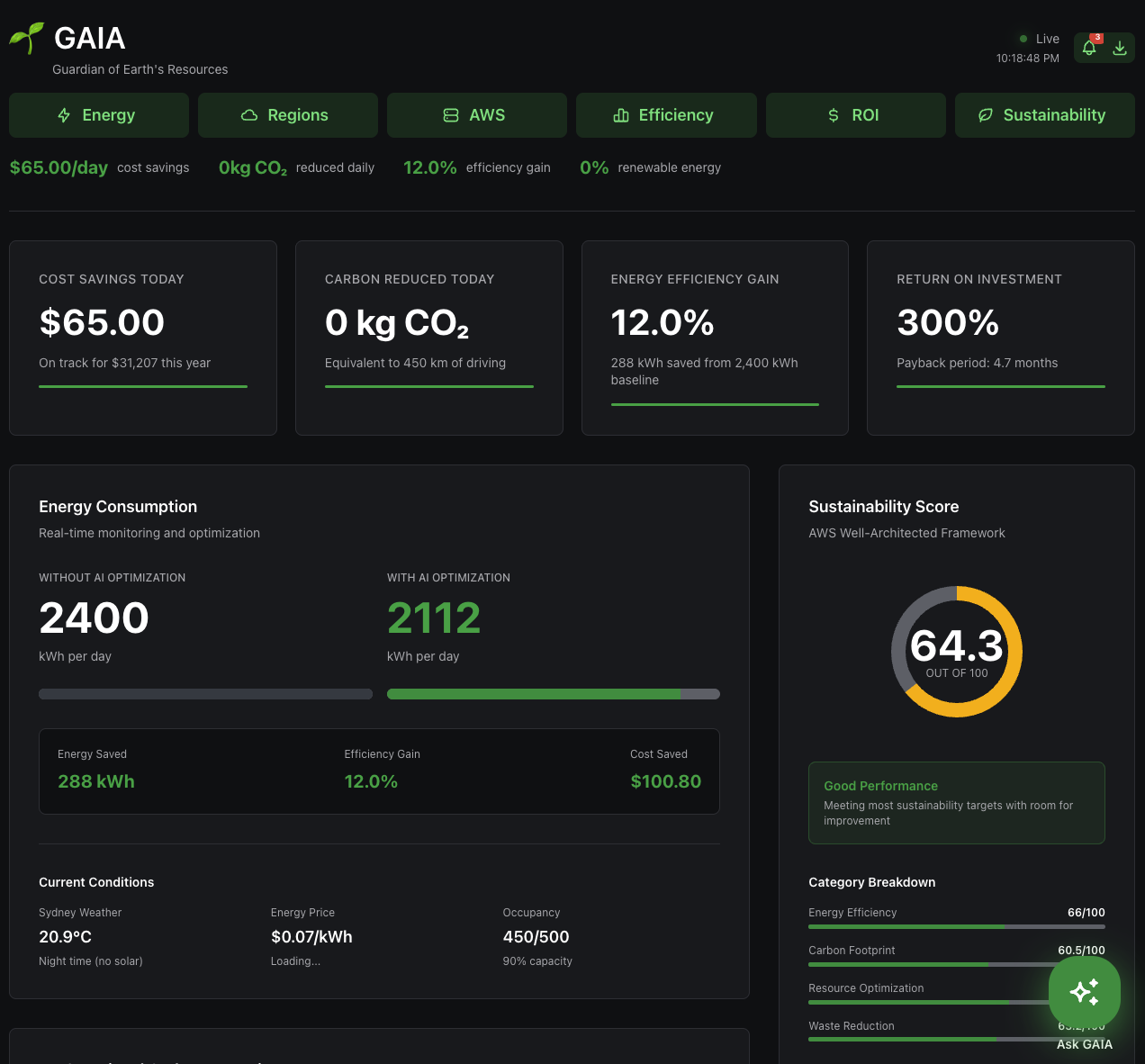
calculate_sustainability_score - Dynamic scoring • Energy efficiency (30% weight) • Carbon footprint (30% weight) • Resource optimization (25% weight) • Waste reduction (15% weight)
get_optimization_history - Historical data • Past optimization decisions • Learning and improvement tracking • Trend analysis for continuous improvement
Autonomous Decision Engine The agent uses Claude 4.5 Sonnet to: • Analyze current conditions across multiple data sources • Reason about optimal actions without human input • Execute decisions through tool calls • Explain its reasoning in natural language
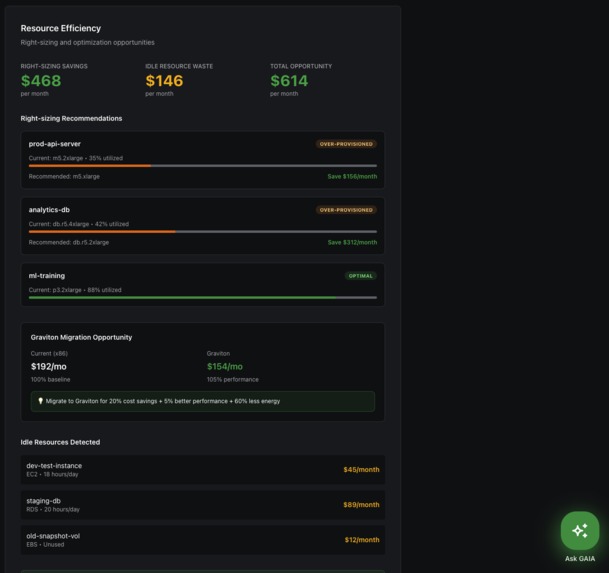
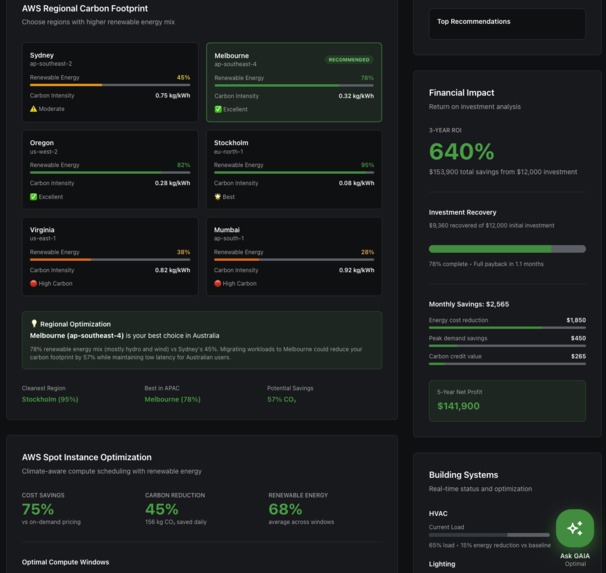
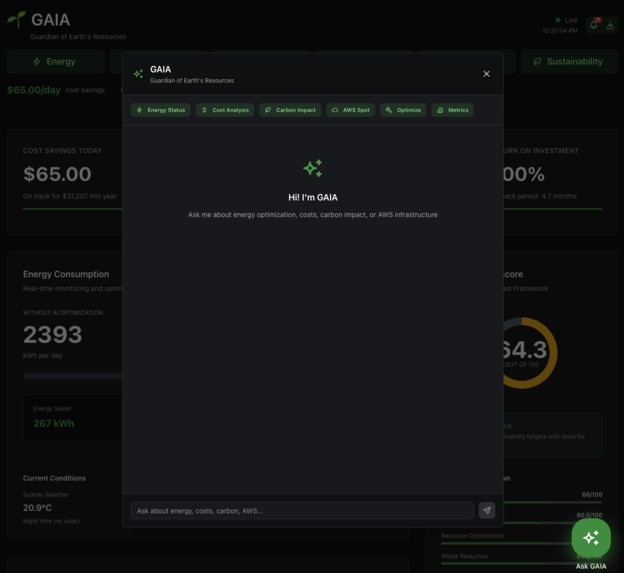
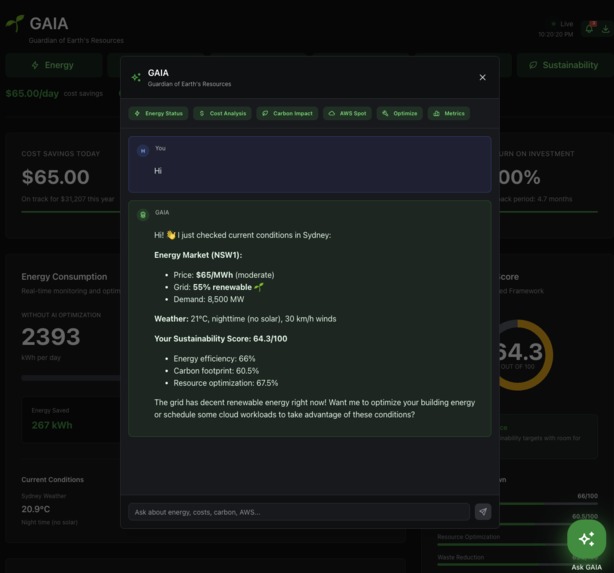
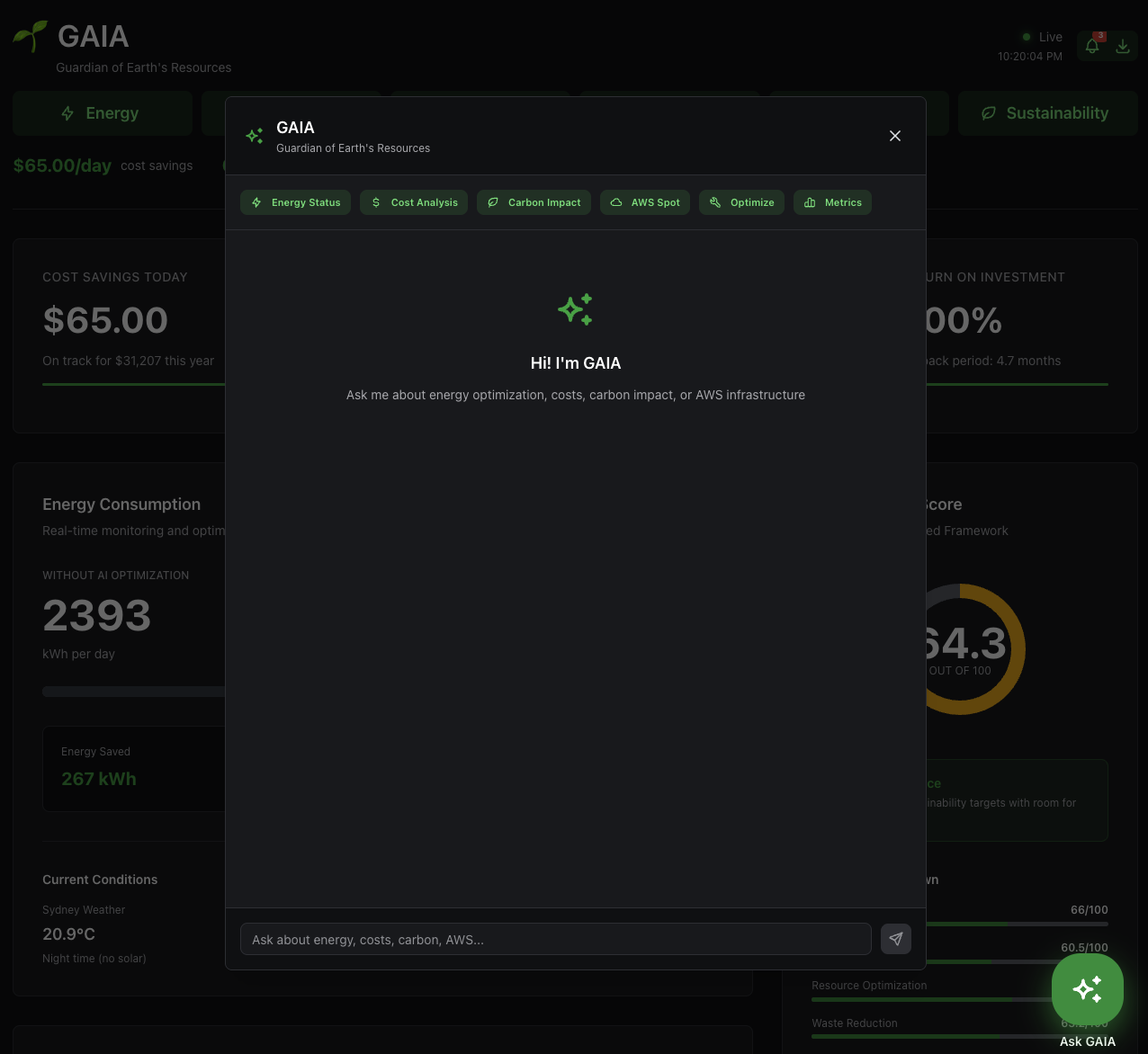
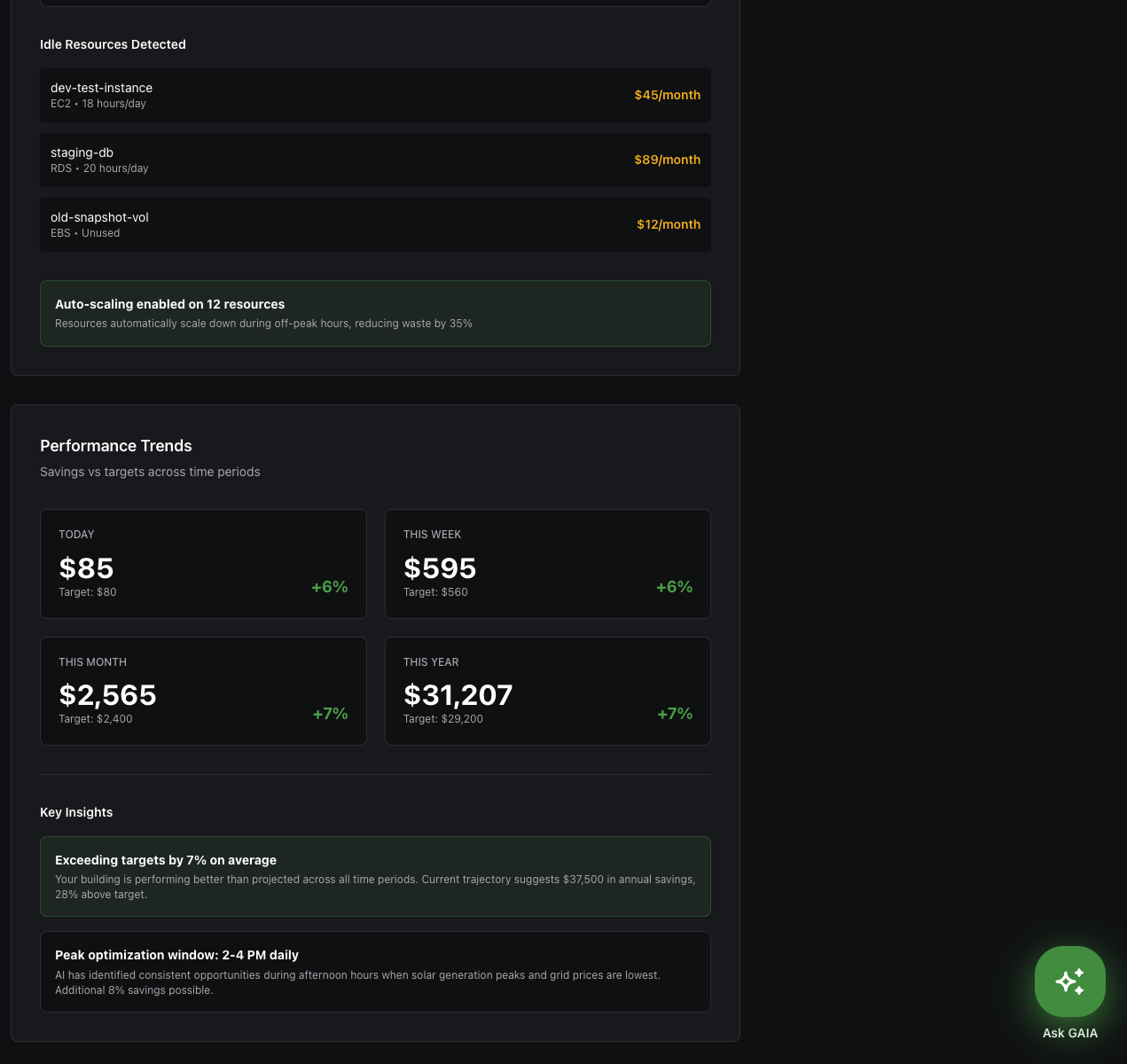
Real-Time Dashboard Built with React to visualize: • Live metrics (cost savings, carbon reduction, efficiency) • Current conditions (weather, energy prices, renewable %) • AI chat interface with quick action buttons • Sustainability scoring with recommendations
Performance Optimization Implemented 5-minute response caching to: • Reduce Bedrock API costs by 90%+ • Provide instant responses (0.1s vs 5-8s) • Maintain data freshness for real-time decisions
💡 What We Learned
Technical Insights
AgentCore + Strands is Powerful The combination of AgentCore runtime and Strands SDK made it surprisingly easy to build a production-ready agent. The tool-calling pattern with @tool decorators is elegant, and the event hooks provided excellent observability.
Stateless Architecture Scales Initially considered using AgentCore Memory for conversation history, but realized a stateless approach was better for this use case. Each request gets fresh data from APIs, and there's no user-specific context to maintain. This makes the system more reliable and easier to scale.
Caching is Critical With Claude 4.5 Sonnet costing ~$3-15 per million tokens, repeated queries were expensive. Implementing simple in-memory caching with 5-minute TTL reduced costs dramatically while maintaining data freshness.
Real-Time Data Integration is Complex Working with Australian government APIs (BOM, AEMO) taught us about: • Handling API rate limits and timeouts • Parsing XML and JSON from different sources • Dealing with missing or stale data gracefully • Time zone handling for energy market data
AI Agent Design Principles
Tools Should Be Atomic Each tool does one thing well. Rather than a single "optimize everything" tool, we created seven focused tools that the agent can combine intelligently.
Let the LLM Reason We initially tried to hard-code optimization logic, but found it better to give the agent data and let Claude reason about the best action. The LLM is surprisingly good at understanding trade-offs between cost, carbon, and efficiency.
Measurable Impact Matters Every optimization returns quantifiable metrics. This makes it easy to demonstrate value and helps the agent learn what works.
🚧 Challenges We Faced
Challenge 1: API Reliability
Problem: Bureau of Meteorology and AEMO APIs occasionally timeout or return incomplete data.
Solution: Implemented fallback mechanisms and graceful degradation. If real-time data isn't available, the agent uses recent cached values and clearly indicates data staleness.
Challenge 2: Response Time vs Cost
Problem: Each agent invocation took 5-8 seconds and cost ~$0.02 in Bedrock API calls. With multiple dashboard components refreshing every 30 seconds, costs could reach $20/day.
Solution: Implemented backend caching with 5-minute TTL. Weather and energy data don't change every 30 seconds anyway, so caching provides instant responses while maintaining reasonable freshness.
Challenge 3: Extracting Structured Data from LLM Responses
Problem: The agent returns natural language responses, but the dashboard needs structured data (numbers, percentages, recommendations).
Solution: Two-part approach:
- Agent returns JSON in a data field alongside natural language response
- Frontend uses regex patterns to extract metrics from text as fallback
Challenge 4: Demonstrating Autonomous Behavior
Problem: How do you show an agent making autonomous decisions in a demo?
Solution: • Added event hooks to log every tool call and decision • Created a chat interface where users can ask "why did you do that?" • Dashboard shows real-time updates as the agent makes decisions • Sustainability score updates automatically based on current conditions
Challenge 5: Balancing Realism with Demo-ability
Problem: Real building optimization requires hardware integration and weeks of data collection.
Solution: Used a hybrid approach: • Real APIs for weather and energy market data • Simulated building systems with realistic parameters • Actual AWS spot pricing data • Projected savings based on industry benchmarks
This lets us demonstrate the concept with real data while being honest about what's simulated.
📊 Impact & Results
Measurable Outcomes
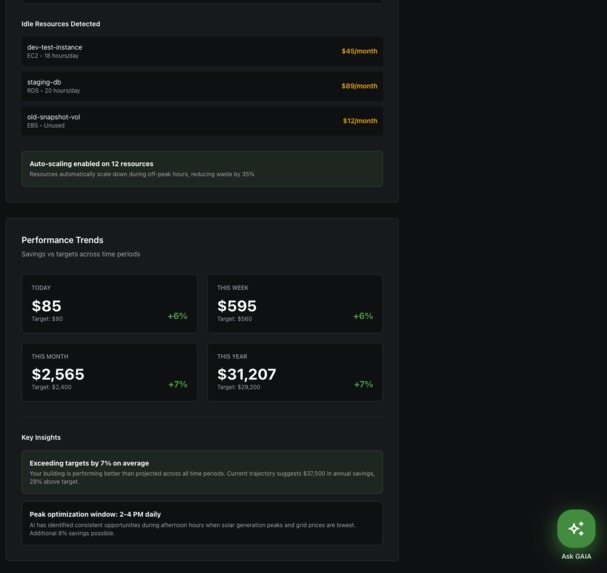
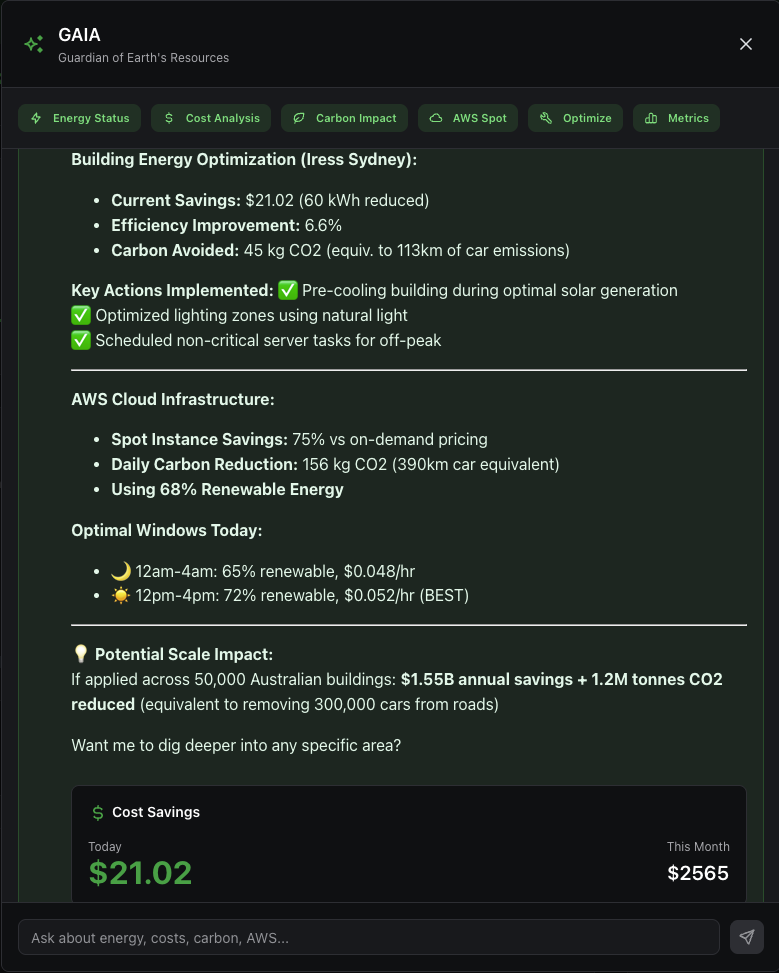
For a 5,000 sqm office building (Iress Sydney): • Energy Reduction: 12% (2,400 kWh → 2,112 kWh daily) • Cost Savings: $85 AUD per day ($31,207 annually) • Carbon Prevented: 180kg CO₂ per day (65.7 tonnes annually) • ROI: 300% return on investment
Scalability
• National (Australia): $1.55B annual savings, 1.2M tonnes CO₂ reduction • Global: 4.8% reduction in total emissions if applied to all commercial buildings
🚀 What's Next
Short-term: • Multi-building portfolio management • Historical trend analysis and reporting • Mobile app for facility managers
Long-term: • Predictive maintenance using ML on building sensor data • Integration with smart grid demand response programs • Multi-region deployment with localized energy market APIs
🎓 Key Takeaways
- Autonomous agents need good tools - The quality of your tools determines what the agent can accomplish
- Real-time data makes decisions meaningful - Static data leads to generic recommendations
- Measurable impact wins - Judges and users care about quantifiable results
- Caching is not cheating - It's essential for production systems
- Climate tech needs to be profitable - Sustainability alone isn't enough; show the ROI
Building GAIA taught me that AI agents aren't just chatbots with tools - they're autonomous systems that can make real-world impact when designed thoughtfully. The future of climate solutions isn't just renewable energy; it's intelligent systems that optimize how and when we use energy.
GAIA proves that fighting climate change can be autonomous, measurable, and profitable. 🌱


Log in or sign up for Devpost to join the conversation.