-
-
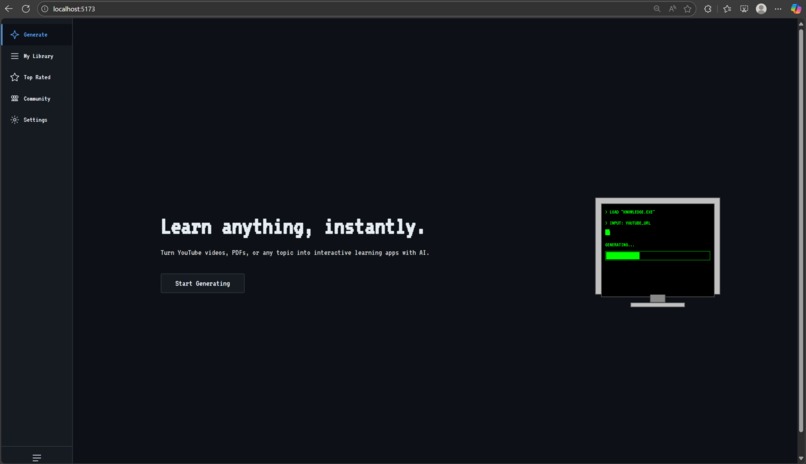
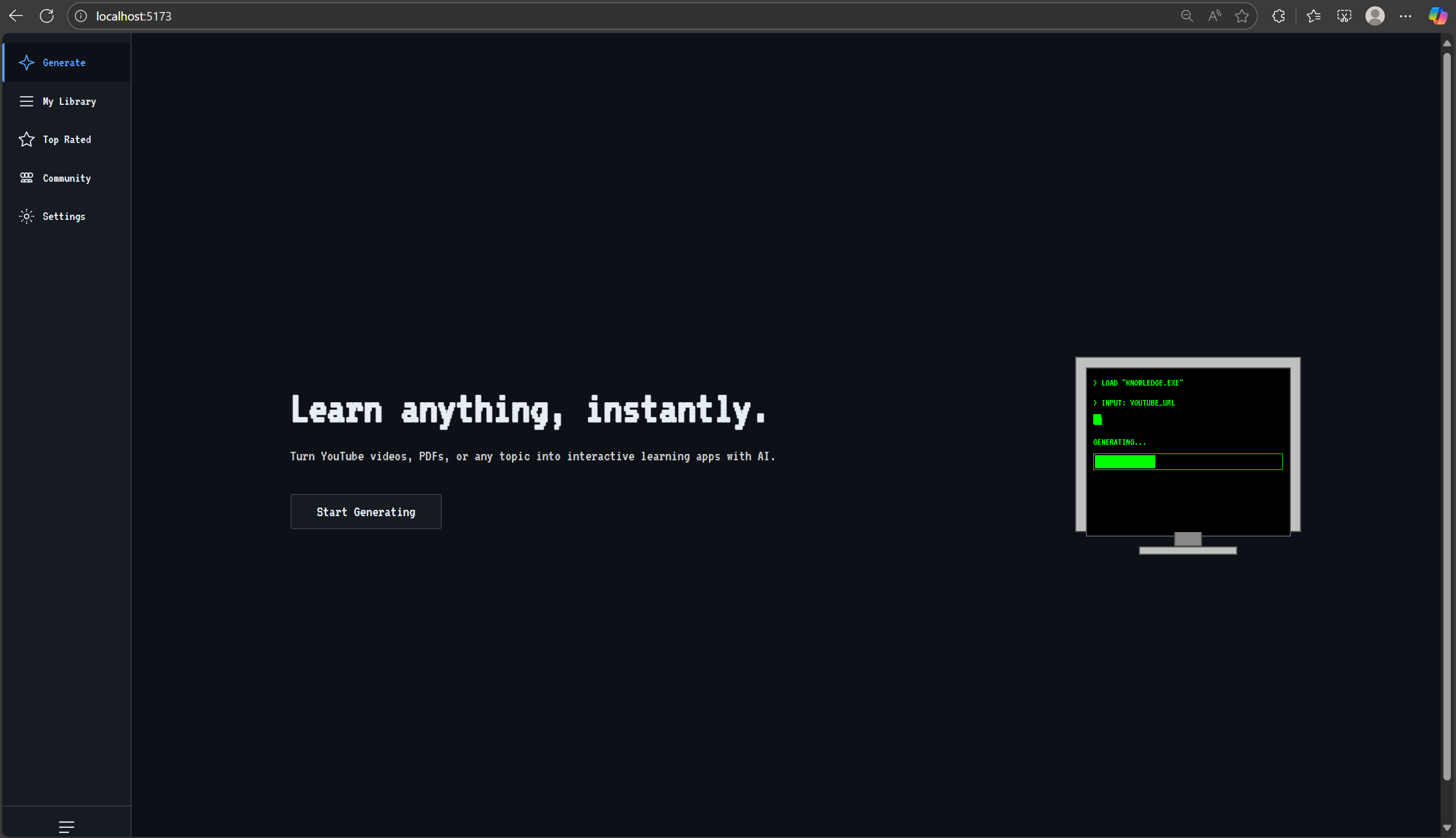
Front Page of G2L
-
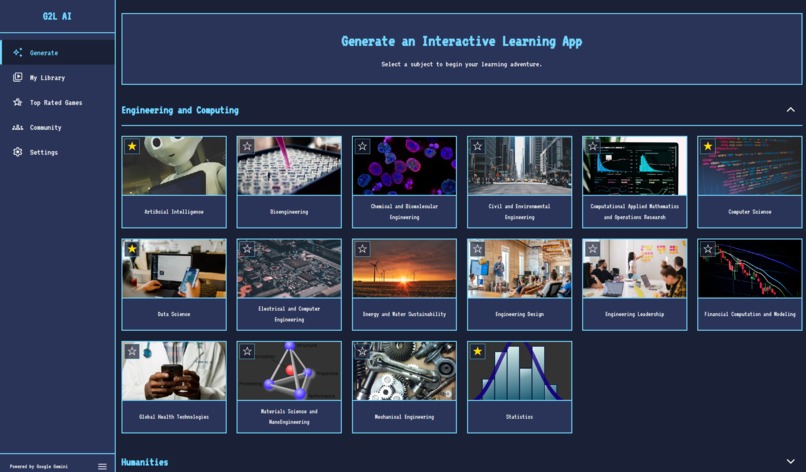
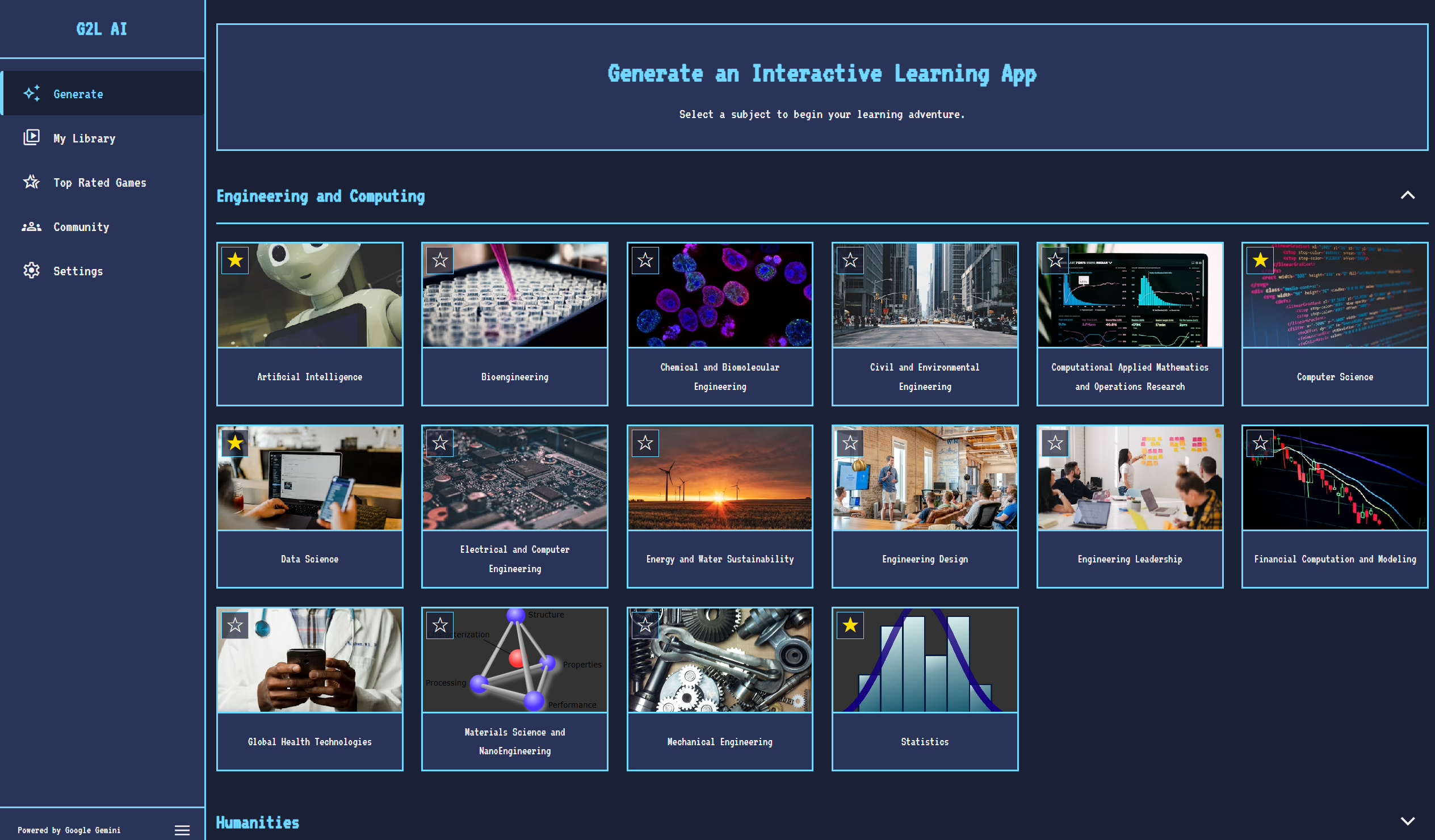
Generate Page 1
-
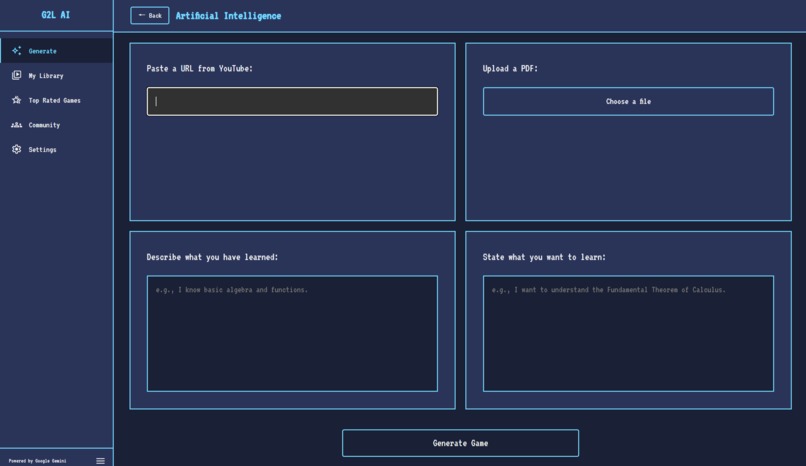
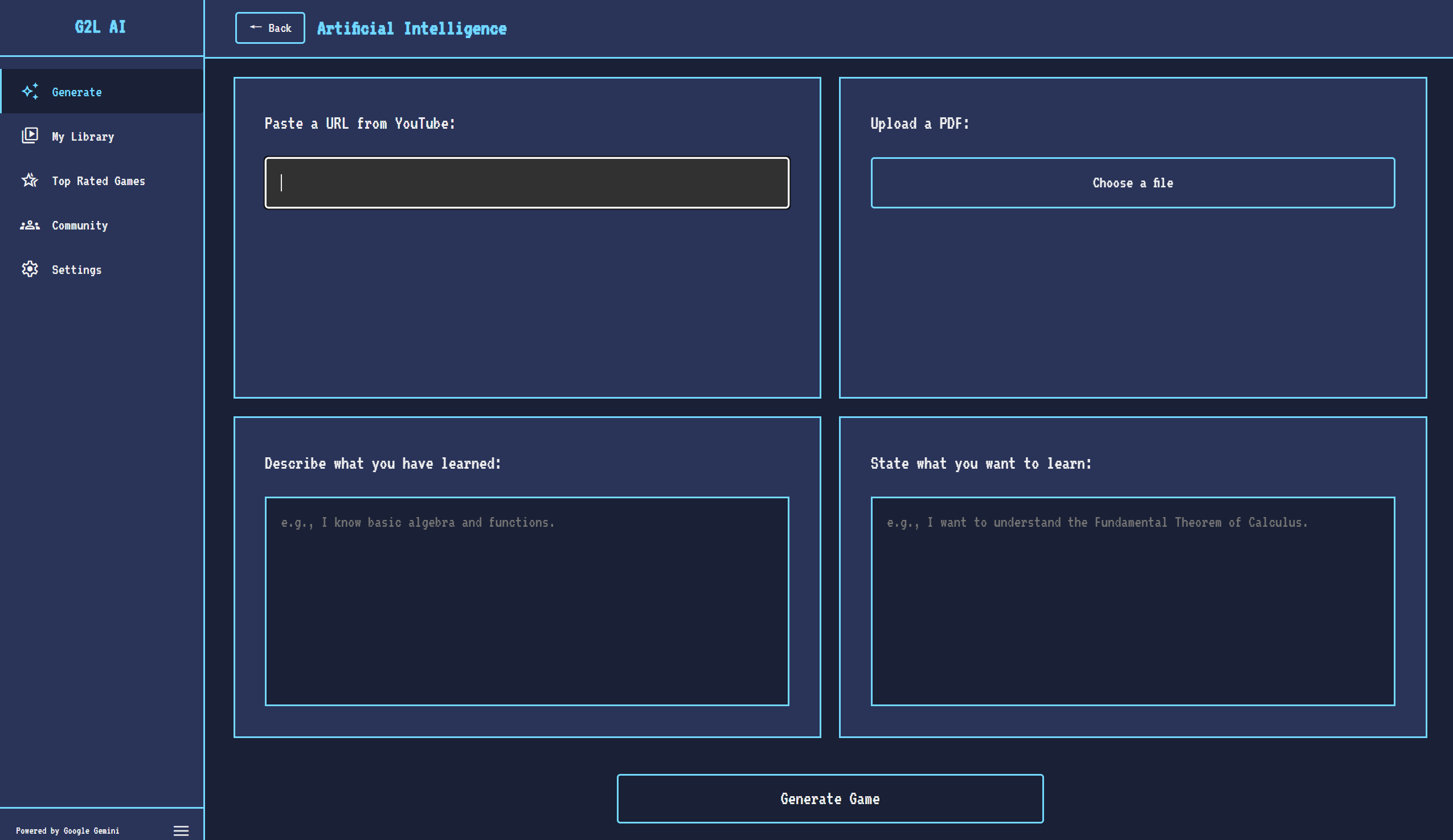
Generate Page 2
-
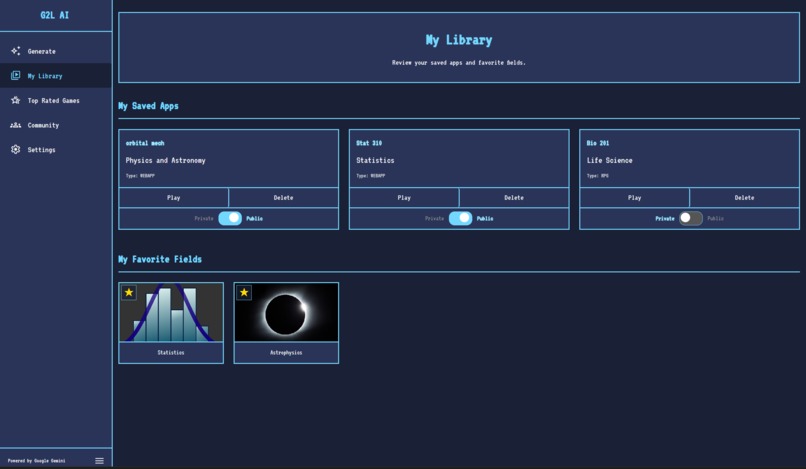
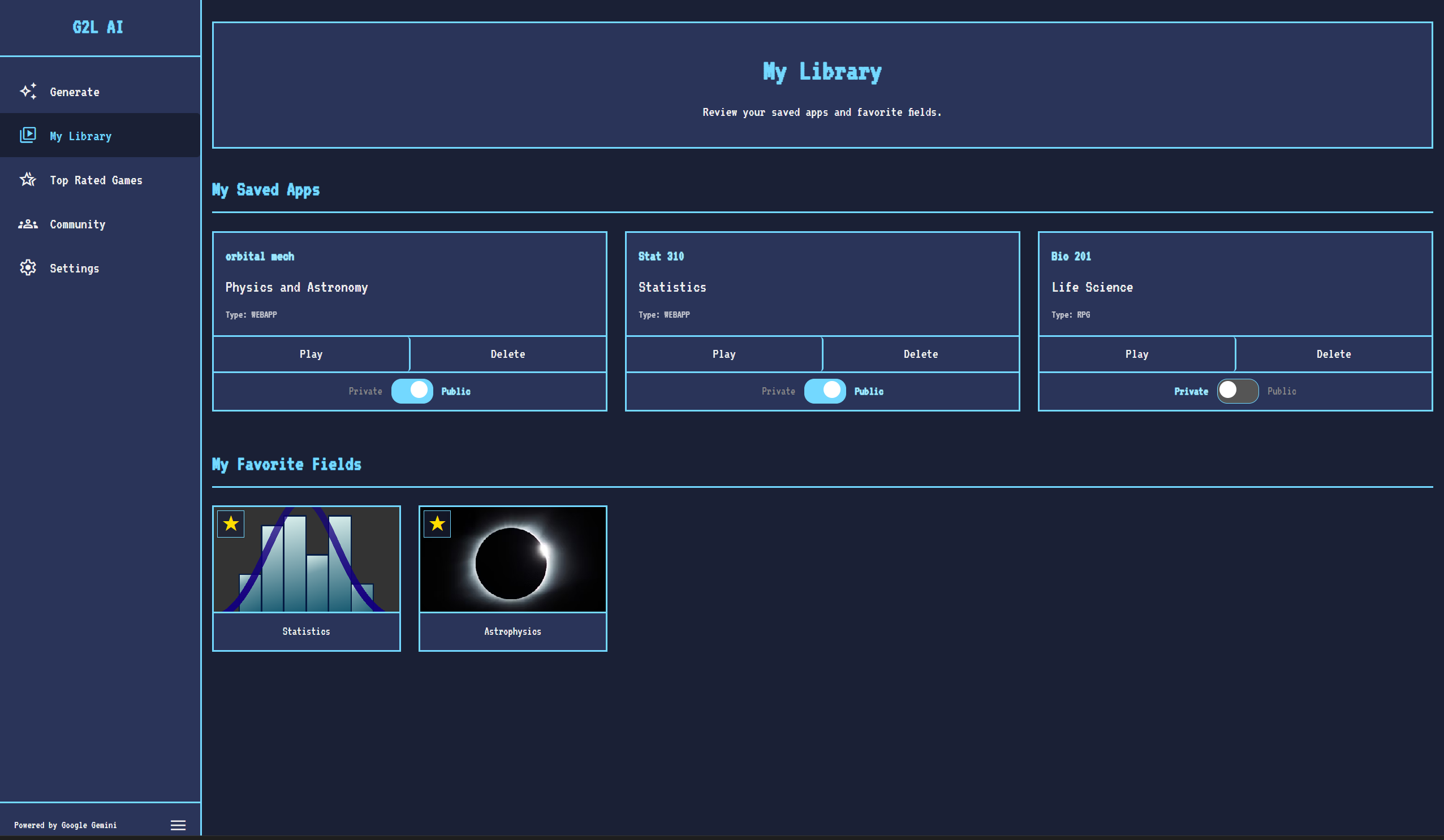
My Library Page
-
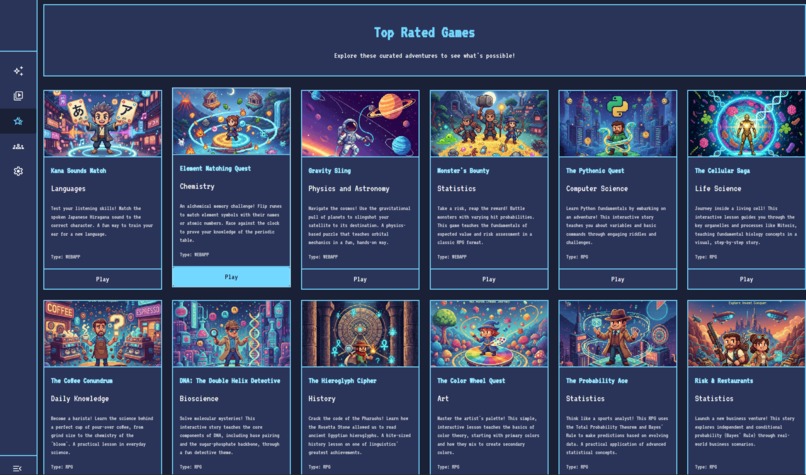
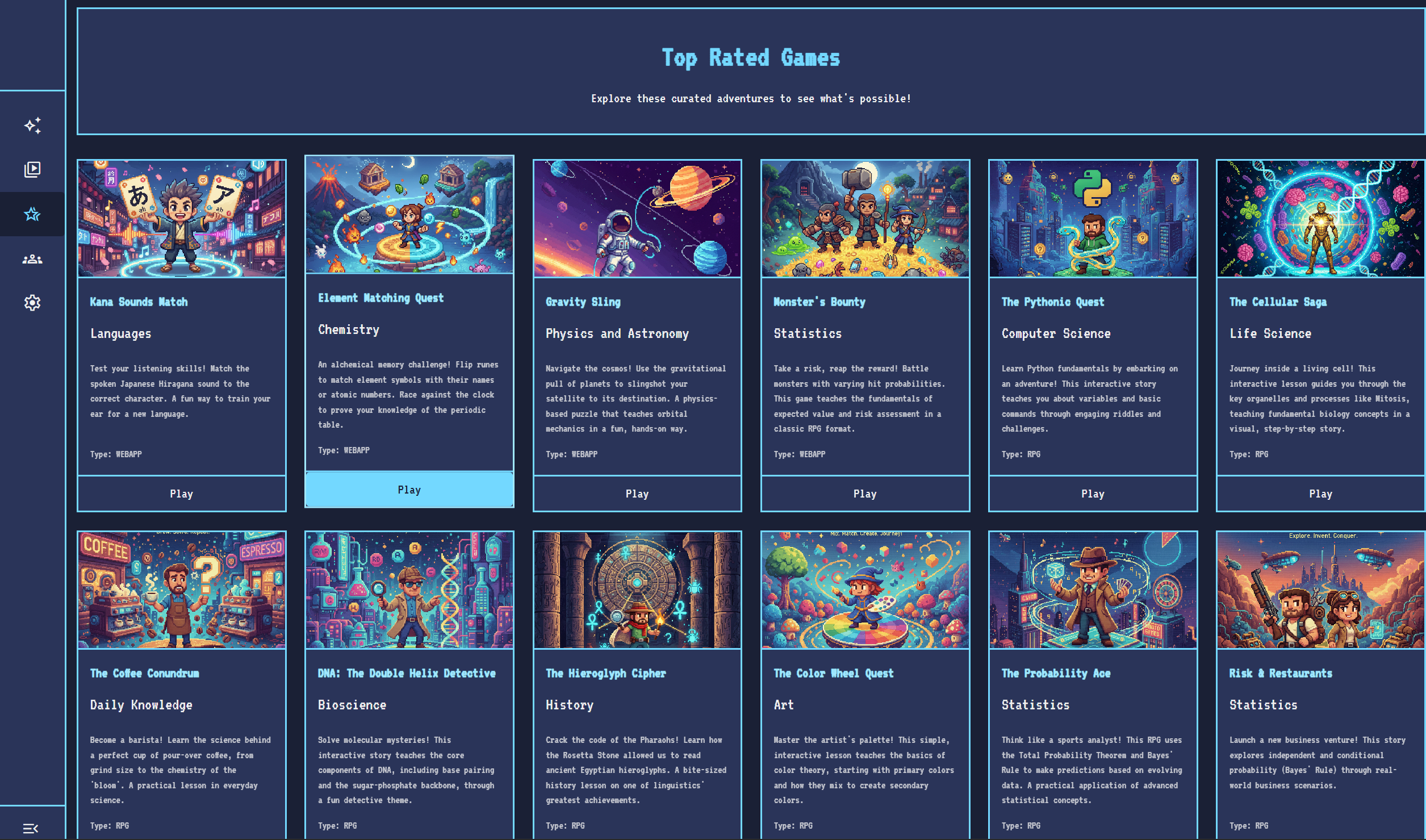
Top Rated Games Page
-
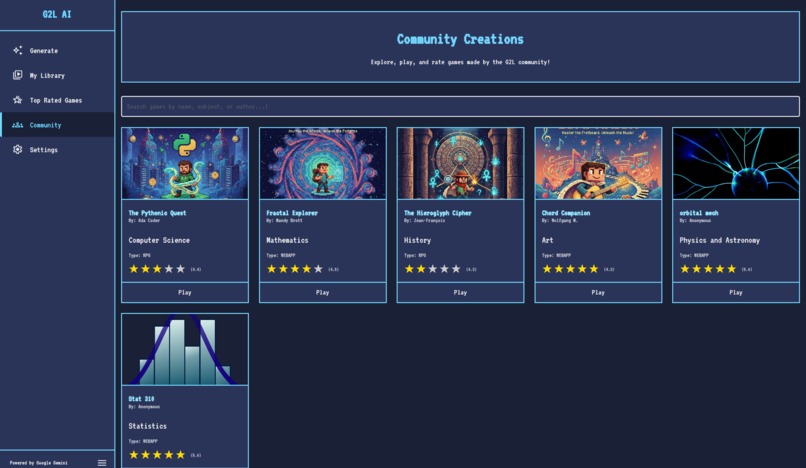
Community Page
-
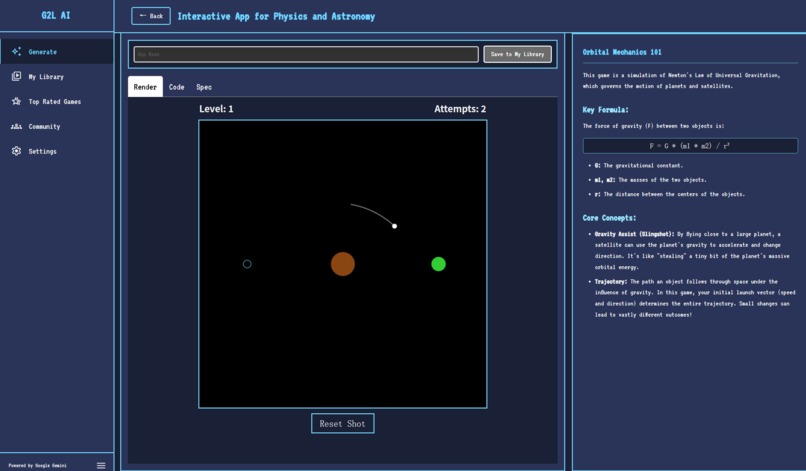
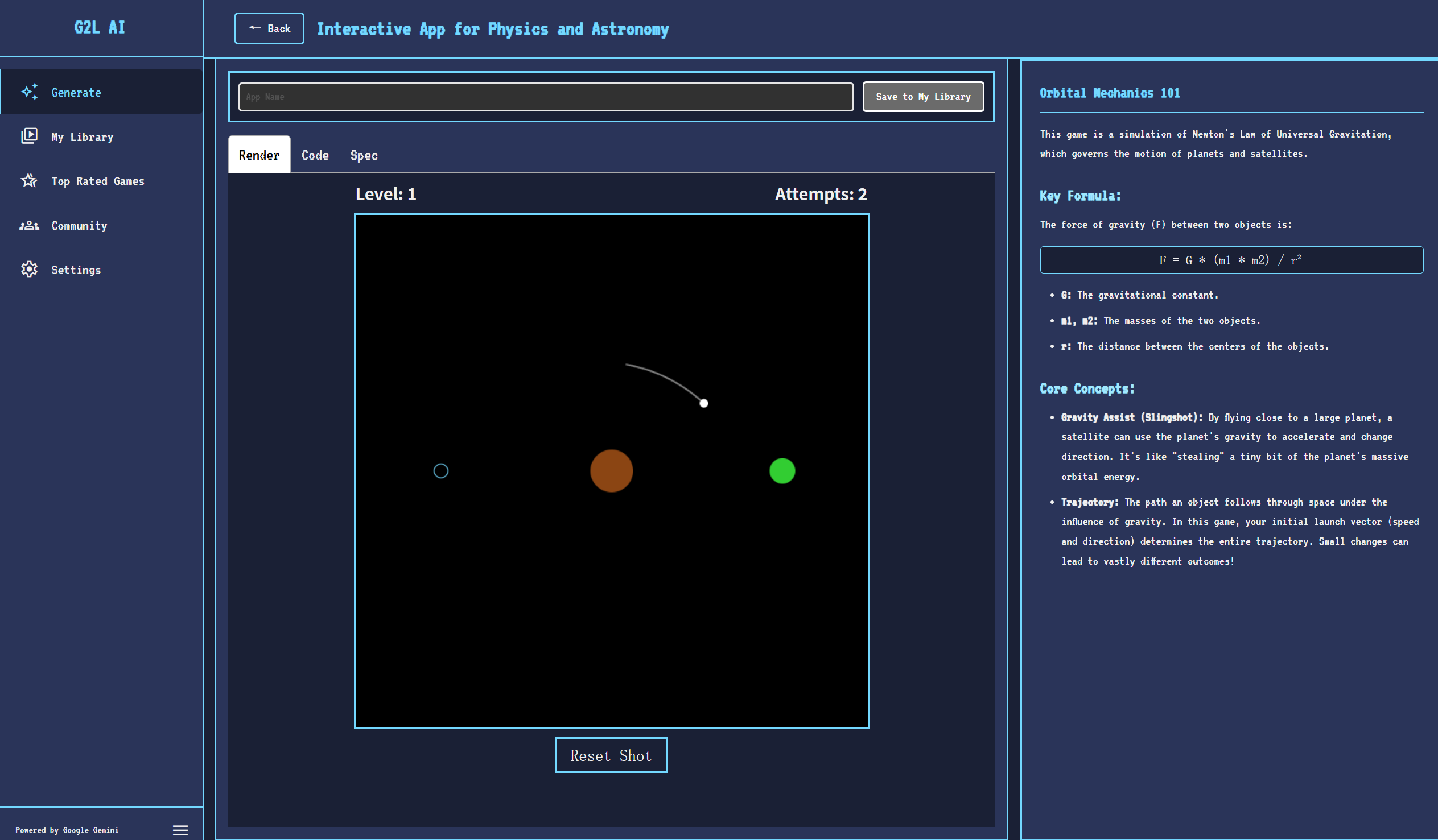
Example Game (physics) Created By G2L
-
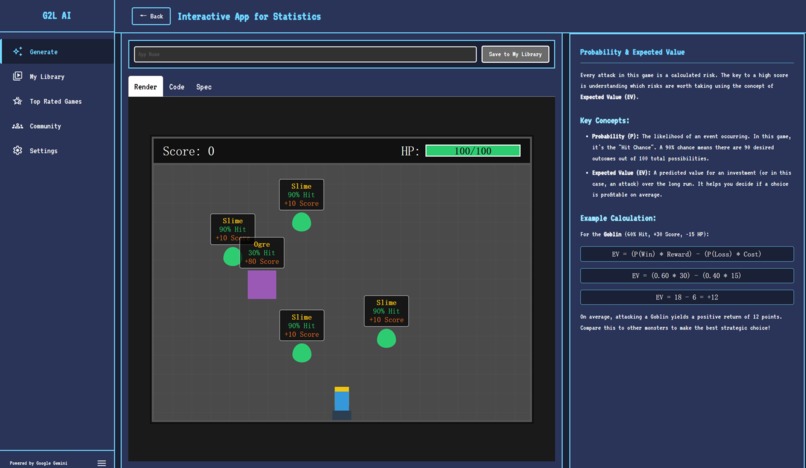
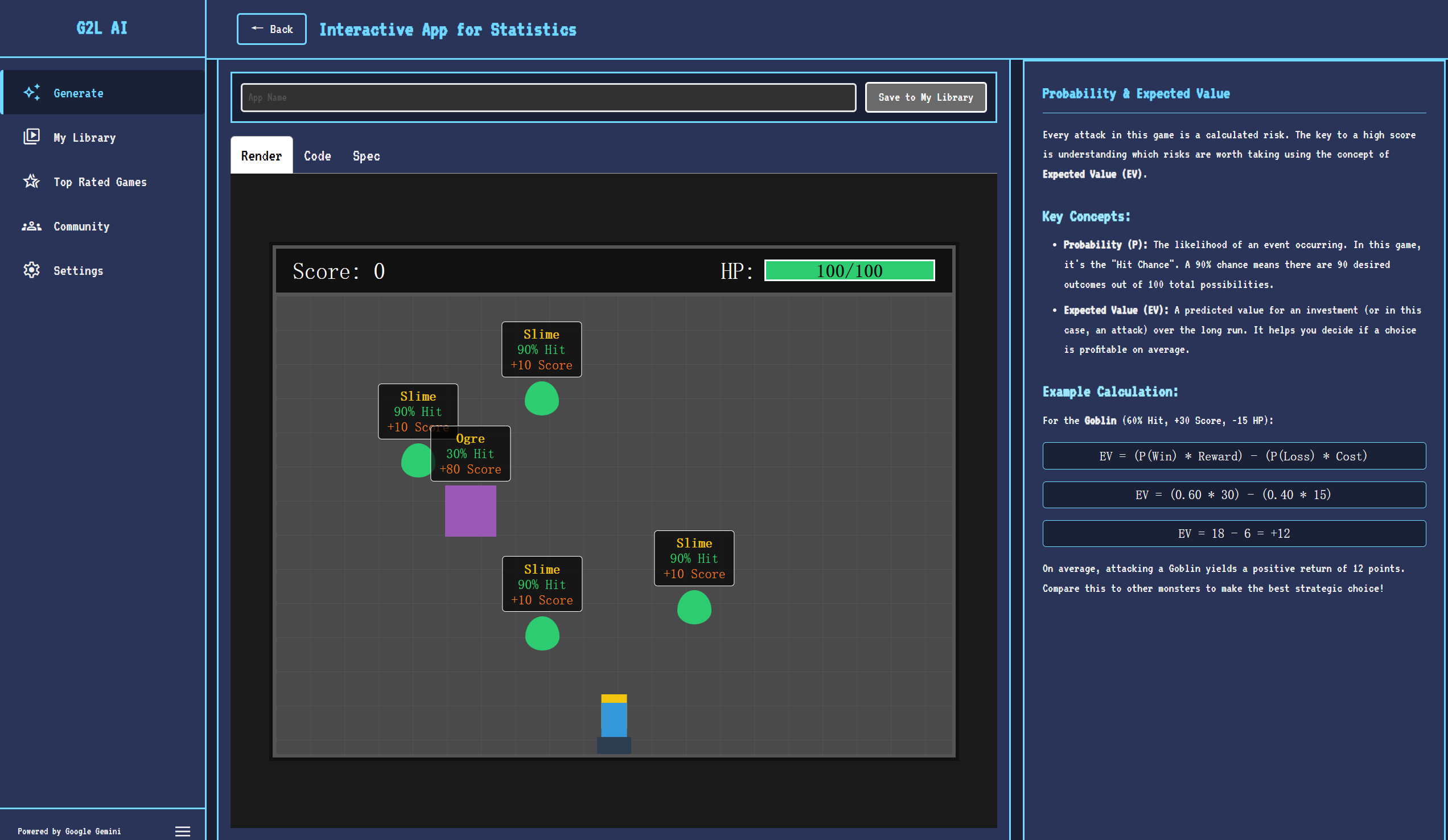
Example Game (statistics) Created By G2L
-
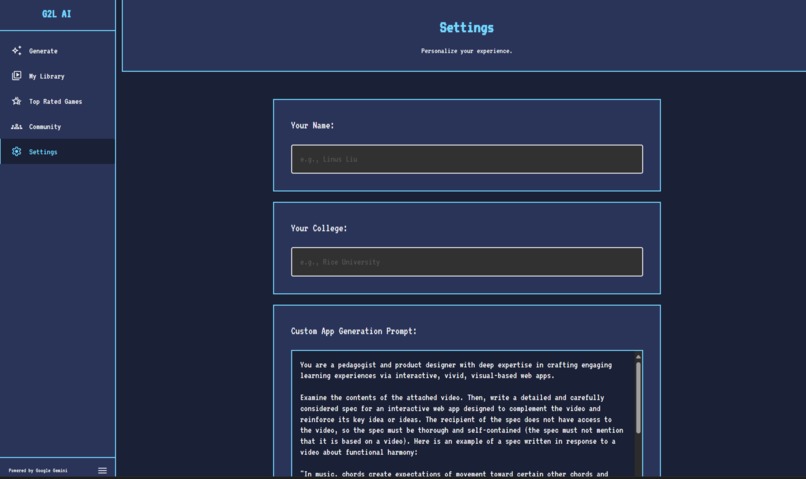
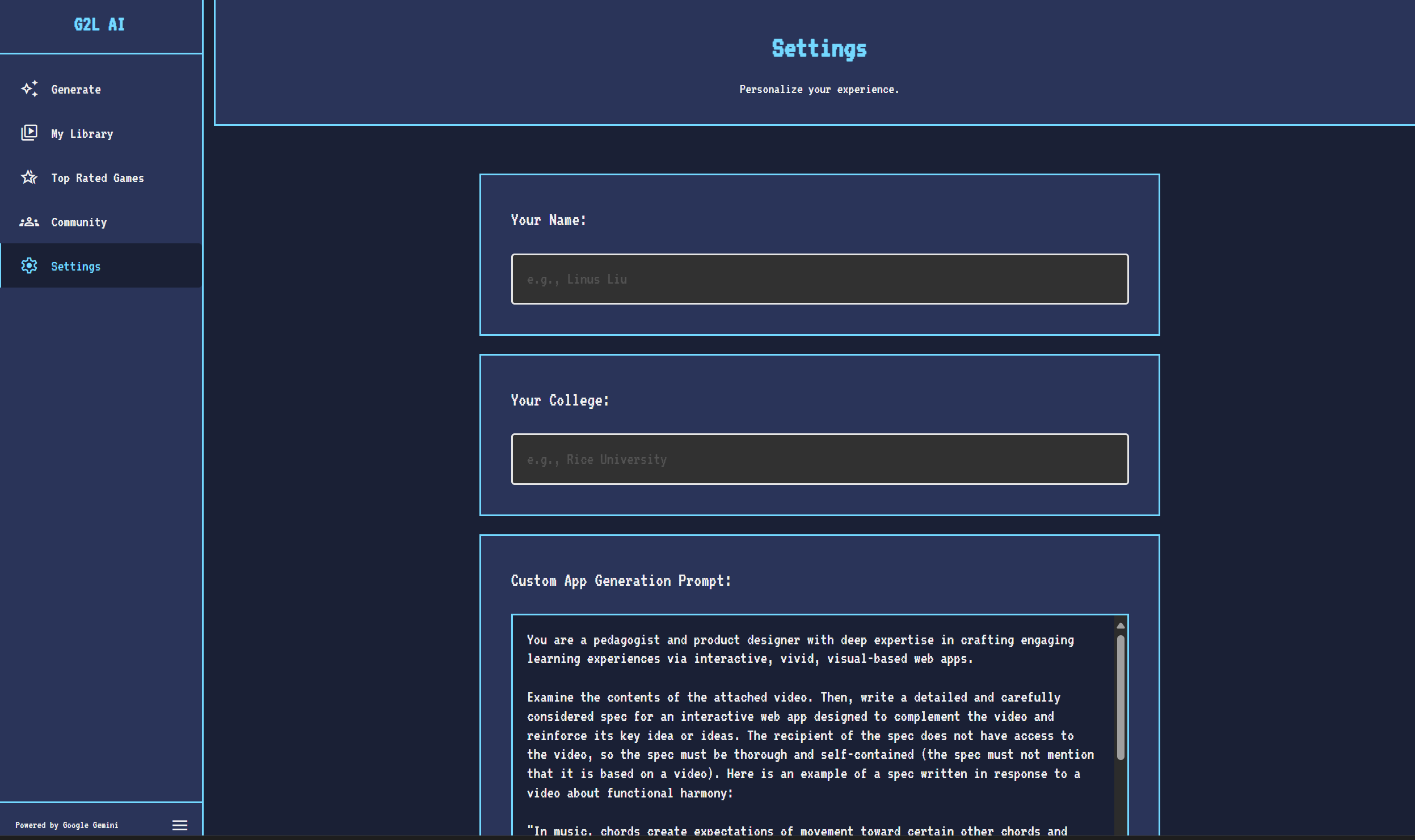
Setting Page

Inspiration
As students at Rice University—where most of us pursue STEM fields—we constantly struggled with abstract concepts across disciplines like mathematics, physics, and computer science. Whether we were tackling multivariable calculus theorems or trying to visualize quantum mechanics phenomena, traditional “read-and-memorize” learning felt limiting. We craved a way to interact with and visually grasp these ideas, not just memorize them.
That’s when the idea clicked: games could transform how we learn. Games turn complex ideas into engaging, hands-on experiences—so why not use games to teach STEM concepts, or even ANY field? And with AI tools (like Gemini, GPT, and others) growing increasingly sophisticated at content generation and coding, we saw an opportunity: let AI build customized games from any learning material. This would give us the freedom to learn any topic—from linear algebra to organic chemistry—in a personalized, visual, and fun format.
What it does
GameToLearn AI (G2L) transforms abstract concepts across any field—from multivariable calculus and quantum physics to literature analysis, history timelines, creative writing techniques, or even sociological theories—into interactive, personalized games. Users submit any learning material (YouTube links, PDFs, plain text, or simple prompts), and G2L’s AI pipeline parses the content, identifies core ideas, and generates a fully playable game tailored to teach or reinforce that material using Google Gemini API key. It also hosts a community library of user-created games (spanning all disciplines) plus tools to share, rate, and discover content—turning passive learning into active, gamified engagement for any subject.
How we built it
We structured the platform around four core pillars: AI-Powered Game Creation: Users input content (videos, PDFs, text), and AI generates a fully playable game. For example, pasting a YouTube link about Newton’s laws might produce a game where players solve physics puzzles to advance.
**Curated Game Library: **A repository of games created by the community, organized by subject (math, physics, biology, etc.) and difficulty.
**University-Specific Community Features: **A major-focused filter so students can find games relevant to their field.
A sharing and rating system: Students post AI-generated games, rate others’ creations, and top-rated games appear on a “High Score Board” for broader discovery.
Challenges we ran into
The hardest parts weren’t just technical—they were about balancing education and engagement:
AI Content Parsing: Making AI reliably “read” YouTube videos (transcribing audio, identifying key moments) and PDFs (extracting text, diagrams) required endless testing with different APIs and prompt strategies.
Game Quality & Educational Value: Ensuring games were both fun and educational was tough. We solved this by creating specialized AI agents: one designs game mechanics, another structures educational content, and a third handles code generation. This division let us tailor games to the material (e.g., a chemistry game uses a “lab simulation” format, while a math game uses “puzzle-solving”).
Prompt Engineering Iteration: Finding the “right” prompts to get AI to generate high-quality, relevant games took weeks of testing. Small changes (like adding “focus on visual interactivity” or “use a narrative-driven format”) made huge differences in output.
Accomplishments that we're proud of
University-Centric Personalization: Creating a platform tailored to Rice community—with major-specific filters (e.g., biology, physics, computer science) and a library curated for our courses—has made learning feel deeply customized for peers in our program.
Prompt Engineering Breakthroughs: Mastering how to “guide” AI to generate high-quality, relevant games was pivotal—subtle tweaks to prompts now produce games that feel purpose-built for learning (not just generic “edutainment”).
What we learned
Building this project forced us to learn across disciplines: AI Workflow Design: We had to teach AI to “understand” diverse content types—YouTube video links, PDF documents, or plain text. This meant designing a pipeline where AI parses media (using transcription for videos, OCR for PDFs), extracts key concepts, and structures them into game-ready logic.
Prompt Engineering Mastery: We quickly learned that how we prompt AI to generate games is just as important as what we ask. Tweaking prompts—for example, “create a 2D platformer where collecting coins teaches vector addition” vs. “make a math game”—produced drastically different (and often better) results. Iterating on prompts became a core part of our process.
User-Centric Design: To serve Rice’s diverse STEM community, we added major-specific categorization. Biology majors can generate games about cellular respiration; physics majors can focus on thermodynamics. This made the learning experience feel tailor-made for our peers
What's next for GameToLearn AI (G2L AI)
We have big plans to evolve the platform:
Faster Game Generation: Optimize our AI workflow to reduce latency—so students get games in seconds, not minutes.
Enhanced Interactivity: Add multimedia elements (voice acting, 3D graphics) and competitive features (multiplayer modes, leaderboards) to make games even more engaging.
Community & Database Optimization: Expand our game library’s search and recommendation systems, so students can easily find games aligned with their courses or interests.


Log in or sign up for Devpost to join the conversation.