-
-
app
-
data-driven payments
-
payment modes
Inspiration
Governments across the world spend billions on various schemes and programs. However, these social support schemes face challenges like corruption, fund misappropriation, delayed transactions. Therefore, only a fraction of money reaches to intended beneficiaries.
So, what if there is a government-to-citizen (G2C) payments solution, which ensures that every social support directly reaches to its true beneficiary?
What it does
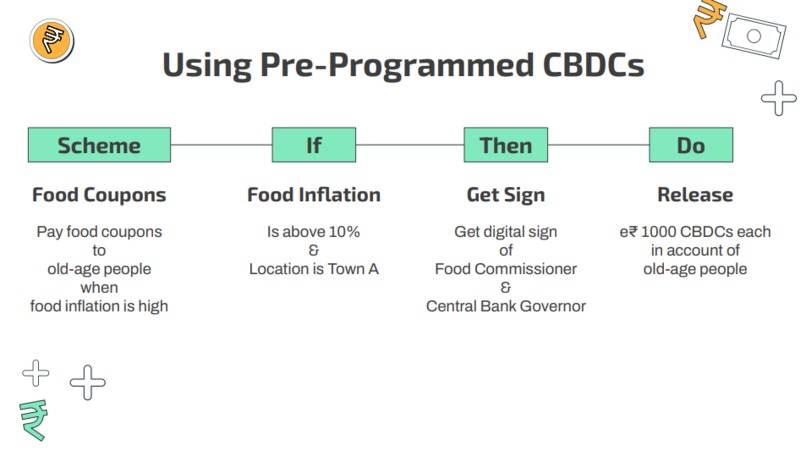
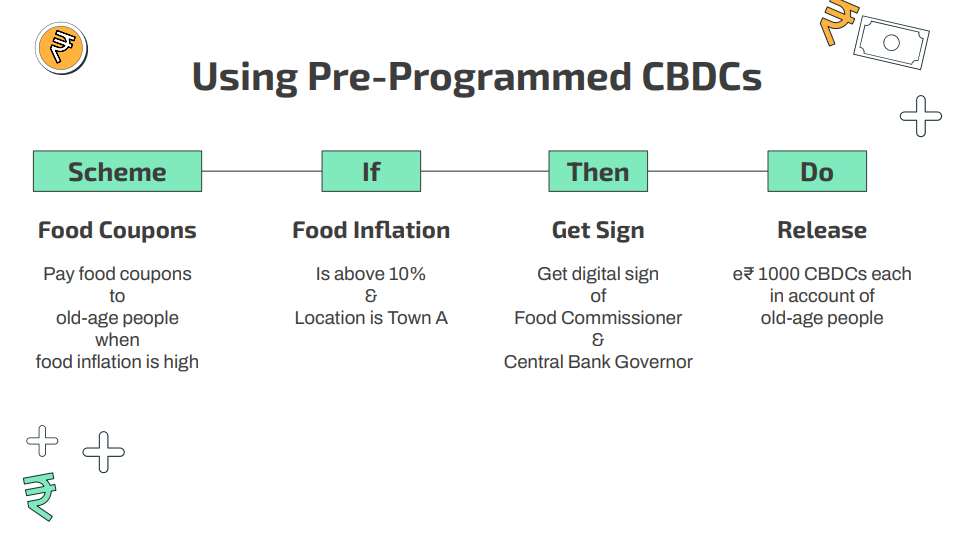
Our platform helps government departments send CBDCs directly to citizens for various social sector schemes. It lets you make conditional payments i.e. if specific conditions are met, the CBDCs would be deposited into citizen’s accounts.
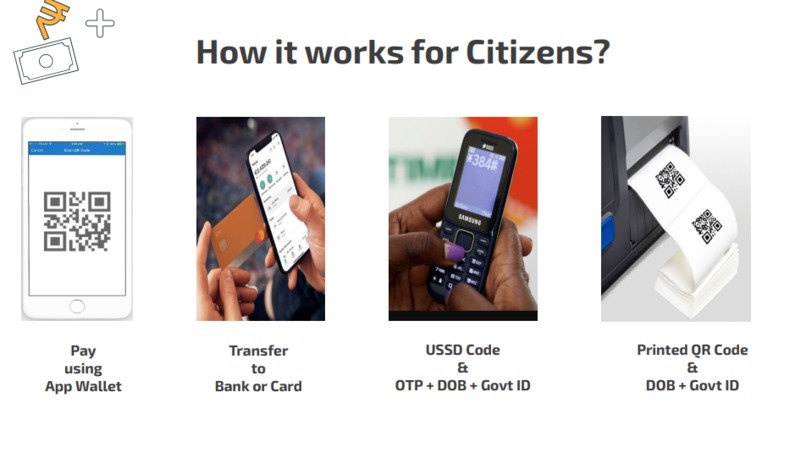
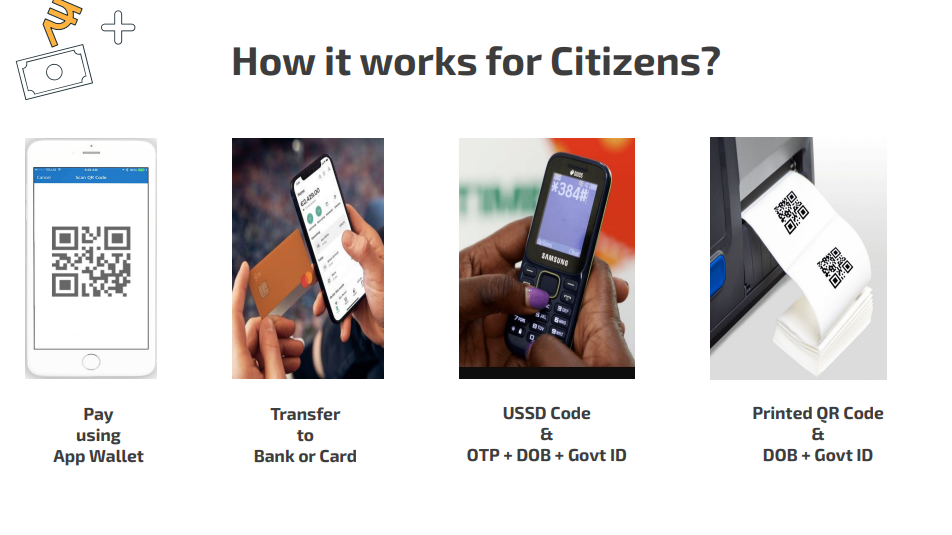
And citizens can easily pay or shop using these CBDCs through multiple modes like using mobile app, bank card, USSD code, or even QR code printed on paper.
What are conditional payments?
- Case 1: If food inflation in town A is above 10% for last 60 days -> Release CBDCs worth $100 as food coupons to citizens above 60 years age in that town.
- Case 2: If extreme temperature condition is sustained for 30 days in region ABC -> Release $5k in CBDCs as crop insurance settlement to each farmer.
We know that most government schemes or programs have such specific conditions like eligibility, amount, when to pay, etc. If we could combine programmable CBDCs along with these data points, we can make conditional payments. We can configure data using APIs, IoT devices or add manually.
Our platform helps make such conditional, automatic and instant transactions to improve last-time finance delivery.
Our Platform Features:
- Profiles: Join platform and create profiles, unique IDs for various users: bank, govt departments
- Citizen Management: Add and manage beneficiary citizens, their accounts and details, add to schemes
- Data Sources: Add and manage various data points including APIs, IoT device, and manual data.
- Data Conditions: Define conditions like “If X -> then Y”
- Schemes: Add and manage various social support schemes, configure data sources and conditions
- Money Management: Create funds, checks, trustlines, etc. to manage funds
- Monitor Funds: Central bank can monitor funds distribution, money usages
- CBDC Release: Approve and release CBDCs to beneficiaries based on modes suitable for them
What are the ways money can be used?
- Pay Directly: using our mobile app and wallet
- Bank/Card: Convert and transfer digital currencies in their traditional bank account or debit cards
- USSD Based: Pay using USSD code, along with OTP, birth year, last 4 digits of a Govt ID to confirm transactions
- Printed QR Code: Govt can print QR codes on paper and distribute them to those who do not have internet or mobile network. Users can pay using QR code along with birth year, Govt ID last digits to confirm transaction
Ripple XRPL features we use:
- Multi-sign: for multiple authorities to authorize CBDCs release
- Trustlines: for allocating resources to grassroot departments to distribute or use funds
- Checks: for pre-authorizing funds for unforeseen circumstances
- Hooks: for smart contracts and pre-programming CBDCs, so that misuse can be avoided
How we built it
We're ideating it using Ripple's public XRP Ledger protocols and test devnet. Technologies we use are devnet XRPL, Android/iOS, USSDs, AWS Lambda, Python, JavaScript, Postgres and so on.
Challenges we ran into
We found it difficult configuring Tokens/IOUs so that real-world government assets can be brought on Ledger. Also, understanding how XRP Reserves feature can be used to lock funds and use later on is challenging.
Accomplishments that we're proud of
We've done detailed ideation and brainstorming around power of CBDCs. We've studied reports and taken opinions of govt depts, citizens to understand issues with existing govt-to-citizen financing. We are analyzing corruption-in-governance related reports to improve our platform.
What we learned
CBDCs can be a true game-changer to eliminate corruption in government departments. Our platform can help Govts speed-up financial inclusion using CBDCs. It can help increase adoption of CBDCs among general public. Also, Ripple already has most of features built-in, that can help build a seamless govt-to-citizen payments system
What's next for G2CPay
We want to integrate Ripple's private Ledger in our product. We will also allow citizens to receive CBDCs from NGOs, UN and other international aid organizations. Alongside government departments, we would also allow NGOs to join the platform to help people in social support programs in future.

Log in or sign up for Devpost to join the conversation.