-
-
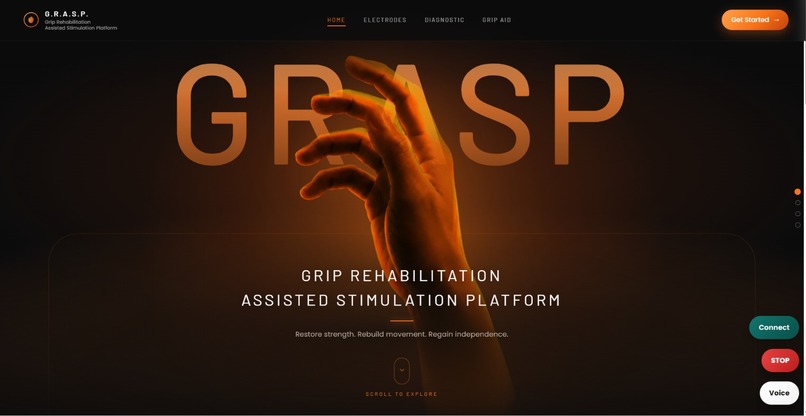
-
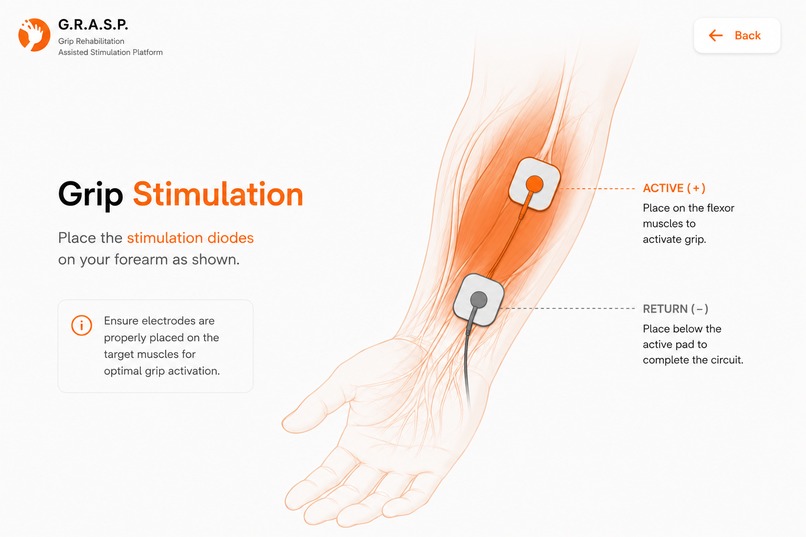
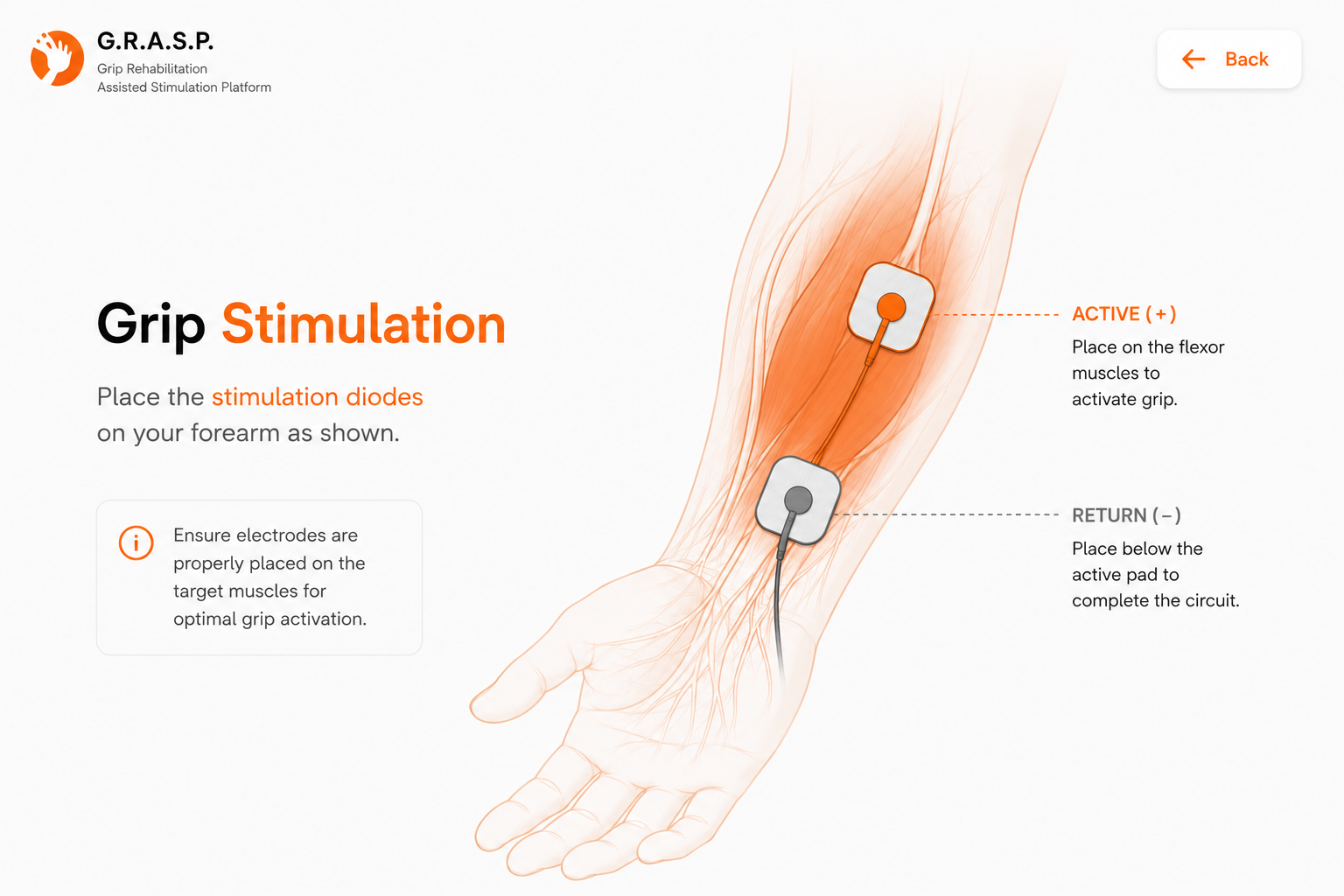
Diode Placement Guide Slide
-
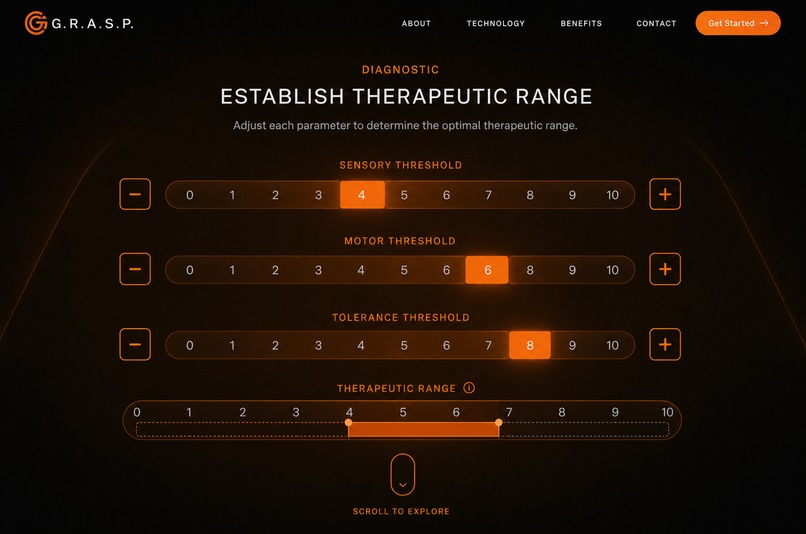
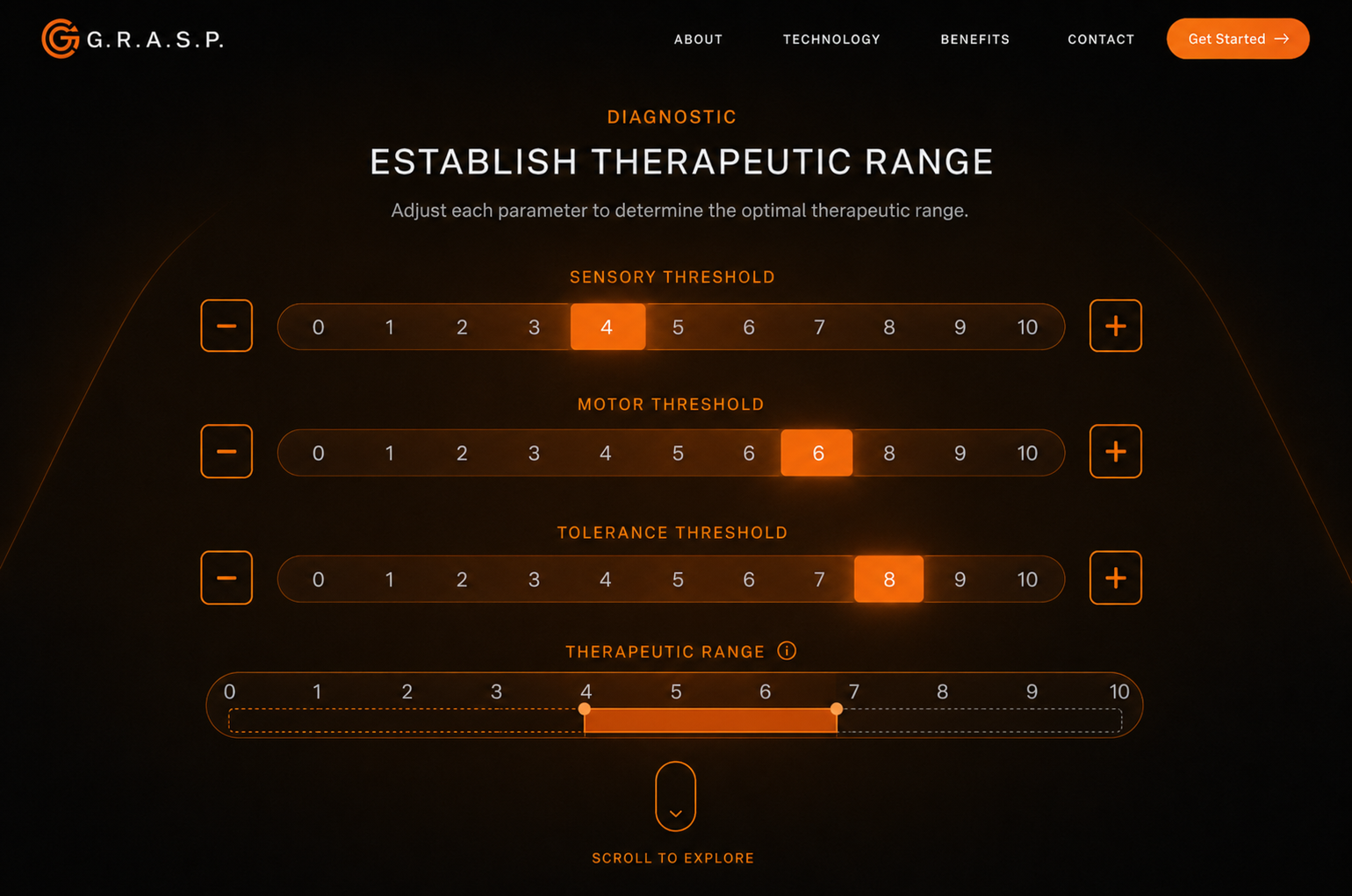
Therapeutic Range Calculator Slide
Every year, millions of people lose something most of us never think about: the ability to close their own hand. After a stroke or other neurological injury, partial paralysis of the hand and forearm turns everyday actions like holding a cup, gripping a doorknob, and shaking a hand into daily reminders of what was lost. The rehabilitation tools that exist are often clinical, intimidating, expensive, or locked behind therapy appointments that patients can only attend a few times a week.
We asked a simple question: what if a patient's own muscles could be their rehabilitation device? Neuromuscular electrical stimulation (NMES/EMS) has been used in physical therapy for decades, but it usually lives in a beige clinical box with cryptic dials. We wanted to wrap that proven technology in an interface so warm, simple, and human that a stroke survivor could use it independently at home — and actually want to.
That's how G.R.A.S.P. was born: the Grip Rehabilitation Assisted Stimulation Platform.
What it does
G.R.A.S.P. pairs a commercial Flex-IT EMS/TENS stimulation unit with electrodes placed on the forearm flexor muscles, and puts the patient in control through a clean, guided web platform. The system does two complementary things:
Grip assistance. Electrical pulses delivered to the forearm flexors cause the muscles to contract, closing the hand around an object. Our interface reduces this to the simplest possible mental model — a giant, realistic 3D switch. Flip it ON to grip. Flip it OFF to let go. For a user whose hand doesn't respond to their own intent, this restores a functional grasp on demand.
Physical therapy and strength training. The same stimulation, delivered in repeated cycles, forces the paralyzed or weakened muscle to contract. Use drives adaptation: repeated activation helps rebuild muscle mass and reinforces the neuromuscular pathways needed for voluntary control, which is the core principle behind stimulation-assisted stroke rehab.
The guided experience. The platform walks the user through the full session flow:
Electrode placement — an illustrated anatomy guide shows exactly where to place the active (+) and return (−) pads on the forearm or bicep, so setup is safe and repeatable without a therapist in the room. Diagnostic calibration — before any session, the user establishes their personal therapeutic range using three intensity thresholds, each adjustable with simple +/− controls:
Sensory threshold — the lowest intensity the user can feel Motor threshold — the intensity at which the muscle visibly contracts Tolerance threshold — the maximum comfortable intensity
The platform computes the therapeutic window between motor and tolerance thresholds, so every session is effective and comfortable — and the calibration adapts as the user's sensation and strength recover over time. Grip Aid mode — the one-switch grip control described above.
How we built it
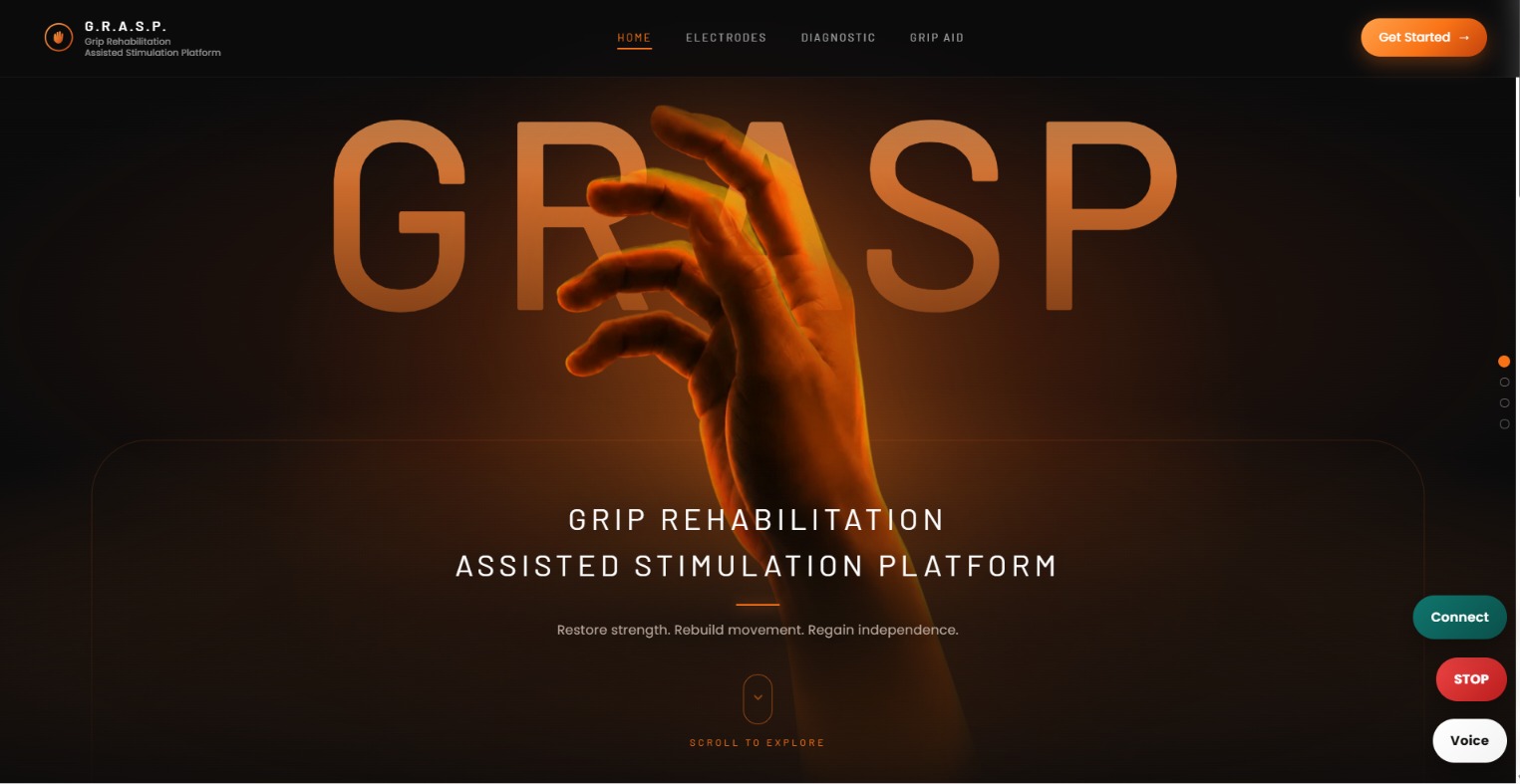
Stimulation hardware: a Flex-IT EMS/TENS unit delivering the electrical stimulation through standard gel electrode pads placed over the forearm flexor group (or bicep, for elbow-flexion training). EMG triggering: the platform is designed around EMG-triggered stimulation — reading the faint electrical activity of the user's own attempted muscle contraction and using it to trigger the assistive stimulation, so the device amplifies the user's intent rather than replacing it. This intent-driven loop is what makes the therapy active rather than passive. The web platform: a single-page, vertically sliding site. Each stage of the experience (home → diagnostic → grip aid → placement guide) is one full-viewport panel the user scrolls through, mirroring the linear flow of an actual therapy session. We designed the entire visual identity ourselves: a warm orange-on-black palette with soft professional gradients, a glowing open hand as the hero image, and consistent typography across every screen — approachable and human, not clinical. Interface components: custom-built threshold bars with discrete increments and +/− steppers, a computed therapeutic-range visualization, and a skeuomorphic 3D rocker switch for grip control with clear ON/GRIP and OFF/RELEASE states — deliberately oversized and high-contrast so it remains usable for people with limited fine motor control or low vision.
Challenges we ran into
Challenge: Rethinking the Servo Design
The initial assumption
Our original design used two servo motors to control the stimulation unit's intensity — one dedicated to pressing the + button and one for the − button. We assumed the servos would give us generous rotational travel and that the ESP32 could drive both without issue, so our early mounting design and control code were built around a two-servo layout.
The realization
On the bench, two problems hit at once. First, our servos were limited to 180° of rotation — far less freedom than we'd designed around. Second, we couldn't get two servos running reliably off the ESP32, so the two-servo plan was dead on arrival.
The design change
We consolidated everything into a single servo. Instead of one motor per button, the one servo rocks between the two: rotating one direction presses +, rotating the other presses −, then returns to a neutral center position. The 180° limit that broke our first design was actually plenty for this — we only needed a short sweep to each side. We remapped the control code so the ESP32 commands three positions (press +, neutral, press −) and repositioned the servo mount so its arm reached both buttons.
The impact
The redesign cost us hours of work time mid-build, but the final system was better for it: fewer parts, simpler wiring, less load on the ESP32, and one calibrated motion instead of two motors to sync. It also taught us the key lesson of the project — test actuator limits and board capabilities on real hardware before designing around them. The constraint forced a simpler, more reliable design than the one we started with.
What we learned
All of our core hardware was new to us. None of us had ever worked with a MyoWare EMG sensor, a TENS unit, or an ESP32 before designing this project. We learned each one from scratch during the design process, reading EMG signals off the MyoWare, understanding how TENS stimulation and intensity control actually work, and programming the ESP32 to tie it all together. Going from zero experience to a functioning integrated system was the steepest and most rewarding learning curve of the project.
What's next for G.R.A.S.P.
Closed-loop EMG sensing to automatically scale assistance as voluntary control returns — helping less as the user recovers more Session tracking and progress dashboards patients can share with their physical therapists Guided PT programs: timed contraction/rest cycles, rep counting, and progressive intensity plans Clinical validation with stroke rehabilitation specialists and real patient trials
G.R.A.S.P. exists for one reason: to give people their grip back — and with it, a piece of their independence.
Built With
- api
- c++
- css3
- emg
- esp32
- gemini
- html5
- javascript
- myoware
- python
- speech
- tens
- typescript
- unit
- vite
- web


Log in or sign up for Devpost to join the conversation.