-
-
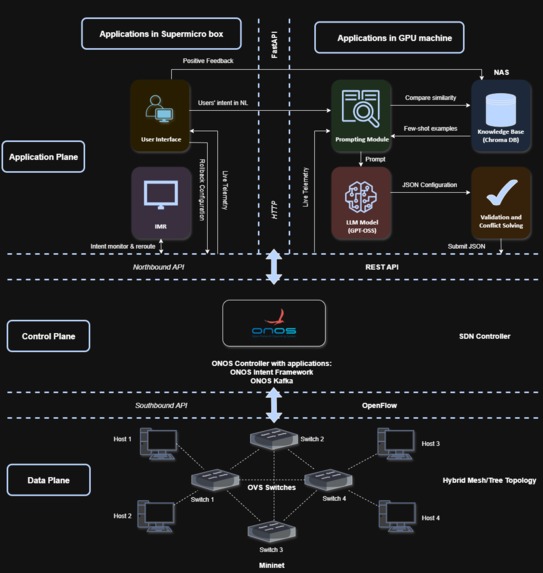
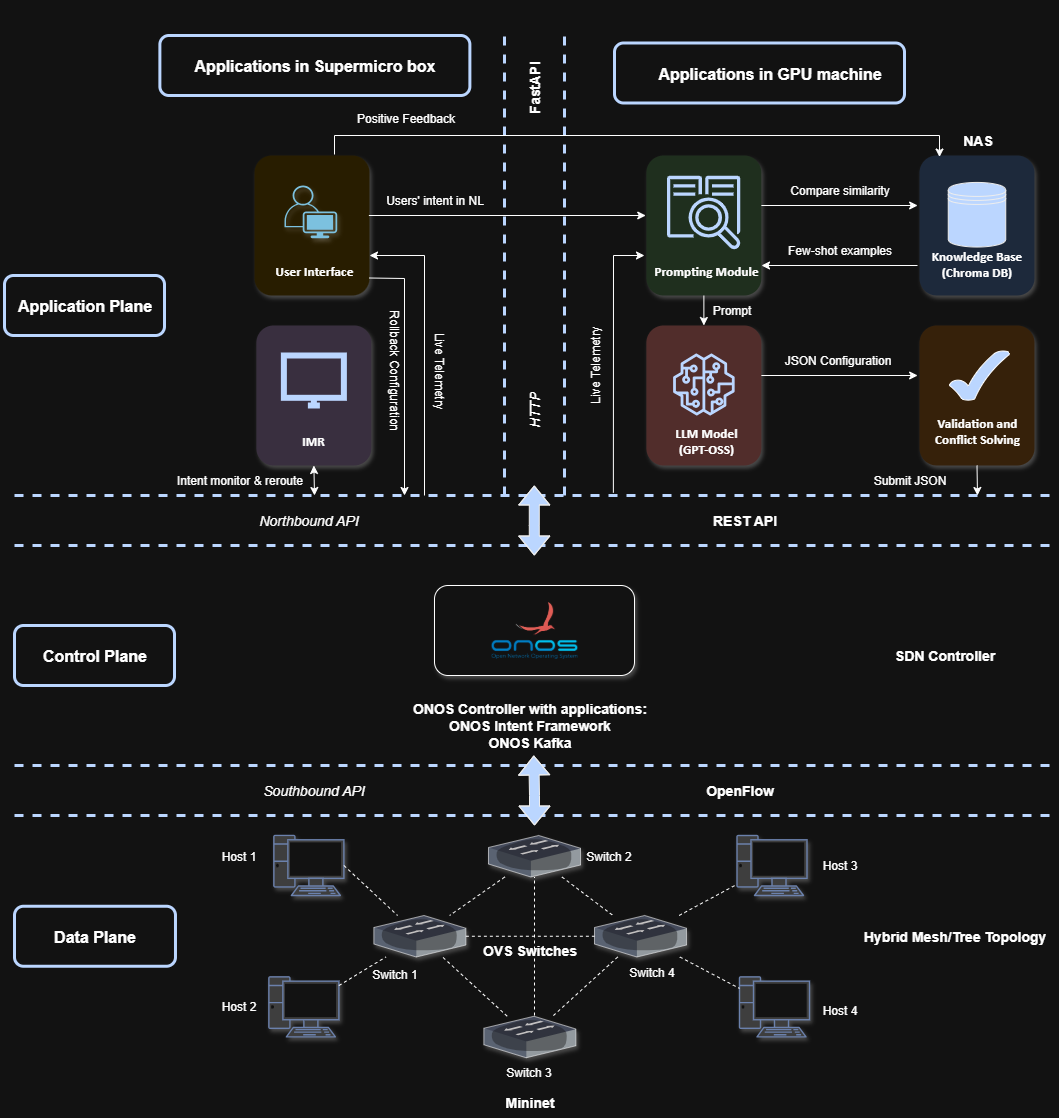
System Architecture
Inspiration
Configuring Software-Defined Networking (SDN) policies can be tedious and error-prone, often requiring deep technical expertise. With the growing adoption of intent-based networking, I was inspired to explore how Large Language Models (LLMs) could bridge the gap between human-friendly instructions and low-level network configurations. The vision is to make network resource allocation more intuitive, efficient, and scalable.
What it does
FYP (For Your Ping) is a work-in-progress system that:
- Lets users express high-level intents like “prioritize video traffic” in natural language.
- Translates these intents into ONOS Intent Framework JSON configurations.
- Simulates the results in a Mininet-based virtual network.
- Provides a dashboard for real-time monitoring of traffic, devices, and policies.
- Lays the groundwork for optimization algorithms that balance bandwidth, routing, and load.
How we built it
Architecture Design
Designed a modular system with four main components:- NLP Module: Uses
gpt-ossto parse natural language and generate structured intents. - Optimizer: Plans to allocate resources dynamically.
- Controller Integration: Communicates with ONOS via REST APIs to push intents.
- Visualization Dashboard: React-based UI to display network state and allow intent submission.
- NLP Module: Uses
Technology Stack
- Backend: Python scripts for parsing, ONOS integration, and simulations.
- Frontend: React, Tailwind CSS for a clean UI.
- Network Simulation: Mininet and ONOS Controller.
- Containerization: Docker for isolated testing and deployment.
- Backend: Python scripts for parsing, ONOS integration, and simulations.
Early Prototyping
Built static UI components, basic ONOS scripts, and tested prompt-based intent parsing.
Challenges we ran into
- ONOS Learning Curve: Understanding its intent framework and APIs took significant time.
- Complex Networking Setup: Simulating multi-node topologies in Mininet while ensuring ONOS communication.
- LLM Integration: Experimenting with prompt design for accurate translation of network intents.
- Time Constraints: Couldn’t complete full optimization logic and end-to-end integration.
Accomplishments that we're proud of
- Clear system architecture design showing feasibility of LLM-driven SDN resource management.
- Initial React dashboard prototype for intuitive intent submission and network monitoring.
- Successfully connected ONOS and Mininet to control simulated network flows.
- Learned to containerize components for easier testing.
What we learned
- Deepened understanding of SDN concepts, ONOS architecture, and Mininet simulation.
- Gained experience in LLM integration and prompt engineering for domain-specific tasks.
- Learned to design and structure large projects under strict time limits.
- Improved knowledge of Docker networking and REST API communication.
What's next for FYP (For Your Ping)
- Complete end-to-end integration: Full pipeline from natural language intent → ONOS JSON → live simulation.
- Develop optimization algorithms for smarter bandwidth, routing, and load balancing.
- Add error handling and intent validation to ensure safe network changes.
- Implement metrics visualization (latency, throughput, fairness) in the dashboard.
- Explore fine-tuning gpt-oss with SDN-specific datasets for higher accuracy.
- Deploy a fully containerized, reproducible version for public testing.
Built With
- docker
- mininet
- onos
- python
- react
- typescript
- vite
- vllm


Log in or sign up for Devpost to join the conversation.