Front-End/Back-End: https://github.com/paulsparks/fx-thing FX Processor: https://github.com/dylanvaneaton/fx-thing-fxprocessor
Inspiration
We love making music, both with real instruments and digitally, but we found that even the most modern software is limiting in its flexibility for chaining effects in complex ways.
What it does
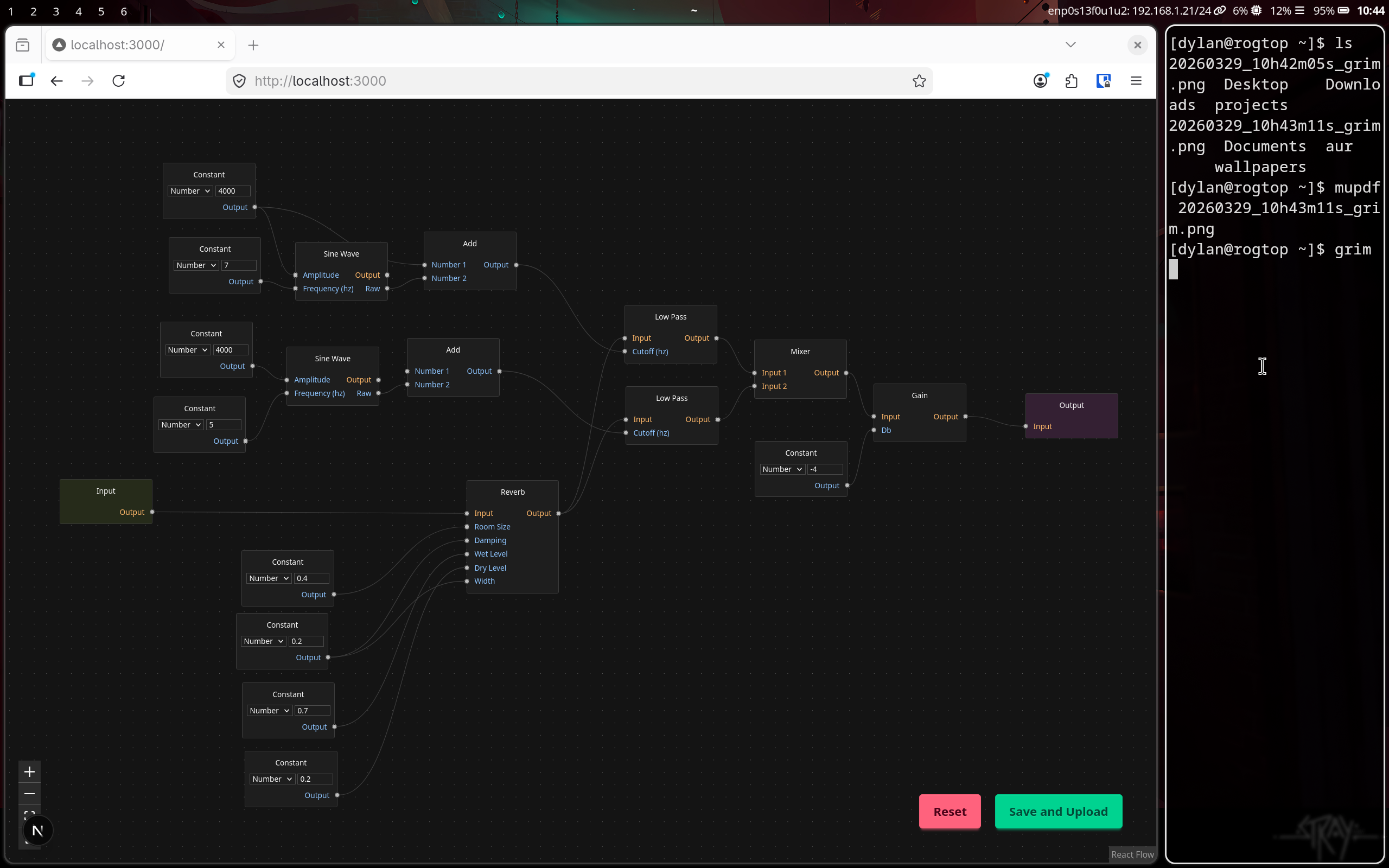
This tool allows a user to build their own audio effects through a modular, user-friendly, visual system. The feature that make this tool truly unique and fun is its massive flexibility, allowing any matching output types to be used as input types, mixing and matching things like audio effects, mathematical functions, audio conversion functions, user-defined sine waves, etc.
How we built it
The front-end is built in Next.js, and the back-end is built in python using jackd for low latency real time audio routing.
Challenges we ran into
The algorithms involved were mathematically dense at times. Additionally, real-time audio processing is very time-intensive; if a few milliseconds are wasted, the whole program can slow to a halt.
Accomplishments that we're proud of
This is our most complex project so far, and we didn't think we would see it to completion like we did. The complex algorithms for both determining node chain paths, and routing them efficiently through audio manipulation pipelines.
What we learned
Dylan and I increased our skill sets in Python and Javascript respectively, and this was our first experience in a project that has this much processing and custom logic.
What's next for FX Graph
We plan to continue working on this, and deploying it onto a standalone device that artists can use to quickly and build and iterate on their custom effects.

Log in or sign up for Devpost to join the conversation.