Inspiration
I spend a lot of time in the Roblox tower defense sceneand two things always bugged me. First, many games are built around collecting and fusing units, but the actual merging is just "two of the same makes a bigger one." It is satisfying for about a week. Second, when you play with strangers, everyone is basically alone on their own lane. The other players are wallpaper.
Then I started looking at Horizon Worlds and hit the wall every creator hits: people walk in and out of a world every few minutes. Most designs treat that as a problem to survive. I flipped the question. What if the constant churn was the whole point? What if the defense you leave behind when you log off becomes the next person's to inherit and grow? That one idea is where Fuzelings started.
What it does
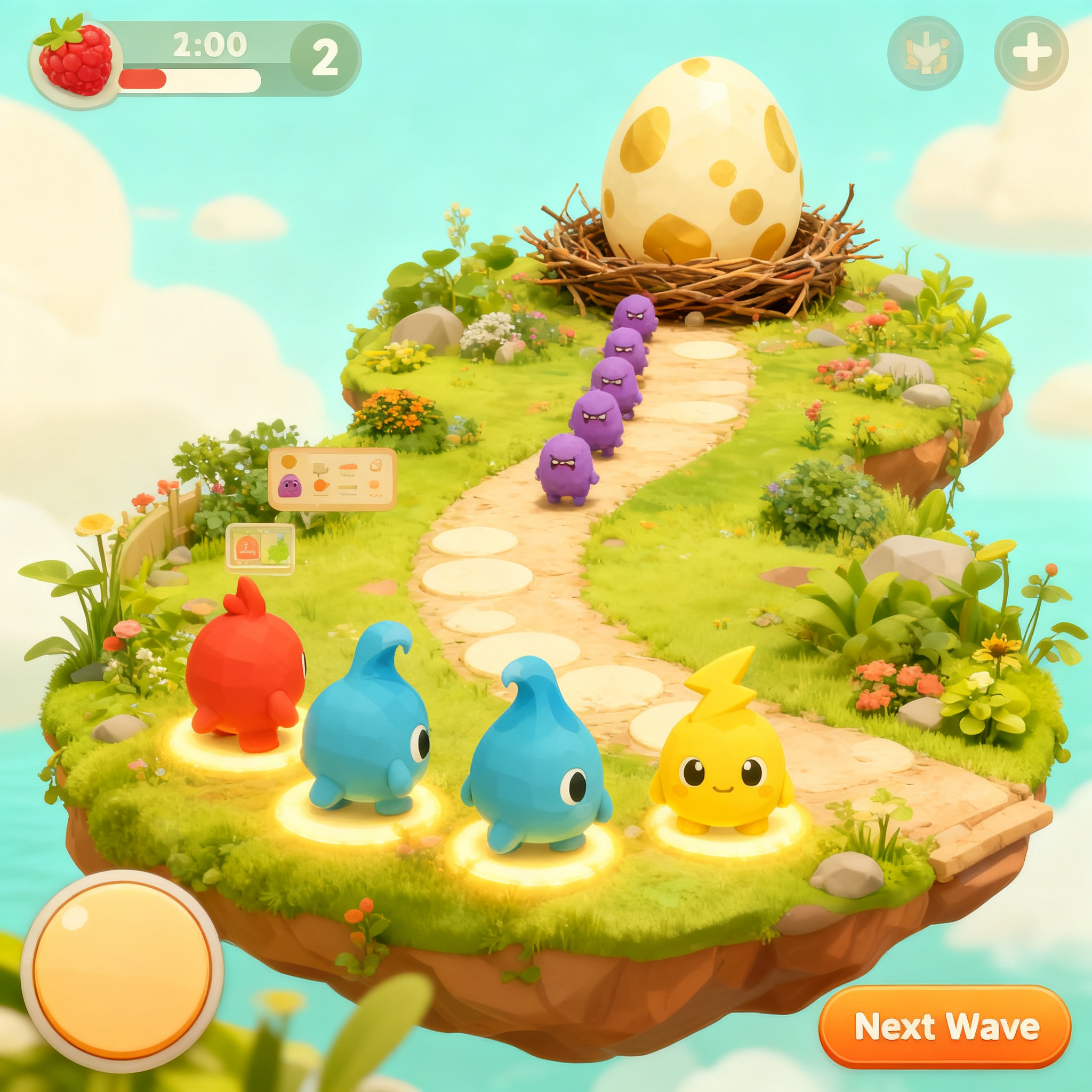
Fuzelings is a co-op tower defense, built mobile-first. You summon little creatures onto a shared board, merge two of the same kind to level them up, and fuse two different kinds to discover a secret hybrid you have never seen. Everyone on the map plays on one common board, but you can only touch your own creatures. Stop the waves of Gloops before they reach the Big Egg.
The twist is everything that happens around the merging. Summons are random, so you trade with the people next to you to finish a fusion. And when a player leaves, their creatures do not vanish. They turn wild and glow, and anyone can adopt them. So the board is never built by one person. It is a living thing that strangers hand off to each other, wave after wave. There are thirty fusions hiding in the Codex, and that is the part that keeps pulling you back.
How we built it
This is a pre-production design project, so "building" meant designing, not coding. I locked the concept before writing a single word of the documents, then built four artifacts that all had to tell the exact same story: a game design document, a player journey map, a visual concept package, and a production plan.
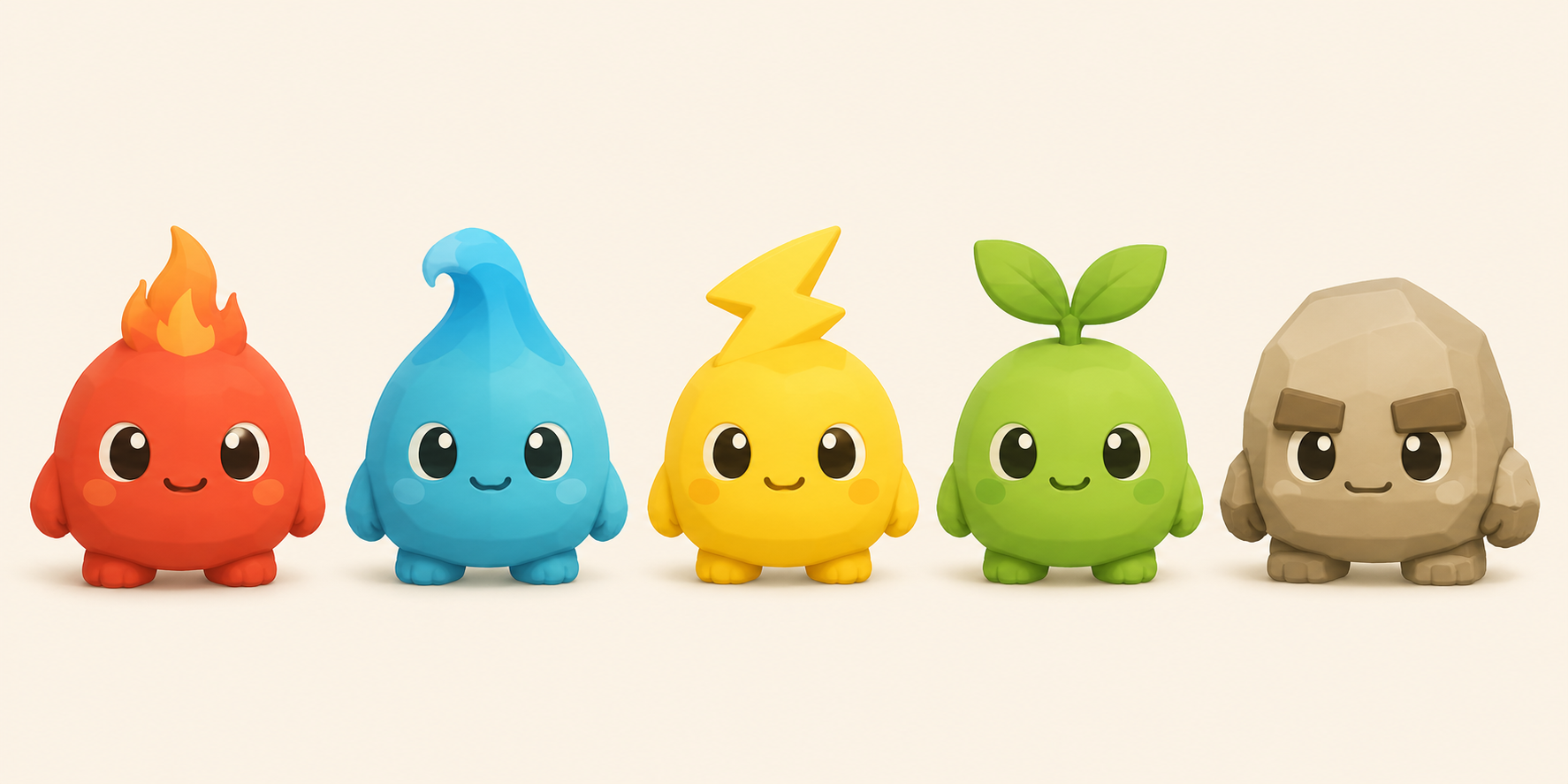
Every decision got filtered through what Horizon can actually do. No 360 degree levels, simple pathfinding, simple models, flat lighting, and that brutal churn. That filter shaped the art style, which I called "Chunky Toy": simple matte shapes with the personality baked into the faces, so the concept art matches what the engine can really render. It also shaped the economy, which I worked out on paper first.
For the visual part I generated the concept art with AI, but locked it to a strict written style spec so the full set reads as one game instead of a pile of unrelated images.
Challenges we ran into
The biggest one was onboarding. Dropping a brand new player straight into a busy, half-built co-op board is a terrible tutorial. The fix was a short solo "Nursery" that teaches summon, merge, and defend in about ninety seconds, and then letting the board teach itself through affordances, like pads that pulse and creatures that shimmer when they can merge, instead of walls of text.
The shared board raised an obvious problem: if anyone can build anywhere, what stops me from wrecking your towers? The answer turned into a rule I kept coming back to. You can help anyone, but you can never touch their stuff. Ownership is per creature, trading happens through a consent based Trade Tray, and griefing simply stops existing.
The smaller ones added up too. Dragging two creatures together is awful on a phone in 3D, so it became tap one, then tap the other. And keeping four separate documents perfectly consistent took a full adversarial read at the end, hunting for any line where one artifact promised something another one did not.
Accomplishments that we're proud of
Turning the platform's worst trait into its best feature. The inheritance mechanic means churn makes the game better instead of worse, and I have not seen another tower defense do that.
Making merging a question instead of an upgrade. Fusing two different types to reveal a hybrid nobody on the server has seen yet is a genuinely new beat for the genre, and it doubles as the "post the clip" moment that spreads a Roblox game.
And coherence. The art, the systems, the player journey, and the build plan all describe one game. The production plan even isolates the scariest piece, handing creature ownership across a disconnect, into its own phase so it gets proven before anything is built on top of it.
What we learned
Constraints are not the enemy of design, they are the tool. Almost every good idea in Fuzelings came from bumping into a Horizon Worlds limitation and asking what it was quietly telling me to do. Churn pushed me toward inheritance. Weak pathfinding pushed me toward fixed pads and a pushback fusion instead of player built mazes. Models limitations pushed me toward a cuter, more readable look.
The player journey map taught me more than I expected. Writing systems is the easy part. Writing the first thirty seconds, the first real decision, and the rhythm of a single session forces you to design the experience, not just the machine that runs it.
What's next for Fuzelings
First, a build of the core loop, solo, with plain cubes, just to prove that "merge or spread" is a real decision before any art exists. Then the shared board (map) and inheritance, which is the version actually worth shipping.
After that, the pieces I cut on purpose to keep the first version readable: a Codex Buddy that rides along and helps, unstable Fusions for the min-maxers, seasonal boards, and custom rooms for friend groups. And underneath all of it, real playtests with the audience this is actually for.
Built With
- markdown
- mermaid

Log in or sign up for Devpost to join the conversation.