Inspiration
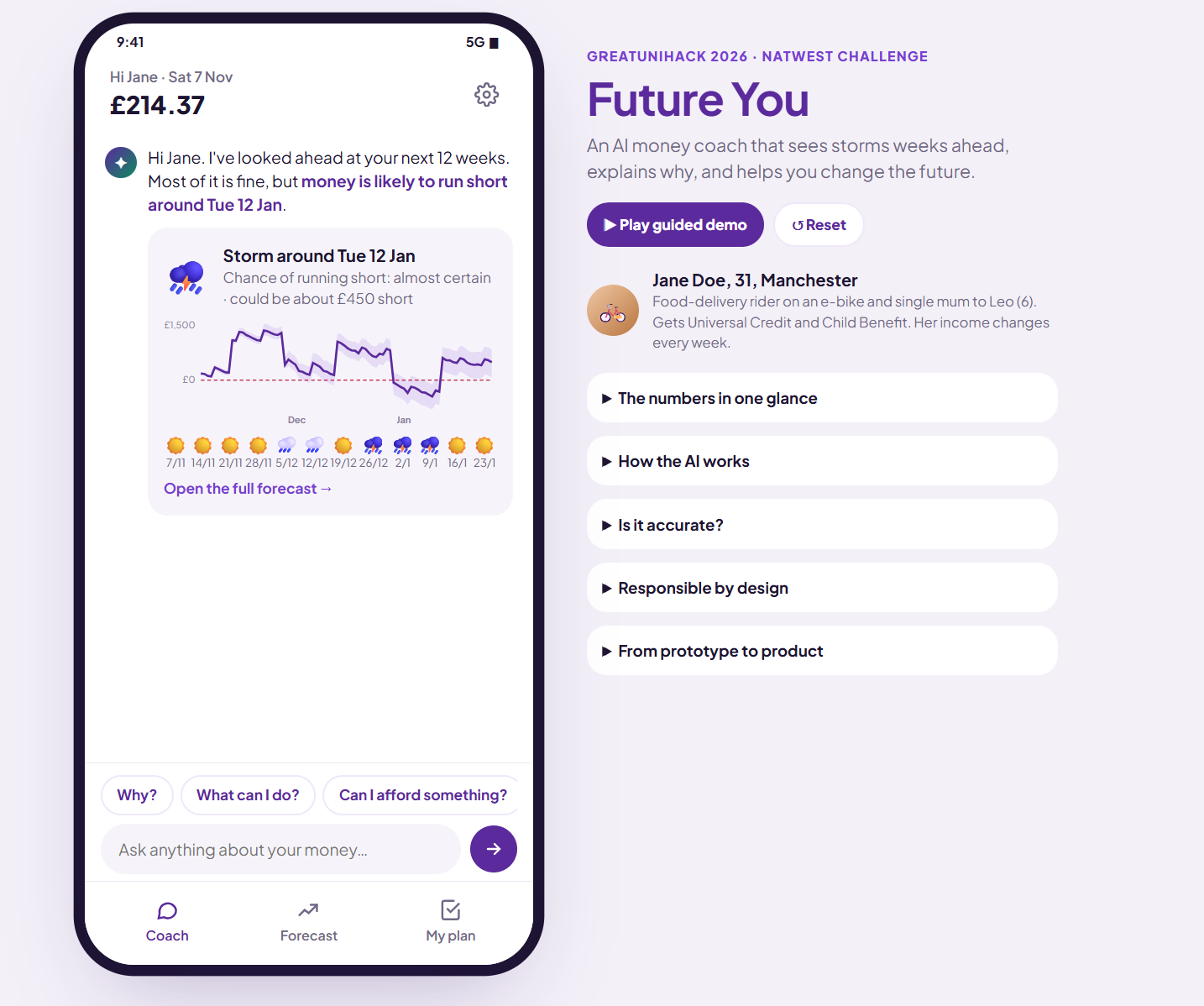
NatWest asked for "financial time travel": AI that spots hardship before it happens. Budgeting apps only look backwards, and the people under the most pressure often don't get caught out by overspending. They get caught out by timing. Our persona, Jane, is a delivery rider and single mum on Universal Credit. Her rent leaves on the 1st, her UC arrives on the 16th, and a busy December quietly cuts her next UC payment. She has £214 today and feels fine. In nine weeks she'll be about £450 short.
What it does
Future You is an AI money coach that sees money storms weeks before they hit.
- The coach speaks first. It forecasts the next 12 weeks and warns Jane: "a storm is likely around 12 January".
- It explains why using her own transactions: bills on the 1st, UC mid-month, quieter delivery weeks.
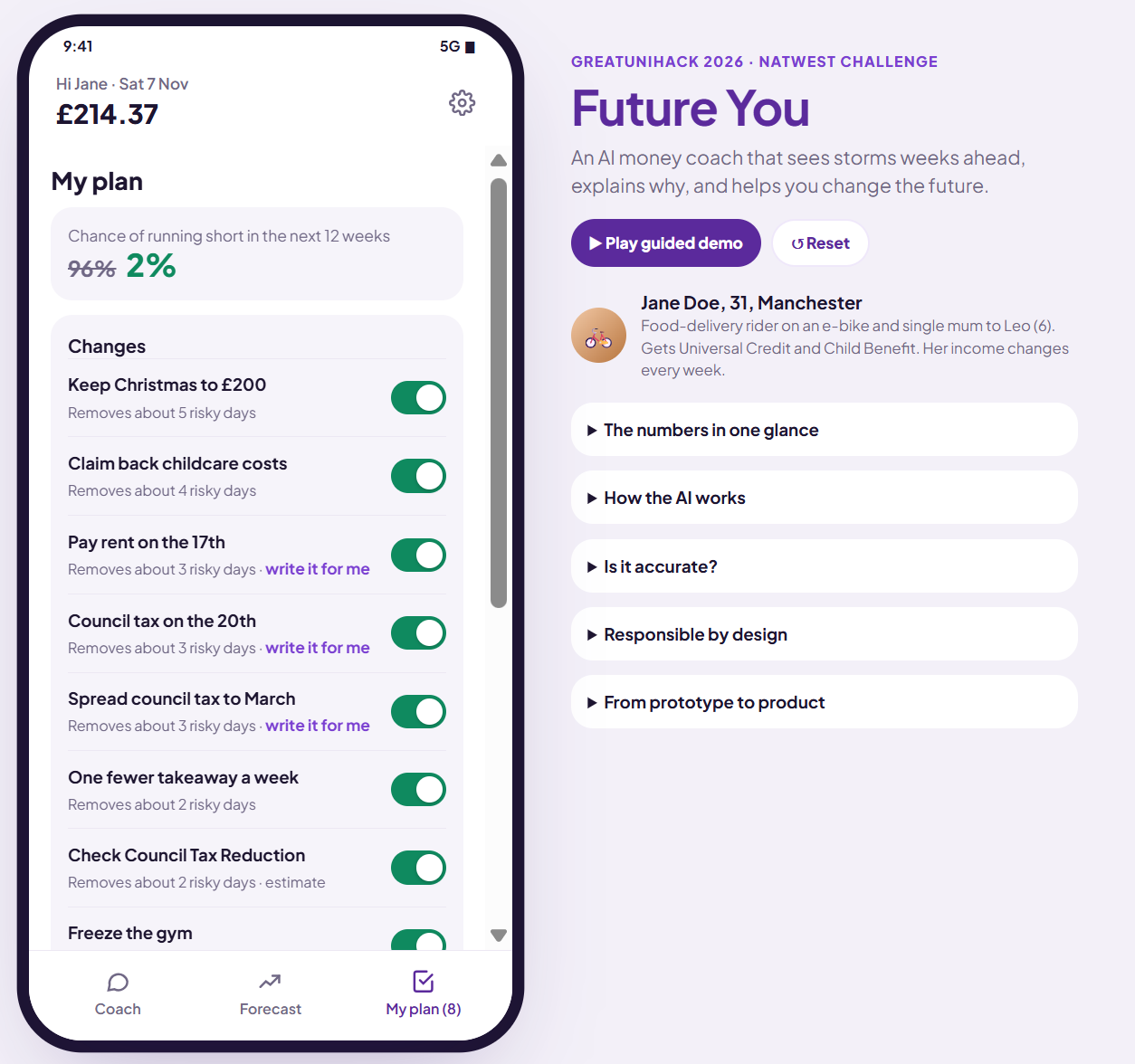
- It suggests fixes, each tested on the simulation, including support she's entitled to but isn't claiming (UC refunds 85% of childcare costs, about £166 a month). It even writes the message to her landlord.
- What-if shocks. "What if my washing machine breaks next week?" It reruns her future with the shock.
- Storm Shield. A buffer that saves only from spare money and covers dips automatically.
- 12-month view. It takes her from 11 months in the red to none, with her high-cost loan gone by April.
- "Can I afford it?" It checks any purchase against her future, not just today's balance.
- Built for everyone. Simple-words mode, large text, high contrast, and replies read aloud.
With 8 small changes, her chance of running short drops from 96% to 2%.
How we built it
- A single-page web app in plain HTML, CSS and JavaScript, with no frameworks.
- A custom forecasting engine that runs in the browser. It detects bills, income, seasonal and yearly costs, and school-holiday pauses from 12 months of Open Banking-style transactions, and models the real Universal Credit rules: the 55% taper, assessment periods and the childcare element.
- A Monte Carlo simulation of 400 possible futures per scenario, from 12 weeks to 12 months, with stress tests for shocks.
- Claude as the coach. Typed questions go to Claude, which calls our engine as tools (forecast, purchase what-if, fixes, shocks, the 12-month view) and answers with visual cards, so it can't invent numbers. Quick-reply buttons use a built-in coach, so the demo never stalls.
Challenges we ran into
- Making the numbers honest. Our first "savings pot" looked like it reduced risk, but it was just moving the same money around. We reframed the Storm Shield as protection against shocks rather than a fix.
- Getting UC timing right, including how a busy month lowers next month's
Built With
- claude
- css
- html
- javascript
