-
-
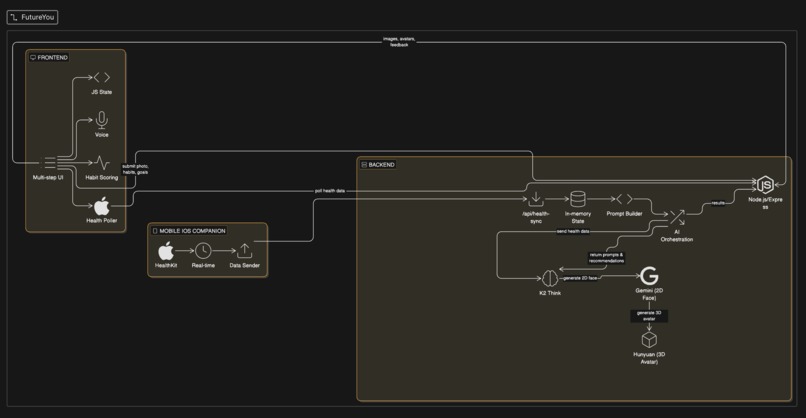
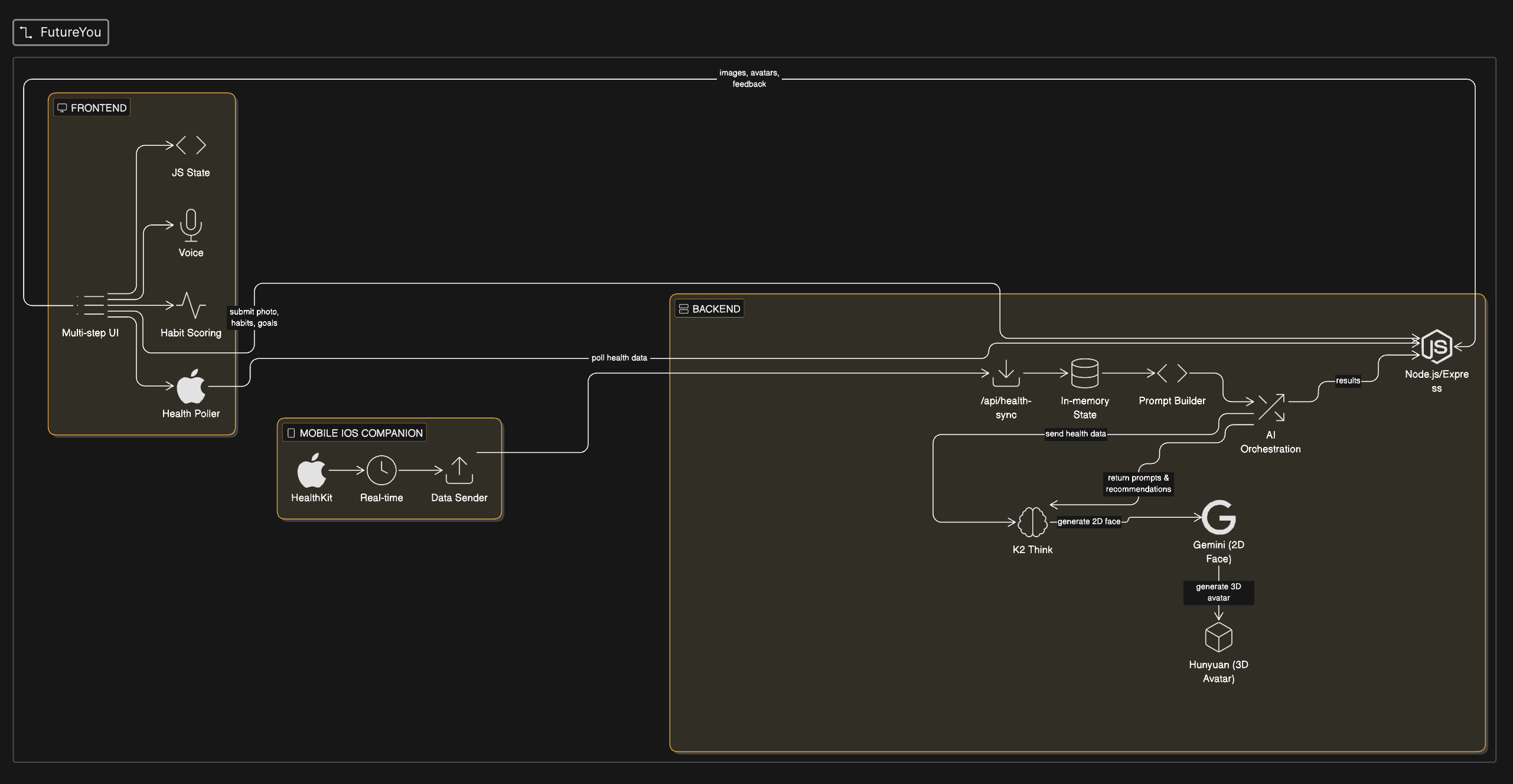
FutureYou Workflow
Inspiration
Even when we know what we should be doing to improve, staying consistent with everyday habits remains a challenge. That gap between intention and action is what sparked the idea behind FutureYou. We were also inspired by the concept of digital twins from Black Mirror, which led us to explore the idea of creating a realistic, evolving 3D version of yourself. At the same time, we noticed how effective simple motivation systems can be: apps where you grow digital plants or take care of virtual pets (like Finch or Forest), and streak-based platforms like Snapchat or Duolingo that keep people coming back. FutureYou is our attempt to combine these ideas into something more personal and impactful: a system that doesn’t just track your habits, but shows you, visually and emotionally, who you’re becoming because of them.
What it does
Customizable 3D avatar based on current health data and comprehensive support system to help you stay on track with goals. In addition to yourself, you can also directly visualize a pet or loved one and how you’d look if you achieve or don’t achieve your goals. Future You creates a customizable 3D avatar based on your current health data and provides a comprehensive support system to keep you on track with your goals. You can visualize a future version of yourself or even a loved one or pet, showing how you'd look if you achieve or don't achieve your goals.
How we built it
On the frontend, we focused on making the experience feel simple but emotionally engaging. Users go through a step-by-step flow where they upload a photo, bring in their health data, and set goals. Instead of using a heavy framework, we kept state management lightweight with a simple JavaScript object so we could move fast and keep everything predictable. We also added voice using the Web Speech API, so the avatar can actually talk to you. It makes the experience feel a lot more personal.
On the backend, we used Node.js and Express to tie everything together. One of the main things we worked on was translating messy, real-world health data into something AI models can actually use. We built an endpoint to receive live data from the iOS app, and then a prompt generation layer that turns that data into structured, meaningful inputs. From there, the backend orchestrates multiple models in sequence.
For mobile, we built a simple iOS companion app with HealthKit. It pulls in things like sleep, steps, and heart rate, and sends them directly to the backend. That way, the system stays up-to-date without users having to manually log everything, which is really important for consistency.
The most interesting part was connecting all the AI pieces. We used K2 as the orchestration layer to take user data and turn it into both visual outputs and behavioral insights. Those prompts go into Google’s Gemini model to generate realistic 2D future images, and then Tencent’s Hunyuan model converts 2D to 3D version which you can interact with.
So end-to-end, it goes from real health data → to a future version of you → to personalized feedback that nudges you to actually change your behavior. And making that loop feel fast and believable was the core thing we focused on.
Challenges we ran into
A major challenge was 3D model generation. Most models only support either text-to-3D or image-to-3D, and they cannot do both. Image-based models preserve identity but can’t modify features (e.g., making a "tired" or "happier" version), while text-based models allow changes but lose realism.
To solve this, we built an orchestration layer. We use a text model (K2) to generate condition-specific prompts from health data (e.g., sleep deprivation → dark circles, fatigue). Then, we combine this prompt with the user’s selfie using a 2D multimodal model to generate a conditioned image. This intermediate image is then used for more accurate 3D generation.
We also faced technical challenges with Xcode and Apple’s ecosystem. Some team members couldn’t install Xcode due to hardware limitations, and Apple developer setup and permissions added friction. Additionally, integrating real Apple Watch data was difficult, which we addressed using our SDK-based companion app.
What we learned
Building FutureYou taught us that strong collaboration is just as important as strong technology. Because the project combined frontend design, backend systems, mobile development, and AI integration, success depended on clear communication and dividing ownership effectively. We learned how to work in parallel while staying aligned on a shared product vision, allowing each team member to focus on their strengths while continuously integrating progress. We also learned how important rapid iteration is during a hackathon, testing ideas quickly, giving honest feedback, and adjusting features in real time helped us move much faster and build a stronger final product. Technically, we learned how to architect AI systems by combining specialized models into a single seamless product experience. Rather than depending on one model for every task, we assigned each model a clear role from reasoning and orchestration to image generation and 3D rendering, then connected them through an efficient pipeline. We also gained hands on experience building a recommendation engine that interprets health data, user goals, and behavioral trends to generate personalized next steps. Most importantly, we learned that successful AI products are not defined only by model capability, but by how effectively those capabilities are translated into experiences that feel intuitive, motivating, and genuinely helpful.
What's next for FutureYou
Our next step is to evolve FutureYou into a real-time behavioral feedback system and ultimately a personal predictive engine, not just a visualization tool. We aim to continuously track user data such as sleep, activity, heart rate, and habit consistency, translating it into an evolving 3D avatar that reflects both current and future states. At key stages of the user journey, the platform will also intelligently generate personalized check-ins and questions to capture mood, motivation, stress, energy levels, and perceived progress, allowing the system to learn from both objective signals and subjective feedback. Instead of delayed consequences, users receive instant visual feedback that makes the impact of their behavior impossible to ignore.
For example, poor sleep may lead to a visibly fatigued future self, showing how they may look in 60 days if the pattern continues, while healthier habits result in a clear glow-up version. If the system detects declining motivation or inconsistent routines, it can ask targeted questions to understand why and adapt recommendations accordingly. Each daily decision is immediately reflected in the avatar, turning small, invisible choices into something tangible and emotionally compelling in real time.
Over time, FutureYou expands beyond feedback into prediction and intervention. By learning from user behavior patterns, biometric trends, and ongoing responses to smart check-ins, the system can simulate future outcomes, proactively guide decisions, and intervene before negative habits compound. By transforming abstract health data into a living, personalized digital twin, FutureYou closes the gap between present actions and future consequences. This creates a powerful instant gratification loop while laying the foundation for a platform that can fundamentally reshape how people understand and optimize their lives.
Built With
- browser-api
- css3
- express.js
- github
- google-gemini
- healthkit-integration
- html
- javascript
- k2-think
- node.js
- swift
- tencent-hunyuan


Log in or sign up for Devpost to join the conversation.