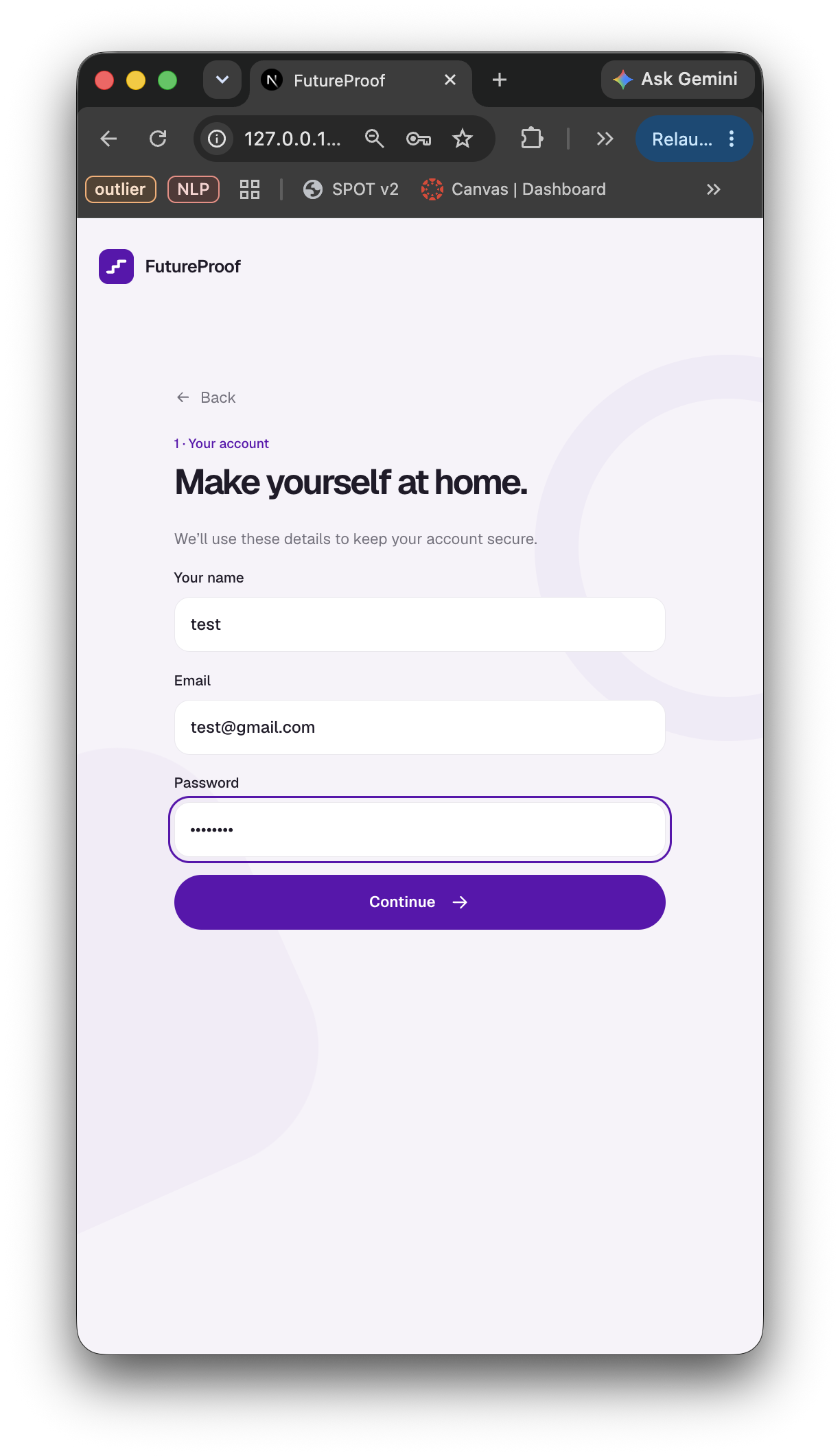
NOTE: for the cloudflare demo, press login and use the Jamie account with password: "jamie1234"
Inspiration
Financial planning tools often assume that people earn a predictable salary and have money left over to save. That does not reflect everyone’s life.
Someone on a zero-hours contract may not know how much they will earn next week. Someone managing on a tight budget may need to protect essential spending until payday. A disabled customer may face additional costs or barriers to accessing support.
Inspired by NatWest’s challenge around financial inclusion and resilience, we built FutureProof around a simple principle: financial support should adapt to the customer’s circumstances.
We wanted to bring NatWest’s idea of “financial time travel” into everyday decisions, helping people see difficulties before they happen and understand their options.
What it does
FutureProof is an AI-powered financial planning app that helps customers understand what is coming, explore their options and plan their next step.
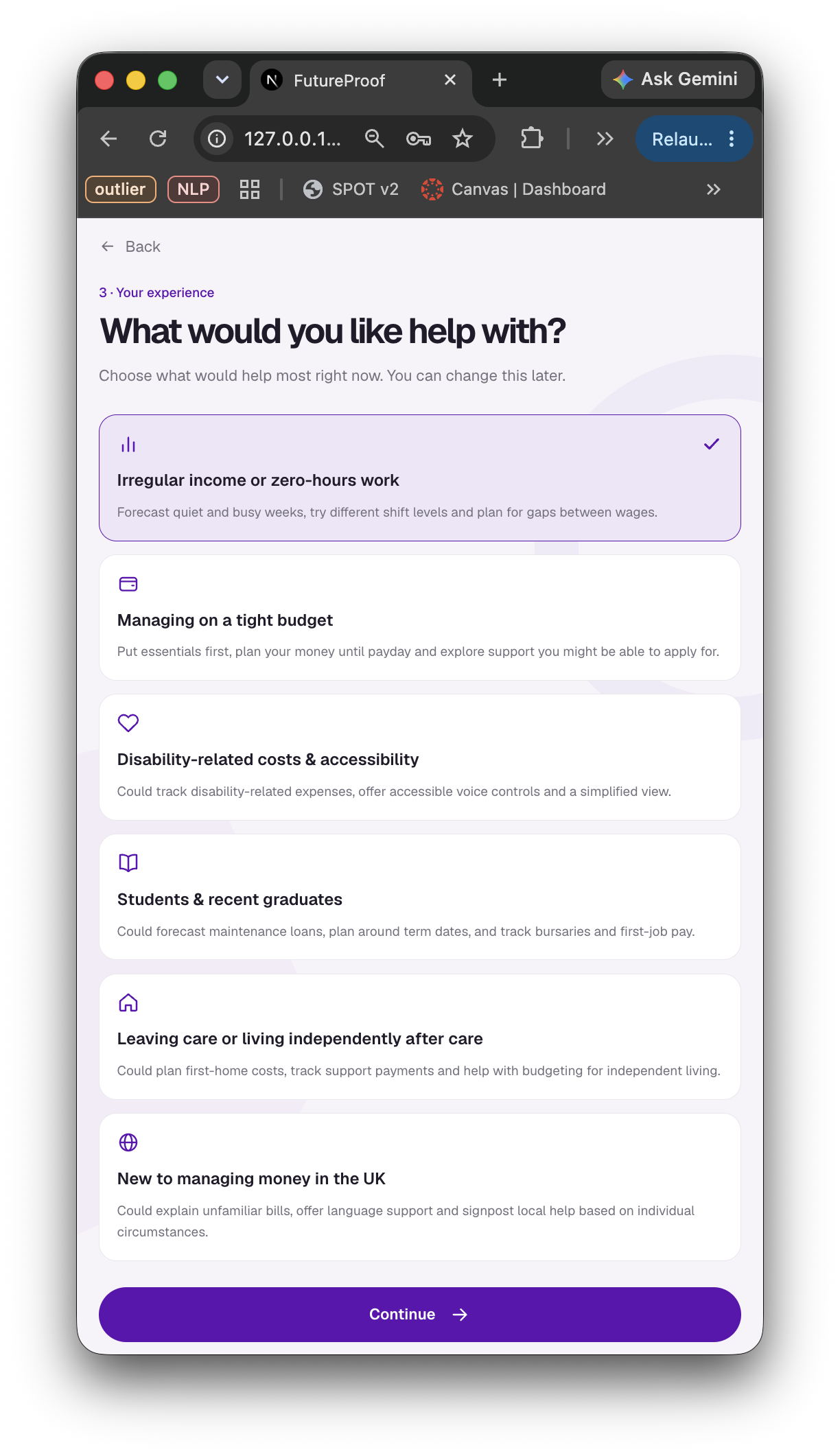
Customers choose what they would like help with. Our prototype demonstrates two tailored experiences:
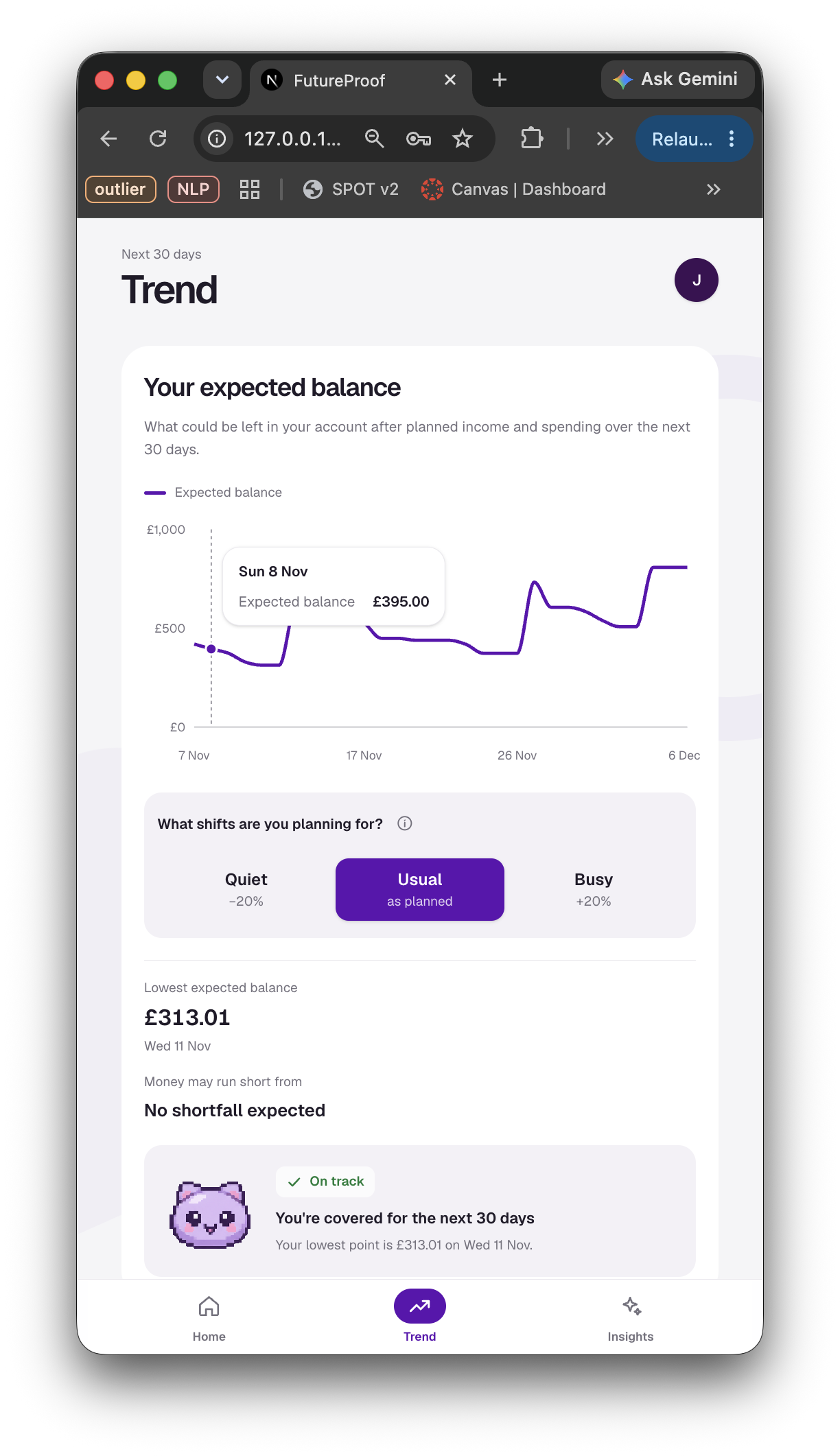
- Irregular income or zero-hours work: Explore how quieter or busier weeks could affect expected income and future balances.
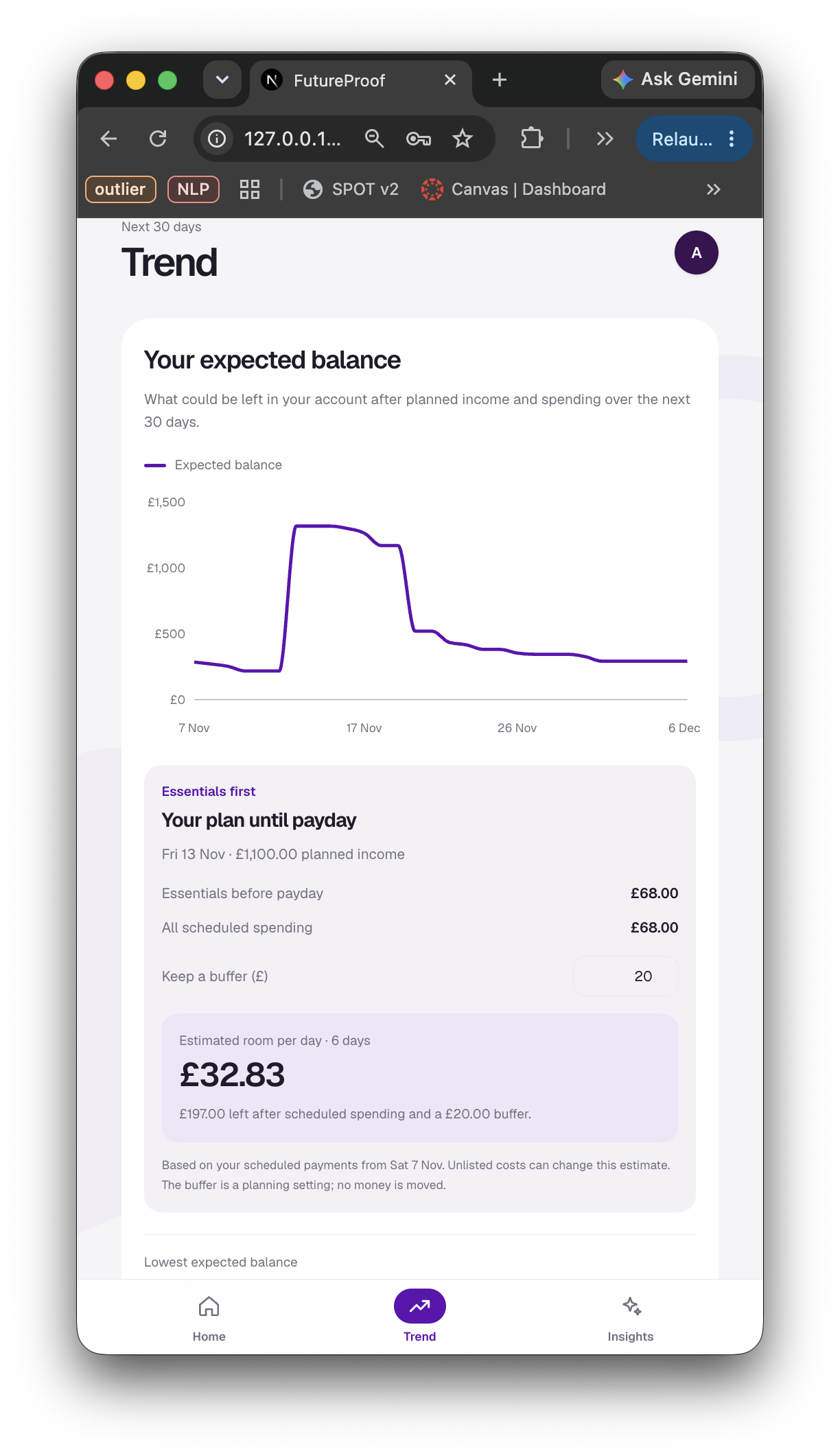
- Managing on a tight budget: Prioritise essential bills, plan until payday and allow for an emergency buffer.
The wider design includes disability-related costs and accessibility, students and recent graduates, people leaving care, and those new to managing money in the UK.
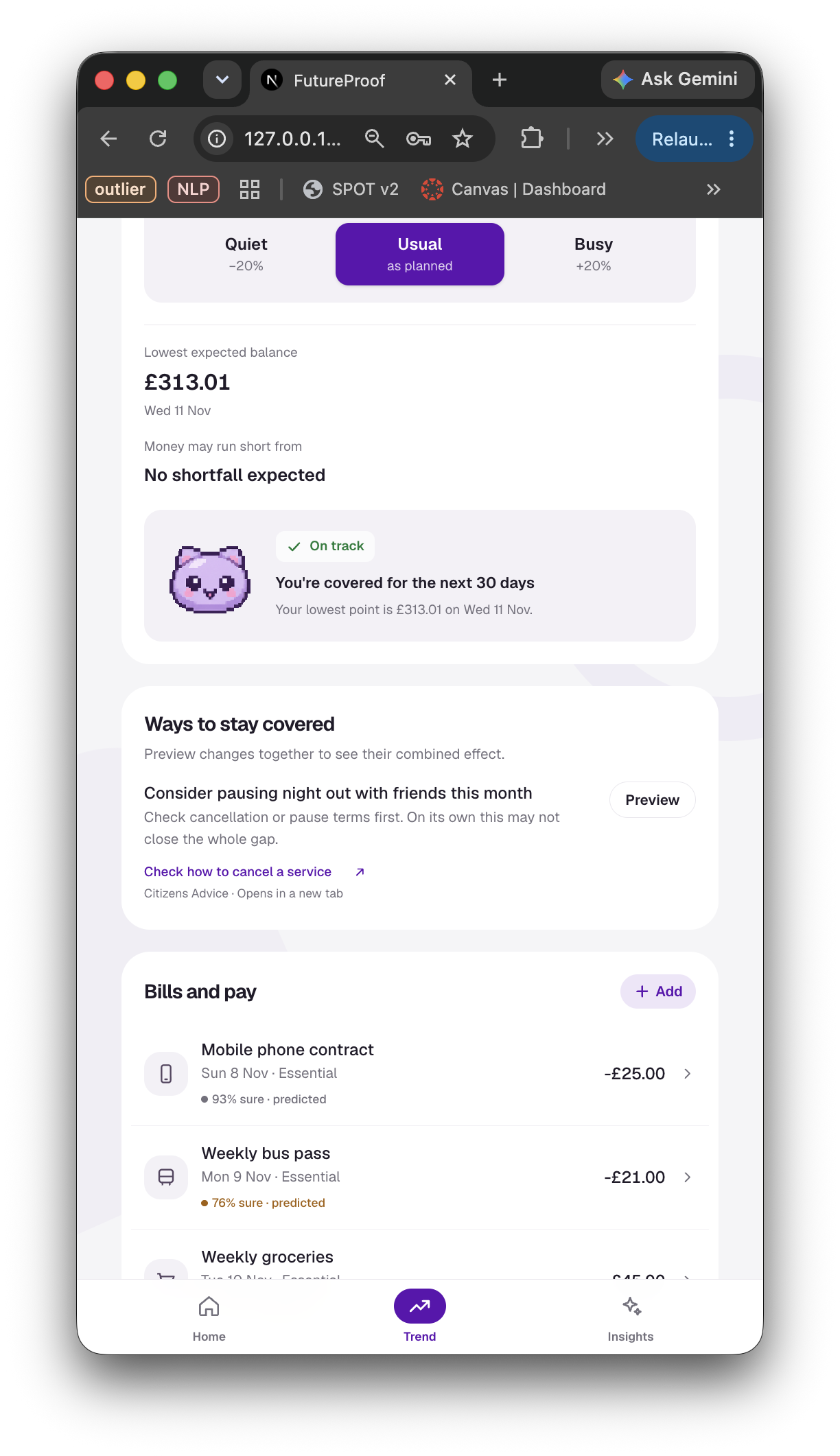
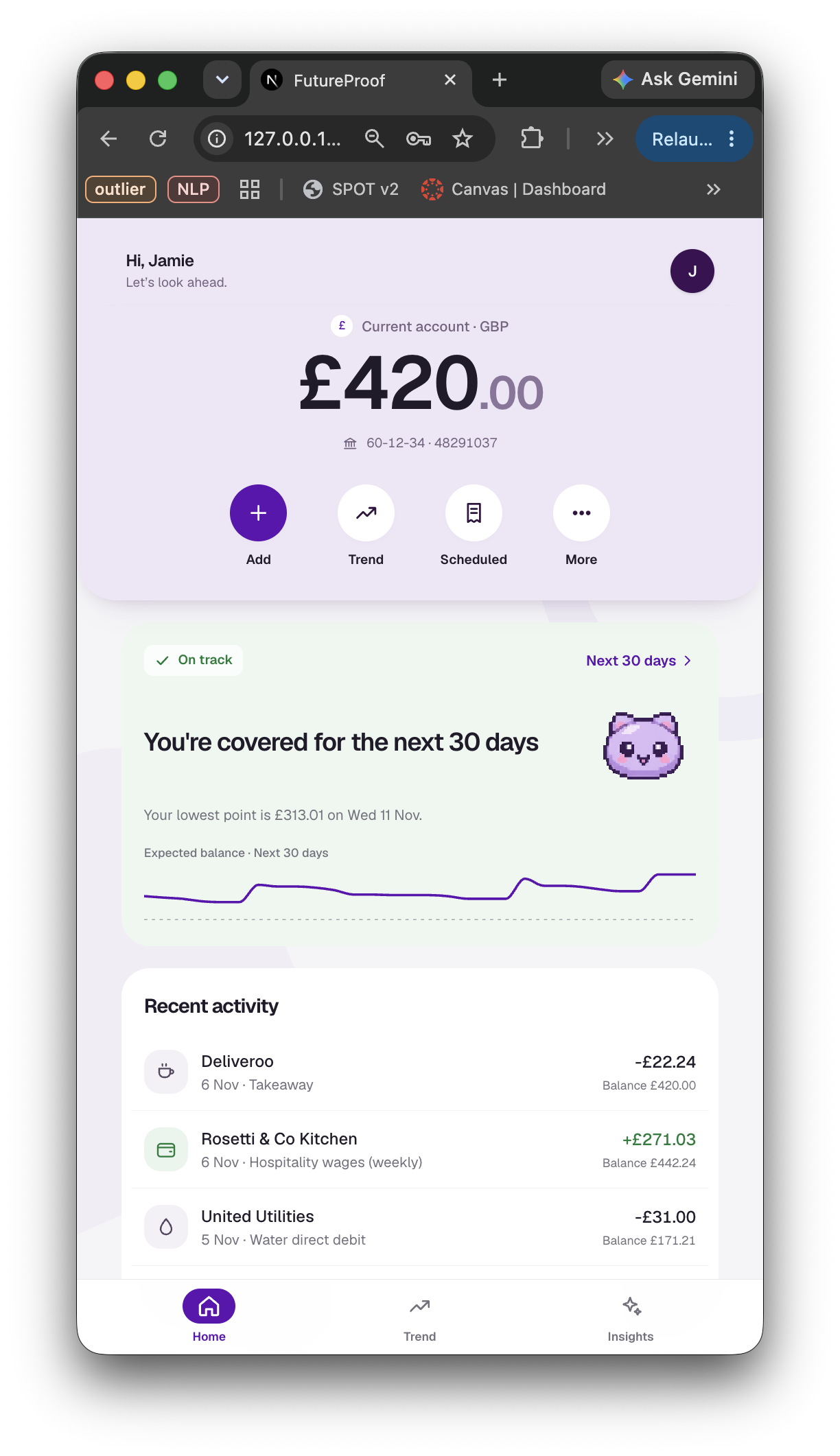
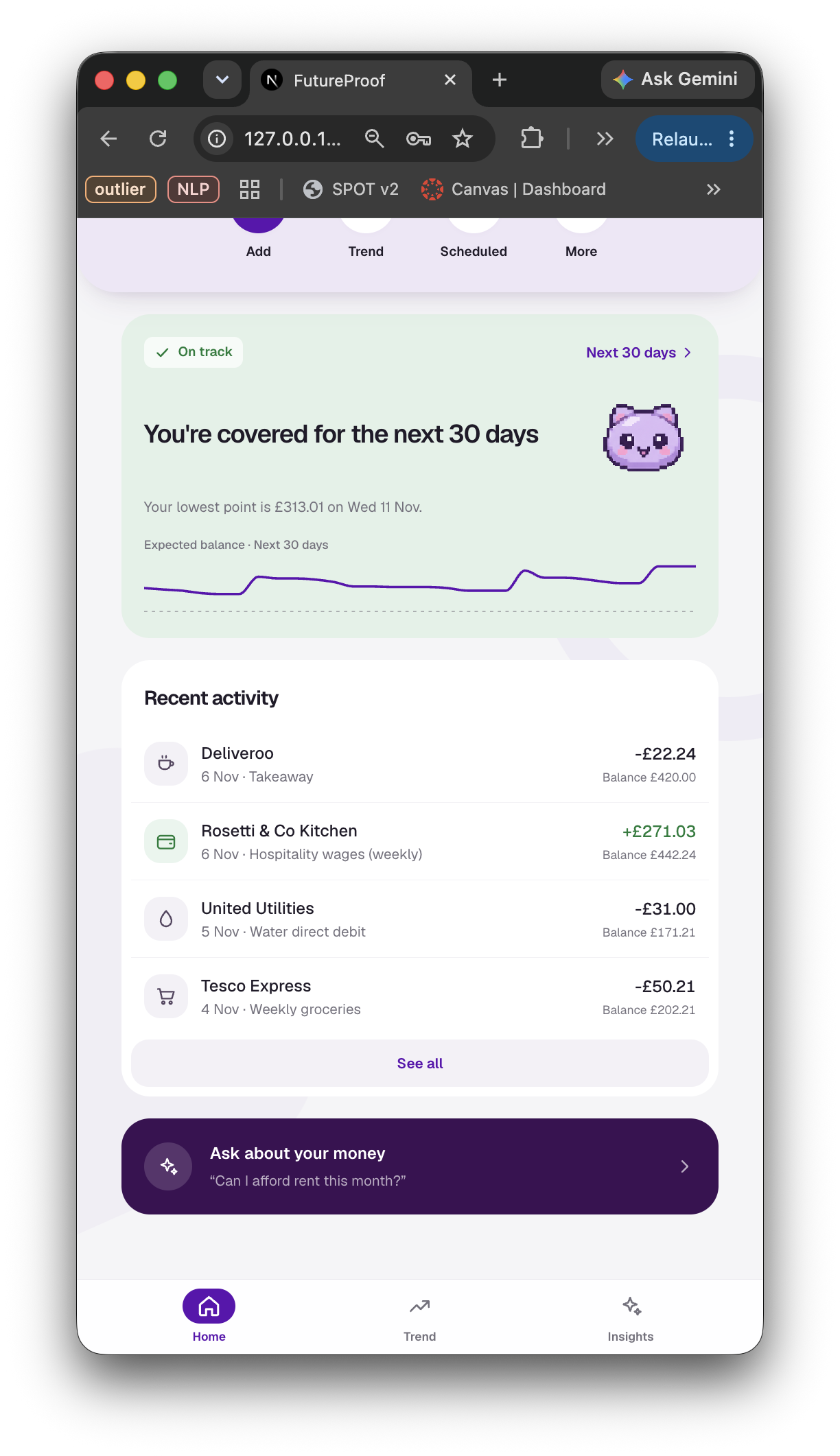
The Home page highlights potential problems in plain language. Trend shows the customer’s expected balance over the next 30 days, including when money could run short.
Customers can preview changes before taking action, such as reducing optional spending, exploring a different bill date or adjusting expected shifts. They can combine options and compare the resulting forecast with their original expected balance.
Advice and support cards link to relevant government services and independent guidance, including GOV.UK, Citizens Advice and Ofcom, helping customers explore practical next steps.
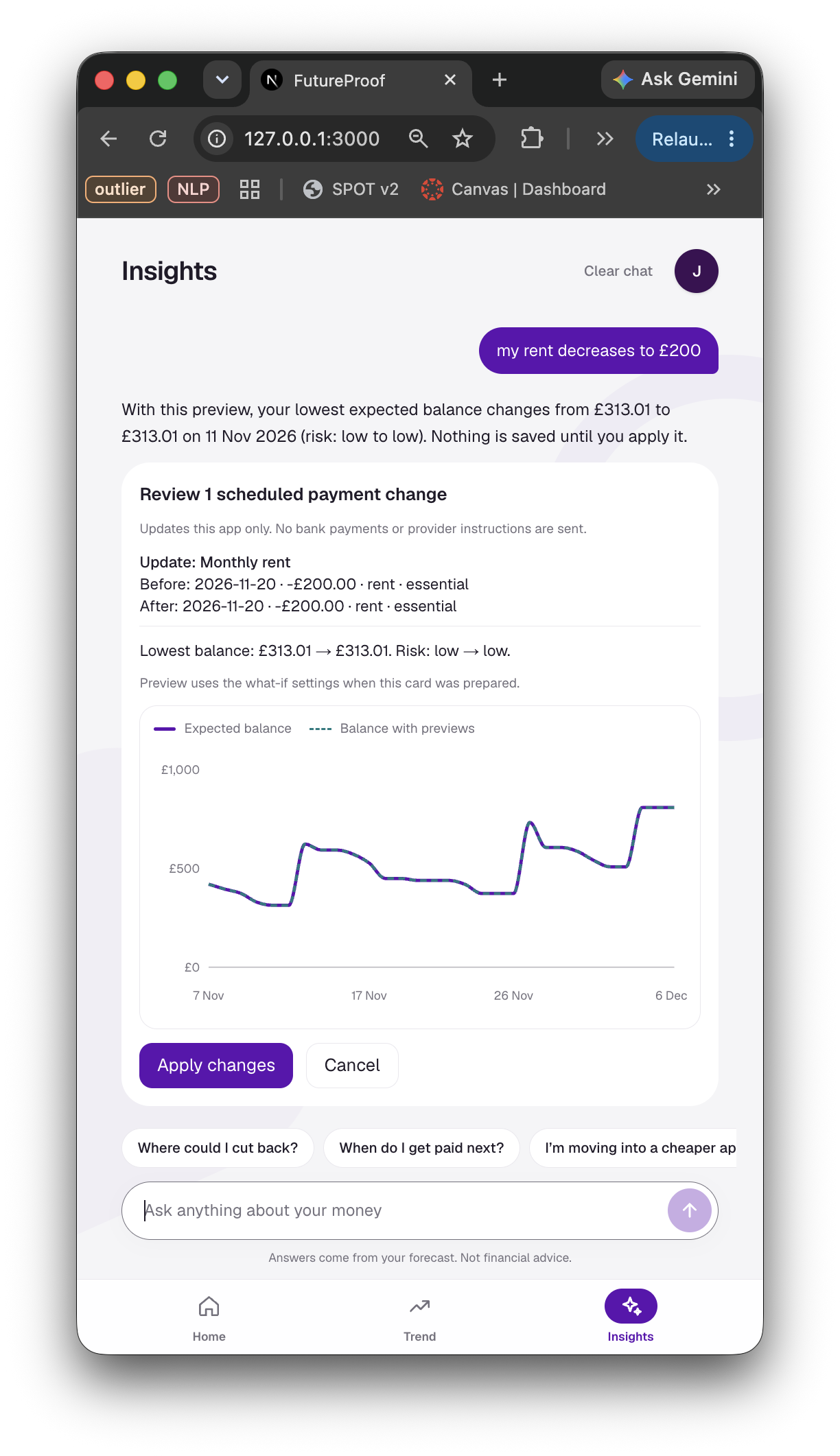
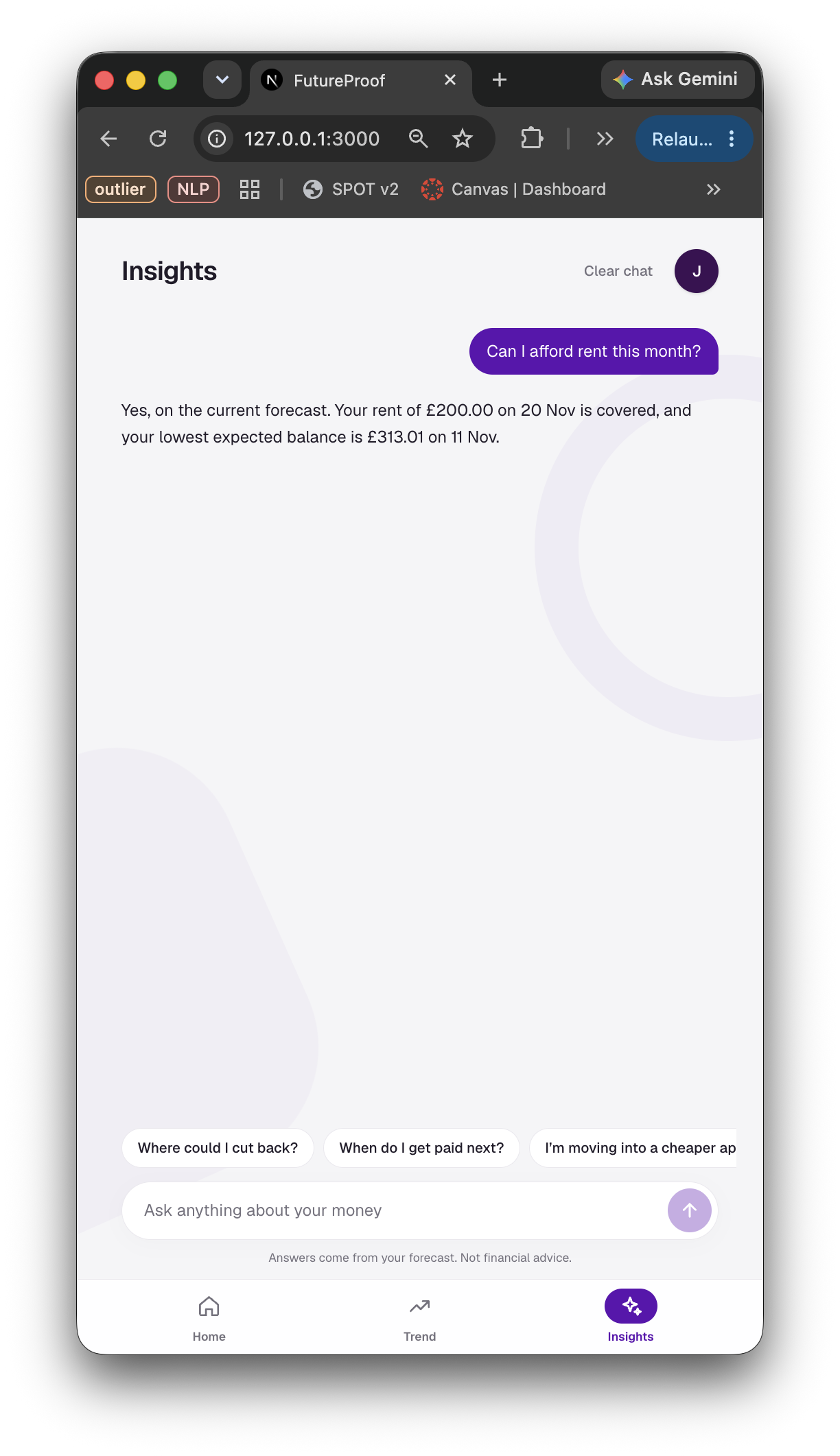
Insights lets customers ask questions in their own words, such as “Can I afford rent this month?” or “Where could I cut back?” They can also explain a change, such as lower rent or a new expense. The assistant can propose updates, show their effect on the forecast and ask for approval before saving them.
Forecasts are estimates. Previews do not move money or change arrangements with providers, and support links do not promise eligibility.
How we built it
We built the frontend with Next.js, React and Tailwind CSS, using Recharts to display expected balances and comparison forecasts.
Our Python FastAPI backend calculates daily balances from scheduled income and spending. These calculations remain deterministic, while Claude powers the conversational Insights experience and helps explain information and propose supported changes.
The prototype includes account registration, saved demo accounts and SQLite storage for newly registered users. Separate sample accounts demonstrate Jamie’s irregular-income journey and Alex’s tight-budget journey.
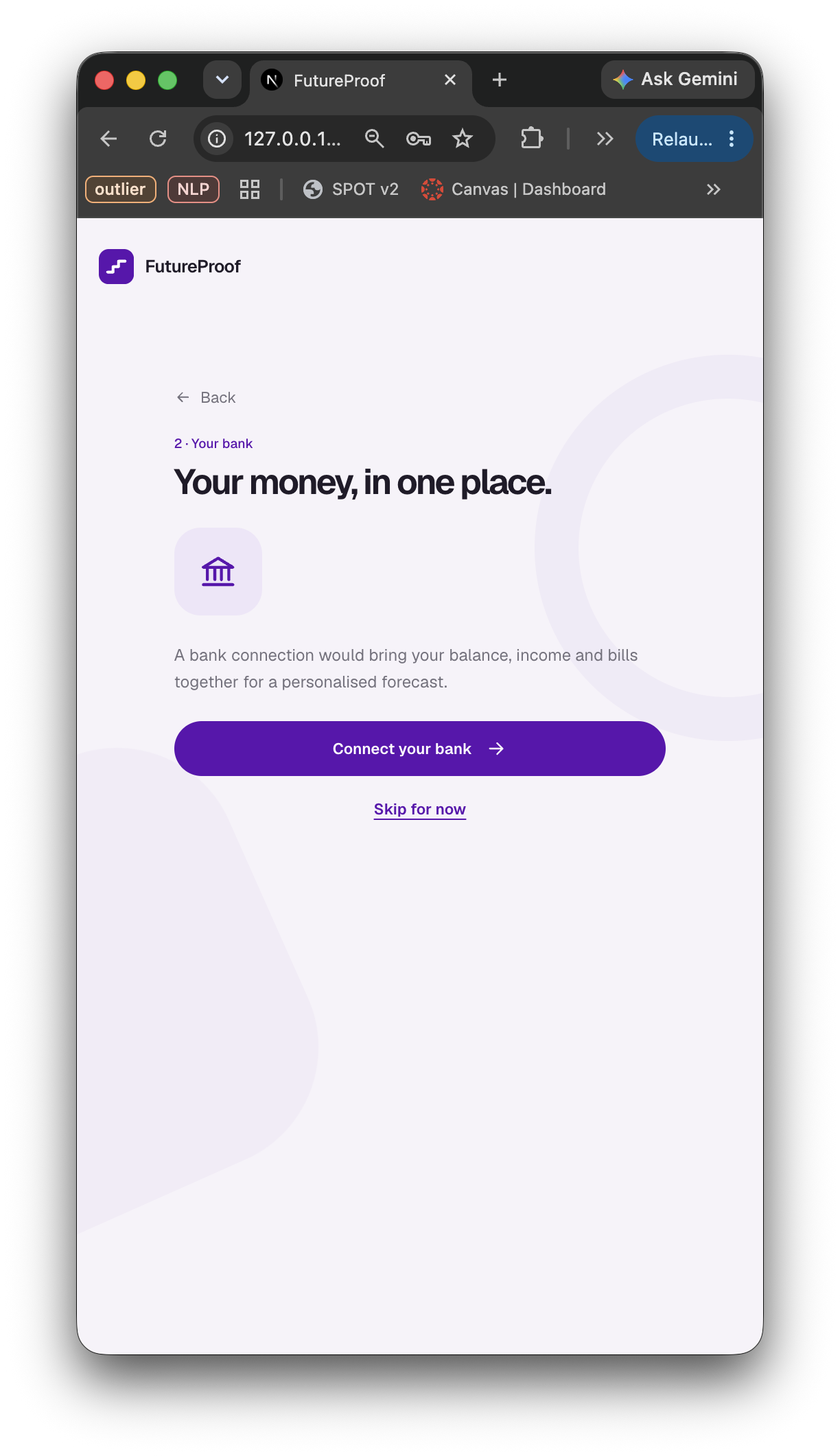
Bank connection is currently a placeholder, and the demonstration uses sample financial data.
Challenges we ran into
One challenge was making forecasts understandable without overwhelming customers. We simplified the graph to focus on expected balance, removed the shaded range and made comparison lines appear when customers preview changes.
Another was making personalisation meaningful. Jamie needs shift controls, while Alex benefits more from payday planning and protecting essential spending.
We also needed to distinguish between exploring an option, updating a plan and taking a real financial action. Clear previews and approval steps help customers understand what will change and keep them in control.
Accomplishments that we're proud of
- Building two working customer journeys with different planning needs.
- Connecting early shortfall warnings with practical options and forecast previews.
- Allowing customers to combine several previews and see their overall effect.
- Building an Insights assistant that proposes changes for review before saving them.
- Linking advice to government resources and independent support.
- Creating an approachable interface with simple language and a companion that reflects the forecast.
- Passing 112 automated tests across the frontend and backend.
What we learned
Financial inclusion requires more than offering everyone the same dashboard. Different circumstances call for different tools, explanations and ways to access support.
We learned that clarity matters as much as functionality. Customers need to understand what a forecast means, what assumptions it uses and what a suggested change would actually do.
We also learned that people’s needs overlap. A student can have irregular income, and a disabled customer can be managing on a tight budget. Future personalisation should reflect those combinations.
What's next for FutureProof
We want to connect real bank data through an appropriate Open Banking integration and evaluate forecast accuracy over time.
We also plan to develop the additional support pathways, including disability-related expenses, student funding and the costs of moving into independent living.
Further improvements include:
- Allowing customers to select multiple support needs.
- Testing accessibility and usability with people from the communities we aim to support.
- Making forecast assumptions and uncertainty easier to understand.
- Helping customers build longer-term buffers and track achievable goals.
- Improving support signposting based on individual circumstances.
Our aim is to help more people prepare for financial difficulties earlier, make informed decisions and build confidence over time.
Built With
- next.js
- python
- sqlite
- typescript
