-
-
SCIENCE
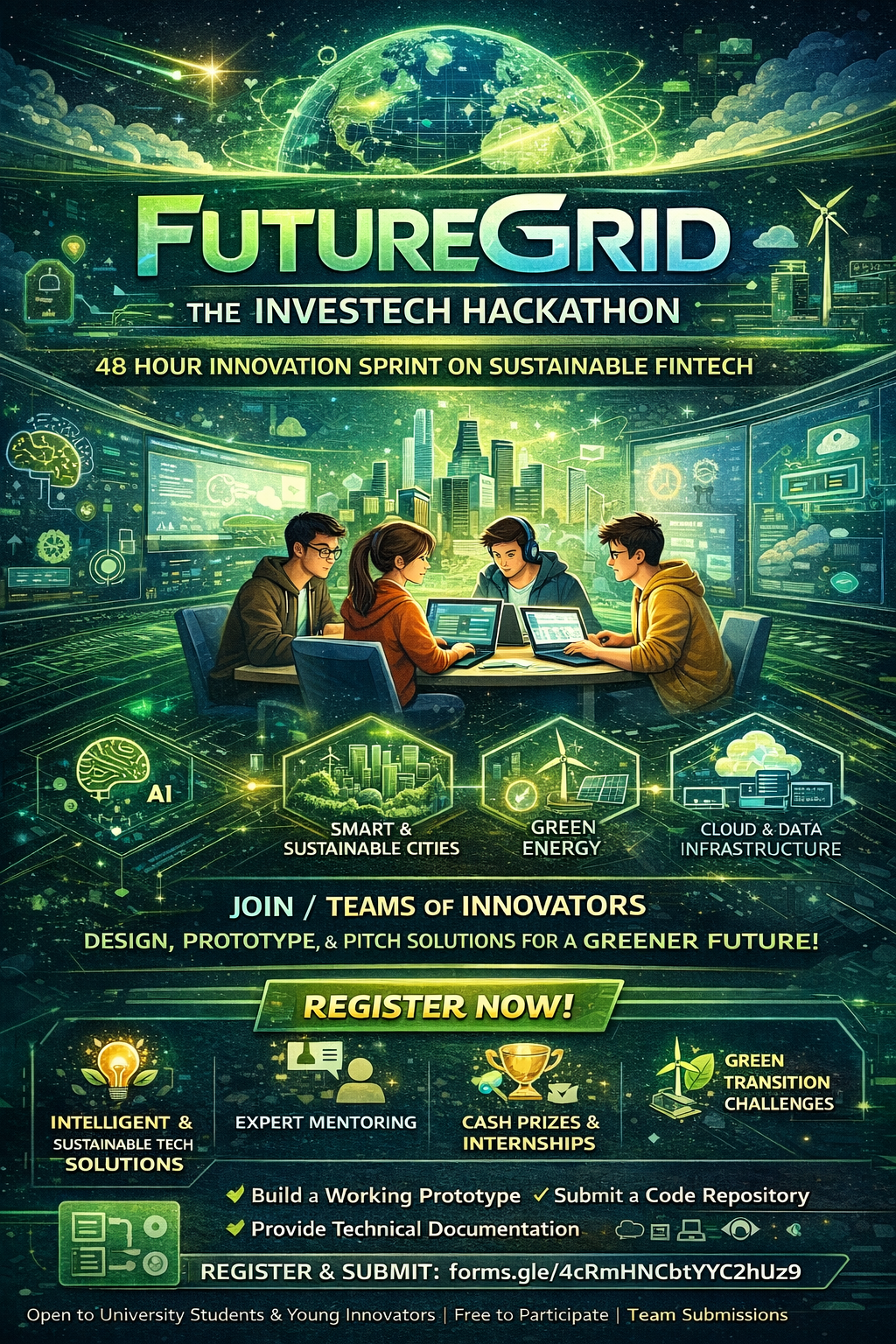
The FutureGrid Narrative: A 48-Hour Sprint for the Planet
Innovation often feels like a slow, iterative process. But in the context of the global climate crisis, we don’t have the luxury of time. This urgency was the catalyst for FutureGrid. Our team set out with a singular mission: to build a bridge between high-frequency digital infrastructure and the volatile demands of green energy systems.
The Inspiration: Data-Driven Sustainability
The inspiration for FutureGrid came from observing the "Data-Energy Paradox." While smart cities generate petabytes of data, very little of it is used in real-time to optimize energy consumption at the edge. We were inspired by the potential of AI to act not just as an analytical tool, but as a proactive manager of sustainable resources. We envisioned a platform where university students—tomorrow’s leaders—could interact with an AI mentor to solve the very problems they will inherit.
Technical Deep Dive: How We Built It
Building FutureGrid required a robust, scalable stack capable of handling real-time AI interactions while maintaining a "green" digital footprint. The frontend is architected using React 19 and Tailwind CSS, leveraging a modular component structure that ensures low-latency UI updates.
The heart of the platform is the Gemini 3.0 Flash integration. By utilizing the Google GenAI SDK, we implemented an asynchronous feedback loop for our "AI Mentor." This model was specifically prompted to act as a sustainability consultant, utilizing system instructions to filter suggestions through the lens of the UN Sustainable Development Goals (SDGs).
// Mathematical Core of Grid Optimization
To calculate the real-time efficiency of our proposed energy nodes, we used the following carbon-aware objective function:
$$ J(x) = \sum_{t=1}^{24} (C_t \cdot E_t + \lambda \cdot |E_t - E_{t-1}| + \gamma \cdot S_t) $$
Where:
$C_t$ is the carbon intensity of the grid at time $t$ $E_t$ is the energy consumption $\lambda$ represents the smoothing penalty for rapid load changes $S_t$ is the storage capacity utilization
Challenges Faced: The 48-Hour Reality
A 48-hour hackathon is a lesson in compromise and focus. Our primary challenge was data normalization. Integrating heterogeneous data sources from simulated smart-city sensors into a format that a Large Language Model (LLM) could reason over required significant effort. We spent 12 hours just perfecting the "System Instructions" for the Gemini model to ensure it didn't hallucinate non-viable engineering solutions.
Another significant hurdle was the UI/UX. In a "Green Tech" project, the aesthetic must reflect the mission. We iterated through three design versions before landing on the "Dark-Grid" glassmorphism style, which provides high contrast for accessibility while maintaining a futuristic, high-tech feel.
What We Learned
This journey taught us that AI is a multiplier, not a replacer. By integrating Gemini, we didn't just build a chatbot; we built a co-pilot for innovation. We learned that technical documentation is just as vital as the code itself—hence our focus on the "Technical Documentation Brief" requirements.
Mathematically, we discovered that simple linear models often outperform complex deep learning architectures in the early stages of energy forecasting due to the high variance in renewable source data: $$ \hat{y} = \omega^T \phi(x) + \epsilon $$ This realization allowed us to pivot our backend logic to be more efficient, saving precious compute cycles and aligning with our "Green Code" philosophy.
Future Outlook
FutureGrid is just the beginning. Post-hackathon, we aim to integrate real-world IoT data from university campuses to turn this prototype into a living laboratory for sustainable infrastructure. We invite you to join us in shaping a world where technology and ecology exist in perfect, algorithmic harmony.
Built With
- css
- geminiapi
- python
- react
- typescript

Log in or sign up for Devpost to join the conversation.