Inspiration
We’re part of a generation where almost everything happens online — food orders, subscriptions, shopping, travel bookings, courses, UPI payments, EMIs, and impulse purchases. Most of the time, money goes out in small amounts, but by the end of the month we don’t always know where it went.
The problem is that most finance apps tell us what already happened:
“You spent this much on food” or “You crossed your budget.”
But that is usually too late.
We wanted to build something that answers a more useful question:
“If I keep spending like this, what will my financial future look like?”
That idea became FutureFund AI — a financial time machine that helps users understand how today’s money habits affect tomorrow’s goals.
What it does
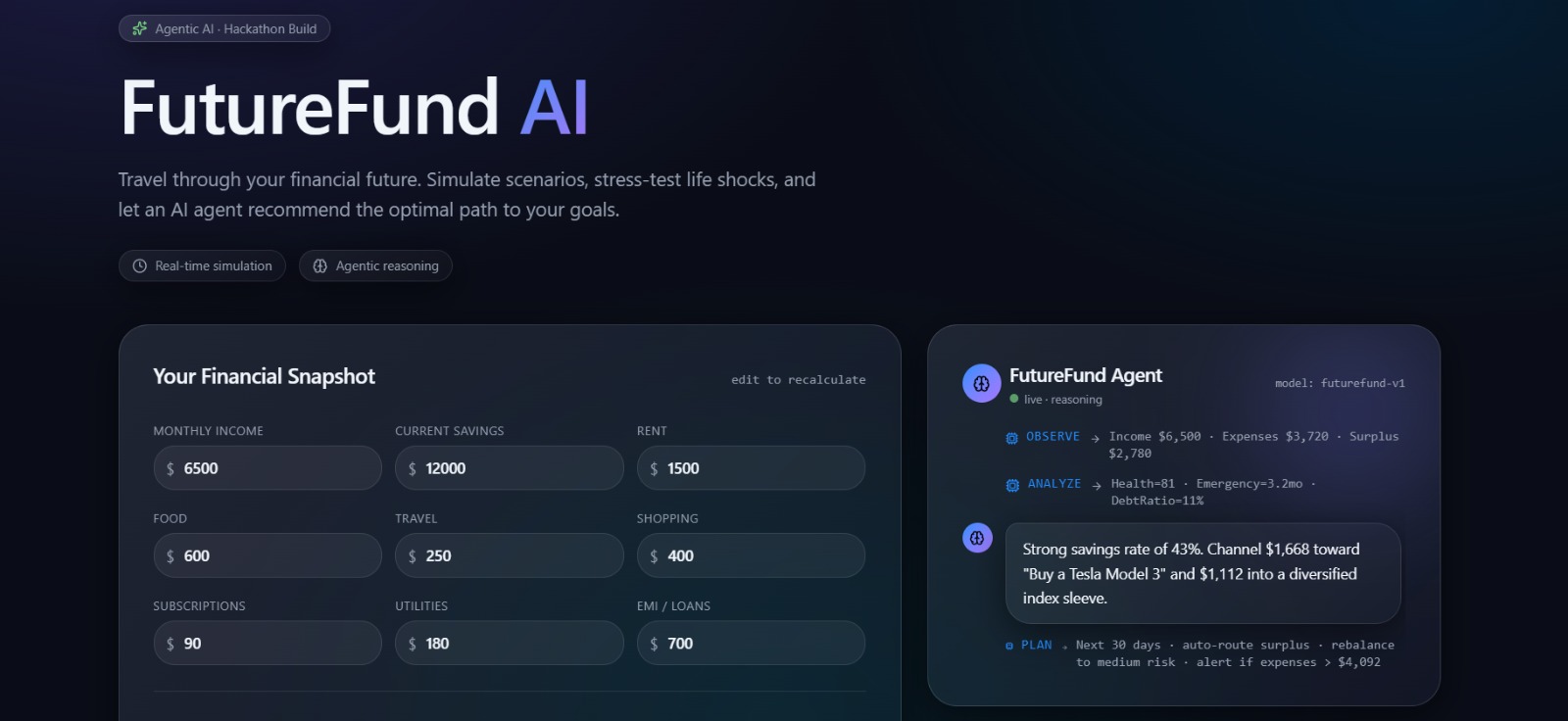
FutureFund AI is an agentic AI fintech simulator that predicts a user’s financial future based on their income, expenses, savings, EMI/debt, and personal goals.
A user can enter details like:
- Monthly income
- Current savings
- Rent
- Food expenses
- Shopping
- Subscriptions
- Travel
- EMI or debt
- Financial goal
- Goal amount
- Target timeline
Then the system generates different future paths:
Current Path
Shows what happens if the user continues spending the same way.
Risky Future
Shows what happens if expenses increase or the user faces an unexpected situation.
Optimized Future
Suggests small practical changes, like reducing food delivery, shopping, or subscriptions, to reach the goal faster.
Life Shock Simulation
The user can simulate events like:
- Medical emergency
- Rent increase
- Bonus received
- One month income loss
After the shock, the agent recalculates the user’s future and gives a recovery plan.
For example, instead of simply saying:
You spent ₹8,000 on food.
FutureFund AI says:
At your current pace, your MacBook goal will be delayed by 2 months. If you reduce food delivery by ₹2,000 and subscriptions by ₹800, you can reach your goal on time while improving your emergency fund.
How we built it
We built FutureFund AI as a combination of a clean frontend dashboard and an agentic backend flow.
For the frontend, we focused on making the experience simple and visual. We created cards for financial health score, monthly surplus, goal ETA, emergency coverage, and risk level. We also added scenario cards and a what-if simulator so users can see changes instantly.
For the agentic part, we designed the system around multiple financial agents:
- Data Agent — understands the user’s income, expenses, debt, and goal.
- Simulation Agent — creates future projections.
- Risk Agent — checks emergency fund, overspending, and EMI burden.
- Recommendation Agent — suggests realistic changes.
- Memory Agent — remembers the user’s goal and preference.
- Shock Recovery Agent — handles unexpected life events and creates a recovery plan.
We used Jac/Jaseci concepts to represent the user’s financial life as a connected graph of income, expenses, goals, scenarios, risks, and recommendations. The idea was to make the project more than a UI around calculations — we wanted the agents to actually reason through the situation step by step.
The main financial logic included calculations like:
$$ Monthly\ Surplus = Monthly\ Income - Total\ Expenses $$
$$ Goal\ ETA = \frac{Goal\ Amount - Current\ Savings}{Monthly\ Surplus} $$
$$ Savings\ Rate = \frac{Monthly\ Surplus}{Monthly\ Income} $$
We also used a financial health score to give users a quick idea of where they stand.
Challenges we ran into
The biggest challenge was making the project feel truly agentic and not just like a normal budget calculator.
It was easy to calculate monthly surplus or goal ETA, but the harder part was making the system explain:
- Why the goal is delayed
- Which expense category matters most
- What trade-off the user should make
- How a sudden life shock changes the future
- What recovery plan makes sense
Another challenge was balancing simplicity and usefulness. Finance can become complicated very quickly, but for a hackathon demo we wanted the experience to be clear enough that anyone could understand it in a few minutes.
We also had to be careful with the UI. If the dashboard looked too complex, users might feel overwhelmed. So we focused on simple cards, visual scenarios, and clear recommendations instead of too many numbers.
Accomplishments that we're proud of
We’re proud that FutureFund AI does not just track spending — it shows consequences.
The most exciting feature for us is the Life Shock Simulation. It makes the app feel different from a normal finance tracker because users can see how unexpected events affect their goals and what they can do next.
We’re also proud of the way the project connects financial planning with agentic AI. The agents don’t just output generic advice; they compare the user’s current path, risky path, and optimized path before generating a recommendation.
Another thing we’re proud of is the relatability of the idea. As students and young people who spend online, we could actually connect with the problem ourselves. Subscriptions, food delivery, shopping, and small daily payments can quietly affect bigger goals, and FutureFund AI helps make that visible.
What we learned
We learned that a good fintech product is not only about numbers. It is also about explaining those numbers in a way people can act on.
A user may not care about formulas, but they do care about questions like:
- Can I afford this goal?
- What happens if my rent increases?
- Am I saving enough?
- What should I reduce first?
- How badly will an emergency affect me?
We also learned how useful agentic thinking can be for financial planning. Instead of one function doing everything, splitting the system into agents made the project easier to understand and explain.
Each agent had a clear responsibility:
- One agent analyzes data.
- One agent simulates the future.
- One agent checks risk.
- One agent recommends actions.
- One agent handles shocks.
This made the project more structured and closer to how a real AI financial assistant could work.
What's next for FutureFund AI
Next, we want to make FutureFund AI more personalized and realistic.
Some future improvements include:
- Uploading bank statement CSV files
- Auto-categorizing transactions
- Supporting multiple goals at the same time
- Adding UPI and bank API integrations
- Creating investment and inflation-aware projections
- Adding recurring subscription detection
- Giving weekly financial nudges
- Supporting different user modes like student, salaried employee, freelancer, or small business owner
In the long term, we imagine FutureFund AI becoming a personal AI money companion for the new generation — not just telling users where their money went, but helping them decide where their money should go next.


Log in or sign up for Devpost to join the conversation.