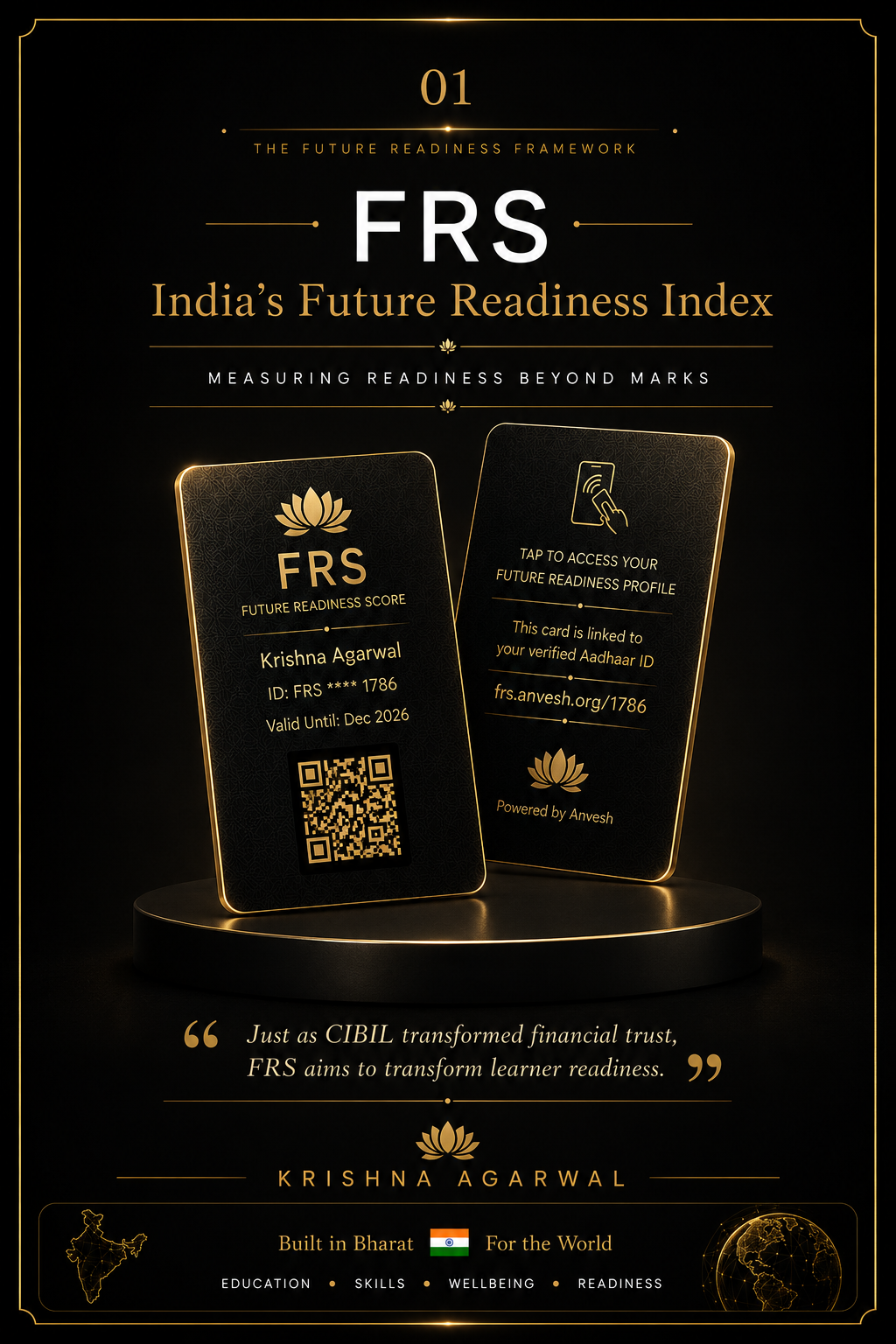
Building Bharat's Readiness Layer
India has over 248 million school students across 1.47 million schools. Yet one exam score still determines some of the biggest opportunities in a learner's life.
Every year, millions of students compete for admissions, scholarships, internships, and careers. But the education system largely measures what students scored, not what they are capable of becoming.
That disconnect inspired us to ask a simple question:
What if every learner had a trusted, evidence-based measure of their future readiness—not just their academic performance?
That question became Anvesh.
The Problem
India's education ecosystem faces multiple interconnected challenges.
📚 Marks dominate decisions
Despite the National Education Policy (NEP) 2020 advocating competency-based education, academic marks continue to be the primary criterion for admissions, scholarships, and career opportunities.
🌏 Language remains a barrier
Nearly 78% of rural learners prefer learning in regional languages, yet the majority of digital educational resources remain English-first.
💼 Skills gap
According to the India Skills Report, more than one in two graduates lack industry-ready skills, creating one of India's largest employability challenges.
🧠 Neurodiverse learners remain underserved
Students with ADHD, autism, dyslexia, and other learning differences often receive limited personalized academic support.
❤️ Mental wellbeing
Adolescent mental health concerns continue to rise, yet schools rarely provide continuous, personalized wellbeing support.
👩🔬 Girls remain underrepresented in STEM
Many girls lose access to STEM pathways because of limited mentorship, role models, and opportunity discovery.
These aren't isolated problems.
They're different symptoms of one larger issue:
India measures performance—but not readiness.
Our Solution
Anvesh is an AI-powered future readiness ecosystem designed to help learners measure, improve, and verify readiness beyond marks.
At the center is the Future Readiness Score (FRS)—an AI-powered readiness index that combines:
Academic performance Skills Projects Certifications Engagement Wellbeing Career readiness Contextual learner information
Unlike traditional assessments, FRS doesn't stop at measurement.
It identifies readiness gaps and immediately activates personalized interventions.
One Platform. Five AI Systems. 📊 FRS
Generates an evidence-based Future Readiness Score and personalized learner profile.
🗣️ BHASHA
Voice-native multilingual learning powered by on-device AI.
Designed for learners in regional languages and low-connectivity environments.
🧩 CHAMPS
Adaptive AI learning for neurodiverse learners including ADHD, autism, and dyslexia.
Every learner receives a personalized pathway rather than a one-size-fits-all curriculum.
❤️ SPARSH
AI-powered wellbeing companion providing mood tracking, check-ins, and personalized guidance.
🚀 SPARK
Connects learners—especially girls—to mentorship, scholarships, competitions, internships, and STEM opportunities.
How It Works
The learner begins by securely sharing academic records, assessments, aspirations, interests, learning preferences, and optional wellbeing inputs.
The AI-powered Future Readiness Engine analyzes structured and unstructured information to generate a holistic readiness profile.
Rather than producing only a score, the system explains:
strengths, readiness gaps, recommended actions, future opportunities, and measurable improvement pathways.
Every learner receives a QR-verifiable digital readiness credential that can be securely shared with schools, universities, employers, NGOs, and government programs.
As learners continue learning, completing assessments, earning certifications, and developing new skills, FRS continuously evolves to reflect meaningful progress.
AI Technologies
Anvesh combines multiple AI technologies into one ecosystem:
Large Language Models (LLMs) Retrieval-Augmented Generation (RAG) Multimodal AI AI Agents Voice AI Speech Recognition Text-to-Speech Personalized Recommendation Systems Predictive Analytics TensorFlow Lite Edge AI Offline AI Inference NLP-based learner profiling
Instead of simply answering questions, AI acts as a personalized learning companion throughout the learner's journey.
Datasets
The platform combines trusted public and user-consented datasets including:
NCERT curriculum State Board curriculum NEP 2020 competency framework DigiLocker-verified academic credentials Academic records Assessments Behavioural engagement Interests Aspirations Learning preferences Wellbeing questionnaires Multilingual speech datasets Anonymous learning analytics
This allows recommendations to remain contextual, explainable, and evidence-based.
Accessibility First
Accessibility isn't an add-on.
It is built into every layer.
Offline support Voice-native AI Regional languages Adaptive learning Neurodiverse support Mobile-first interface QR-verifiable credentials Privacy-preserving AI
The goal is simple:
Every learner deserves access regardless of language, disability, income, or internet connectivity.
Responsible AI
We follow a Privacy-by-Design approach.
Consent-based data collection Encryption Role-based access Data minimization Anonymous analytics Consent-based DigiLocker verification Human oversight Bias monitoring Transparent AI recommendations
AI supports learners and educators—it does not replace them.
Impact
Anvesh contributes directly toward:
SDG 4 — Quality Education SDG 5 — Gender Equality SDG 8 — Decent Work & Economic Growth SDG 10 — Reduced Inequalities
Digital credentials also reduce paperwork while enabling secure, paperless verification.
Early Validation
Although still in the early stages, the platform has already demonstrated encouraging traction:
1,100+ learners onboarded 1,500+ Future Readiness Profiles generated 164 paid FRS subscriptions during live deployment QR-verifiable FRS credentials successfully deployed
Built With
- accessibility
- agents
- ai
- analytics
- css
- edge
- engine
- generative
- lite
- llm
- multimodal
- natural-language-processing
- postgresql
- predictive
- python
- rag
- react
- recommendation
- speech-to-text
- supabase
- tailwind
- tensorflow
- text-to-speech
- typescript

Log in or sign up for Devpost to join the conversation.