-
-
Every life you have left.
-
 GIF
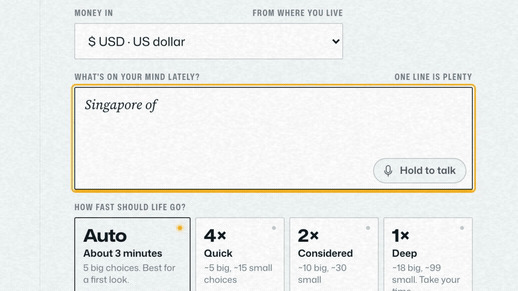
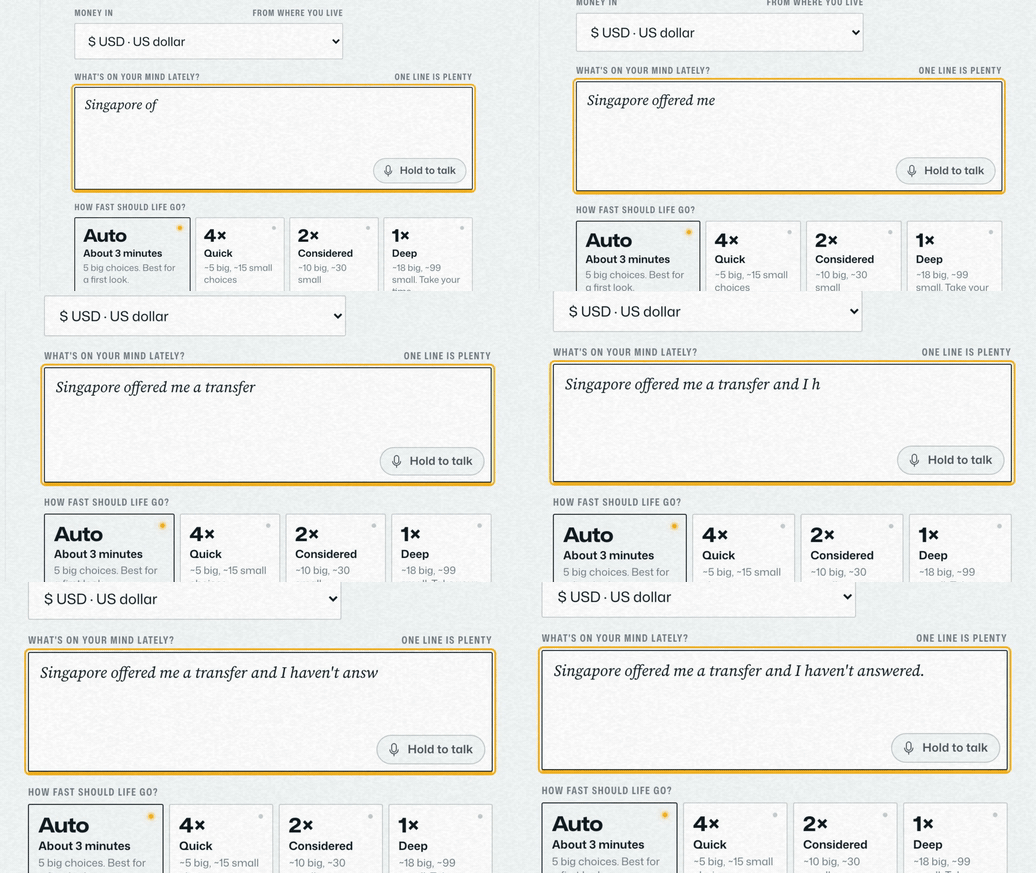
Tell it who you are, in one line.
-
 GIF
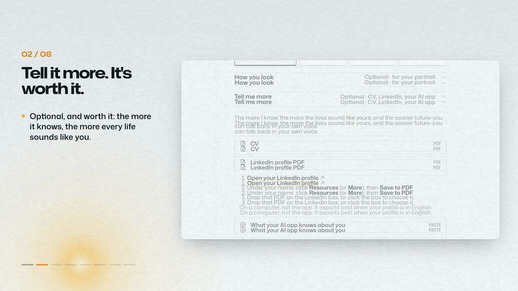
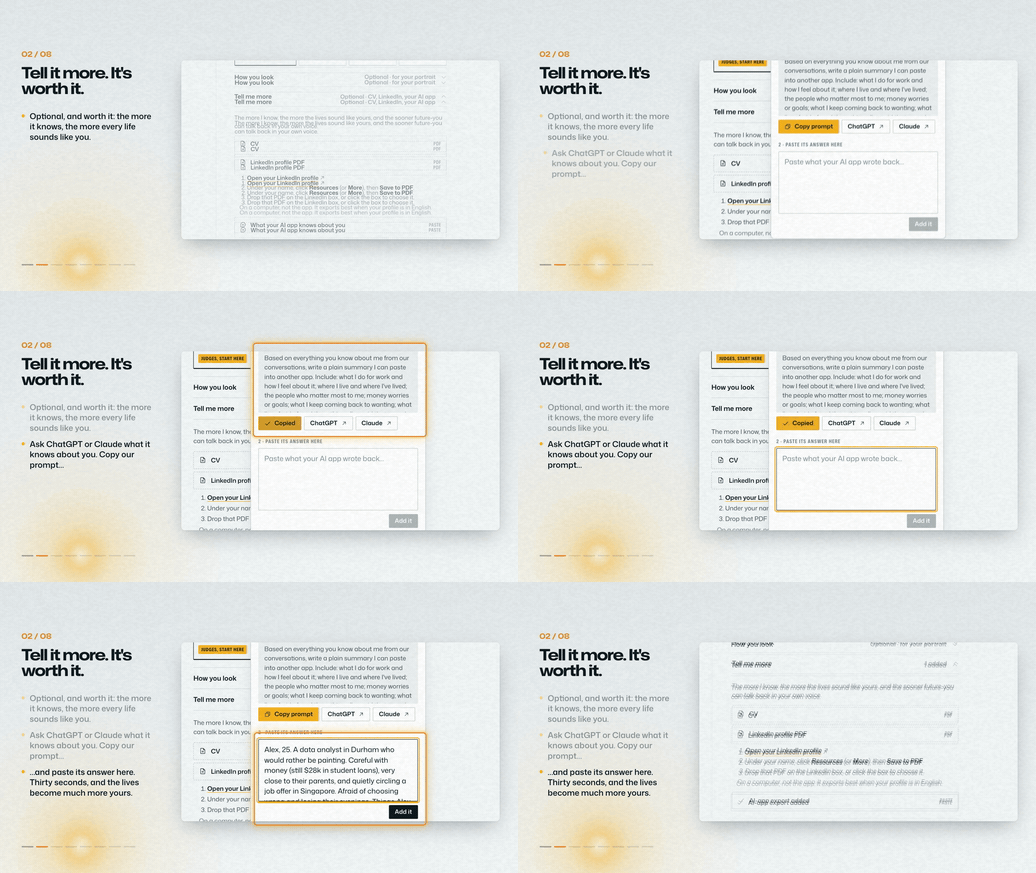
Paste what your AI app already knows about you. It's optional.
-
 GIF
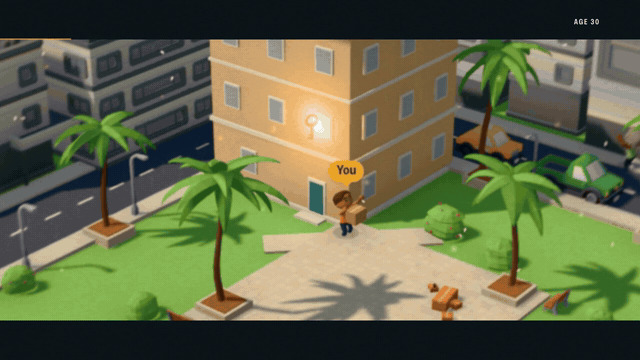
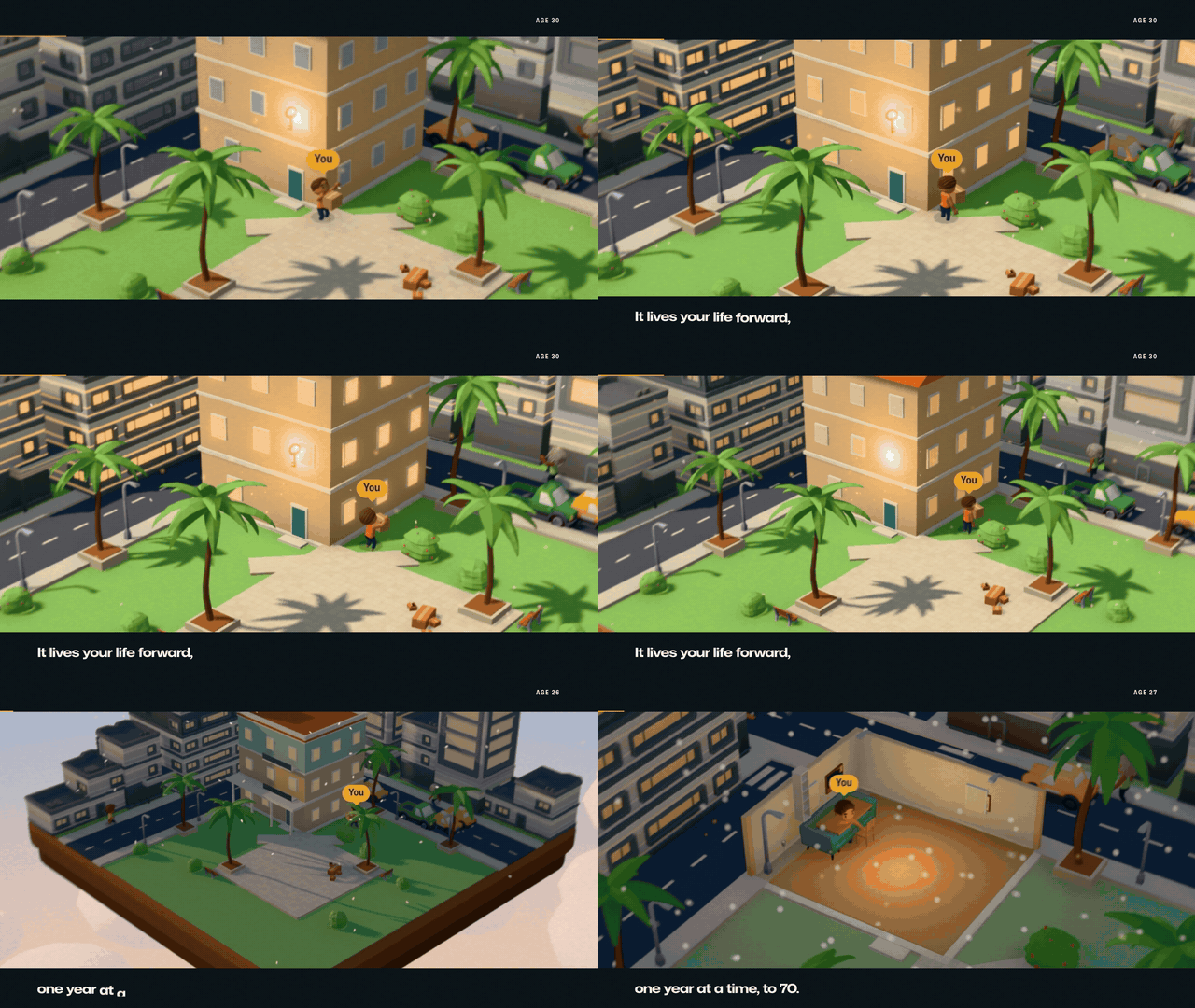
Your life plays forward, one year at a time, to 70.
-
 GIF
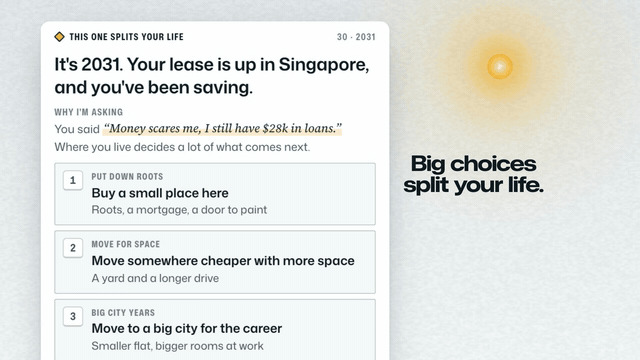
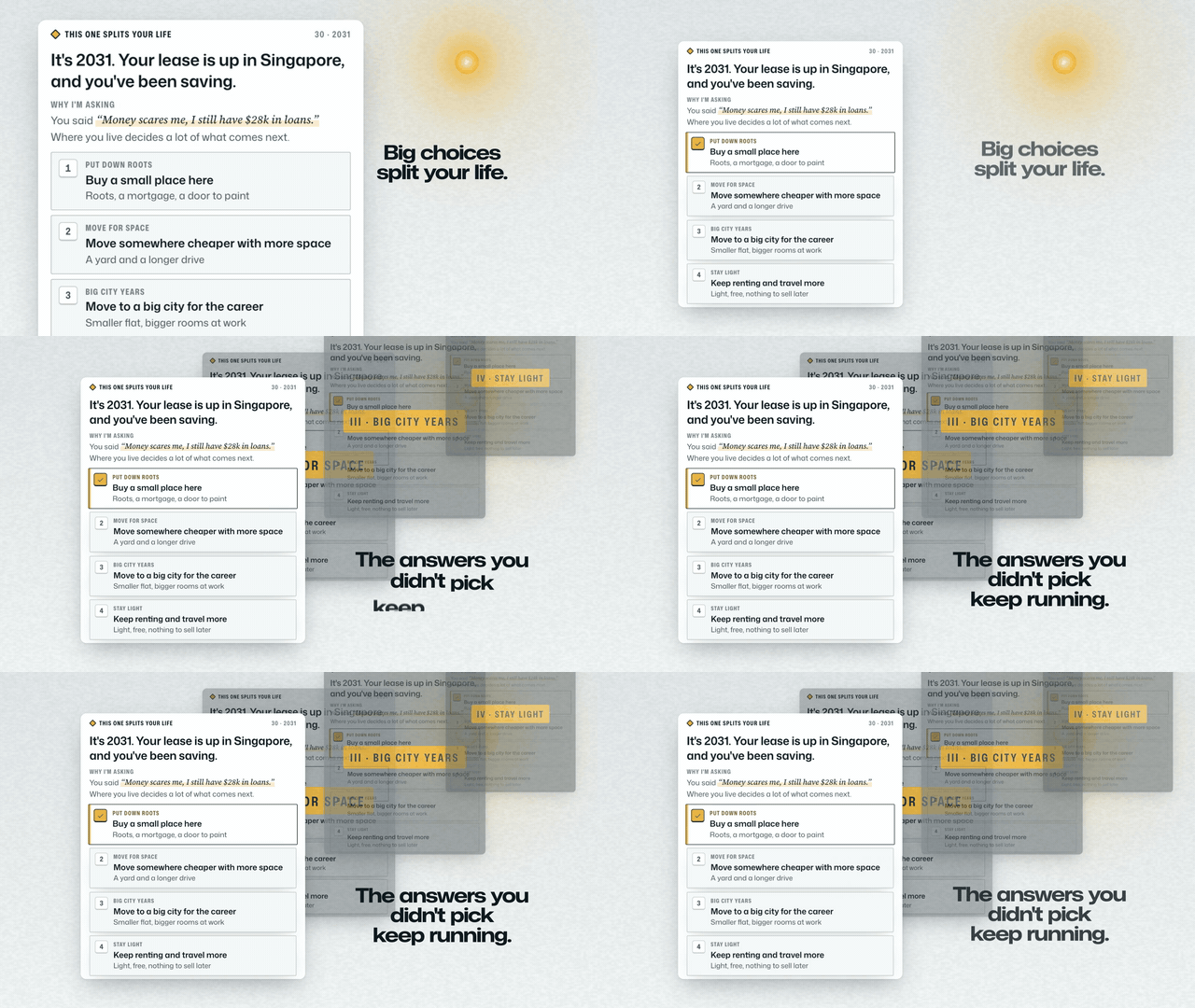
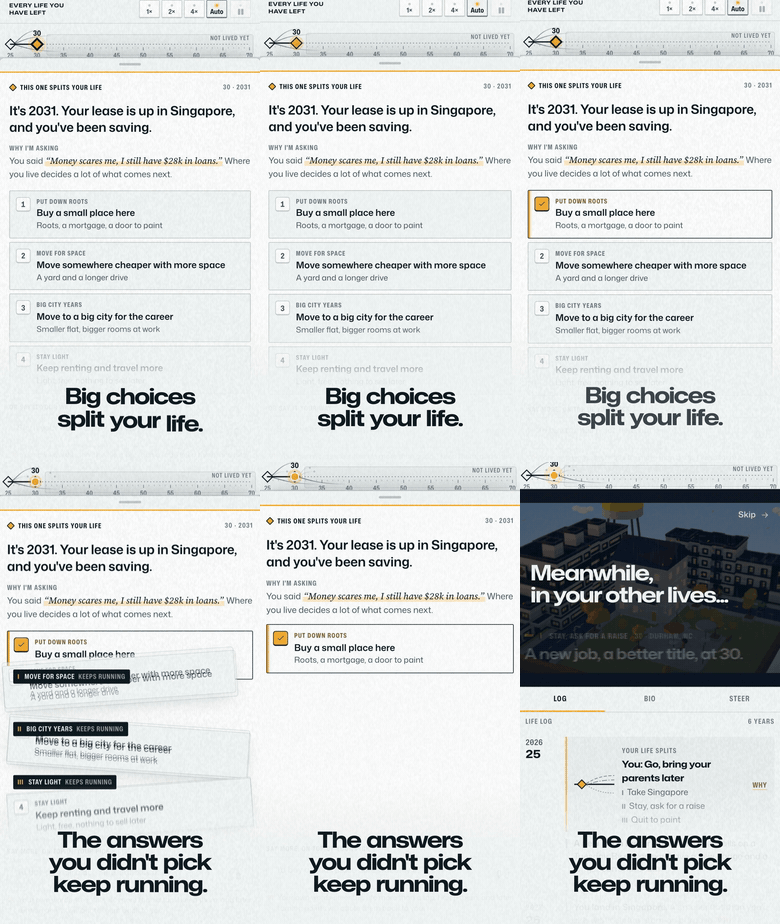
Big choices split your life. The answers you didn't pick keep running.
-
 GIF
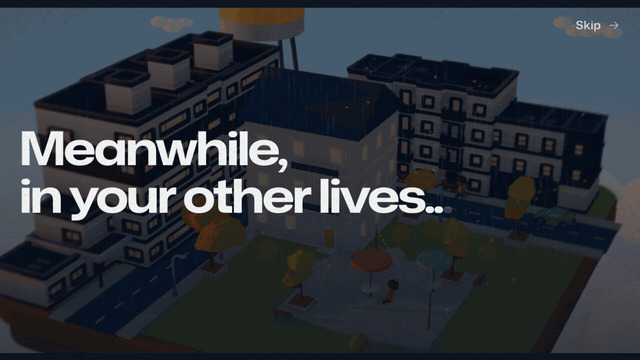
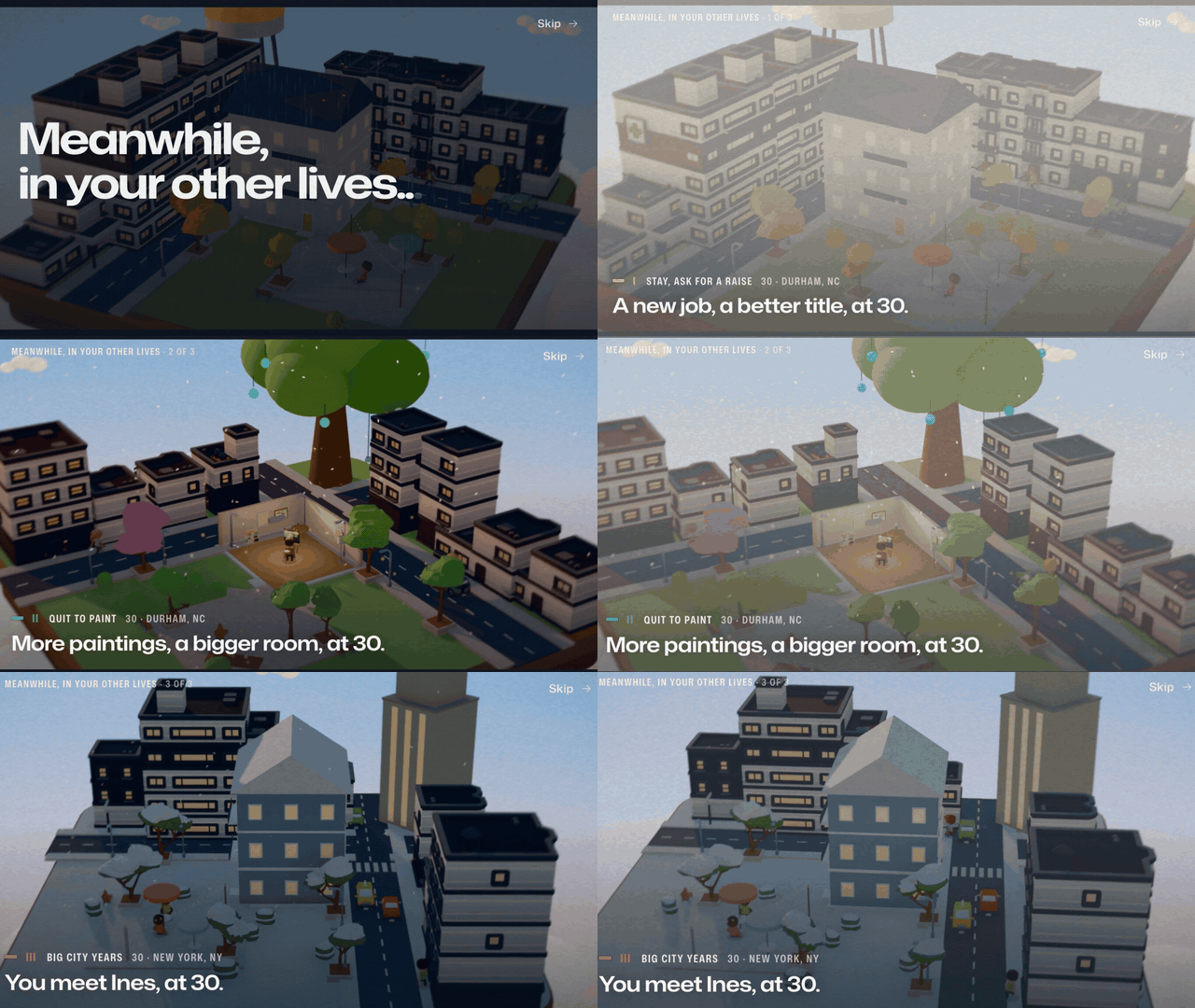
Meanwhile, in your other lives…
-
 GIF
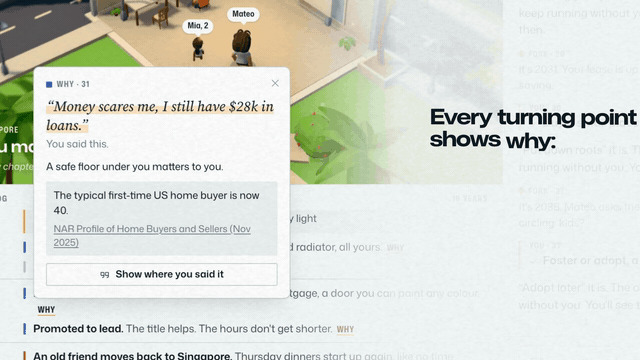
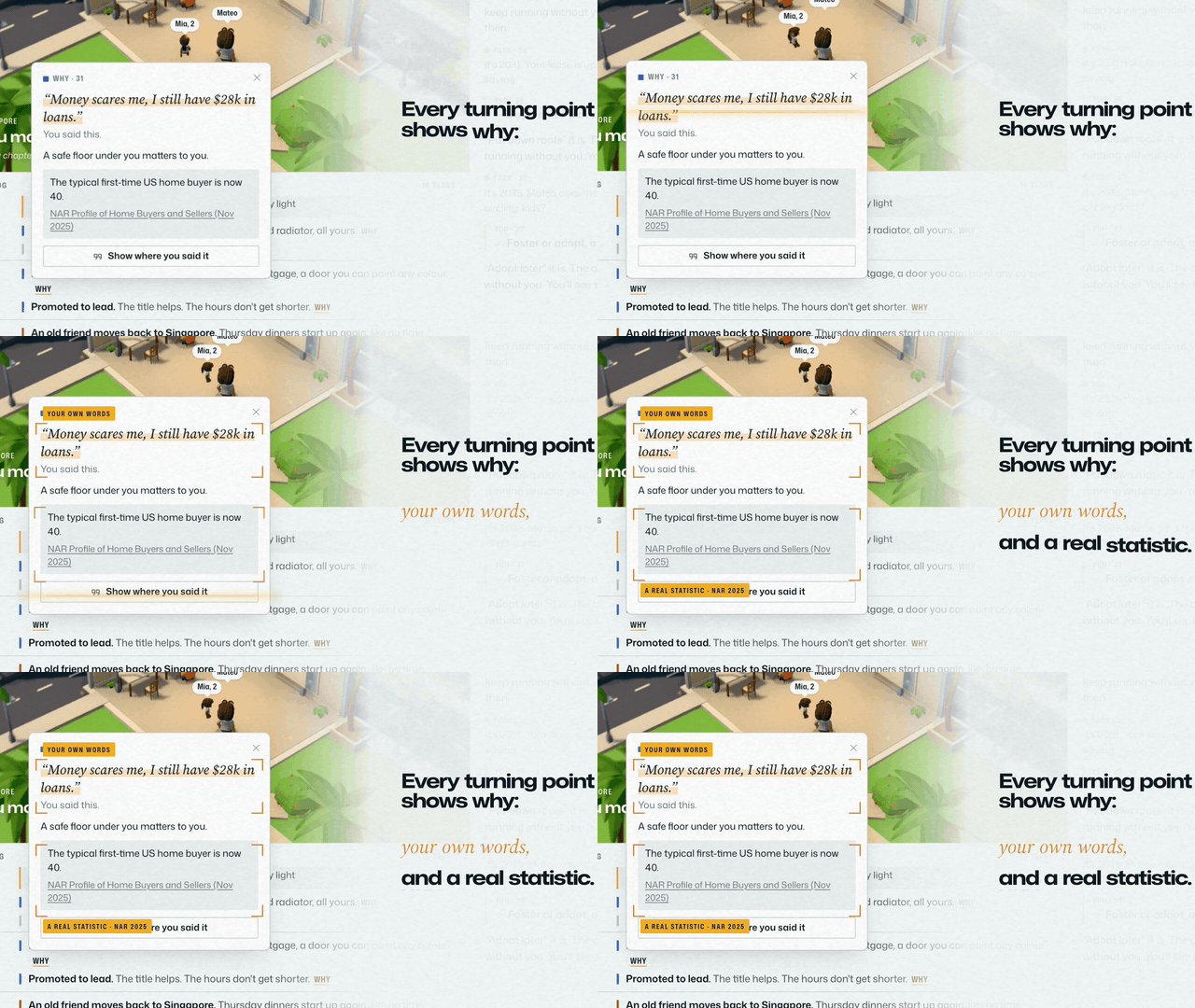
Every turning point shows why: your own words and a real statistic.
-
 GIF
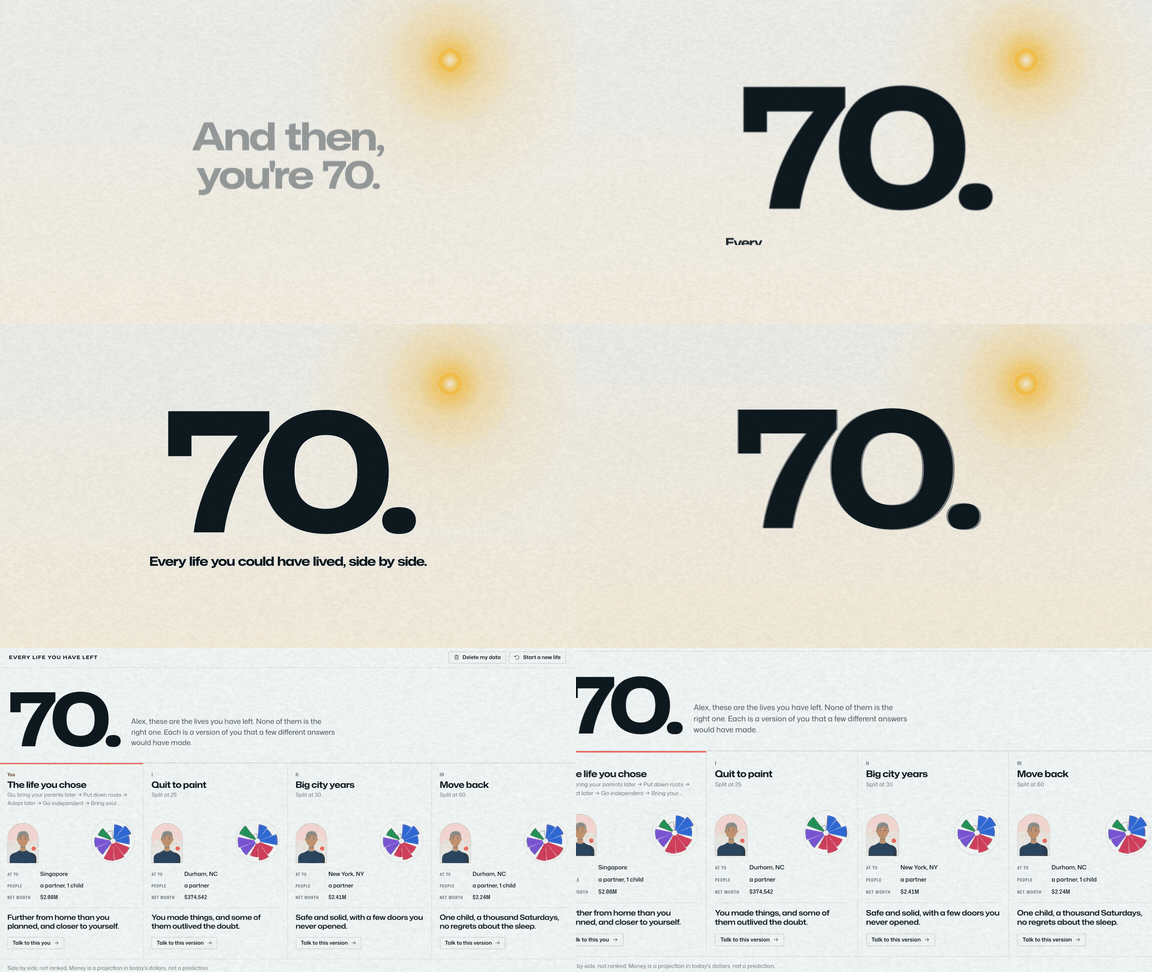
At 70, every life side by side. None is ranked best.
-
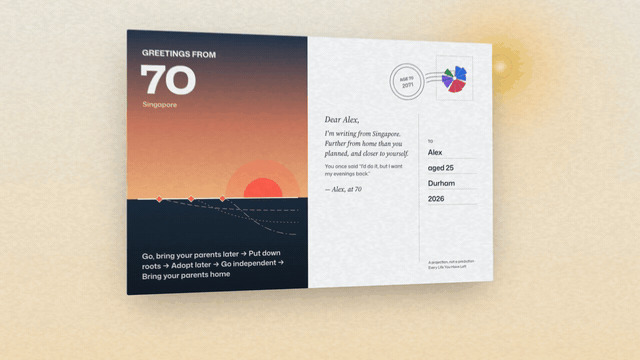 GIF
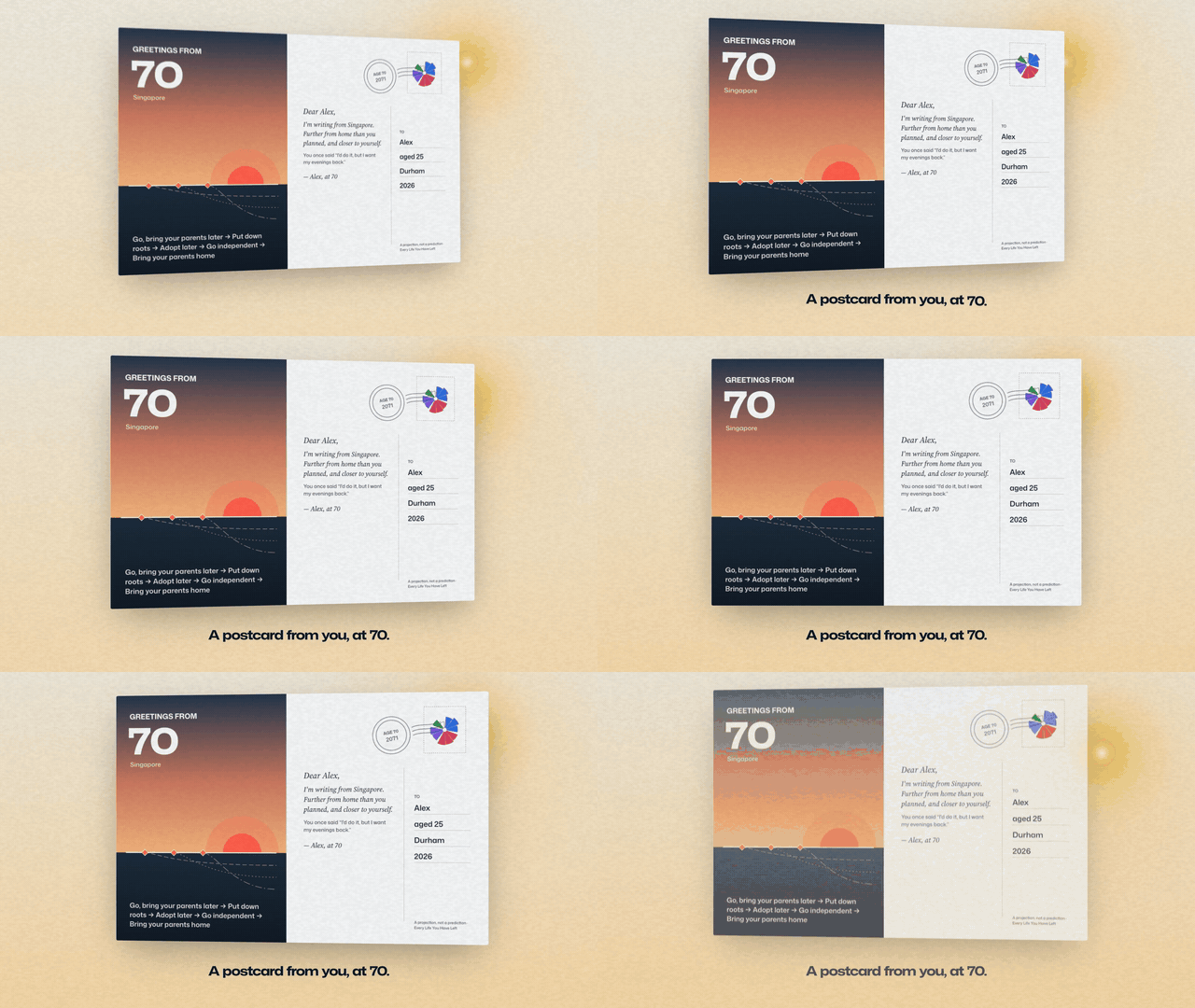
A postcard from you at 70.
-
 GIF
What you get at 70.
-
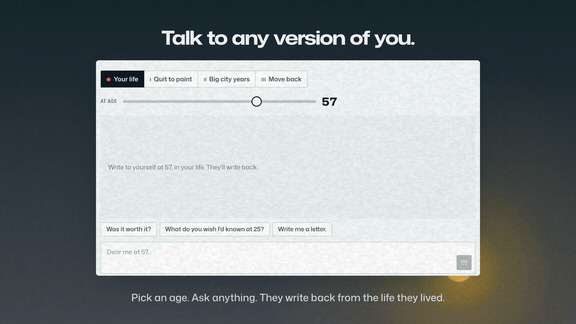 GIF
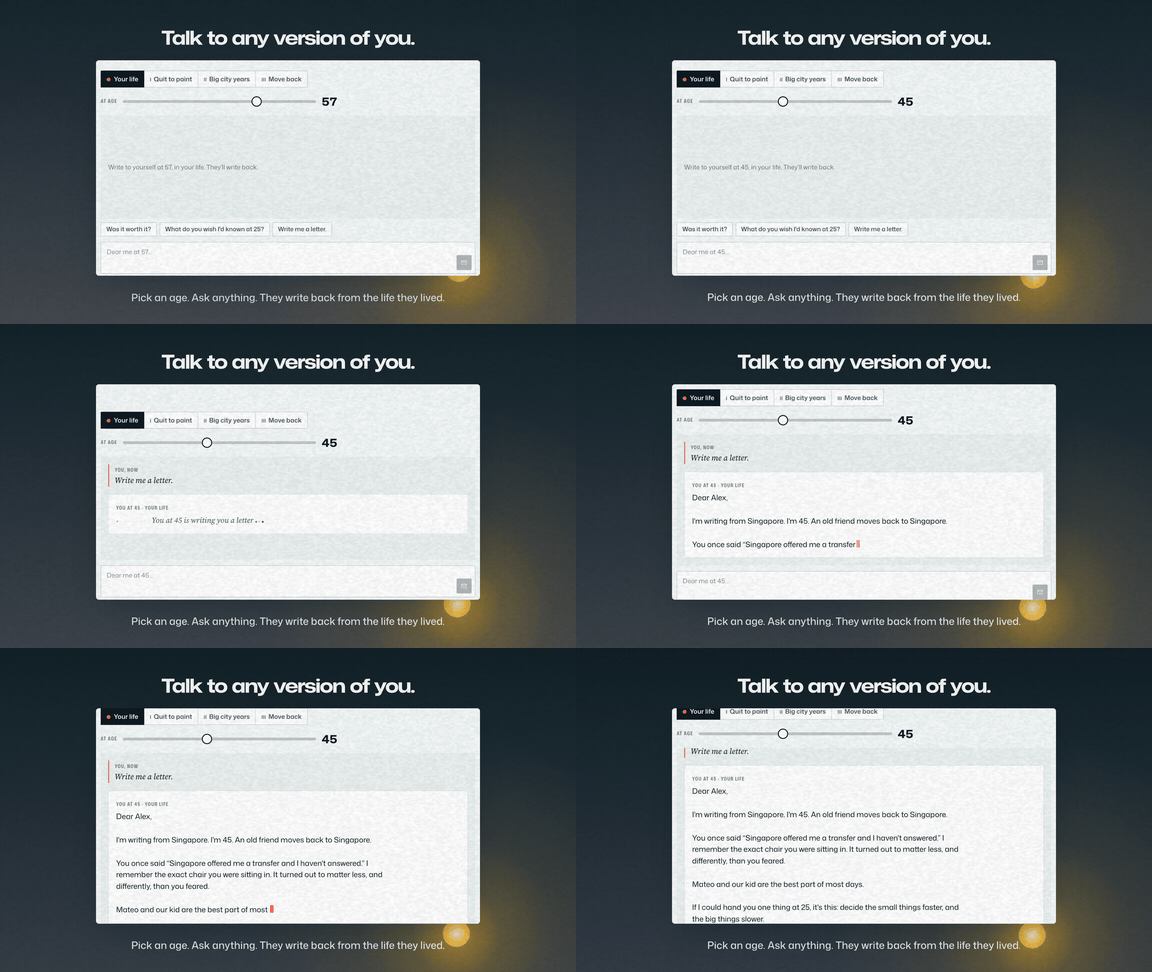
Talk to any version of you, at any age.
-
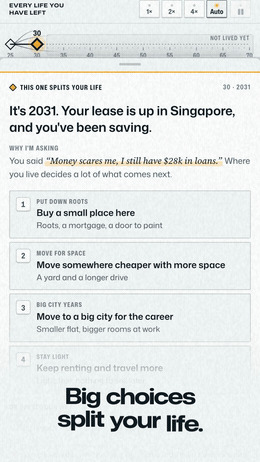 GIF
It works on your phone too.

Inspiration
We're two people standing at a crossroads that nobody can choose for us.
Jack is 25, a Data Scientist. Soon he goes back to Bangkok to start his career again, and right now he honestly doesn't know where life is going to take him.
Paul is 36, a cybersecurity engineer. He left a good life back home to start over in the US, and every day here feels like a clock ticking: find a job, settle down, make the bet pay off.
We're both a little lost. But we bet on being here, at Duke, and on the future being bright. So we wanted to see it. Not one prediction, but every life we might still have left.
We're far from the only ones deciding alone:
- A US school counselor has 376 students on average (ASCA, 2023–24).
- Only about 1 in 6 college grads say career services really helped (Gallup).
And seeing your future changes what you do today:
- People who feel connected to their future self save more (Ersner-Hershfield et al., 2009).
- Seeing an aged version of yourself raised retirement saving (Hershfield et al., 2011).
- In MIT's 2024 Future You study, one conversation with an AI future self reduced anxiety in 344 young adults and strengthened their connection to who they'll become.
- Seeing several possible selves, not just one, widened people's sense of what's possible (Possible You, NeurIPS 2025).
So we asked: what if you could live the rest of your life before you choose, and keep every life you didn't pick to see who you can become?
What it does
Every Life You Have Left plays the rest of your life, from today to 70, in a small 3D world. You tell it who you are in one line (typed or spoken, with an optional CV or LinkedIn PDF). Then your life plays year by year, and you make its choices.
What's new:
- It's your life, built from your words. Nobody else's birth, no random stranger. A short warm-up learns who you are, and every small choice teaches it more.
- The lives you don't choose keep living. At every big decision you pick one answer, and the other three keep running in the background. "Meanwhile, in your other lives…" shows you where they went.
- Every turning point shows why: the exact sentence you said that caused it, next to a real statistic with its source. "Money scares me, I still have $28k in loans" sits next to "The typical first-time US home buyer is now 40" (NAR, 2025).
- At 70, every life side by side. The city, the people, the money and a one-line verdict for each, with none ranked best. Then a postcard from yourself, and a conversation with any version of you, at any age.
- Time feels like a life. Following William James (1890), the years right after today are dense with choices and play slowly, and later years speed up. A new chapter slows time again. An original score follows you from the first year to 70.
Who it helps. Students and young adults at their first big crossroads, especially the ones deciding far from home or without anyone to ask. It is free to play. Career centers can give it to every student, when they can't give every student an hour: a campus license at about $3 per student a year, and students play free. It's kind by design: no death or serious illness, crisis resources (988) if you're struggling, never your race, and incognito if you'd rather we save nothing.
Beyond campus, the same engine could help banks and insurers show people their long-term future (saving, protection, retirement) and raise awareness before it's too late. That would need a retune toward money and risk, so it's an alternative path, not today's product.
How we built it
- One Cloudflare Worker serves the React app. Each life runs in its own Durable Object, which writes the years ahead and keeps up to three hidden lives going.
- Gemini on Google Cloud writes the story: Flash for the years and decisions, Flash-Lite for the fast parts, an image model for the portraits and a voice for your future self.
- Our code owns the odds. 35 sourced base rates (BLS, Census, Pew, NAR, Gallup and others) live in code. A ledger of people, places and money checks every year the model writes, and code decides the pacing, the rare life shocks, when children can arrive, and how money moves.
- Privacy in code: unbundled consent, incognito mode, encrypted uploads, deletion after 30 days (7 for uploads), and one button that deletes everything.
- Most of the code was written by Claude Code agents in parallel branches, while the two of us designed, played our own lives and turned every playtest into fixes.
Challenges we ran into
- Keeping a 45-year life consistent. Children aged wrong, money drifted, and cards asked about a city you had already left. The ledger and its checks fixed it.
- Slow first words. About 1 in 3 model calls stalled for 25–60 s before writing anything. Now a faster model races any call that stalls, and each fork is prepared while you're still choosing.
- Making it feel like a life, not a quiz. Pacing took four rounds, and subjective time was the answer.
Accomplishments that we're proud of
- 100% of turning points quoted the person's own words, across 15 test lives on four models, each graded by a separate AI model. That AI grader gave Gemini 3.8 Flash 5.0 out of 5, against 2.3 for an open model.
- A whole life to 70 in about two and a half minutes on production, for about $0.55.
- The lives you didn't choose keep living, and at 70 you can talk to any of them.
- Privacy that is real, not just written down: incognito truly saves nothing, and the delete button erases everything.
What we learned
- The model should write, and code should decide. Every time the model chose the pacing, the money or who exists, the life drifted.
- Read people charitably. A prompt that seizes on one anxious clause writes a darker life than the person described.
- People see themselves in small things. When Jack lived his own life in it, choice after choice kept turning toward a camera: filming his neighbourhood and its ordinary days. He had never said that out loud, and it became the warmest part of his story.
What's next for Every Life You Have Left
- Measure it: a before/after study of how connected people feel to their future self, the way the MIT study did.
- A campus pilot: free for students, offered through career centers.
- Local odds for every country. Today the statistics are US data, used as approximate elsewhere.
- Every crossroads after graduation: a layoff, a midlife reset, retirement.
Built With
- claude-code
- cloudflare-agents-sdk
- cloudflare-d1
- cloudflare-r2
- cloudflare-workers
- d3.js
- durable-objects
- gemini
- google-cloud
- google-search-grounding
- gsap
- hono
- node.js
- pdf.js
- radix-ui
- react
- react-three-fiber
- three.js
- typescript
- vertex-ai
- vite
- web-crypto
- wrangler
- zod
- zustand

