Inspiration
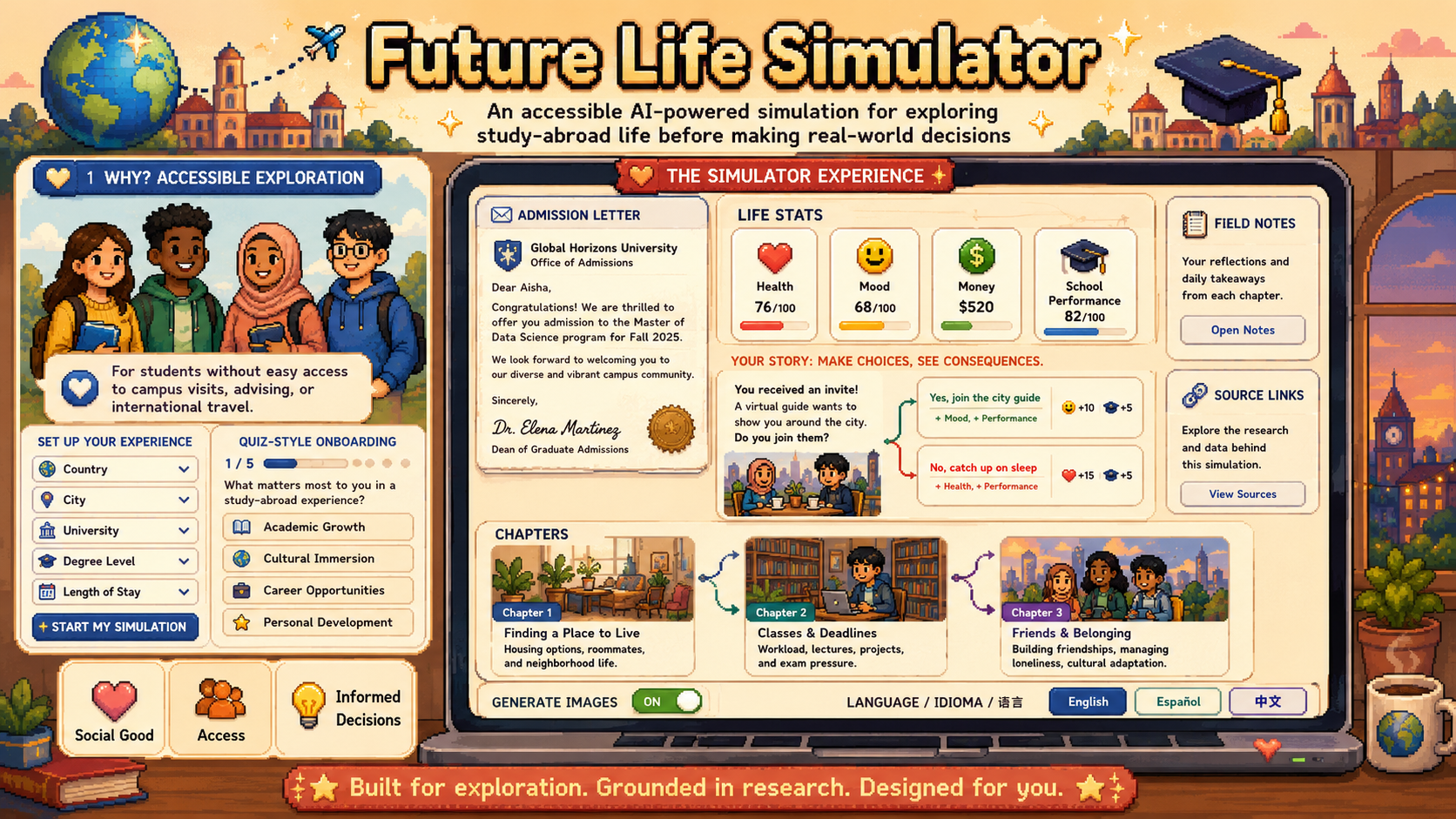
Future Life Simulator was inspired by a social good question: what if more people could experience the feeling of studying abroad before they ever had the money, visa, confidence, or access to do it in real life?
For many students, studying abroad is a huge decision, but not everyone can “try before deciding.” Some students cannot afford campus visits, consulting services, or international travel. Some do not have easy access to reliable information. Others may never be able to study abroad at all, but still deserve a way to imagine that world.
We built Future Life Simulator to make study-abroad exploration more accessible, immersive, and human.
What it does
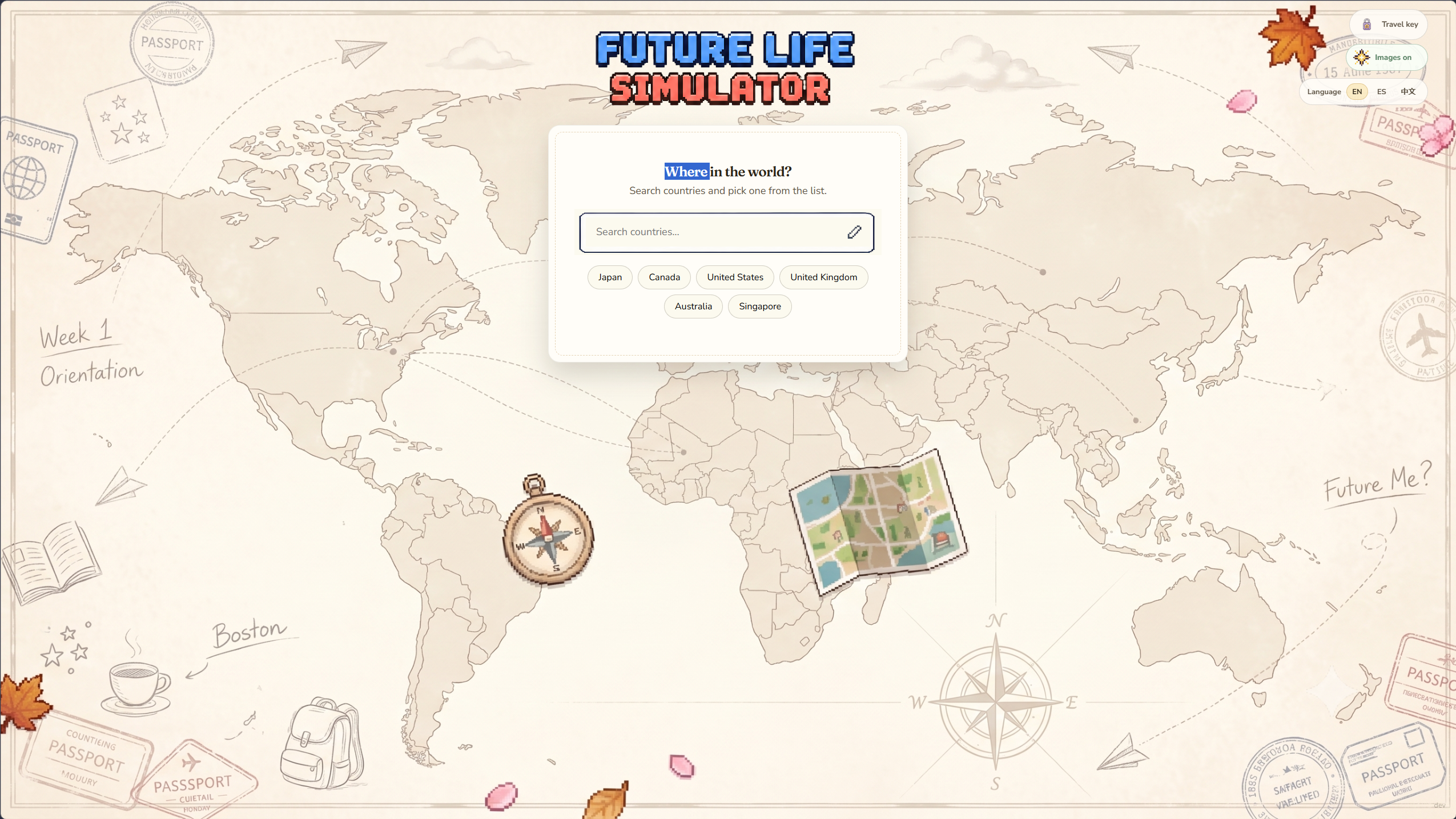
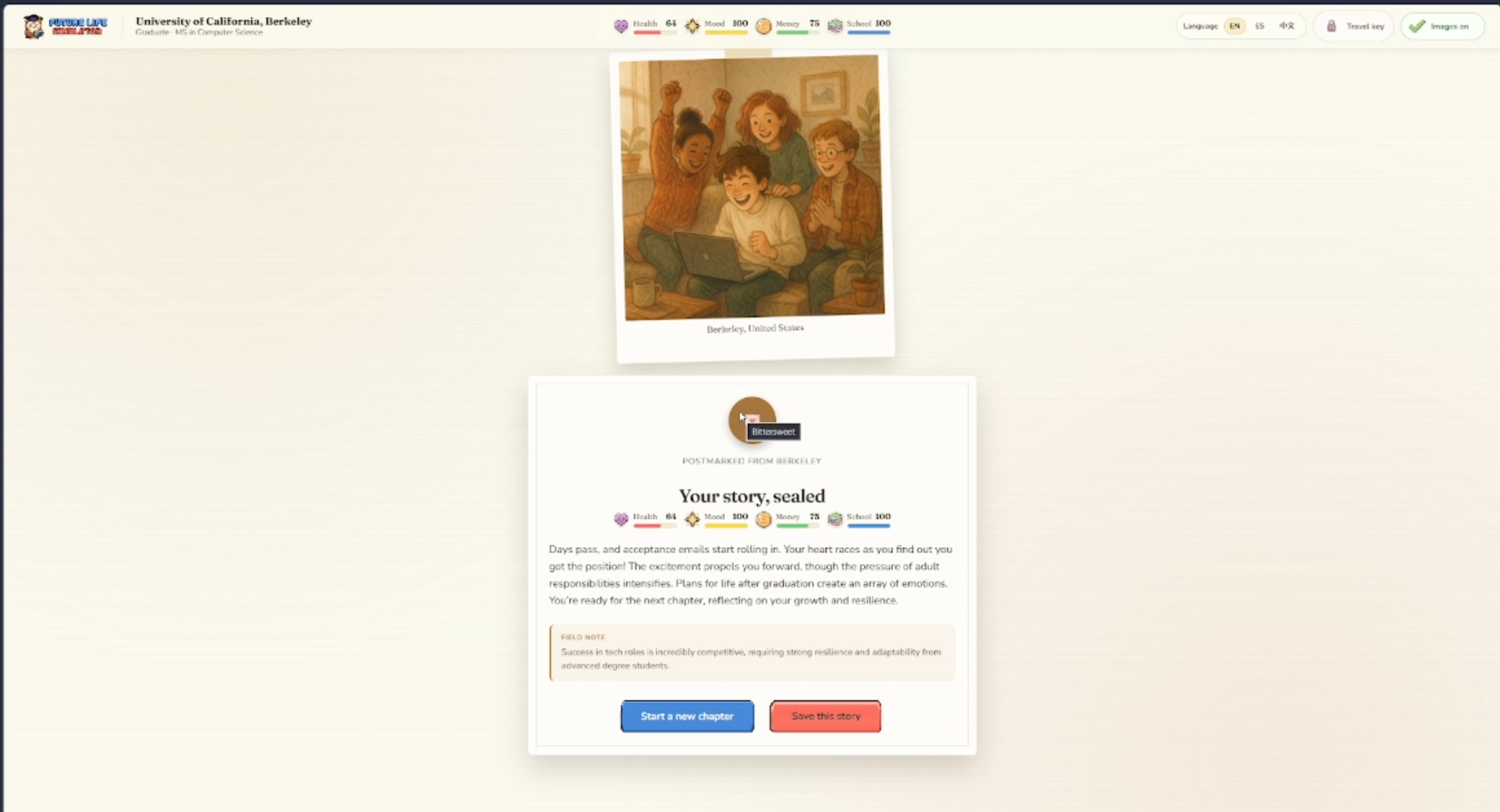
Future Life Simulator lets users choose a country, city, university, degree level, and length of stay. It then generates a personalized study-abroad life simulation with:
- A quiz-style onboarding flow
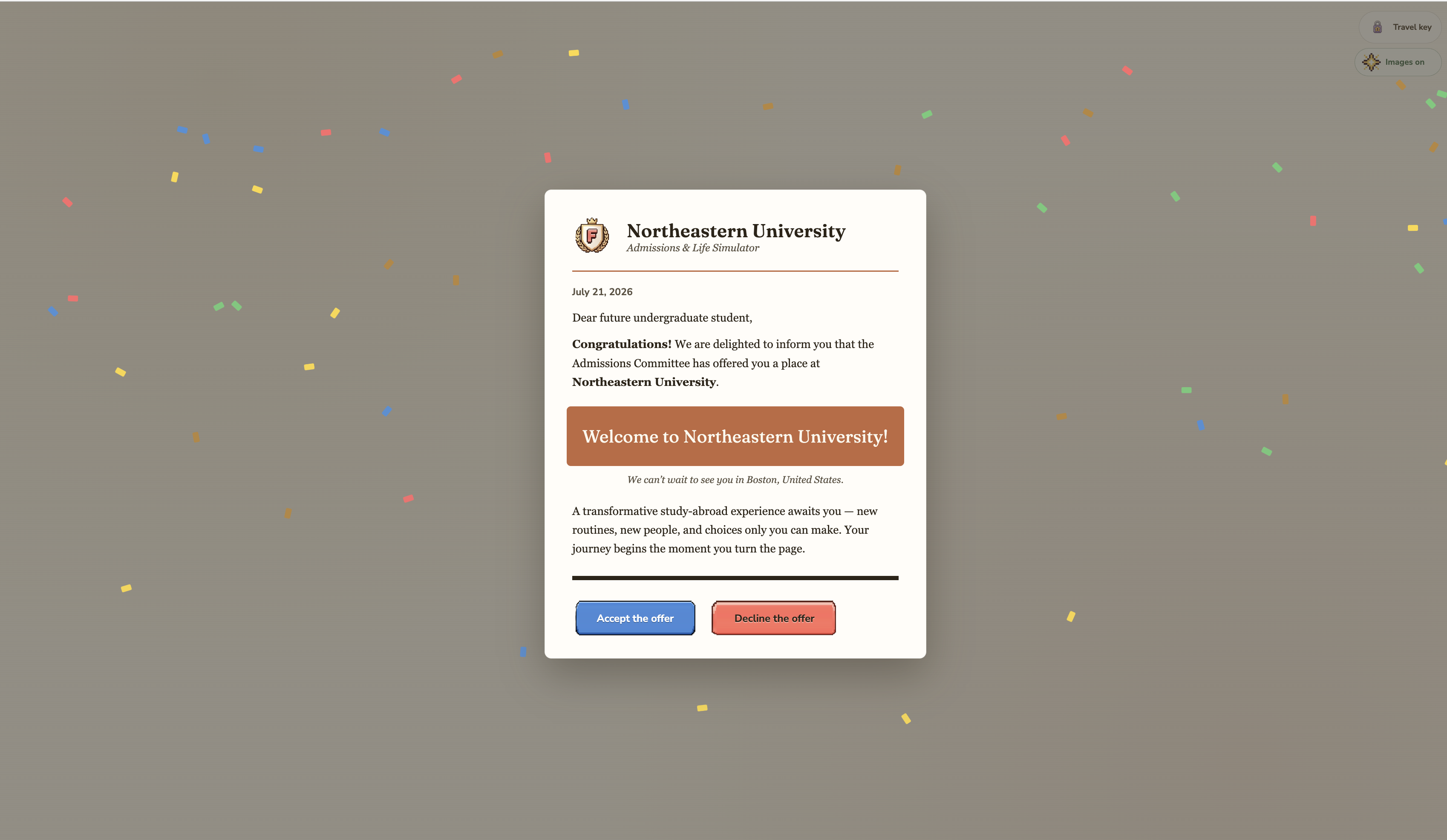
- A personalized admission letter
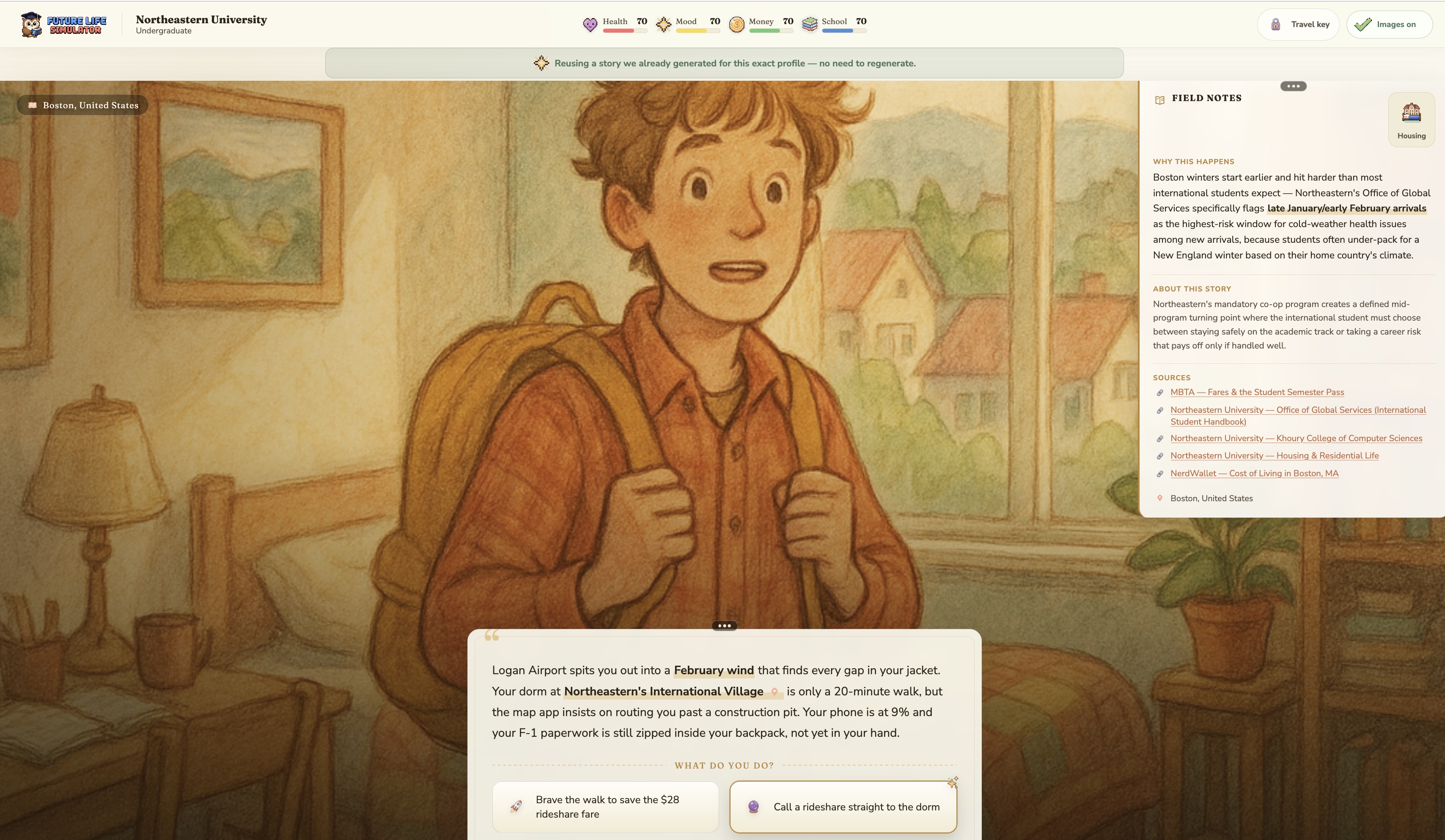
- Branching choices and consequences
- Life stats such as health, mood, money, and school performance
- Academic and everyday life challenges
- Research-grounded Field Notes
- Source links for verification
- AI-generated illustrations for each chapter
- A toggle to turn image generation on or off
- Multilingual UI support for English, Spanish, and Chinese
The goal is to give users an accessible simulation of what life abroad might feel like, especially for people who cannot easily access firsthand experience, advising, or international travel.
How we built it
We built the frontend with React, TypeScript, and Vite. The backend uses Node.js and Express, with OpenAI APIs powering research, story generation, and image generation.
The system uses a multi-step pipeline:
- A research layer gathers context about the selected university and location.
- A design layer structures the story, choices, stats, challenges, and insights.
- An image layer creates consistent chapter illustrations.
- A cache layer stores generated stories and assets so repeated profiles load faster.
- The frontend renders everything as an interactive life simulator.
Codex played a central role throughout the hackathon. It acted as our co-designer, co-builder, and co-refiner, helping us move from a social good idea to a working product.
Challenges we ran into
One major challenge was making generation reliable. At first, only the first chapter received an image, so we inspected the generation pipeline and changed the system to make sure every chapter could receive a matching illustration.
Another challenge was making the simulator feel realistic rather than like a generic academic story. Early versions focused too heavily on schoolwork, so we expanded the challenge space to include housing, money, friendships, health, loneliness, daily routines, cultural adaptation, and career pressure.
We also had to balance richness with accessibility. Image generation makes the experience more immersive, but it can be slower and more expensive, so we added a toggle that lets users choose whether to generate images.
Accomplishments that we're proud of
We are proud that Future Life Simulator became more than a story generator. It is an accessible, research-grounded simulation that helps people imagine an experience they may not be able to access directly.
We are especially proud of:
- Centering the project around social good and access
- Making study-abroad exploration more immersive and less intimidating
- Including both academic and everyday life challenges
- Giving every chapter a consistent illustration
- Providing source links so users can verify information
- Adding image-generation controls for affordability and speed
- Supporting multilingual UI for broader access
What we learned
We learned that AI can make important experiences more accessible, especially when the goal is not to replace reality, but to help people imagine, prepare, and make more informed decisions.
We also learned that building a good AI experience requires more than prompts. It needs structured data, reliability, caching, fallback behavior, UI polish, source verification, and careful attention to who the product is for.
Codex helped us learn faster during the hackathon. It was not just a coding assistant; it became a co-designer, co-builder, and co-refiner.
What's next for Future Life Simulator
Next, we want to extend multilingual support beyond the UI so the generated story itself can be produced in the user’s chosen language.
We also want to add:
- More countries, cities, and universities
- Better support for students with different financial situations
- More life-event categories beyond academics
- More transparent source citations
- Shareable story summaries
- A lower-cost mode for users with limited API access
- Advisor or classroom modes for education counseling
Long term, Future Life Simulator could become an accessible tool for students, families, and educators to explore international education decisions in a more human and inclusive way.
Built With
- css
- express.js
- gpt-4o
- image-generation
- live-search
- node.js
- openai-api
- react
- typescript
- vite

Log in or sign up for Devpost to join the conversation.