-
-
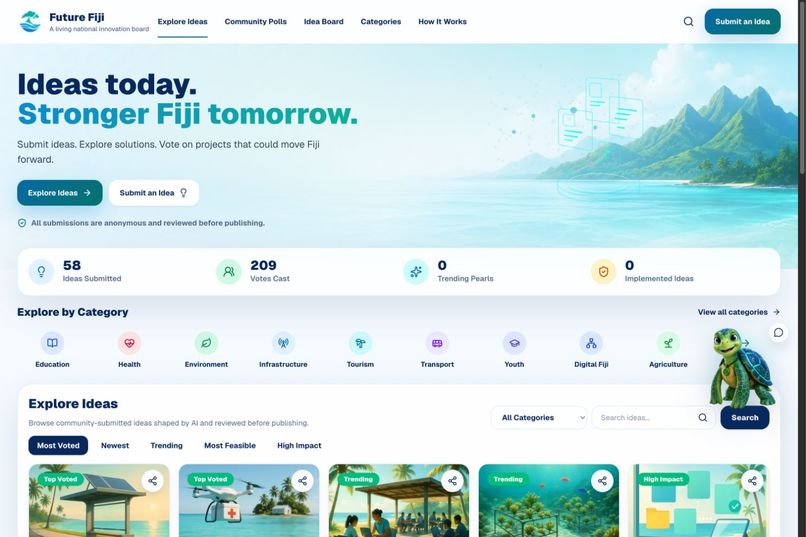
Home
-
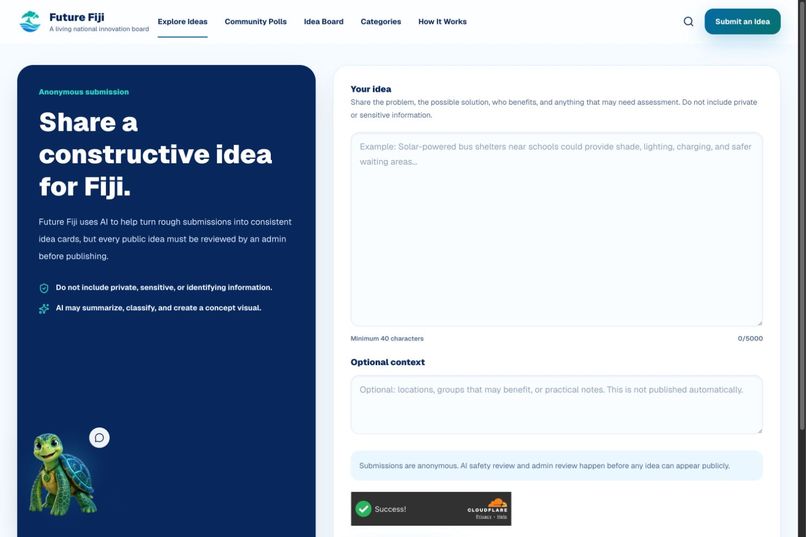
Submit idea
-
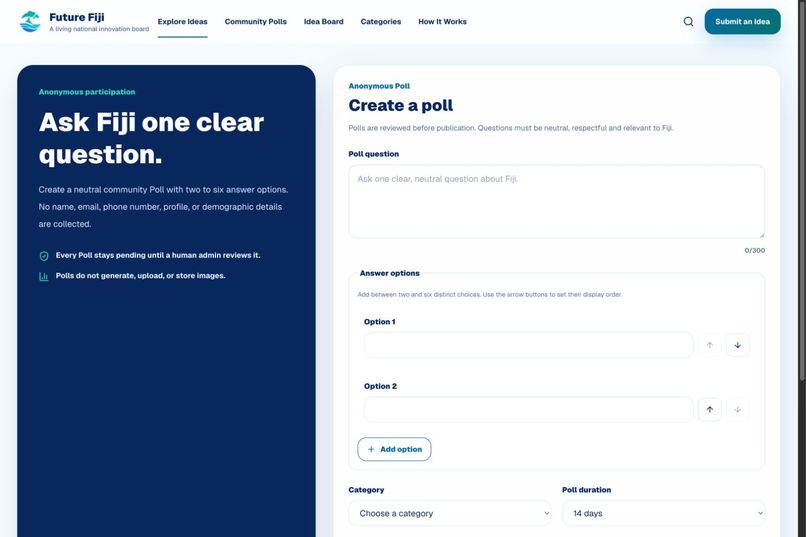
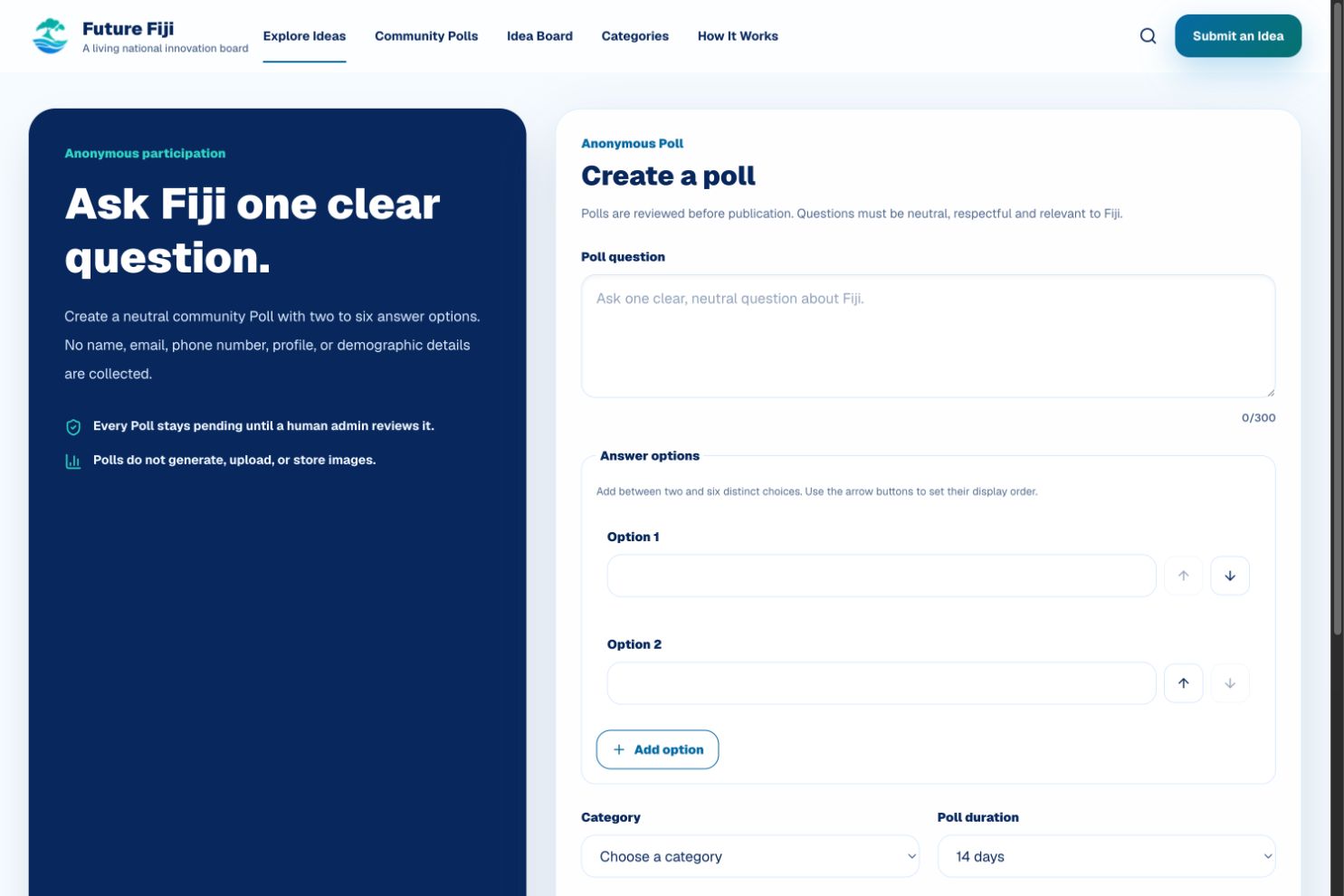
Create Poll
-
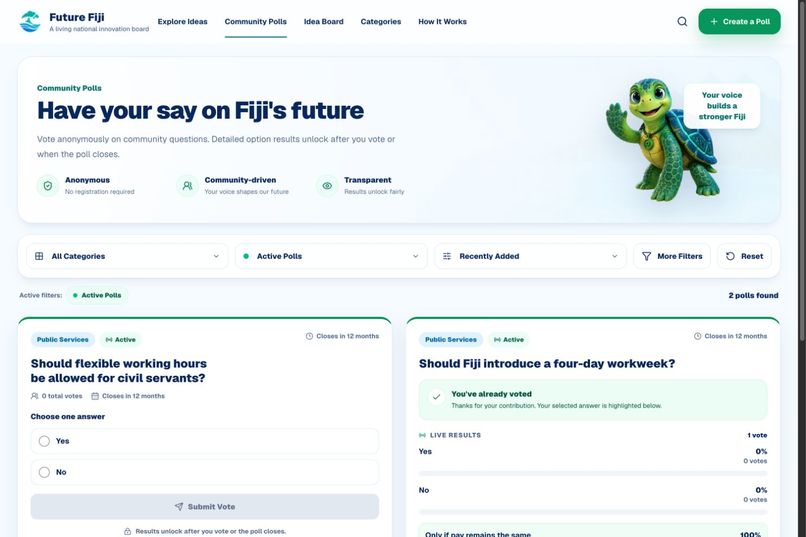
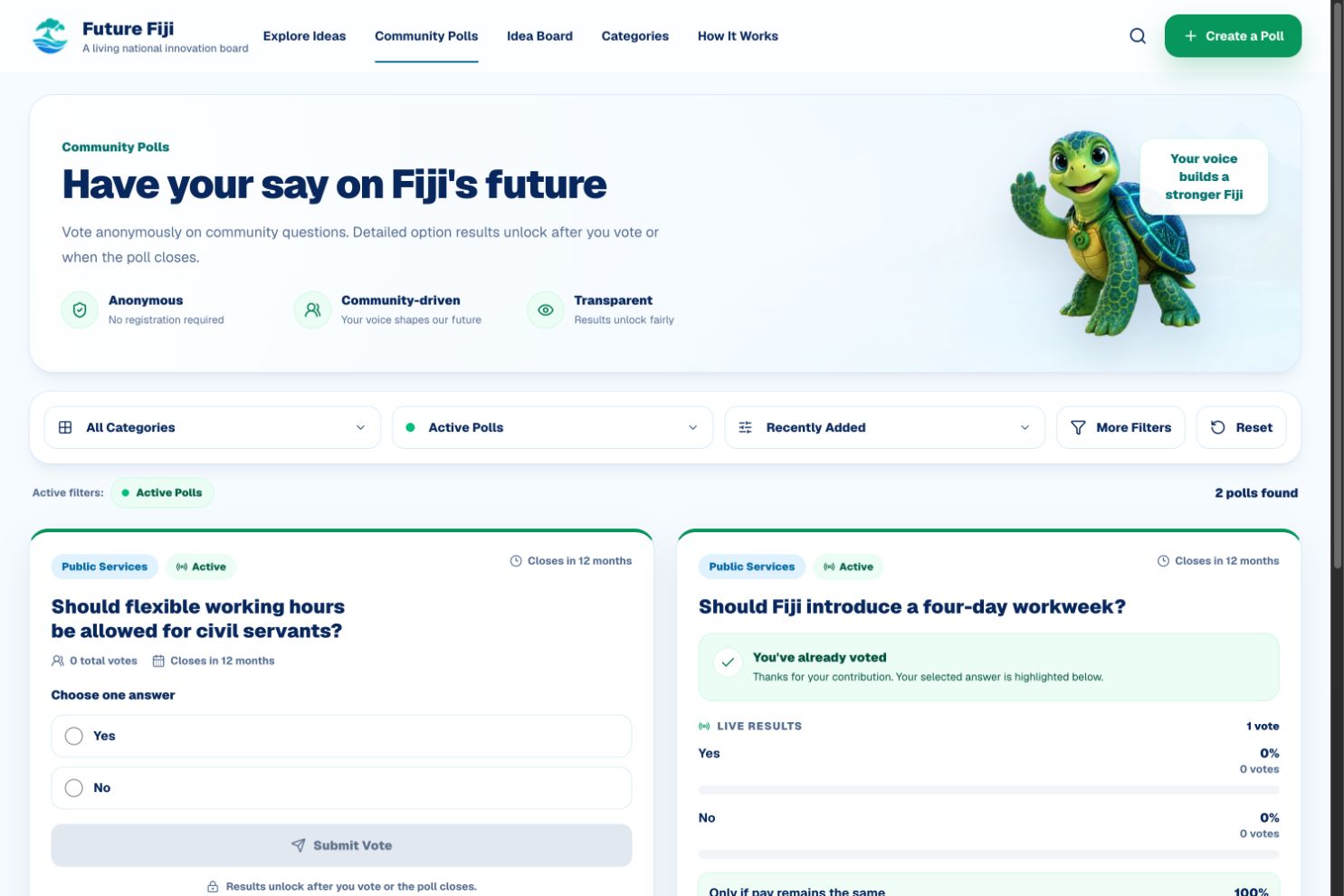
Polls Page
-
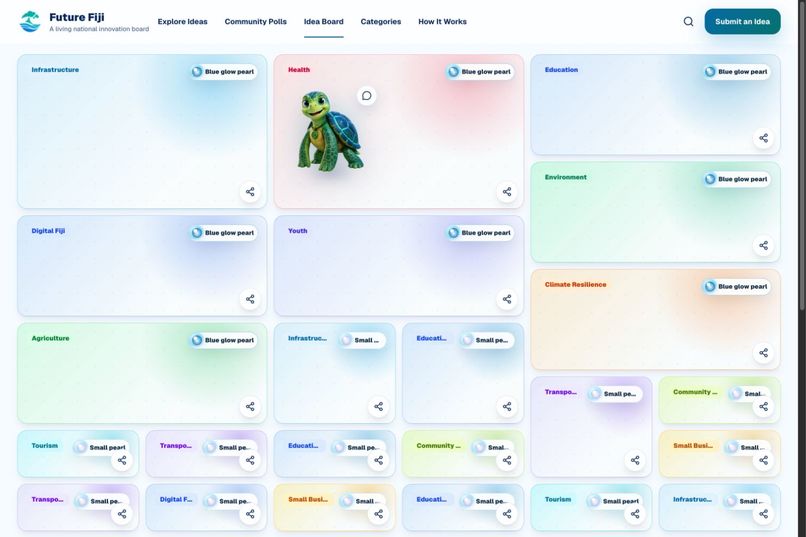
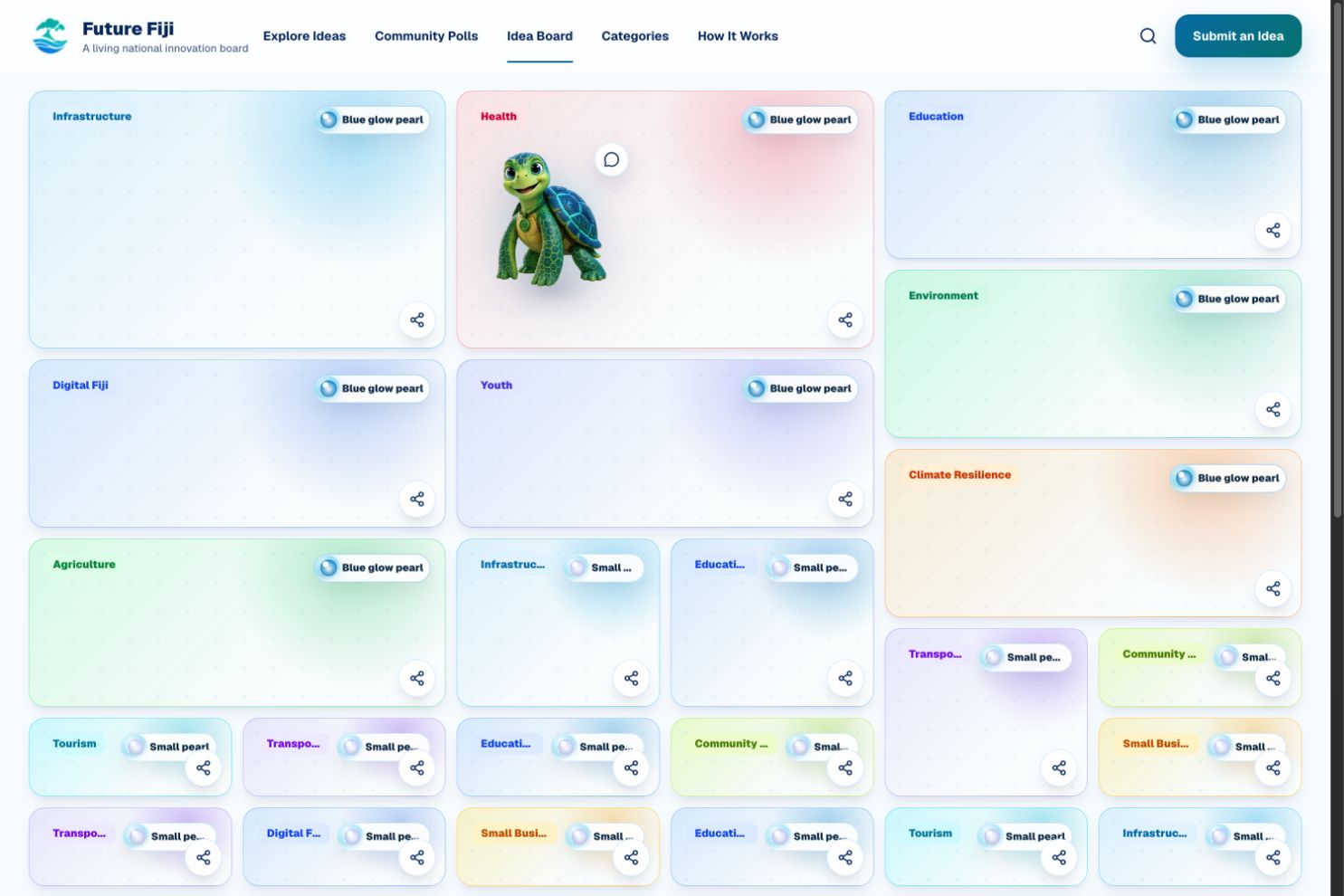
Ideas Board
-
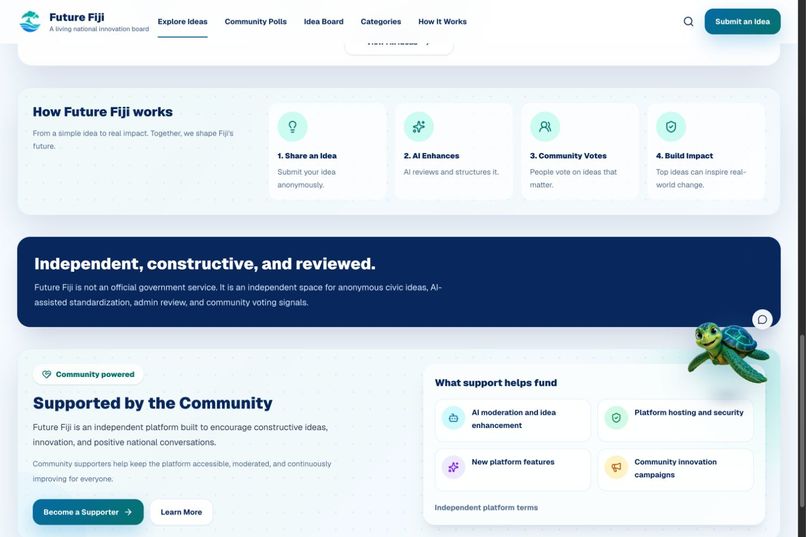
About
-
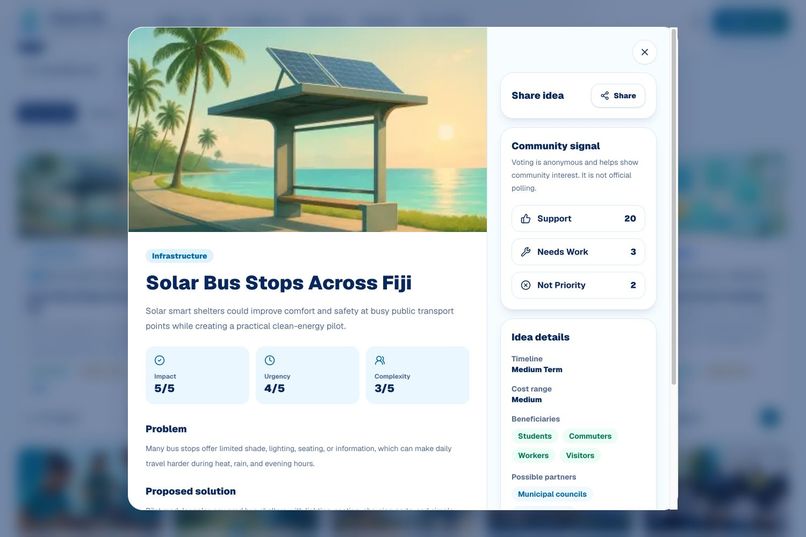
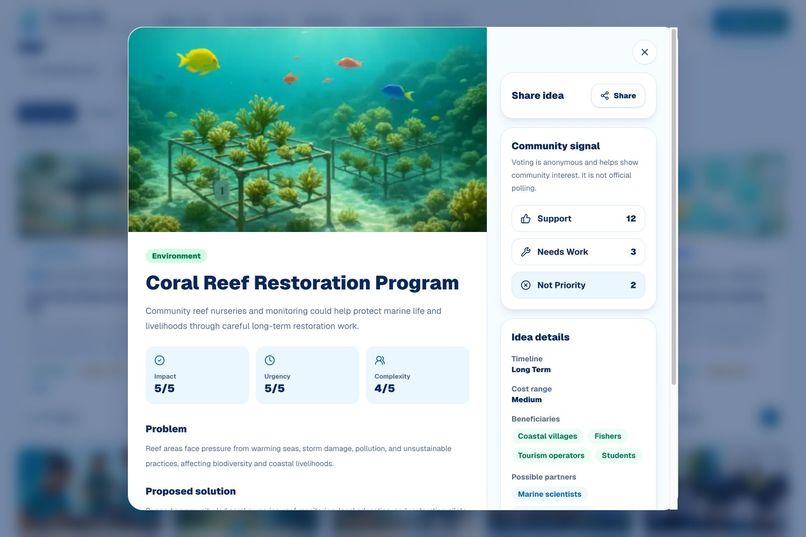
Idea details
-
Ideas
-
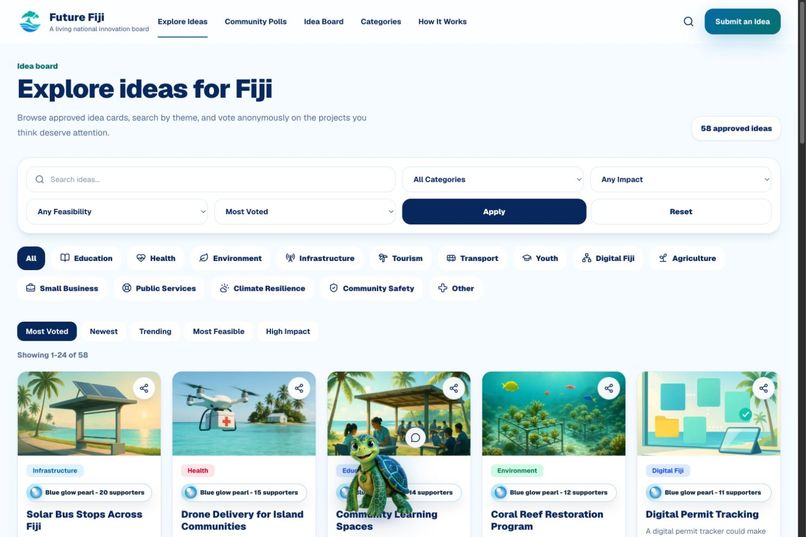
Explore Page
-
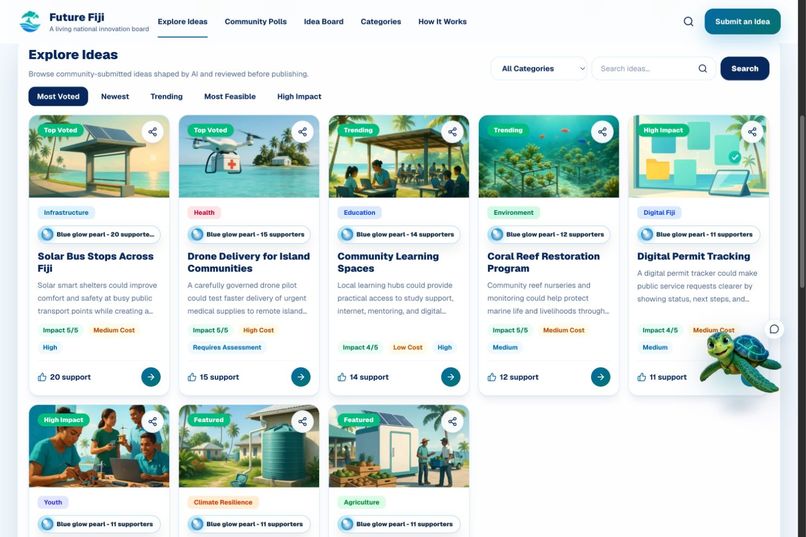
Idea List
-
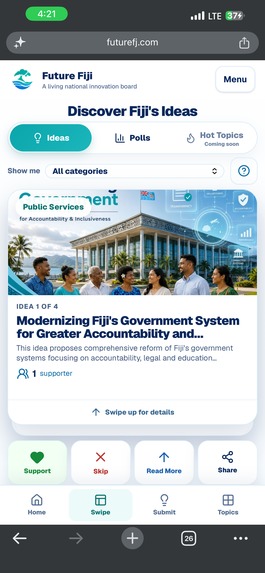
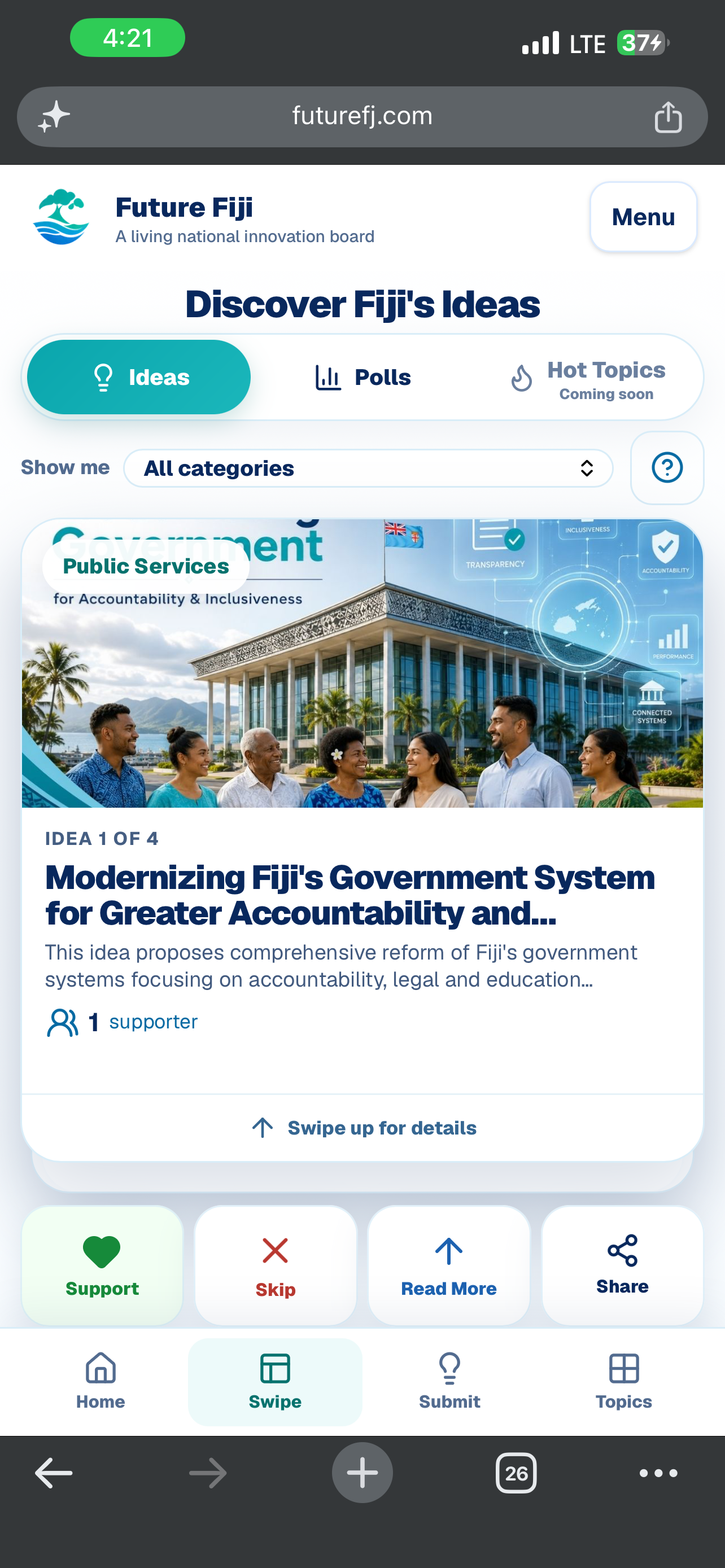
Mobile only swipe idea feature
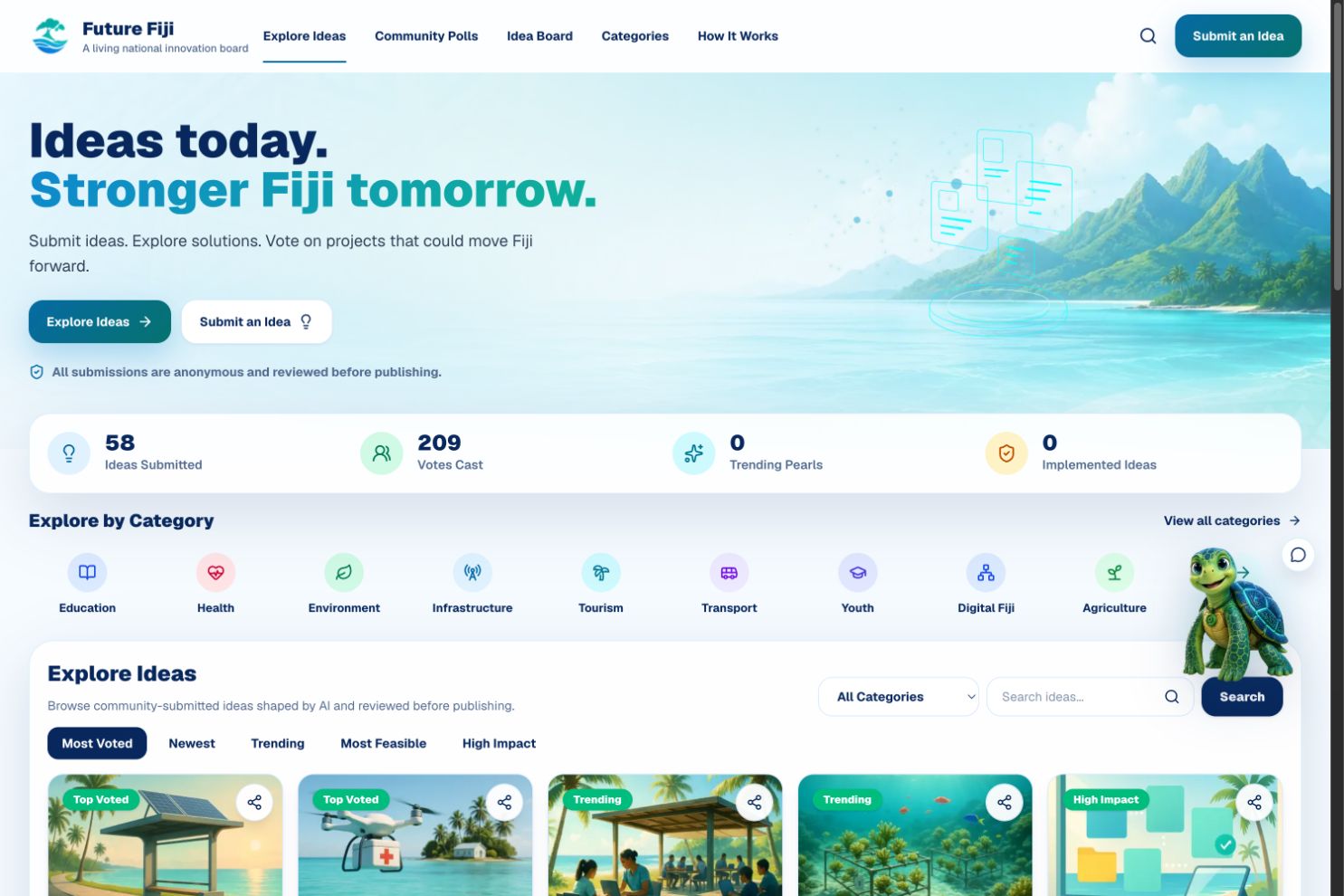
Future Fiji
Inspiration
Fiji has no shortage of creative people, practical knowledge, or ideas for improving the country. The challenge is that many of these ideas remain inside private conversations, community meetings, social media comments, or personal notes.
There is no widely accessible platform where citizens can submit constructive proposals, discover ideas from others, and demonstrate public support for solutions that could improve the community.
I created Future Fiji to help close that gap.
The project is based on a simple belief:
Meaningful national innovation should not come only from governments, consultants, or large organisations. Citizens often understand local problems because they experience them every day.
Students, teachers, healthcare workers, entrepreneurs, civil servants, rural communities, and ordinary citizens should all have a way to contribute to Fiji's development.
Future Fiji gives those voices a structured and accessible platform.
About the Project
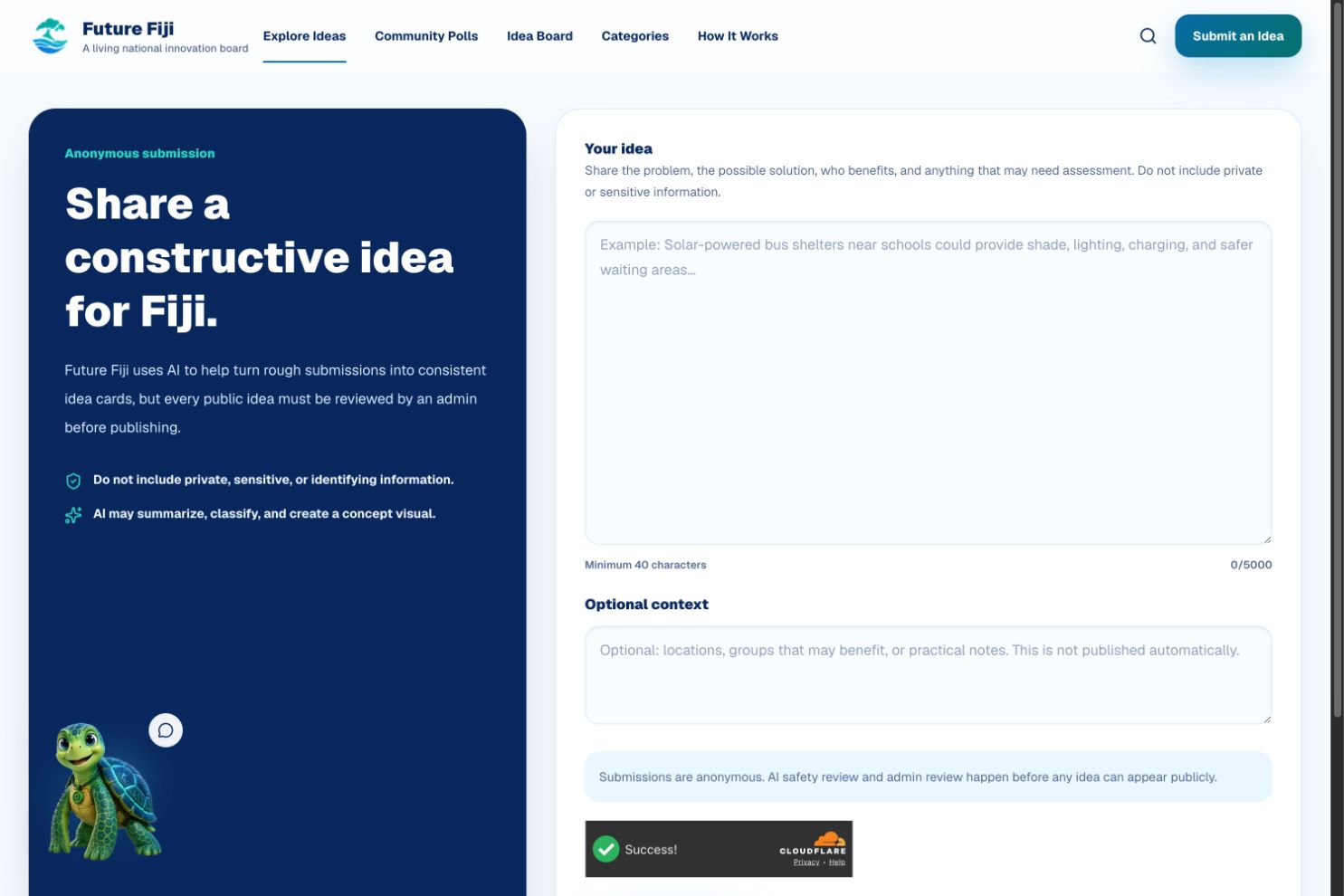
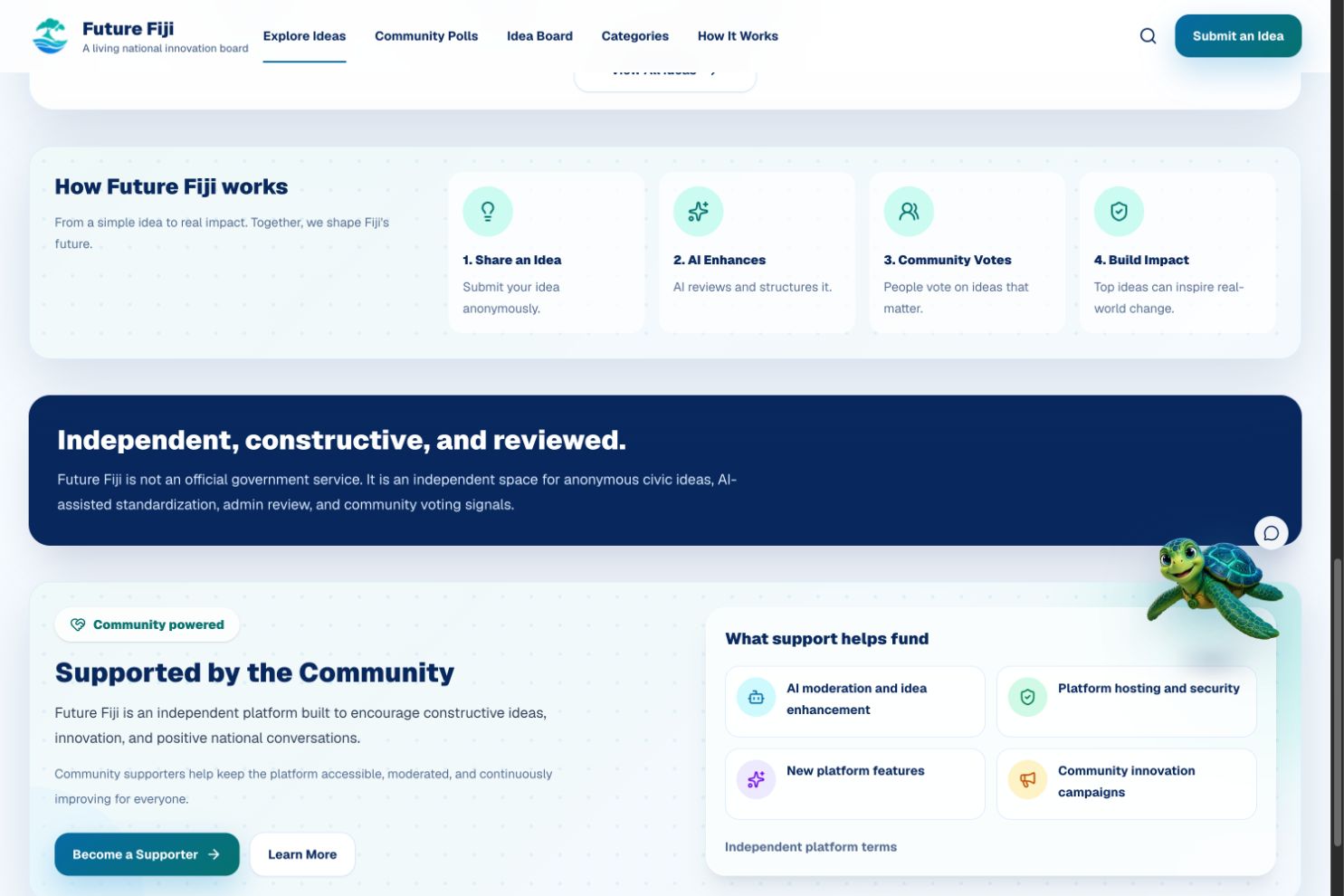
Future Fiji is an AI-enabled civic innovation platform where people can submit, discover, discuss, and support ideas for improving the community.
The platform is designed to encourage solutions rather than complaints. Citizens are asked to explain:
- The problem they have identified
- Their proposed solution
- The potential benefits
- The communities or sectors that may be affected
- How the idea could potentially be implemented
The idea can be a rough sentence and just thoughts scribbled down on the form. AI helps structure them.
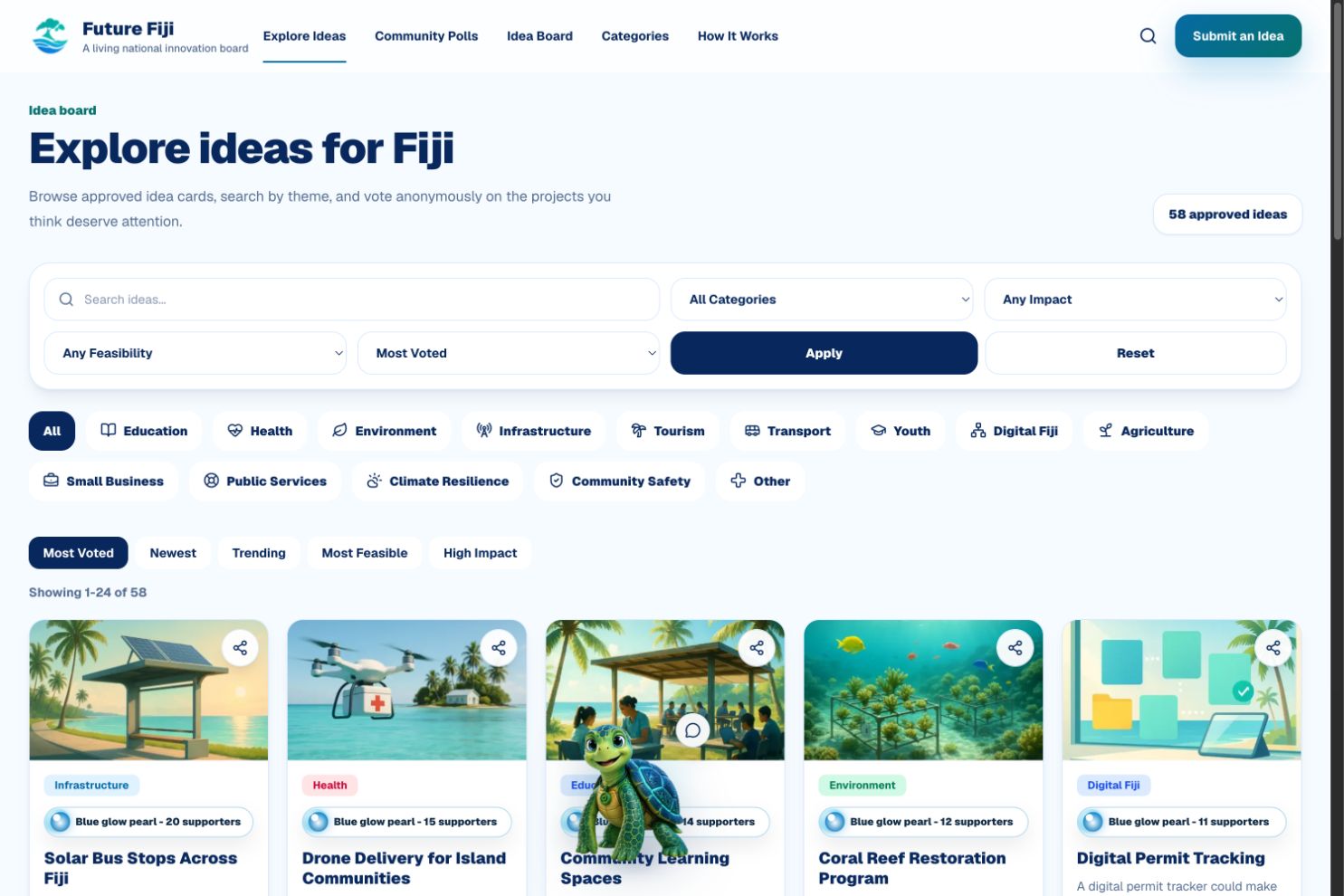
Users can explore proposals covering areas such as:
- Healthcare
- Education
- Technology
- Infrastructure
- Governance
- Public safety
- Sustainability
- Economic development
- Community services
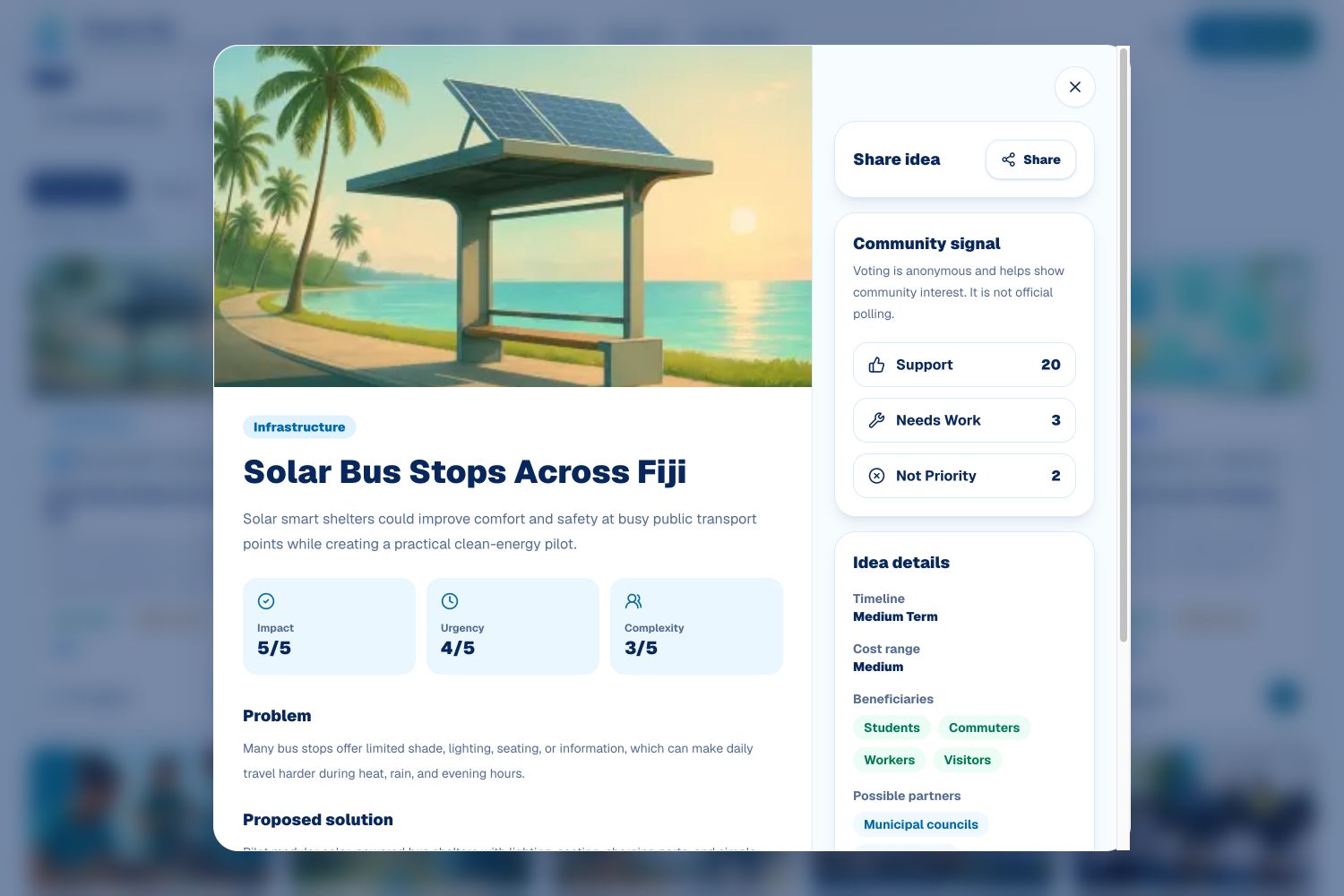
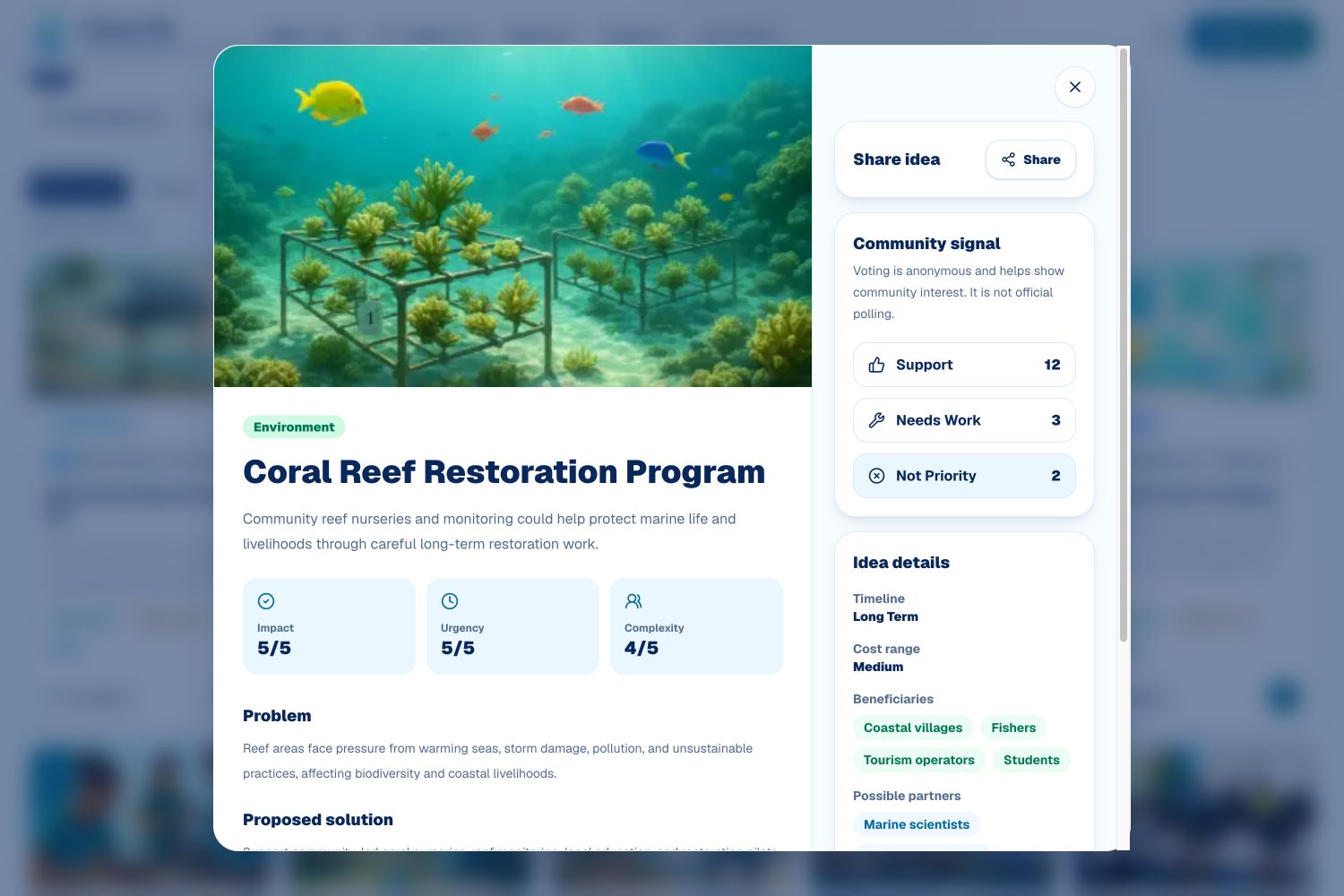
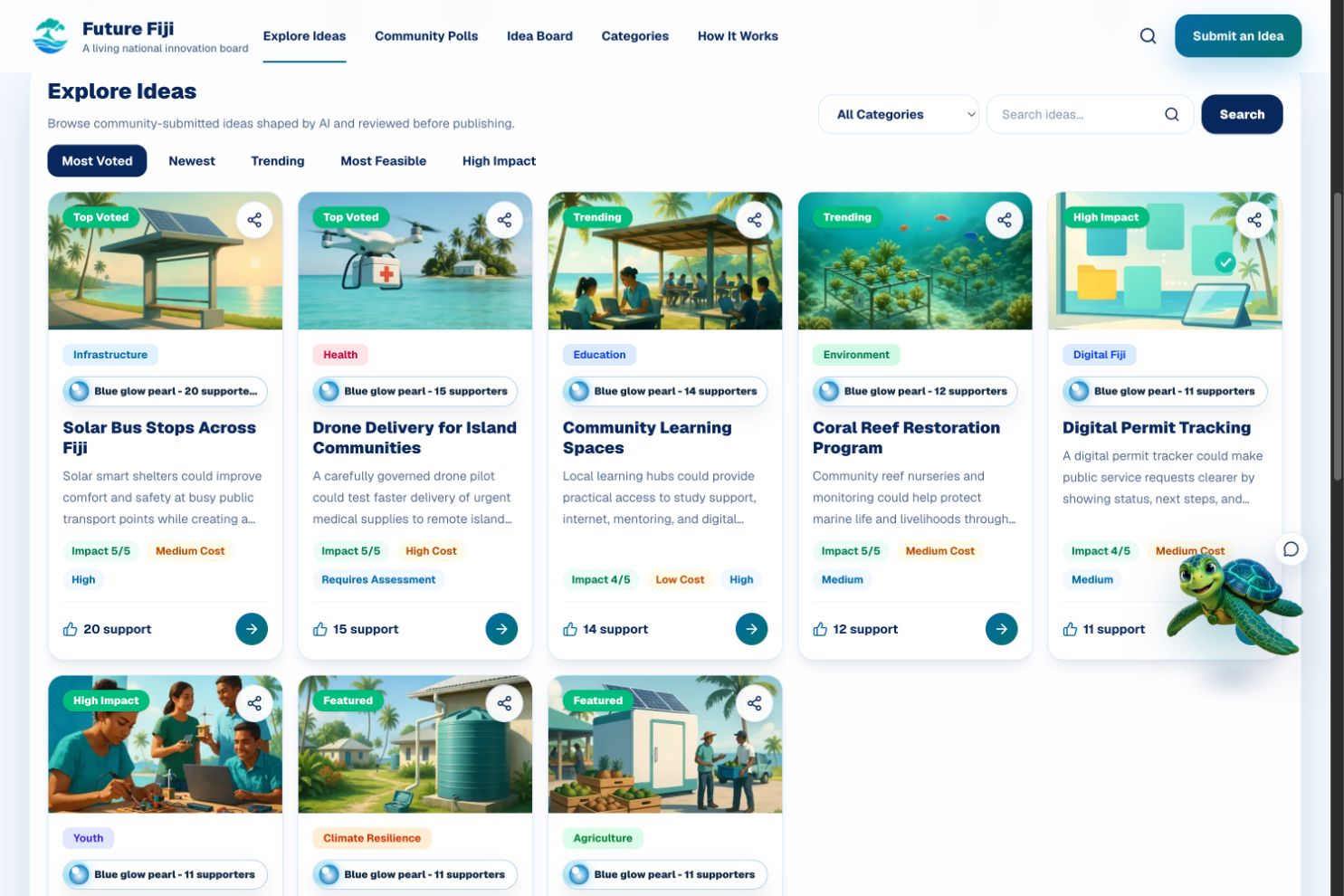
Citizens can vote for ideas they support, helping promising proposals gain greater visibility.
An idea may be valuable, but its potential impact remains limited if citizens cannot communicate it clearly or bring it to the attention of the right people.
Future Fiji uses AI to strengthen each part of this process.
How AI Is Used
OpenAI technology supports several parts of the platform's content and participation workflow.
AI can help:
- Transform rough thoughts into structured proposals
- Improve grammar, readability, and clarity
- Suggest suitable titles, summaries, and categories
- Detect potentially harmful, inappropriate, or low-quality submissions
- Identify similar or duplicate proposals
- Make technical ideas easier for the public to understand
- Generate visual concepts for submitted ideas
- Support future feasibility and impact assessments
The purpose of AI is not to replace the citizen's voice or decide which ideas the community should adopt.
Instead, AI acts as a facilitator that helps citizens communicate their ideas more effectively while preserving the original intent of each proposal.
How I Built the Project
Future Fiji was developed as a full public platform rather than a static directory of suggestions.
The application uses:
- Next.js for the public interface and application layer
- MySQL for structured data storage
- OpenAI models for AI-assisted content processing and moderation and image generation.
- Responsive web design for desktop and mobile access
- Administrative tools for reviewing submissions and managing content
The platform includes:
- Anonymous and low-friction idea submission
- Categorised idea discovery
- Search and filtering
- Community voting
- AI-assisted moderation
- AI-assisted content enhancement
- Concept images for proposals
- Administrative review workflows
- Controls for spam, automated abuse, and duplicate voting
I also created Viti, a friendly sea turtle mascot inspired by Fiji's marine environment.
Viti makes the platform feel more approachable and can guide users through idea submission, discovery, voting, and future AI-assisted workflows. It also has chat assistance where user can ask questions about submitted ideas.
The visual identity combines:
- Ocean blue and teal colours
- Green environmental tones
- Fijian-inspired patterns
- Modern civic technology design
- Friendly and accessible visual elements
The objective was to create something that feels innovative and globally relevant while remaining distinctly Fijian.
The concept shows that every idea begins as a pearl, and as the idea gains support and develops, the pearl grows with it adding a gamified layer without turning civic engagement into a points-only competition.
Challenges I Faced
Balancing Open Participation and Content Quality
A public platform must be prepared for:
- Spam
- Offensive content
- Incomplete submissions
- Duplicate ideas
- Automated abuse
- Vote manipulation
- Politically sensitive discussions
Making the submission process too restrictive would discourage participation. Making it completely uncontrolled would reduce trust in the platform.
AI-assisted moderation provides a middle layer by identifying potential concerns and supporting human review.
Turning Complaints Into Solutions
Many public discussions focus on what is wrong, but a civic innovation platform must help people explain what could be done.
The platform therefore encourages users to move from:
Problem -> Proposed Solution -> Expected Outcome
This structure makes ideas easier to understand, compare, evaluate, and potentially implement.
Communicating Complex Ideas
Some proposals involve legislation, digital systems, infrastructure, financial reform, or government processes that are difficult to explain quickly.
AI-assisted summaries and concept imagery help make these ideas more accessible to the wider public.
Establishing Trust
Citizens may hesitate to participate if they believe:
- Their identity will be exposed
- Their proposal will be dismissed
- Their idea could be taken without recognition
- The platform represents a political organisation
- Their contribution will never reach decision-makers
Future Fiji is therefore positioned as an independent and non-partisan civic platform focused on constructive ideas rather than political campaigning.
What I Learned
Building Future Fiji reinforced that technology alone does not create civic participation.
People are more likely to contribute when a platform feels:
- Safe
- Relevant
- Understandable
- Inclusive
- Respectful of their time
- Connected to real outcomes
I learned that AI is especially valuable when it reduces barriers to participation.
A citizen may understand a problem very well but struggle to write a formal proposal. AI can help structure that person's knowledge without replacing their perspective.
I also learned that local context matters.
A civic technology platform for Fiji cannot simply copy a system designed for a much larger country. It must consider:
- Fiji's population size
- Cultural and linguistic diversity
- Internet accessibility
- Rural and maritime communities
- Community relationships
- Political history
- Public trust
- The capacity of institutions to respond
The strongest role for AI is not to decide Fiji's future.
Its role is to help more citizens participate in shaping it.
What Comes Next
The long-term vision is for Future Fiji to become a bridge between:
- Citizens
- Government agencies
- Development partners
- Civil society organisations
- Researchers
- Businesses
- Universities
- Community leaders
- Potential implementation partners
Future development may include:
- AI-guided idea development
- Similar-idea detection and proposal consolidation
- Multilingual submissions
- Voice-based idea submission
- Evidence and feasibility analysis
- Community collaboration spaces
- Public implementation roadmaps
- Progress tracking for adopted ideas
- Government and industry innovation challenges
- AI-generated policy briefs
- Regional expansion for other Pacific Island countries
Future Fiji began as a platform for collecting ideas.
It is evolving into an AI-enabled civic innovation ecosystem where citizens can help identify problems, develop solutions, build public support, and contribute to the future of their country.
Our ideas. Our future. Our Fiji.
Built With
- framermotion
- generative
- github
- gpt
- mysql
- next-js
- openai
- ratelimiting
- rbac
- react
- restapi
- tailwind
- three.js
- typescript
- vitest
- zod

Log in or sign up for Devpost to join the conversation.