-
-
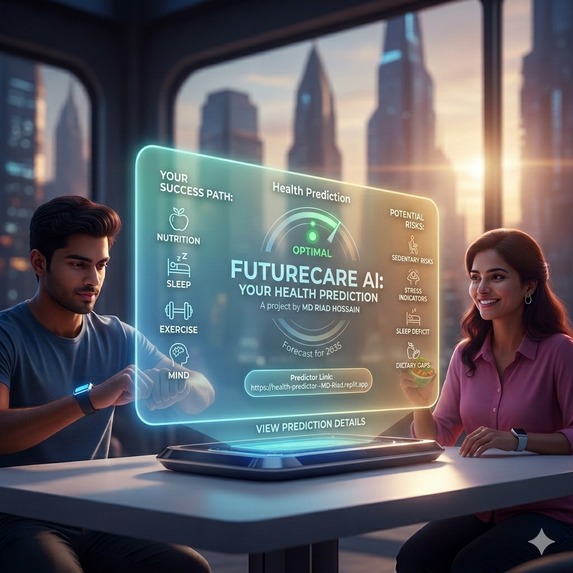
FutureCare AI
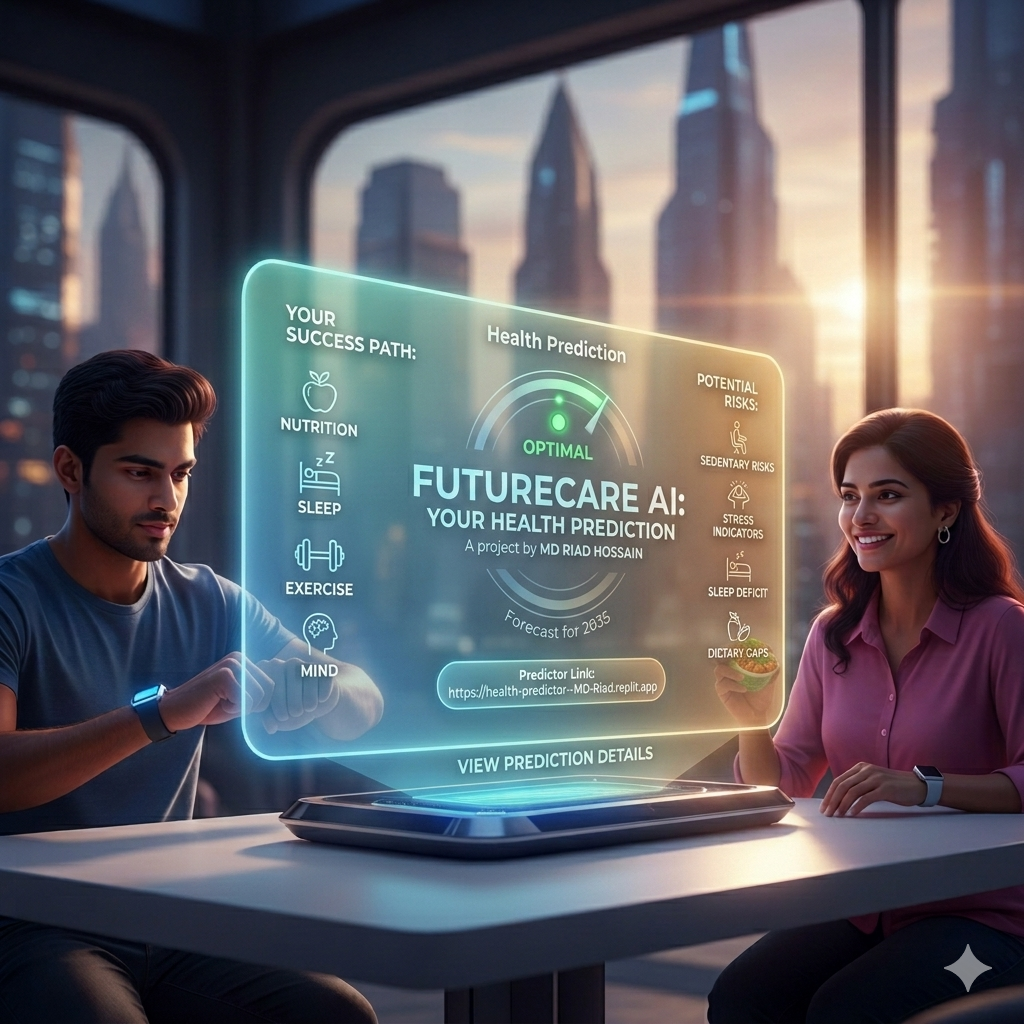
Inspiration
As a science student and a tech enthusiast from Gazipur Cantonment College, I have always believed that 'Prevention is better than cure.' With the rapid growth of AI, I wanted to build something that doesn't just treat illnesses but prevents them by looking into the future. The 10th anniversary of UWB Hacks inspired me to think about the next decade. I realized that many long-term health issues are caused by daily habits we ignore today. This motivated me to create FutureCare AI—a tool to help people visualize the future impact of their current lifestyle and take action now to ensure a healthier life in the years to come.
What it does
FutureCare AI acts as a digital health consultant for the next decade. By taking user inputs such as daily exercise routines, sleep duration, and dietary habits, the application uses predictive logic to simulate a future health score. It provides users with an immediate 'Health Outlook' for the next 10 years, categorizing their lifestyle as either a 'Success Path' or a 'Warning Path.' The goal is to provide a visual wake-up call that motivates people to fix their habits today to avoid medical complications in the future."
How we built it
FutureCare AI was developed using a modern web-tech stack focused on speed and functionality. Backend: We used Python with the Flask framework to handle the logic and data processing. Frontend: The user interface was crafted using HTML5 and CSS3, utilizing Bootstrap 5 to ensure a fully responsive and futuristic design that works on all devices. Logic: We implemented a predictive algorithm that analyzes lifestyle variables (like sleep and exercise) to generate long-term health forecasts. Environment: The entire project was developed and deployed via Replit, allowing for seamless collaboration and real-time testing.
Challenges we ran into
One of the primary challenges was designing a predictive logic that felt accurate and meaningful based on just a few user inputs. We had to carefully balance the weight of each habit—like sleep versus exercise—to ensure the feedback was realistic. Additionally, since this was a fast-paced hackathon, building a fully responsive and futuristic UI using Bootstrap while managing the Flask backend in a limited timeframe was a significant hurdle. Ensuring that the application remained user-friendly without overcomplicating the data entry was a key focus during development. Why this works: It shows you thought about the user experience (UX). It highlights your technical effort in balancing the backend logic. It mentions the time pressure, which is common in hackathons. Would you like me to write the "Accomplishments" or "What's next" sections as well?
Accomplishments that we're proud of
We are incredibly proud of successfully building a functional and responsive web application from scratch within the tight deadline of this hackathon. Integrating a Python (Flask) backend with a modern Bootstrap frontend to solve a real-world problem—long-term health awareness—is a major achievement for us. We also took pride in creating a clean, futuristic user experience that aligns perfectly with the 'Hacks the Future' theme. Moreover, being able to translate a complex vision into a working tool that can actually motivate people to live healthier lives is our greatest success.
What we learned
"Building FutureCare AI was an incredible learning journey. Technically, we deepened our knowledge of the Flask framework and learned how to bridge the gap between a Python backend and a responsive Bootstrap frontend. We also gained experience in creating predictive logic and handling user data efficiently in a real-time environment. Beyond the code, this project taught us the importance of time management and problem-solving under pressure. We learned how to take a broad concept like 'the future' and narrow it down into a functional tool that addresses a real-world problem—healthcare awareness. This experience has truly strengthened our passion for using technology to create social impact.
What's next for Future care AI
The current version of FutureCare AI is just the beginning. Our next step is to integrate the Gemini API to provide more personalized, AI-driven health recommendations based on global medical data. We also plan to allow users to connect their wearable devices (like smartwatches) to sync real-time activity and sleep data for even more accurate predictions. Additionally, we aim to include a 'Future Avatar' feature that visually shows users how their physical appearance might change over the next 10 years based on their lifestyle. Our ultimate goal is to turn this into a comprehensive mobile app that serves as a lifelong health companion.


Log in or sign up for Devpost to join the conversation.