Inspiration
Global crises today are no longer isolated events. A drought does not simply affect agriculture; it triggers food shortages, migration waves, economic stress, and geopolitical instability. However, most existing tools still analyze these risks in isolation, forcing decision makers to react too late. There is a fundamental gap in how global risk is understood. We wanted to build a system that does not just display data, but reveals how crises actually interact and evolve. That idea led to FusionScope, a platform designed to connect fragmented signals into a unified, actionable intelligence system.
What it does
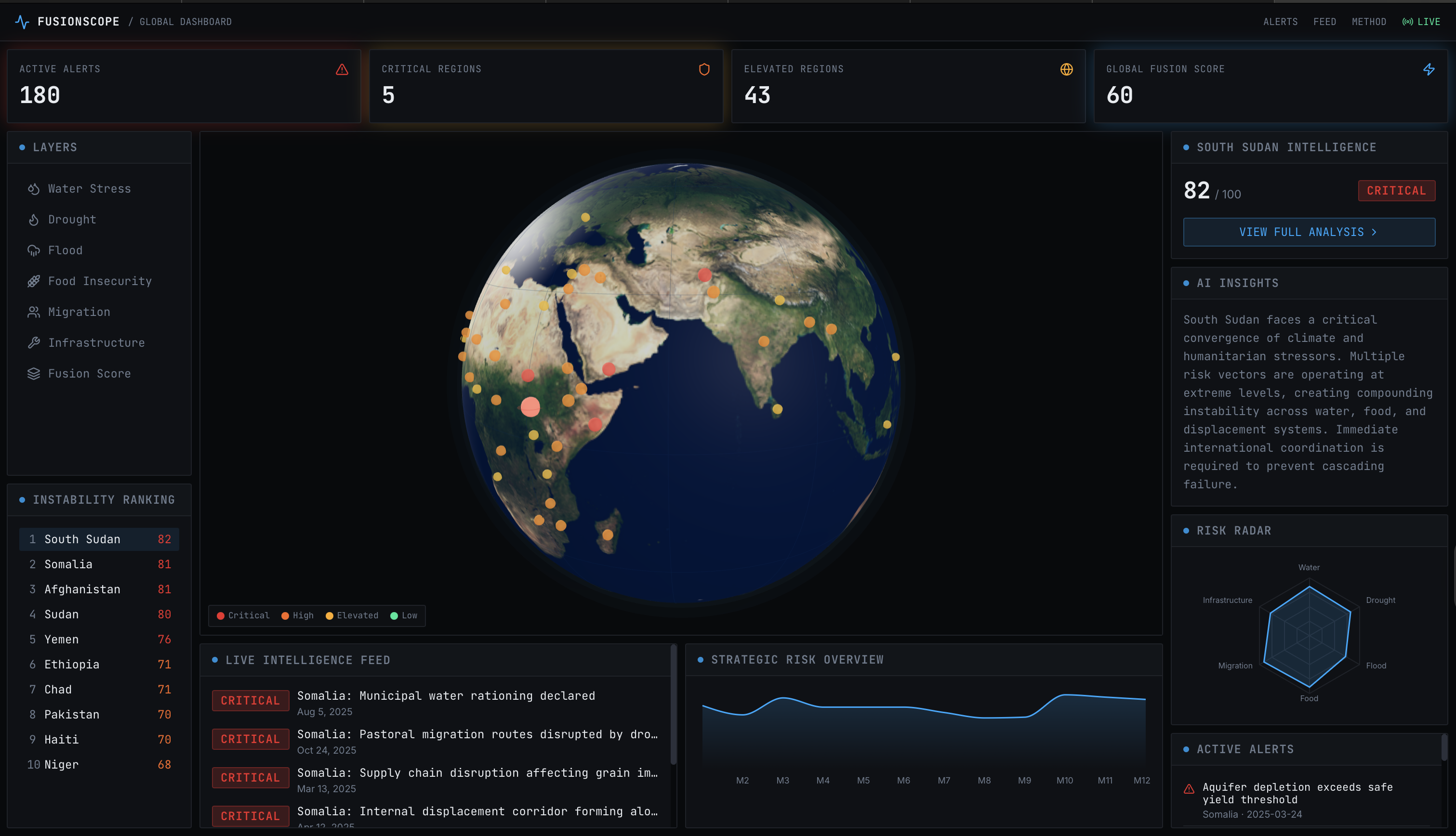
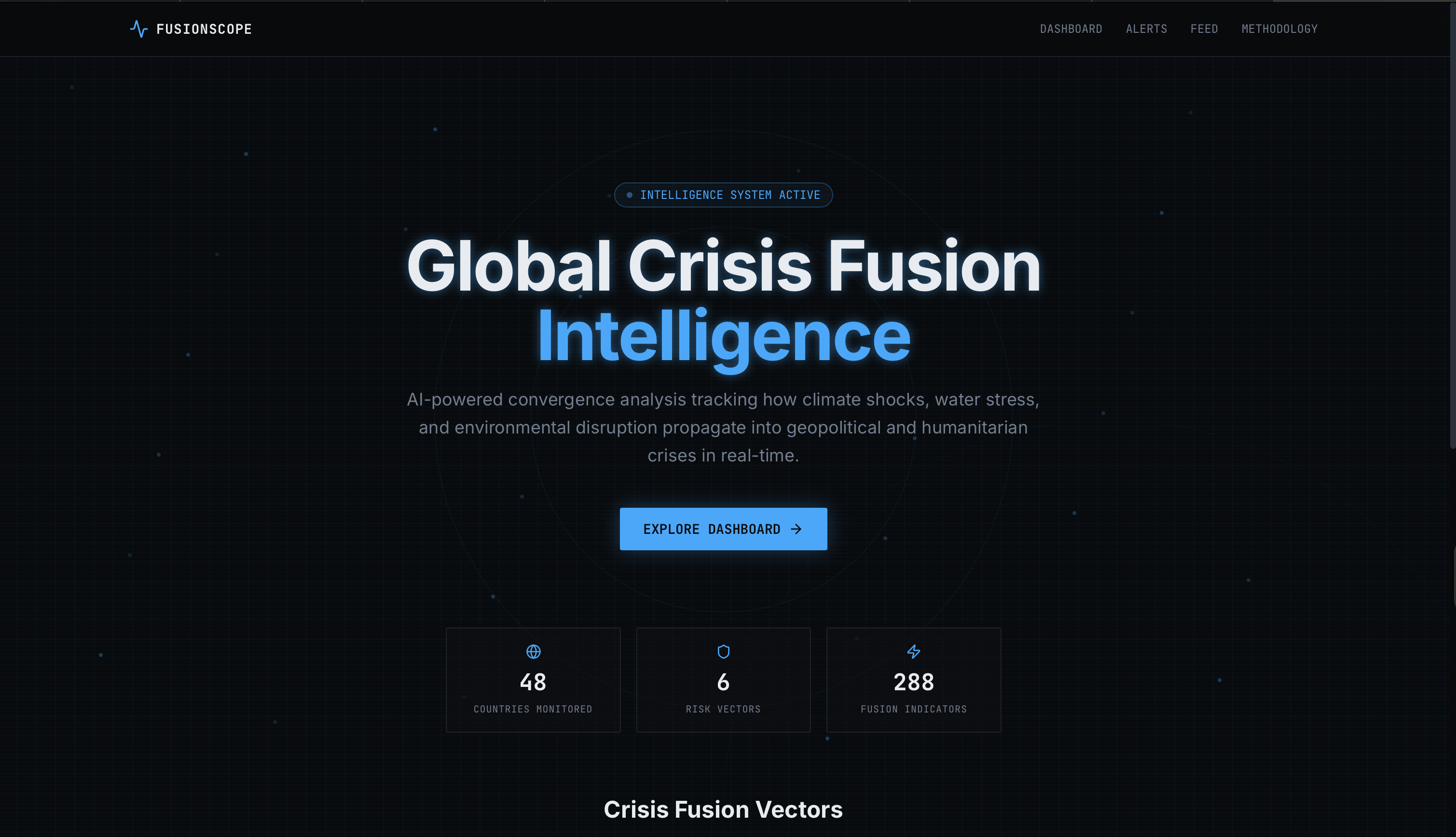
FusionScope is a global crisis intelligence platform that transforms disconnected data into a single, coherent view of risk. It tracks over 48 countries and analyzes six key dimensions: water stress, drought, flood, food insecurity, migration pressure, and infrastructure disruption. At the core of the system is a fusion score, which combines all six factors into a single interpretable metric that reflects systemic risk. Instead of navigating multiple dashboards or datasets, users can instantly identify global hotspots, understand why regions are at risk, and monitor how those risks are evolving. FusionScope turns complexity into clarity and enables faster, more informed decision-making.
How we built it
FusionScope is a full-stack, production-ready application built for performance, reliability, and rapid deployment. The frontend is developed using React, TypeScript, Vite, and Tailwind CSS, creating a high-density interface that resembles real-world intelligence platforms. The backend is powered by FastAPI and structured through a clean API architecture, backed by a seeded dataset representing realistic global conditions. We designed a fusion algorithm that combines all six risk vectors using weighted scoring to generate a meaningful and actionable index. To ensure robustness, we implemented a centralized API client with a fallback mechanism, allowing the frontend to remain functional even if backend services fail. This architecture allowed us to balance speed and reliability under strict time constraints.
Challenges we ran into
One of the biggest challenges was integrating multiple systems under intense time pressure while maintaining stability. We were building the frontend, backend, and deployment pipelines simultaneously, which led to issues with data consistency, schema mismatches, and API reliability. Deployment introduced additional complexity, as backend services required time to stabilize, and environment differences caused unexpected failures. Instead of allowing the system to break, we designed around failure by implementing fallback mechanisms, standardizing data contracts, and prioritizing stability over unnecessary complexity. This approach allowed us to deliver a functional and resilient system despite real-world constraints.
Accomplishments that we're proud of
We successfully built a complete,production-ready full-stack intelligence platform within a hackathon timeframe. The fusion scoring system is a key accomplishment, as it transforms multiple complex variables into a single metric that is immediately useful for decision-making. The user interface is another major achievement, delivering a polished and professional experience that feels like a real intelligence terminal rather than a prototype. Most importantly, we created a system that remains usable even when parts of the infrastructure fail. This is not just a demonstration, but a practical and deployable product.
What we learned
We learned how to move from concept to execution rapidly while maintaining system integrity. One of the most important lessons was the need for clear data contracts between frontend and backend systems. Aligning expectations early significantly improves development speed and reduces friction. We also learned that reliability is as important as functionality. Building fallback systems and handling failure cases made the product far more robust. Finally, we learned that combining multiple simple components into a unified system can create significantly more value than building isolated features.
What's next for FusionScope
FusionScope is only the beginning. Our next step is to integrate real-time data sources to replace seeded datasets and enable live global monitoring. We also plan to introduce predictive capabilities that forecast risk trends and identify emerging crises before they escalate. Additional enhancements will include advanced geospatial visualization, country comparison tools, and deeper analytical features. Our long-term vision is to evolve FusionScope into a decision intelligence platform that can be used by governments, NGOs, and global organizations to proactively manage risk and respond more effectively to global challenges.


Log in or sign up for Devpost to join the conversation.