-
-

Logo
-
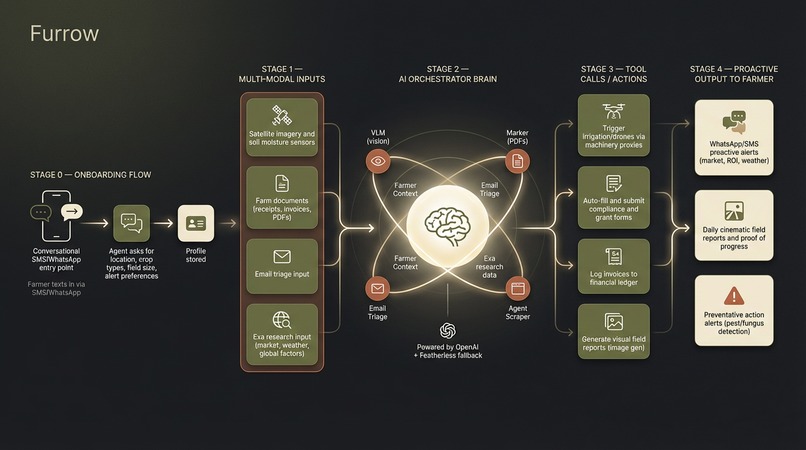
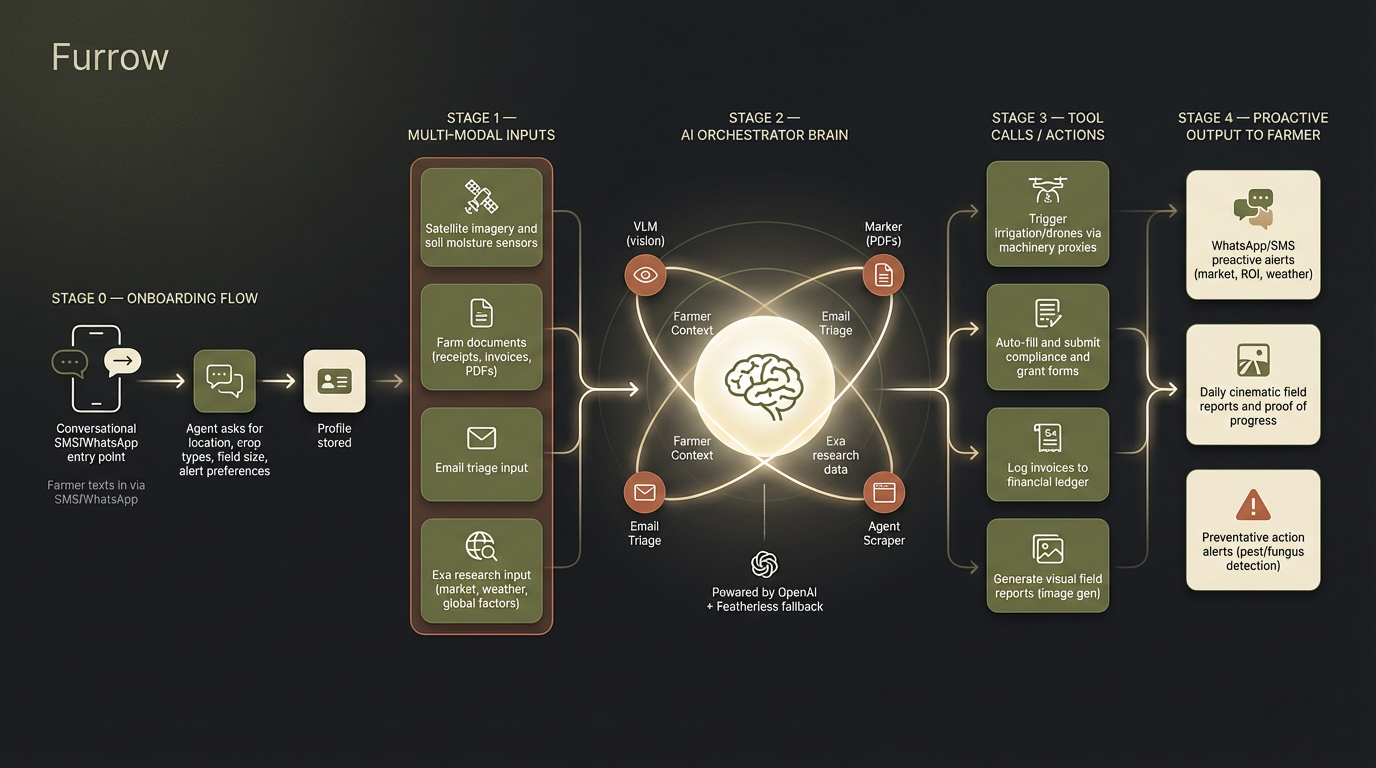
Agentic Workflow
-
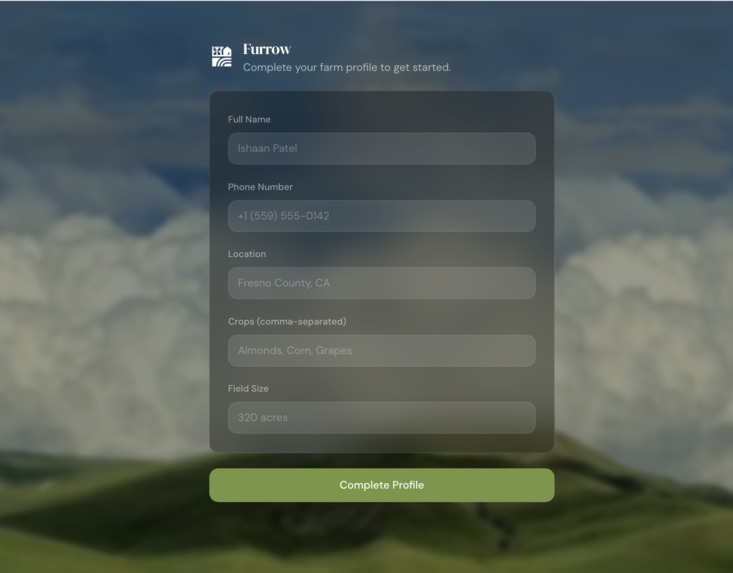
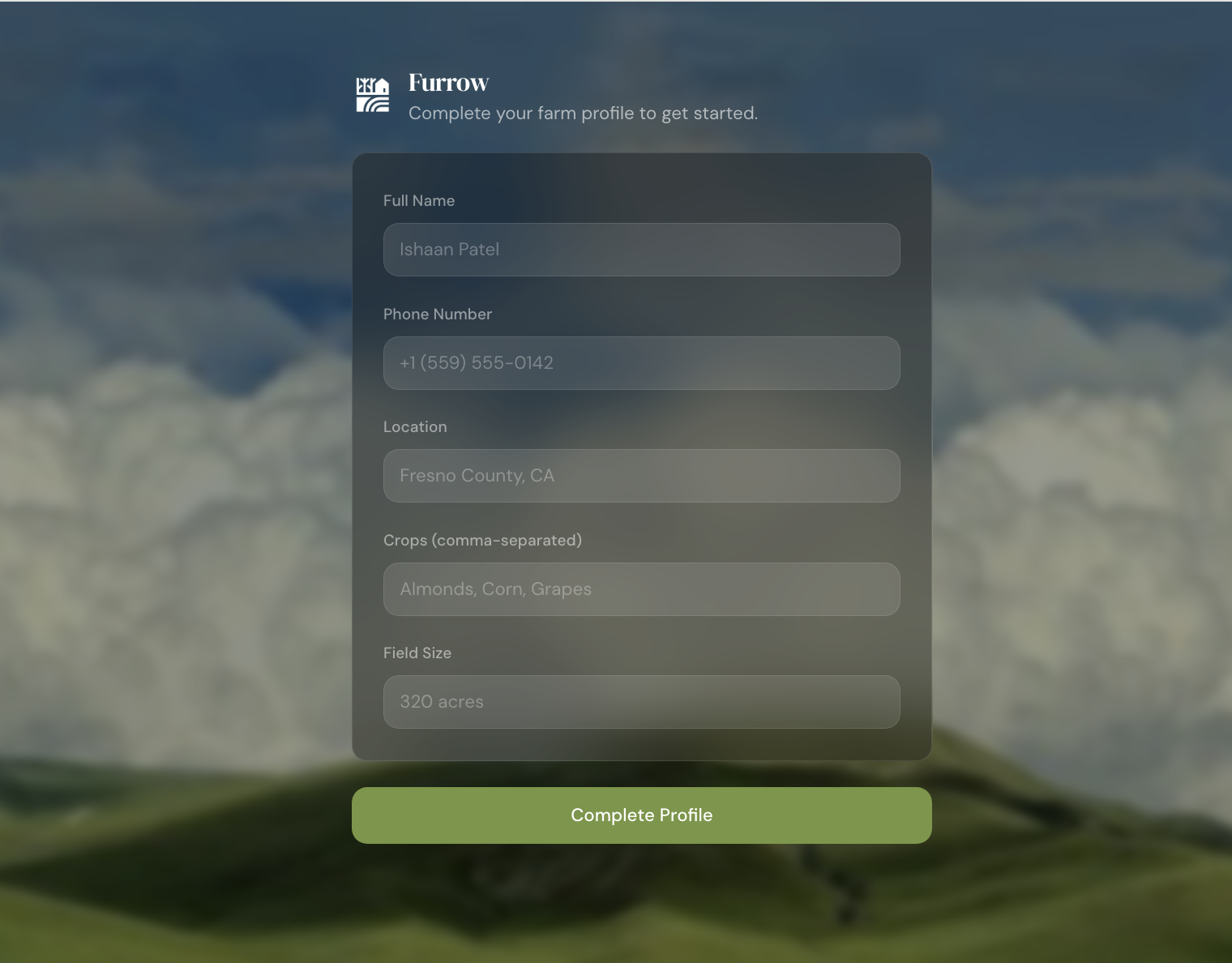
Onboarding Form
-
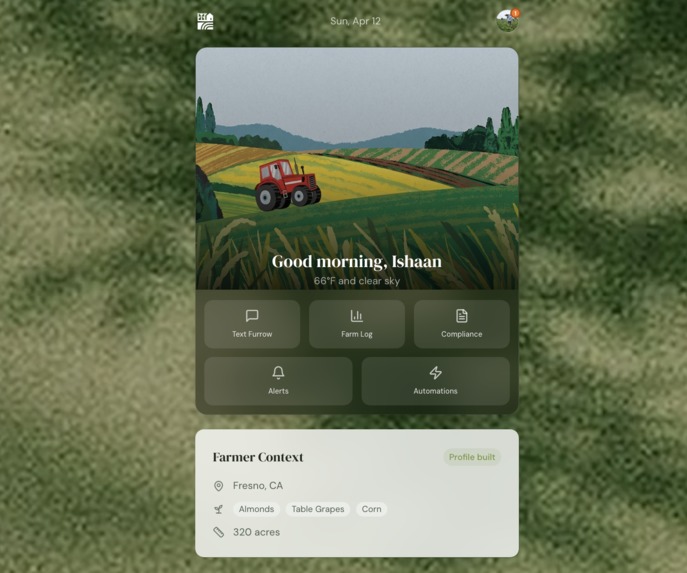
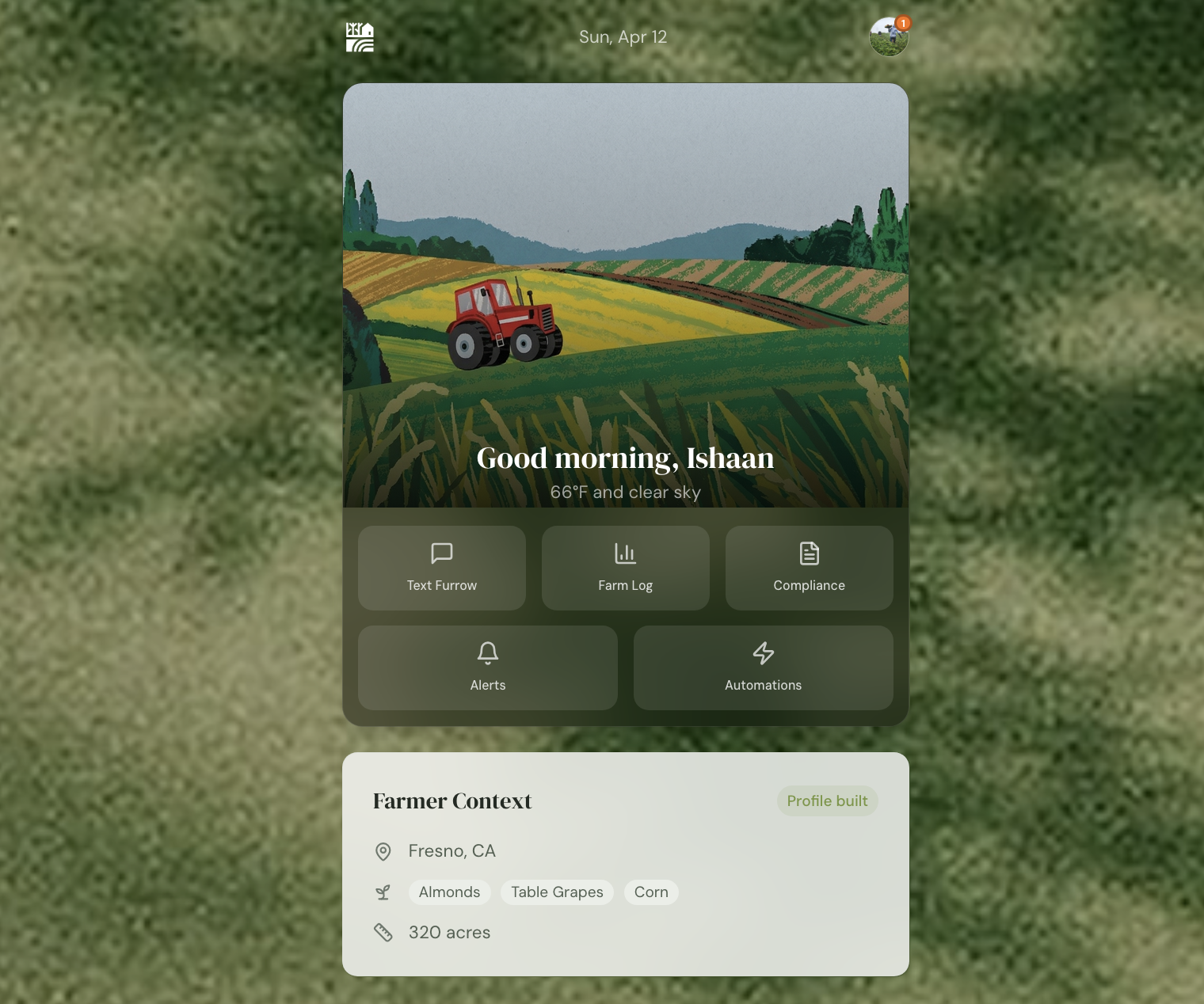
Onboarding Landing Page
-
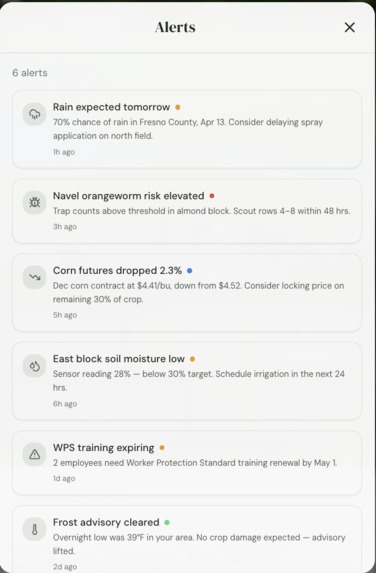
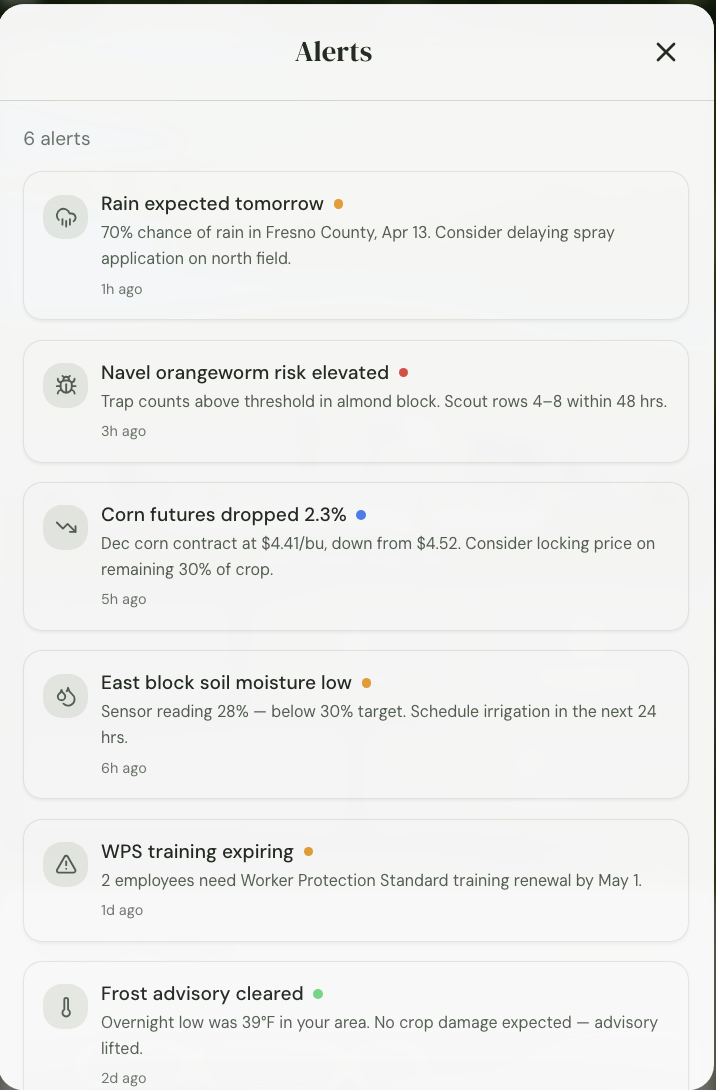
Alerts
-
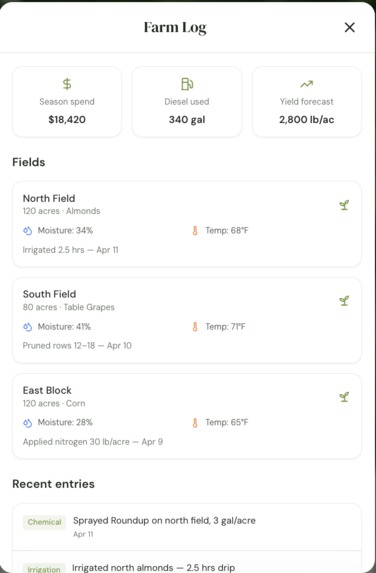
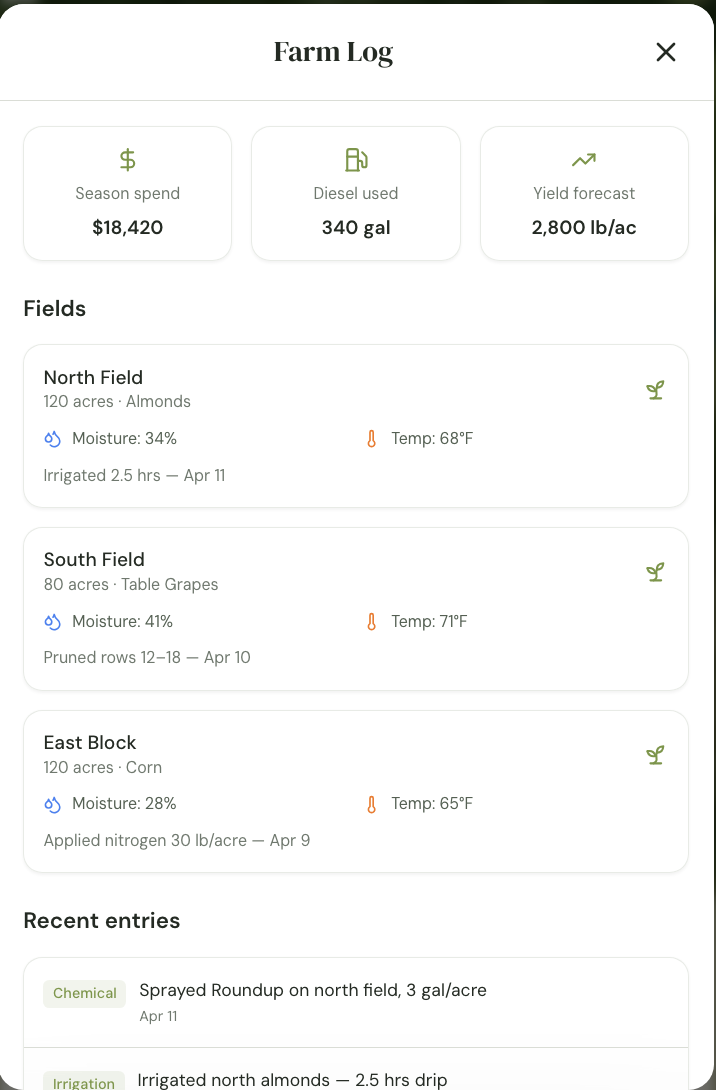
Farm Log
-
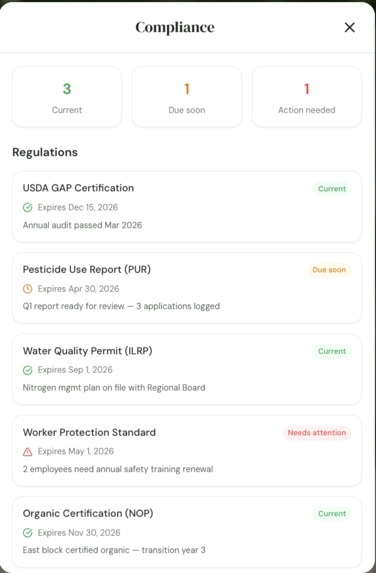
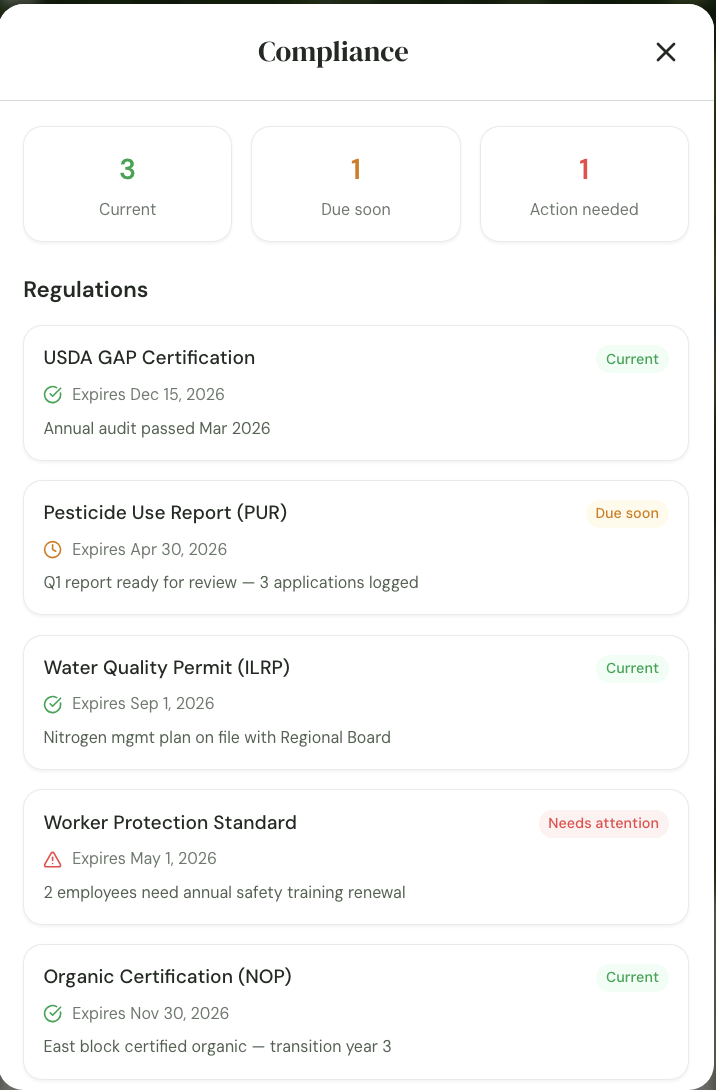
Compliance
-



Inspiration
Farmers don't sit at computers — they're in the field at 6 AM making split-second decisions about whether to spray, sell, or wait. Most farm software requires a laptop, a login, and training they don't have time for. The insight was simple: farmers already have a phone. What if their farm advisor lived in their messages?
We built Furrow for the farmer who sends a voice note with muddy gloves on, snaps a photo of a sick corn plant, and needs a real answer in under 30 seconds — not a dashboard to log into.
What it does
Furrow is an AI farm advisor that lives in your messaging app. Farmers send text, voice notes, or photos and get back actionable intelligence:
- Conversational logging — messy voice notes, photos, or plain text get transcribed, analyzed, and turned into structured farm log entries with chemical REI/PHI compliance checks and natural reply confirmations
- Crop and receipt vision — photos are automatically classified as crop images (disease, pest damage, drought stress) or purchase receipts (auto-logged chemical applications) and handled accordingly
- Proactive daily briefings — FarmPulse morning summaries cover weather impact, commodity price movement, budget burn, soil sensor readings, upcoming compliance deadlines, and a recommended next action. Farmers can drill down on any item by replying.
- Real-time market research — Exa-powered web research pulls live USDA reports, drought and climate outlooks, and global factors like fertilizer prices and trade policy that affect farm economics
- Specialist integrations — Gmail and Google Calendar via Composio, image generation via Gemini, and GPT-4o vision run as parallel specialist pipelines triggered by intent
How we built it
Furrow runs on a FastAPI backend deployed on Railway, with inbound messages arriving via Sendblue webhooks. The core is a 3-tier routing architecture that keeps latency low for simple messages while handling complex requests through full agentic pipelines:
- Reflex tier — GPT-4o-mini handles greetings and small talk in ~1 second
- Composer tier — parallel specialist agents (vision, research, integrations) feed into GPT-4o as a reply composer, producing 1–3 humanized conversational bubbles
- Hermes tier — a Dockerized agent sandbox with Kimi K2.5 handles complex multi-step tasks via the OpenAI Agents SDK
Before any message hits the agent loop, all media is pre-processed in parallel: voice notes go through Groq Whisper large-v3-turbo, images through GPT-4o vision — converting everything to clean text context the orchestrator can reason over. An IntentRouter classifies each message and routes it to the right tier and specialists. A BubbleDispatcher handles humanized delays, rate limiting, typing indicators, and delivery.
The web dashboard (Vite + React + shadcn/ui) handles onboarding via HMAC-signed SMS links. Farmers fill a 60-second profile form and Furrow personalizes every response from then on. Farmer data persists in PostgreSQL via SQLAlchemy.
Challenges we ran into
- Kimi URL truncation — Kimi K2.5 was silently dropping path segments from image URLs when constructing tool call arguments. We solved it by pre-analyzing all images before the agent loop so the LLM never touches a raw URL.
- Featherless concurrency limits — Kimi costs 4 compute units per request on our plan, meaning only 1 concurrent request at a time. We moved the orchestrator to Groq and reserved Kimi purely for reply composition.
- Reliable multimodal tool calling — getting an LLM to consistently call the right tools for audio + image + text arriving in one message took real iteration. The pre-analysis pattern — process everything first, inject results as text — was the breakthrough.
- 3-tier routing under a deadline — designing clean interfaces between the Reflex, Composer, and Hermes tiers so three people could build in parallel without stepping on each other required upfront architecture discipline that paid off fast.
Accomplishments that we're proud of
- A fully multimodal pipeline: voice note → transcription → image analysis → intent routing → agentic reasoning → grounded market research → personalized reply bubbles, all triggered by a single message
- A vision pipeline that auto-classifies crop photos vs. purchase receipts and handles each through a different specialist flow
- Exa-powered responses grounded in real 2026 USDA data, not hallucinated market guesses
- A complete onboarding flow: SMS link → profile form → backend persistence → personalized agent context
- A 3-tier routing system that delivers ~1s responses for simple messages while supporting full multi-step agentic tasks for complex ones
- The pre-analysis pattern — a reliable architecture decision we arrived at under pressure that we'd use again on any multimodal project
What we learned
- Pre-processing media before the agent loop is dramatically more reliable than asking the LLM to call tools on raw URLs
- Model routing is an architecture decision: Whisper for audio, GPT-4o for vision and composition, Kimi K2.5 for complex agentic tasks, GPT-4o-mini for fast-path reasoning, Exa for real-time knowledge — each model doing what it's best at
- Meeting users where they already are (SMS and messaging apps) is more powerful than building the perfect app nobody opens
- Tier-based routing lets you optimize for both speed and capability without sacrificing either — fast messages feel instant, complex ones still get handled correctly
- Parallel development with clean service boundaries is what made a hackathon team ship a full-stack multimodal agent in a weekend
What's next for Furrow
- Expanded messaging platform support — broader coverage so farmers can reach Furrow from wherever they already communicate
- Proactive push alerts — not just daily briefings but real-time notifications for frost risk, spray windows, and compliance deadlines as conditions change
- Calendar integration — auto-set REI/PHI reminders immediately after chemical applications are logged
- Bank and co-op connections — pull input costs and loan data directly into the agent context for real margin analysis
- Expand coverage — more crops, more regions, Spanish-language support for the ~40% of US farmworkers who are Spanish-speaking
Built With
- alembic
- composio
- docker
- exa
- fal-ai
- fastapi
- featherless
- gemini
- groq
- lovable
- open-mateo
- openai
- postgresql
- pydantic
- python
- railway
- sendblue
- sqlalchemy
- vercel


Log in or sign up for Devpost to join the conversation.