-
-
cover
-
-
-
Inspiration 🐍
In Mexico and Latin America, many small and medium-sized businesses (SMEs) rely on technology for their day-to-day operations but lack the resources to prevent failures before they happen.
Most tools send alerts only after a problem has occurred, causing losses and affecting customers.
That’s why we created CoyoteCoders — Zikit, inspired by the motto “Before the phone rings.” Our goal is to anticipate problems and send timely alerts so businesses like Gracko, Gramo, Kaiku, and TTR can prevent failures before they affect their operations.
What it does🐍
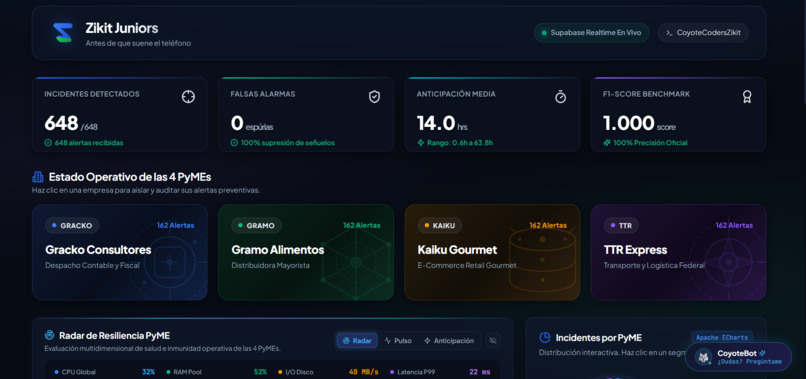
CoyoteCoders — Zikit is a predictive monitoring platform designed to help SMEs detect potential failures before they affect their operations. It analyzes metrics such as CPU usage, memory, storage, and response times to generate early alerts and recommend preventive actions.
Key features
- Predictive detection: Monitors four business profiles and anticipates risks based on their needs:
- Gracko: Prevents problems in billing and payroll processes.
- Gramo: Detects inventory and performance risks.
- Kaiku: Anticipates failures that could affect online sales.
- TTR: Identifies problems that could disrupt GPS tracking and logistics.
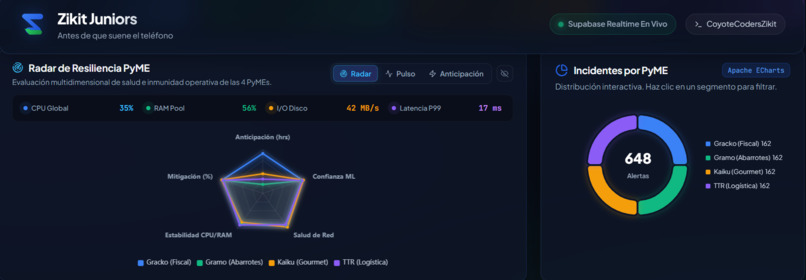
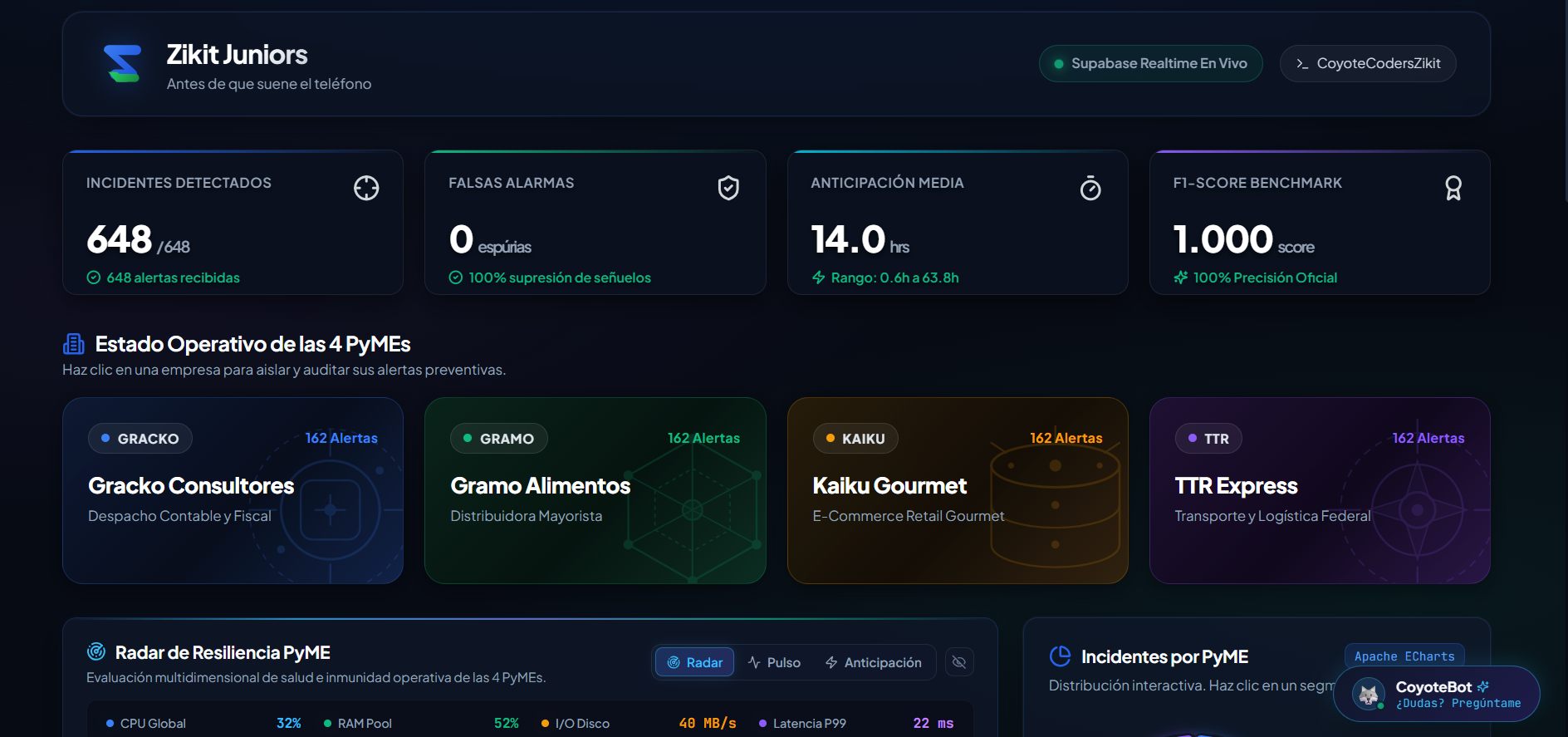
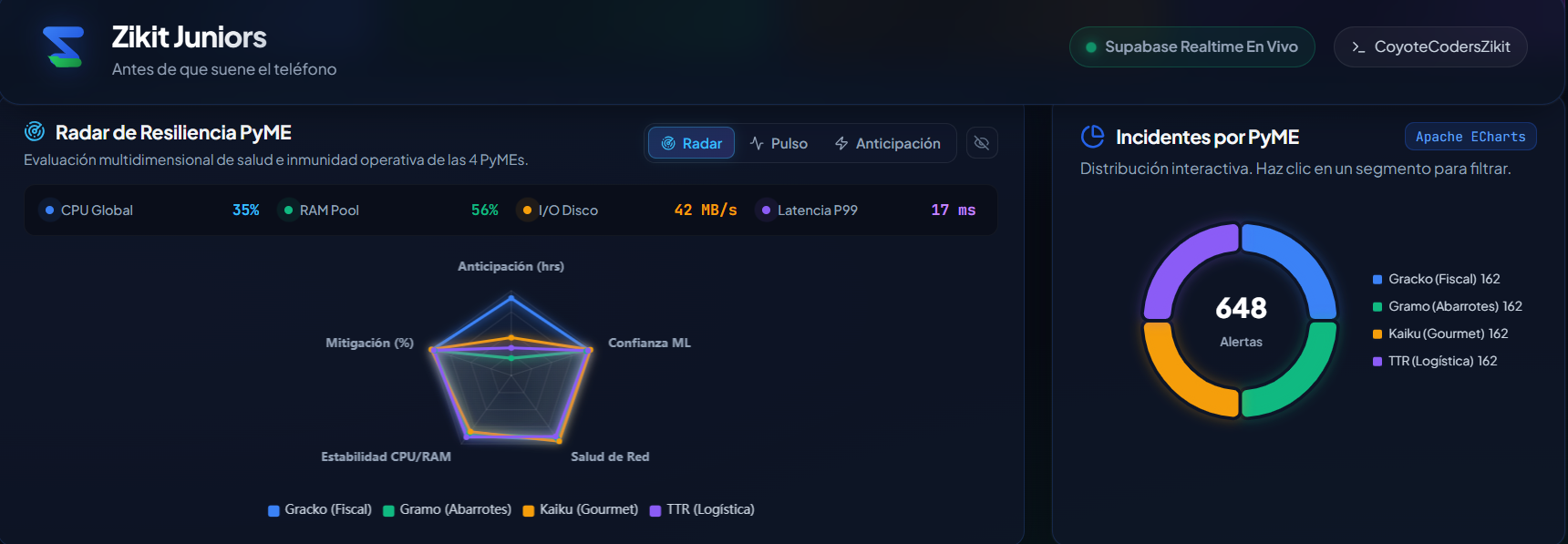
- Real-time monitoring dashboard: Displays performance, stability, and service health indicators through interactive charts.
- Incident analysis: Shows how each problem develops, its possible causes, and recommendations for resolving it, with an option to export the diagnosis.
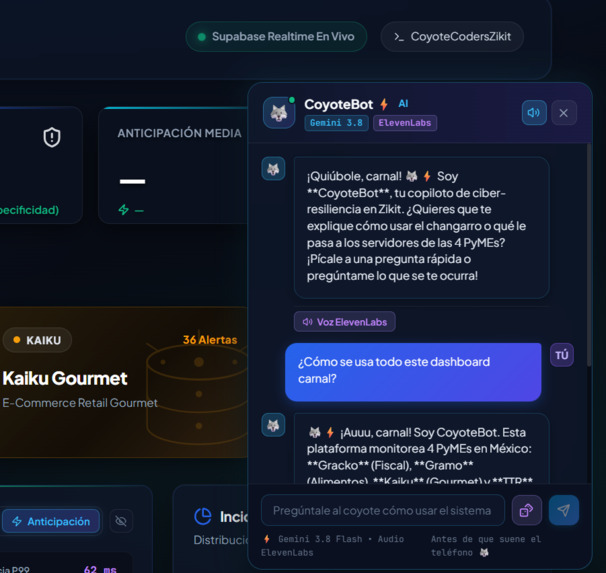
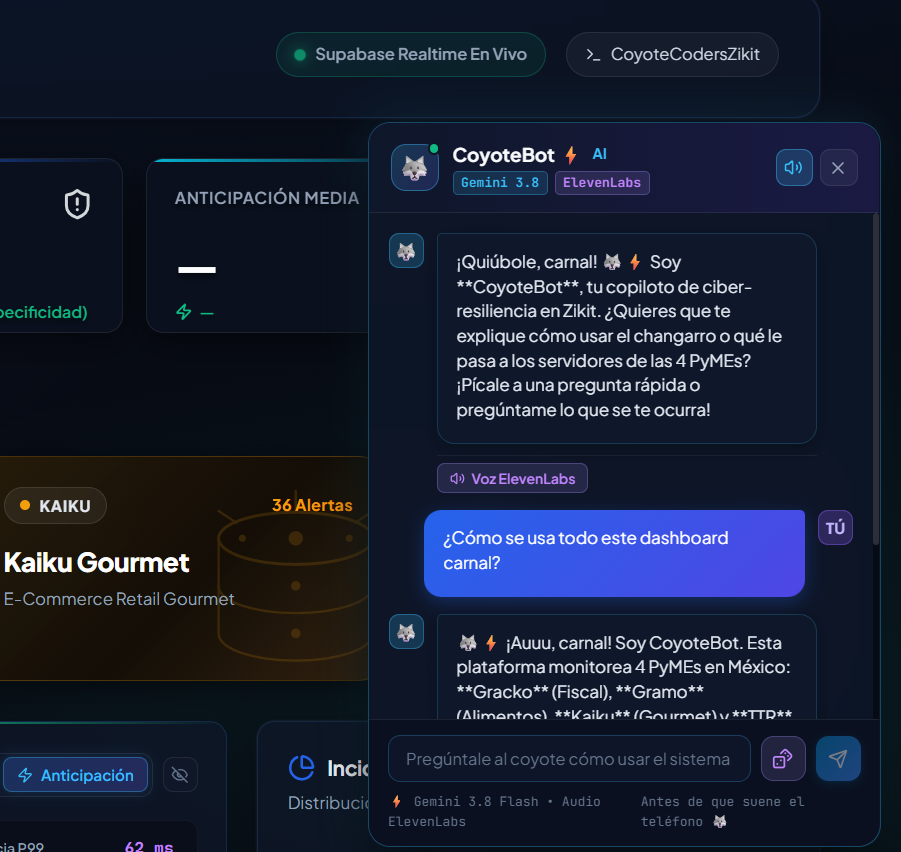
- CoyoteBot 🐺, an AI assistant: Explains alerts and system components through text and voice responses, making technical problems easier to understand.
- Audit tools: Allows users to filter incidents by company and confidence level, upload CSV files, and export reports for analysis.
The main goal is to move from reacting to failures to anticipating them, giving SMEs the tools to act before their services are affected.
How we built it🐍
We developed CoyoteCoders — Zikit by combining a predictive analysis engine, a real-time web interface, and artificial intelligence tools to anticipate failures and make them easier to diagnose.
Backend and causal engine
- Python 3.10 + FastAPI + uv: A lightweight, high-performance backend for processing metrics and managing alerts.
- Causal detection engine: Uses sliding windows and trend analysis to identify anomalies before they become incidents.
- Context-aware operational calendar: Takes each SME’s patterns into account, such as payroll closing periods, nightly backups, and promotions, to reduce false alarms.
- WebSockets and Supabase Realtime: Keep indicators, alerts, and system events synchronized.
Storage and traceability
- TigerData (TimescaleDB): An integration focused on efficient time-series management, making it easier to store, query, and analyze large volumes of historical telemetry.
- Solana: A traceability layer that records cryptographic fingerprints of alerts to verify their existence and demonstrate that they were generated before the operational impact.
Frontend and visualization
- React 19 + Vite 6: A modular, reactive interface for checking the status of each company.
- Apache ECharts: Interactive charts for visualizing resilience, real-time telemetry, alert lead times, and incidents.
- Custom CSS: Responsive design, lightweight animations, and an interface that adapts to computers and mobile devices.
Artificial intelligence and voice
- Google Gemini + Backboard: An intelligent assistant with operational context for all four SMEs and an architecture designed to expand access to AI models and manage fallback options in case of failures or availability limits.
- ElevenLabs TTS: Voice response generation with multilingual support, temporary audio storage, and a fallback through the Web Speech API.
- CoyoteBot 🐺: A copilot that explains alerts, possible causes, and mitigation recommendations in accessible language.
- Vultr: Everything is deployed on a server at https://66.42.82.247/dashboard/.
- Deployment (Vultr): The same Docker Compose file runs locally and in production.
Evaluation and reliability
- Pytest + evaluator.py: Automated tests to validate system behavior and evaluate early alert detection. The suite includes 24 unit and integration tests that run in under 0.4 seconds.
The architecture is designed so SMEs can understand what is failing, anticipate risks, identify their causes, and act before those risks affect their operations.
Challenges we ran into🐍
- Distinguishing anomalies from normal behavior: Nightly backups and scheduled processes can cause spikes in CPU usage and traffic. We developed an operational calendar that takes each SME’s routines into account to reduce false alarms and detect truly unusual behavior.
- Anticipating failures accurately: We adjusted thresholds and analyzed metric trends to generate alerts before a service goes down, aiming to meet the rule t_alert ≤ t_impact without overwhelming users with unnecessary notifications.
- Visualizing data even without telemetry: We designed dynamic indicators and interactive charts that keep the dashboard informative while data comes in, making continuous system monitoring easier.
- Optimizing AI voice responses: We implemented a speech synthesis process that removes formatting from responses, prioritizes relevant content, and temporarily stores audio so it can be played without making additional requests to ElevenLabs.
These challenges led us to prioritize three things: reliable anticipation, fewer false alarms, and a clear, accessible monitoring experience.
What we learned🐍
- Business context matters more than raw data: A CPU or RAM reading on its own tells you nothing. Knowing the day of the week and which process an SME is running turns a false positive into an accurate conclusion.
- Explainability is essential: SME system administrators don’t trust AI black boxes that say “89% likelihood of failure.” They need to see why: which resource is running out, how quickly it is changing, and what the step-by-step contingency plan is.
- Real-time full-stack synchronization: We learned to orchestrate WebSockets, LLM agents, neural audio streaming, and vector graphics within a lightweight stack without overloading memory or slowing down the browser.


Log in or sign up for Devpost to join the conversation.