Inspiration
I have cats, so I know how naughty and persistent they can be. That became the starting point for Furball Diplomacy: what if defending against cats meant dealing with their curiosity, stubbornness, and complete inability to ignore a dangling toy?
I wanted to bring comedy to tower defense and make something approachable even for people who don’t usually play the genre.
What it does
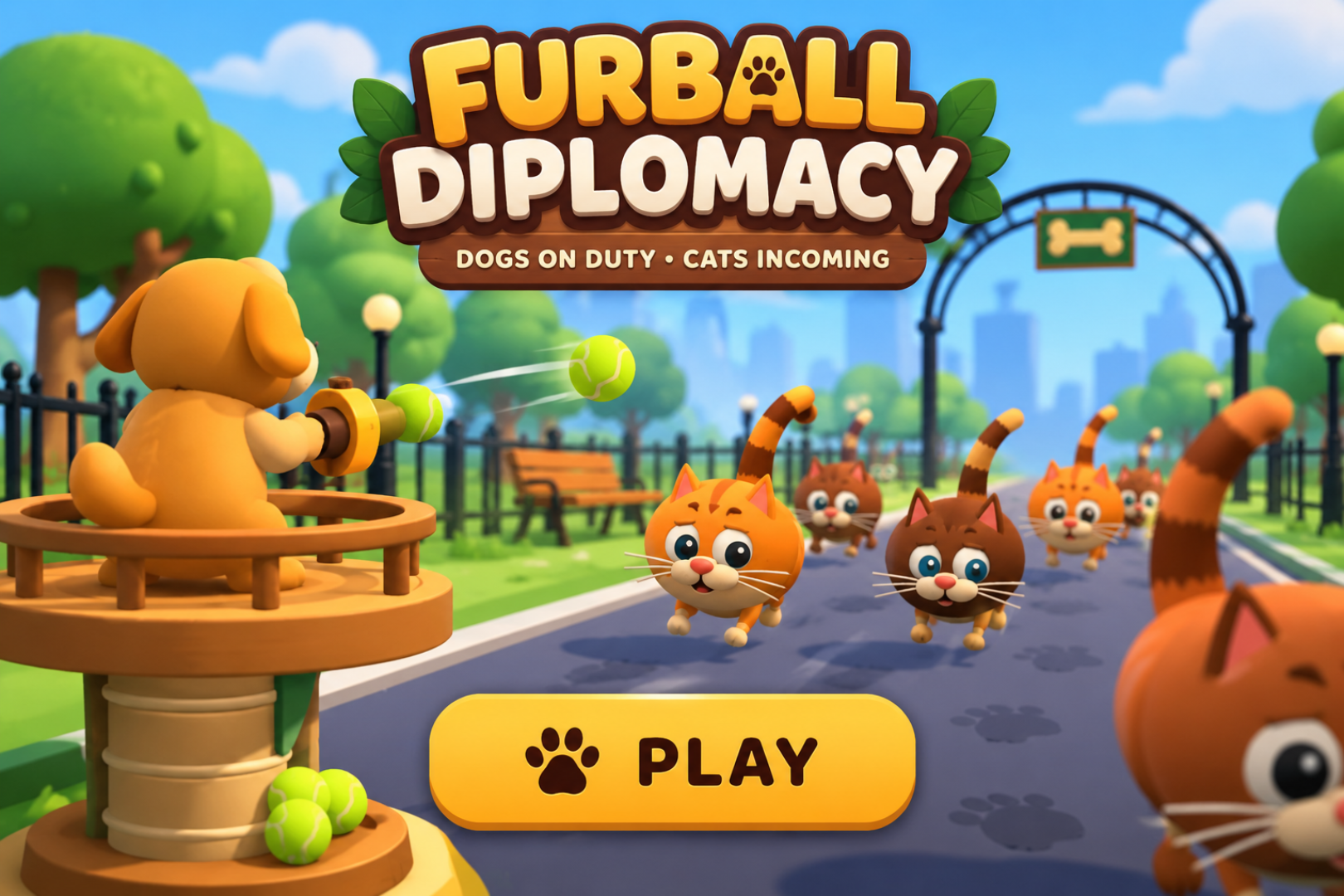
Furball Diplomacy is a single-player, portrait tower-defense game where dogs protect their park from nine waves of mischievous cats.
Players build and upgrade defensive towers, deploy distractions such as a dangling toy, laser pen, catnip, and falling fish, and choose a park power: sprinklers, a chicken chase, or a dog-operated leaf blower. The challenge is balancing spending and timing while the cats cause chaos
How we built it
The game was built through AI-assisted development using Codex, with additional input from Claude. It uses Three.js for its 3D world and runs in a browser.
Development involved repeated playtesting on computers, phones, and tablets. Watching other people play was especially useful: their unexpected taps and confused reactions often told us more than our own testing did.
Challenges we ran into
Moving between AI tools with limited shared context made it challenging to maintain a consistent direction and an accurate build log.
Another challenge was making the game understandable. Early ideas involving rescuing cats and assigning them to towers sounded interesting, but players struggled to understand them. We simplified those systems and concentrated on clearer choices.
The 3D presentation needed iteration too. Camera movements could obscure the action or feel disorienting, and character animations sometimes communicated something very different from what we intended.
Accomplishments that we're proud of
The biggest accomplishment is that the game became genuinely fun to play - not just technically functional.
The distractions are a particular highlight. Watching an advancing group of cats abandon its mission for a toy or catnip gives the game the playful personality we were hoping for.
We’re also proud of how much real player feedback shaped the result, from clearer controls to more readable tower upgrades.
What we learned
We learned to use 3D space to help players enjoy and understand the action, rather than moving the camera simply because we could.
We also learned that an impressive feature isn’t necessarily a useful one. Sometimes removing a mechanic, shortening a message, or leaving the camera alone improves the experience more than adding another effect.
What's next for Furball Diplomacy
We’d love to add more levels, each with its own strange setting, environmental powers, and distractions.
A space level is particularly tempting: there’s plenty of potential for ridiculous cat behaviour in zero gravity. The aim would be to keep the core game familiar while giving players new situations to laugh at - and new strategies to discover.
Built With
- claude
- css3
- html5
- javascript
- openai-codex
- three.js
- web-audio-api
- webgl
