-
-
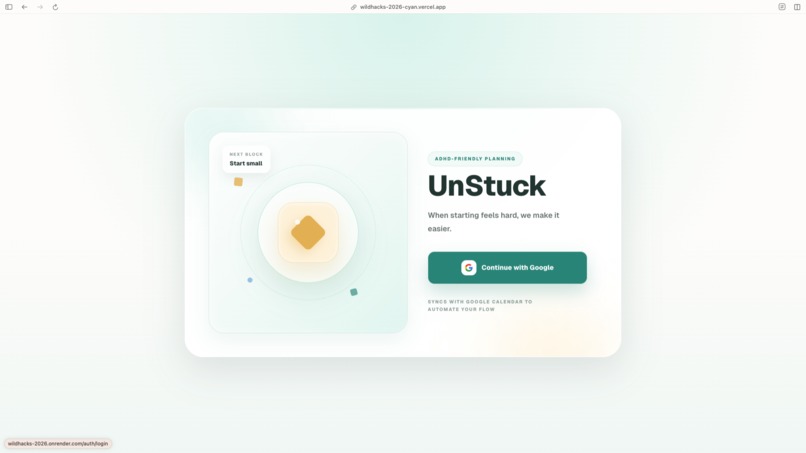
Login Screen
Inspiration
Executive dysfunction—a core symptom of ADHD—often makes massive, ambiguous tasks feel impossible to start. We saw how traditional task managers and calendars only make this worse by demanding meticulous manual scheduling and presenting overwhelming walls of text. We wanted an application that served less as a "list" and more as an empathetic, proactive coach. We set out to build an ambient assistant that handles the cognitive load of planning, breaking things down, and adjusting schedules, so the user only has to focus on one small, actionable step at a time.
What it does (Makes task less confusing for ADHD people)
Unstuck is an agentic AI schedule manager and focus application purposely built to minimize cognitive overwhelm.
- Agentic Breakdown: Users simply "brain dump" what they need to do into a conversational chat interface. The AI parses the dump, breaks it down into 1-5 tiny, highly specific subtasks, and assigns accurate time estimates.
- The Honest Estimator: ADHD often causes "time blindness" (underestimating how long tasks take). Unstuck quietly measures how long users actually take to complete tasks versus their original estimates. It builds a personalized "Deviation Ratio" and uses an invisible background algorithm to automatically multiply future task estimates by this ratio, protecting the user from overbooking themselves.
- Automated Workflow: Unstuck connects natively to your Google Workspace. If a subtask requires starting an essay or writing an email, the AI automatically spins up templates in Google Docs or creates Drafts in Gmail behind the scenes so the "scary blank page" hurdle is already crossed when the user hits Focus Mode.
- Ripple-Effect Rebalancing: We implemented a Priority-Weighted Earliest Deadline First (PW-EDF) algorithm. If a user needs an extra 15 minutes, they hit a button; the platform automatically ripples through their Google Calendar and safely pushes non-fixed events backward without breaking hard deadlines.
- ADHD-Targeted Gamification: We engineered a Gem and Streak system to provide immediate dopamine hits. Finishing subtasks awards gems, while finishing parent blocks builds a streak. Crucially, we implemented an "ADHD Tax Avoidance" system—if a streak breaks because a task was missed, users can spend Gems to buy their streak back, removing the shame usually associated with missed habits.
How we built it
We split the architecture into a heavily decoupled frontend and backend:
- Frontend: Next.js and Tailwind CSS mapped out to a beautiful, modern "Liquid Glass" UI. We focused on keeping distractions low; the Focus Mode completely strips out the overall task and time pressures, showing only the next single step and a rounded minute-counter.
- Backend & AI Architecture: We used Python FastAPI connected to a MongoDB backend (via Beanie ODM). For our AI, we utilized Google Gemini (2.5 Flash). We designed a custom "Megaprompt" schema approach to let the AI output natural conversational coaching alongside deeply structured JSON scheduling blocks in a single, fast API call, minimizing rate limits.
- Integrations: We used Google OAuth to grant the platform seamless read/write scope to Google Calendar, Google Docs, and Gmail templates. We hosted the platform actively via Vercel (for Next.js) and Render (for the Python API).
Challenges we ran into
- AI "Focus Degradation" vs. Rate Limiting: Initially, we asked Gemini to be friendly in one API request, and then rigidly parse task blocks in a second background request. This caused lag and hit free-tier API rate limits. We had to engineer a complex JSON "Megaprompt" that forced the LLM to output both conversational replies and strict application schemas in one shot without hallucinating.
- Complex Google OAuth Flows: Handling scopes for Calendar editing, Docs creation, and Gmail composition simultaneously required tight control over access tokens, refresh loops, and handling user sessions gracefully when token expiry occurred.
- The Math of Time: Handling timezones, mapping continuous events across Google Calendar, and calculating the "Honest Estimator" deviation ratio required highly resilient data structures.
Accomplishments that we're proud of
- Our Focus Mode UI is stunning. It bridges beautiful design with real psychological utility—distilling complex schedules into a single, inviting checkbox without overwhelming the user.
- The "Honest Estimator": Building a backend system that actually learns how a specific user experiences time and automatically re-adjusts their schedule to prevent burnout is a feature we think could genuinely help people.
- Connecting deep, agentic Google Workspace actions: Seeing the AI realize an assignment needs a document, automatically executing the Google Docs API to generate an outlined starter template, and feeding the link right into the user's dashboard felt like magic.
What we learned
Building robust prompts that don't shatter under edge cases is a massive challenge. We learned that the easiest way to give an ADHD user control is actually to take choices away from them. Simplifying the UI, abstracting away the math of shifting calendar blocks, and hiding complex API interactions behind a simple chat window drastically improved the user experience.
What's next for Unstuck
- Expanding our gamification to include customizable habit avatars and a full badge unlocking system.
- Releasing a mobile companion app that interfaces with native iOS/Android notifications to intercept the user immediately when their "Honest Estimates" deviate too far off track.
- Offering deeper data analysis so users can visualize their "Time Blindness" improvements over the course of months!

Log in or sign up for Devpost to join the conversation.