-
Interphase
Inspiration
Thousands of organizations spend hours interpreting grant guidelines, searching through old reports, and rewriting the same information into application forms. Small nonprofits and student organizations often have valuable evidence, but it is scattered across PDFs, spreadsheets, reports, and internal documents.
We wanted to build something more useful than a chatbot that simply answers questions about uploaded files. FundTrace was inspired by the need for a trustworthy workflow that helps organizations understand what a funder requires, connect each requirement to evidence, identify missing information, and prepare an application for human review.
What it does
FundTrace is an AI grant application and compliance workflow assistant.
Users can open a grant project, review extracted requirements and deadlines, upload organization documents, inspect evidence matched to each requirement, generate draft answers and export a review package.
Each draft answer includes its AI generated status, confidence, supporting evidence, and source location when evidence is available. Users can edit, approve, regenerate or flag an answer as needing information. An answer only counts as complete after explicit human approval.
FundTrace never submits an application to a funder. It prepares a reviewable application package and keeps the user in control.
How we built it
We built FundTrace with React 19, TypeScript, Vite, Tailwind CSS, React Router, Vitest, Testing Library and Lucide icons.
The application has a structured domain model for projects, requirements, documents, evidence, drafts, approval states and activity history. A reducer manages workflow state, while versioned localStorage provides persistence for the browse based MVP.
The AI layer uses a provider-independent AiService interface. FundTrace includes a deterministic demo engine that works without an API key and an OpenAI compatible provider integration for real AI analysis. AI responses are validated against schemas and provider citations are checked against documents in the current project before they are displayed.
The application is deployed publicly on Vercel. Its server side API route keeps provider credentials out of the browser.
Challenges we ran into
The main challenge was making AI output useful without presenting it as automatically trustworthy. A fluent answer is not enough for a grant application so we designed the workflow around evidence, confidence, missing information warnings and explicit approval.
We also had to make the product reliable without requiring every judge to configure an API key. Demo mode uses deterministic seeded data and realistic processing states, allowing the complete workflow to be tested consistently while preserving a path to real provider-backed analysis.
Another challenge was handling document limitations honestly. The current MVP processes text-based uploads directly and uses prepared passages for the seeded demo corpus. Unsupported document formats are clearly identified rather than being presented as successfully analyzed.
Accomplishments that we're proud of
We built a complete end to end workflow rather than a single AI prompt:
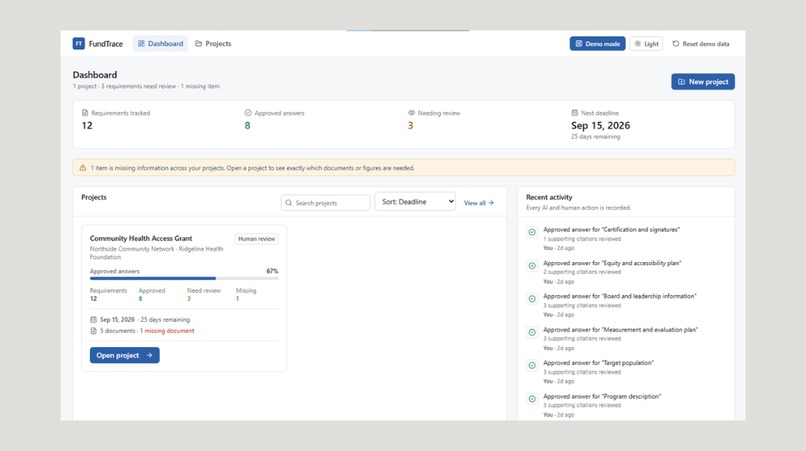
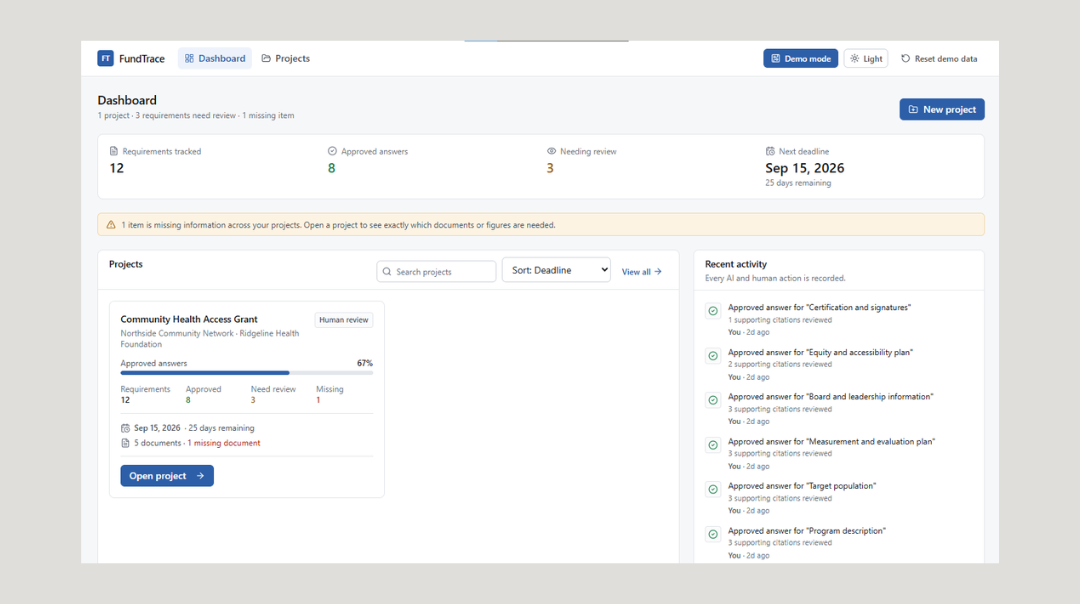
- A project dashboard with deadlines and completion metrics
- Requirement extraction and status tracking
- Evidence matching with source citations
- Missing information detection
- Draft answer generation and editing
- Human approval and audit history
- Document upload and processing states
- Review package export
- Demo mode that works without an API key
- Provider mode with server side credentials
- Responsive and accessible interface
- 77 automated tests covering the domain logic, AI engine, reducer, exports and full user workflow
The most important accomplishment is that FundTrace makes the AI's work inspectable. Users can see why a draft was generated and where its supporting information came from.
What we learned
We learned that the most valuable AI products are often workflow products, not chat products. The AI is useful when it reduces repetitive work, but trust comes from showing evidence, exposing uncertainty, and allowing a person to make the final decision.
We also learned that graceful demo behavior matters. A product should be understandable and testable even when external services are unavailable. Separating the demo engine from the provider integration made the application more reliable and easier to evaluate.
What's next for FundTrace
The next version would add authentication, organization workspaces, a shared database, cloud document storage, and full PDF, DOCX and XLSX extraction.
We would also add background processing for large document sets, stronger permission controls, usage and cost limits, collaboration features and integrations with cloud drives and grant management systems.
The longer term vision is to expand FundTrace beyond grant applications into compliance reporting, permits, audits, and other workflows where organizations must turn scattered documents into verified, reviewable submissions.
