Inspiration
Full Shelf started with lettuce. A recent recall made me wonder what happens when affected food is already moving through a local food bank. What I found was a living operation in which inventory, refrigerated transportation, custody, partner agencies, and community commitments must remain aligned. When any one of those changes, the entire day may need to be replanned.
My enterprise software background made me see the opportunity for an agentic control plane that could plan the day and stay agile as reality changed. Specialized agents could do the coordination while the people responsible for the operation retained authority.
What it does
Full Shelf is an operational control plane for food banks. It brings inventory, transportation, partner commitments, safety eligibility, custody, and approvals into one current operating plan.
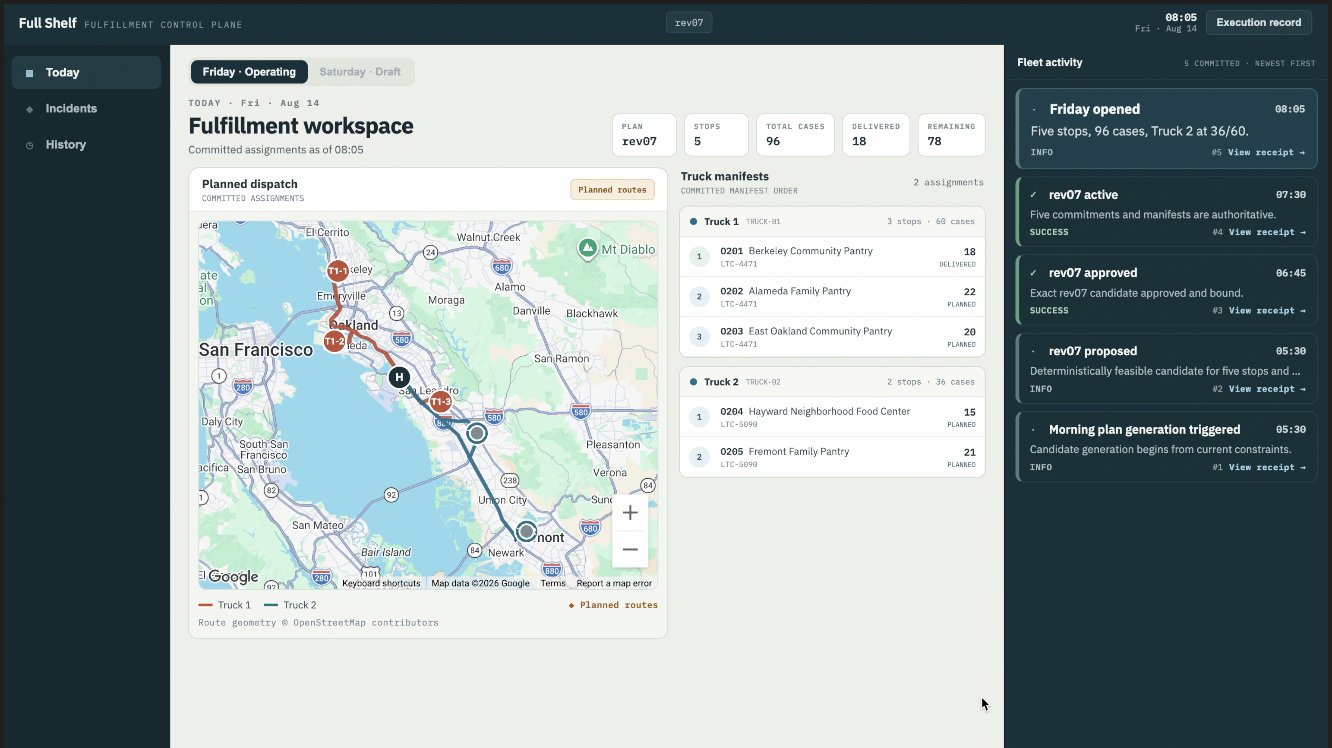
Plan the day. Specialized agents evaluate available food, vehicle capacity, delivery obligations, and operating constraints to produce a feasible plan. Directors can see what can be fulfilled, where capacity is tight, and which commitments already require attention.
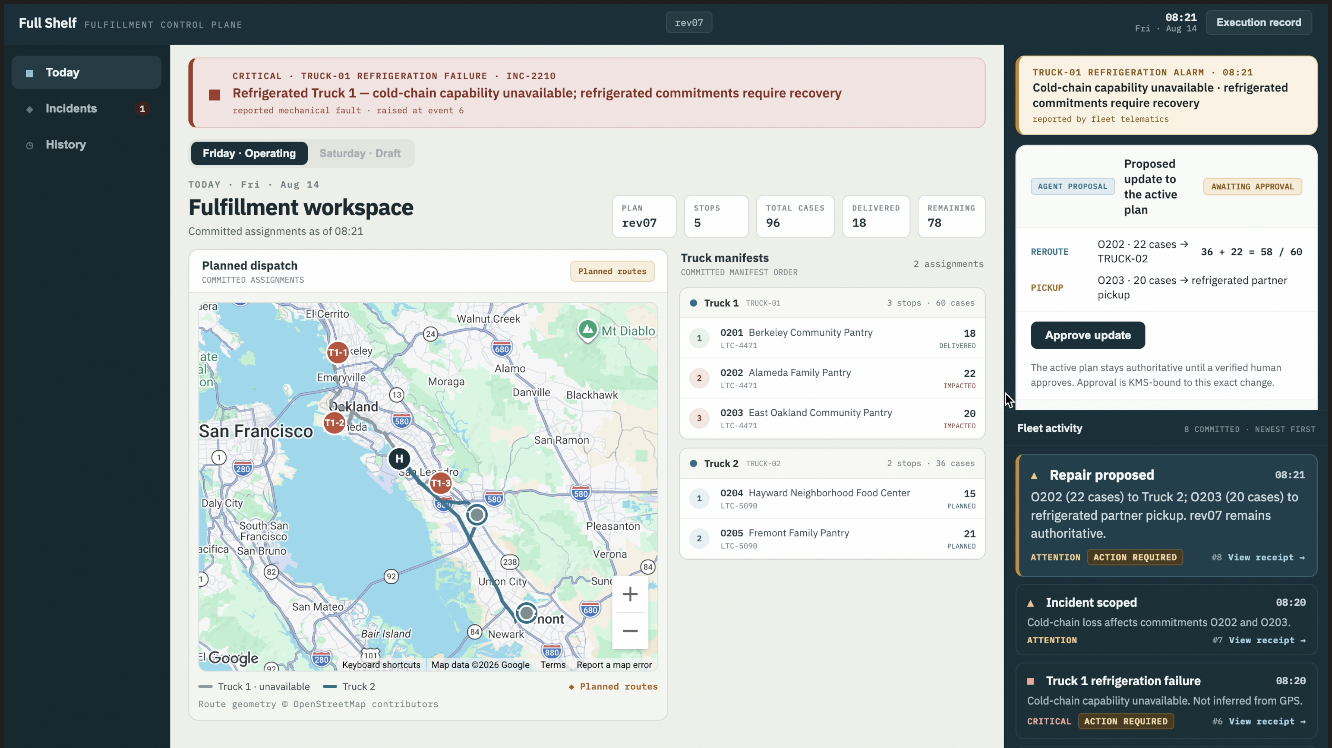
Adapt when reality changes. When logistics change—for example, when a truck becomes unavailable—Full Shelf remaps affected deliveries across the remaining resources. It can shift work to other vehicles, use approved partners for refrigerated pickup, and surface unavoidable shortfalls instead of hiding them inside an impossible plan.
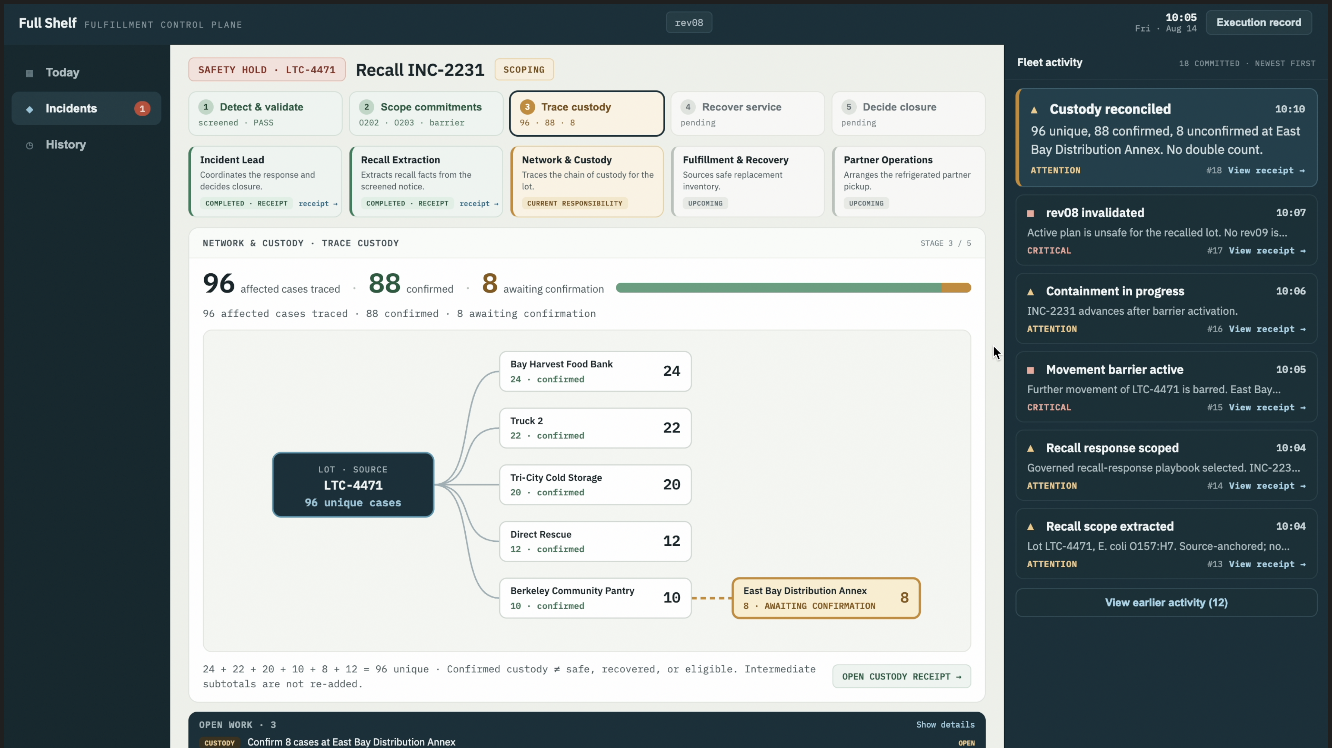
Protect safety and custody. When food becomes unsafe or uncertain, Full Shelf traces affected inventory through the custody network, stops it from being used, and identifies the commitments that require replacement. Recovery uses only inventory and custody evidence the operation can verify. Unconfirmed cases remain open rather than being treated as resolved.
Keep people in control. The agent fleet analyzes the operation and proposes specific changes. Full Shelf presents those changes and their consequences to the director, and only an approved plan becomes authoritative. If the evidence or approval is incomplete, the system refuses the action.
Carry the operation forward. Open shortages, unavailable equipment, and unresolved custody do not disappear at the end of the day. Full Shelf carries those constraints into the next operating plan so the food bank always begins from the state the previous day actually established.
How Google Cloud powers Full Shelf
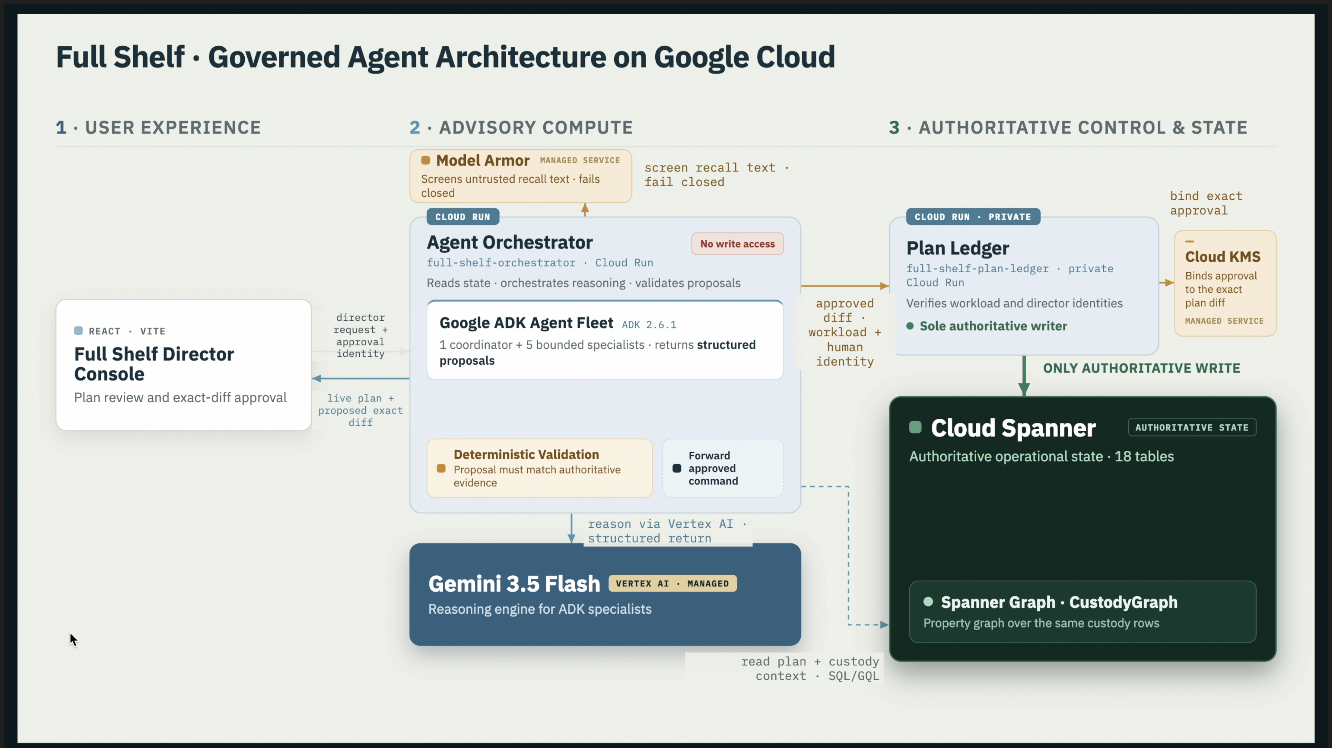
Full Shelf’s architecture follows one rule: Gemini recommends, a human approves, and only the ledger writes.
| What Full Shelf needs | Google Cloud capability | What it makes possible |
|---|---|---|
| Specialized operational judgment | Gemini 3.5 Flash on Vertex AI + Google ADK 2.6.1. The Incident Coordinator sequences five specialist agents: Fulfillment Planning & Recovery, Incident Lead, Recall Intake & Extraction, Network & Custody, and Partner Operations. | Each operational trigger reaches the expertise it needs and returns a structured recommendation rather than a command. |
| Safe handling of untrusted input | Model Armor screens external recall notices and partner messages before they reach Gemini. | Unsafe input or an unavailable safety check stops the workflow before agent reasoning or authoritative action. |
| Separation between reasoning and writes | Two Cloud Run services isolate the agent orchestrator from the private plan ledger. | The orchestrator can read, reason, and propose, but it has no path to mutate authoritative state. |
| One durable operating state | Cloud Spanner stores plans, commitments, incidents, approvals, evidence, receipts, and unresolved work across 18 tables. Spanner Graph traverses custody over those same rows. | The fleet can reason across multiple days and follow food through the network without creating competing sources of truth. |
| Approval bound to the exact change | Cloud KMS binds the operator’s identity and approval to the proposed plan change. | An approval cannot authorize different quantities, actions, or revisions if the recommendation changes later. |
| Event-driven, observable execution | Pub/Sub, Cloud Tasks, and Cloud Scheduler support accepted events, controlled re-entry, and scheduled planning. Cloud Trace and Cloud Logging preserve execution evidence. | Full Shelf can coordinate work over time while keeping each run inspectable. |
Every agent output is revalidated against the same authoritative evidence before it can reach human approval. If input screening, validation, identity, approval, or KMS binding fails, the operating state does not change.
How we built it
Full Shelf is built around one practical rule: each layer should own only the decisions it can prove.
Start with the operating day, not the model. The foundation is a versioned operating record connecting inventory, vehicles, commitments, custody, incidents, approvals, receipts, and unfinished work. That record exists independently of any agent session. A new event can change the plan, but it cannot erase the plan, evidence, or obligations that came before it.
Give agents bounded jobs. The system first constructs safe, feasible options from the current operating state and enforced capacity, safety, and custody rules. Specialist agents then interpret the situation, investigate the relevant evidence, and choose among those bounded options. Each agent has a defined role, limited tools, and structured output that must be validated before use. The model provides judgment where tradeoffs matter; deterministic code retains ownership of arithmetic, identifiers, eligibility, policy, and final validation.
Keep the path to authority narrow. An agent recommendation becomes a proposed plan change, not an instruction to the database. The director reviews the exact change and its consequences. Before anything becomes authoritative, the private ledger verifies that the current plan, approved change, operator identity, and requested action all still match. If the proposal changes, its previous approval no longer applies.
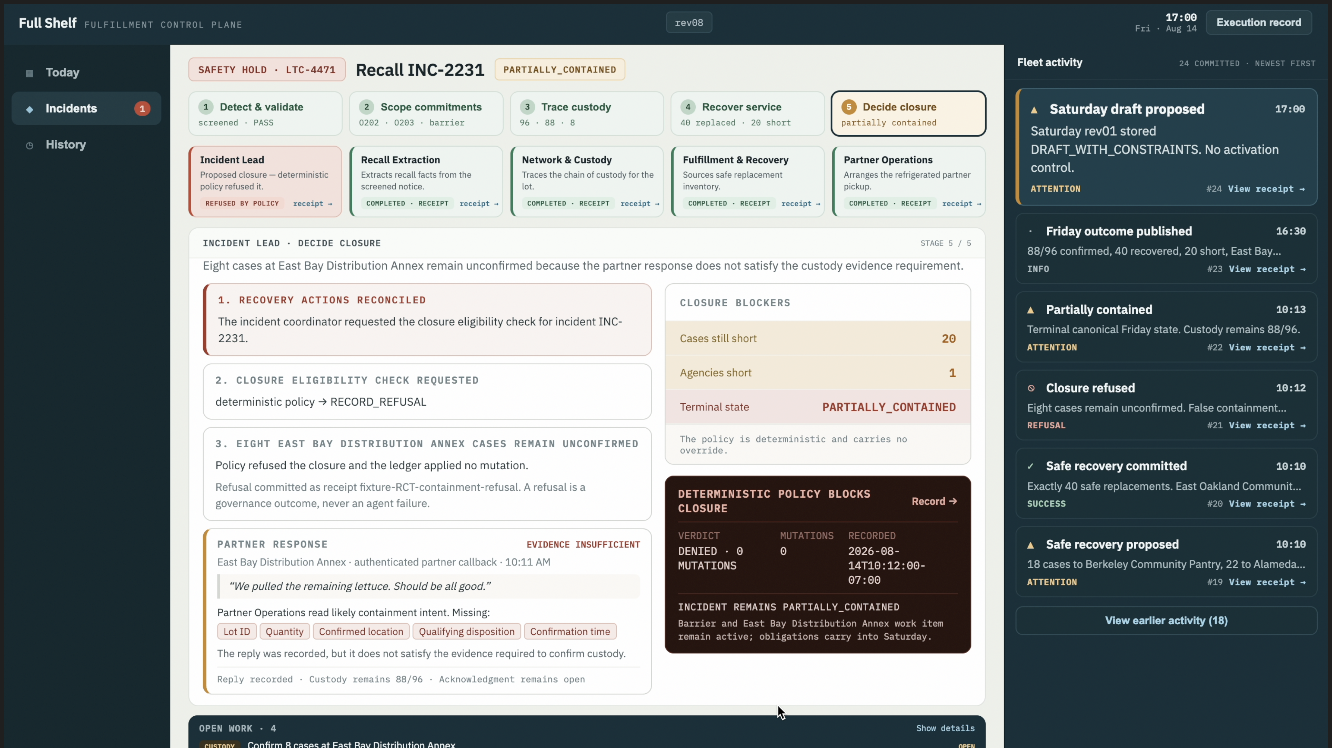
Treat incomplete as an outcome. We built the negative paths alongside the successful ones. Blocked input never reaches the fleet. Unsupported agent output never reaches approval. Missing partner evidence stays missing, unresolved custody prevents full closure, and shortages or unavailable equipment carry into the next operating day. The interface reflects those durable outcomes rather than manufacturing a clean ending. The filmed demo replays a previously completed run at a filmable pace without changing what the system concluded.
Challenges we ran into
Coordinating a fleet without hidden drift. The challenge was not creating five agents. It was keeping their shared schemas, validators, operating sequences, projections, and replay evidence aligned as the fleet evolved. An early orchestration change passed its targeted tests but failed repository-wide verification. We reverted the batch, rebuilt the recall sequence from one authoritative source, and added regression checks so the coordinator and downstream surfaces could not silently disagree again.
Turning safeguards into real gates. The Incident Lead was meant to authorize which specialists could run, but an early implementation checked that decision only after the specialists had executed. The proposal was withheld, yet an unauthorized agent could already have reached Gemini. We moved the check ahead of dispatch and changed the test standard: success now means the unauthorized specialist was never invoked, not merely absent from the final recommendation.
Designing a truthful control plane. Food-bank operations produce a dense mix of plans, custody, incidents, approvals, partner evidence, unfinished work, and multi-day consequences. Making that understandable without overwhelming the director required several interface generations. We also removed an early telemetry animation because it implied vehicle activity the operating record could not prove. The final experience emphasizes confirmed state, proposed changes, unresolved evidence, and operator decisions rather than decorative agent activity.
Accomplishments that we're proud of
A fleet that operates as a system. Full Shelf coordinates five specialist agents across daily planning, disruption recovery, recall response, custody analysis, and partner operations. Each agent has a bounded role, limited tools, structured output, and a defined place in the operating sequence. The result is a fleet whose work can be combined and verified—not a collection of independent assistants.
A narrow path from reasoning to authority. Gemini can investigate evidence and recommend an operating change, but it cannot write authoritative state. The director approves the exact proposed change, and the private ledger independently revalidates the plan, operator, approval, and requested action before committing it. If anything no longer matches, the operation fails closed.
An operating record that survives the demo moment. Full Shelf preserves plans, commitments, incidents, custody, approvals, receipts, and unfinished work outside the agent session. A shortage, unavailable truck, or unresolved custody case remains part of the next operating day instead of disappearing when a workflow ends.
Refusal as a successful outcome. I am particularly proud that Full Shelf does not manufacture a clean ending. When partner evidence cannot confirm the remaining recalled cases, the system records partial containment, refuses closure, and produces zero unsupported mutations. Repository-wide tests cover these orchestration, authorization, refusal, mutation, and interface boundaries.
What we learned
- Food banks are living logistics networks. Inventory, refrigerated transportation, custody, partners, safety, and community commitments must remain aligned as conditions change.
- Several agents do not automatically make a fleet. The real work is shared contracts, deterministic sequencing, bounded tools, and repository-wide verification.
- Human control must be architectural. Approval must happen before execution, bind to the exact proposed change, and be revalidated where authoritative state is written.
- Google services work best with narrow responsibilities. Reasoning, input protection, durable state, custody traversal, execution isolation, and approval binding each need a clear owner.
- Operational UX should show consequences, not agent theater. The operator needs to understand what changed, what remains uncertain, and what requires their decision.
What's next for Full Shelf
Expand the operating surface. Extend Full Shelf beyond daily planning, vehicle disruptions, and recalls to coordinate donation intake, warehouse and cold-storage capacity, volunteer availability, weather closures, and cross-food-bank collaboration.
Connect live operating systems. Integrate authenticated warehouse, transportation, telematics, recall, and partner systems so live operational events can enter the same governed planning and recovery loop.
Productionize fleet governance. Add versioned agent contracts and playbooks, continuous fleet-wide evaluations, configurable approver and service identities, stronger deployment automation, and replayable rollback evidence for every release.
Built With
- artifact-registry
- cloud-build
- cloud-kms
- cloud-logging
- cloud-run
- cloud-scheduler
- cloud-spanner
- cloud-tasks
- cloud-trace
- gemini-3.5-flash
- google-adk
- google-maps-javascript-api
- model-armor
- pub-sub
- react
- secret-manager
- spanner-graph
- typescript
- vertex-ai
