-
-
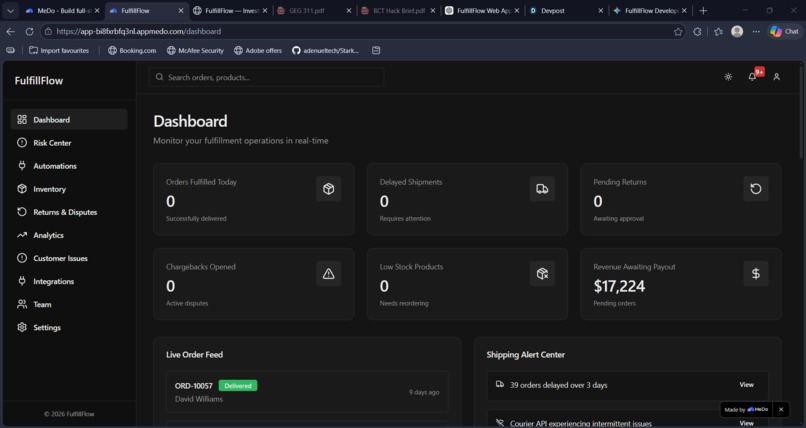
Dashboard
-
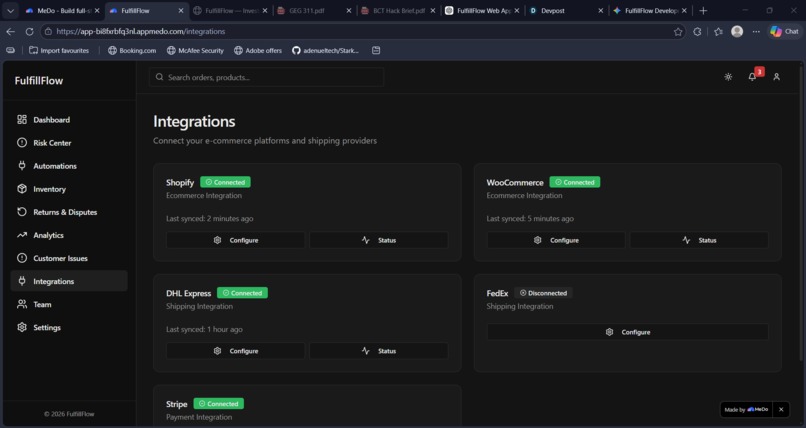
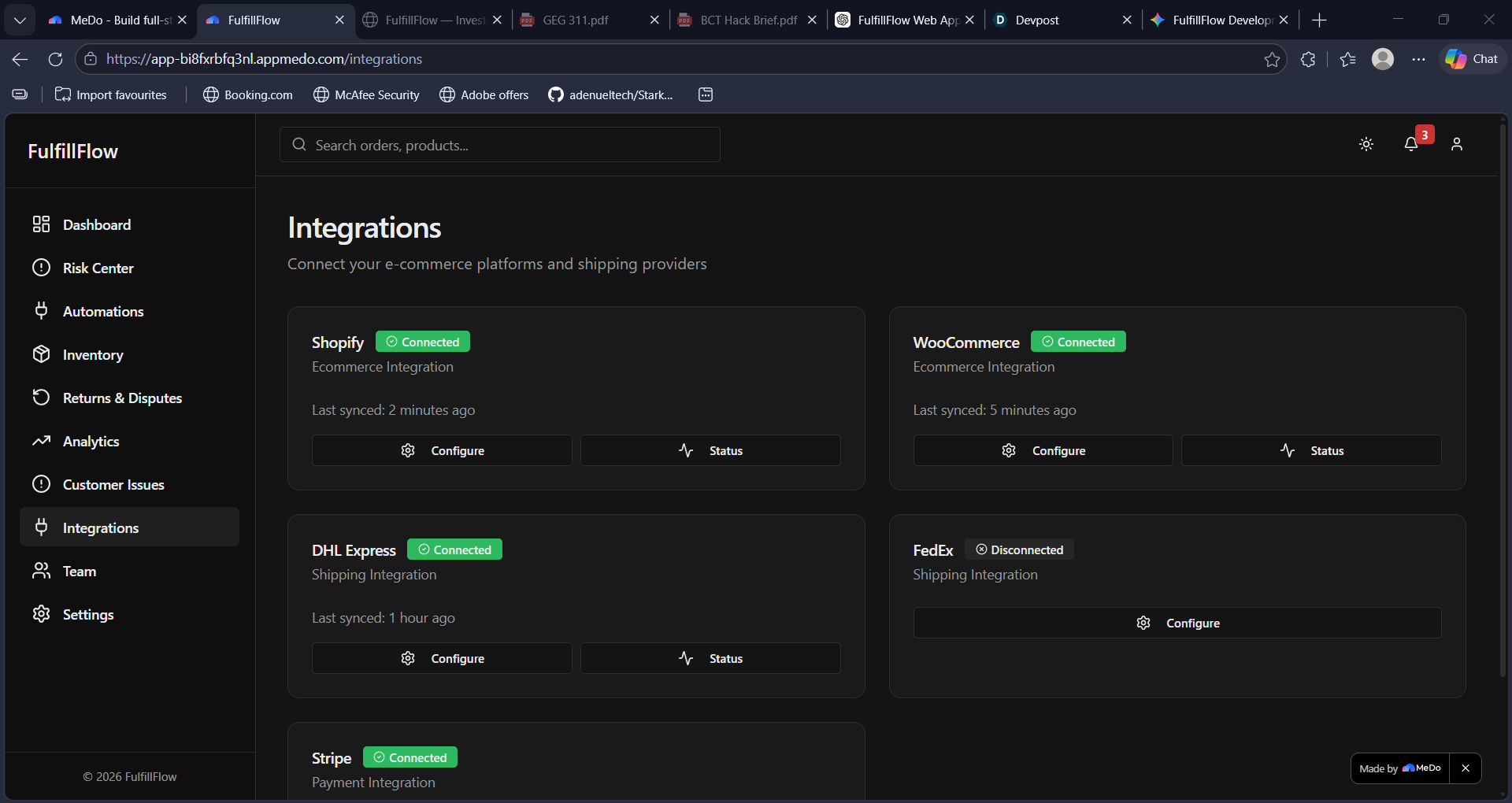
Integration
-
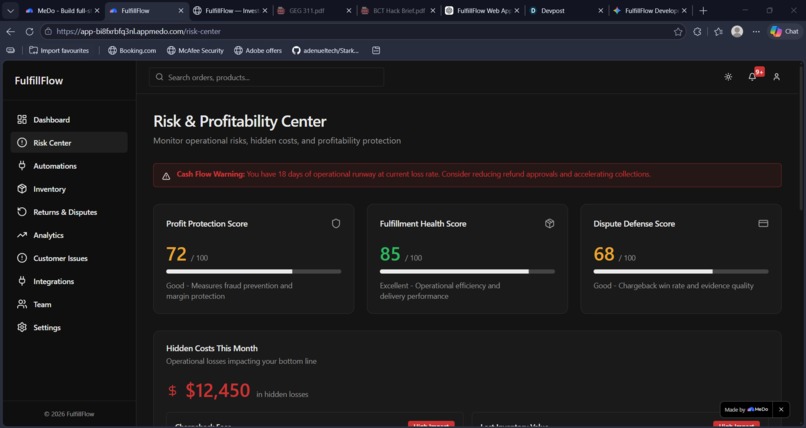
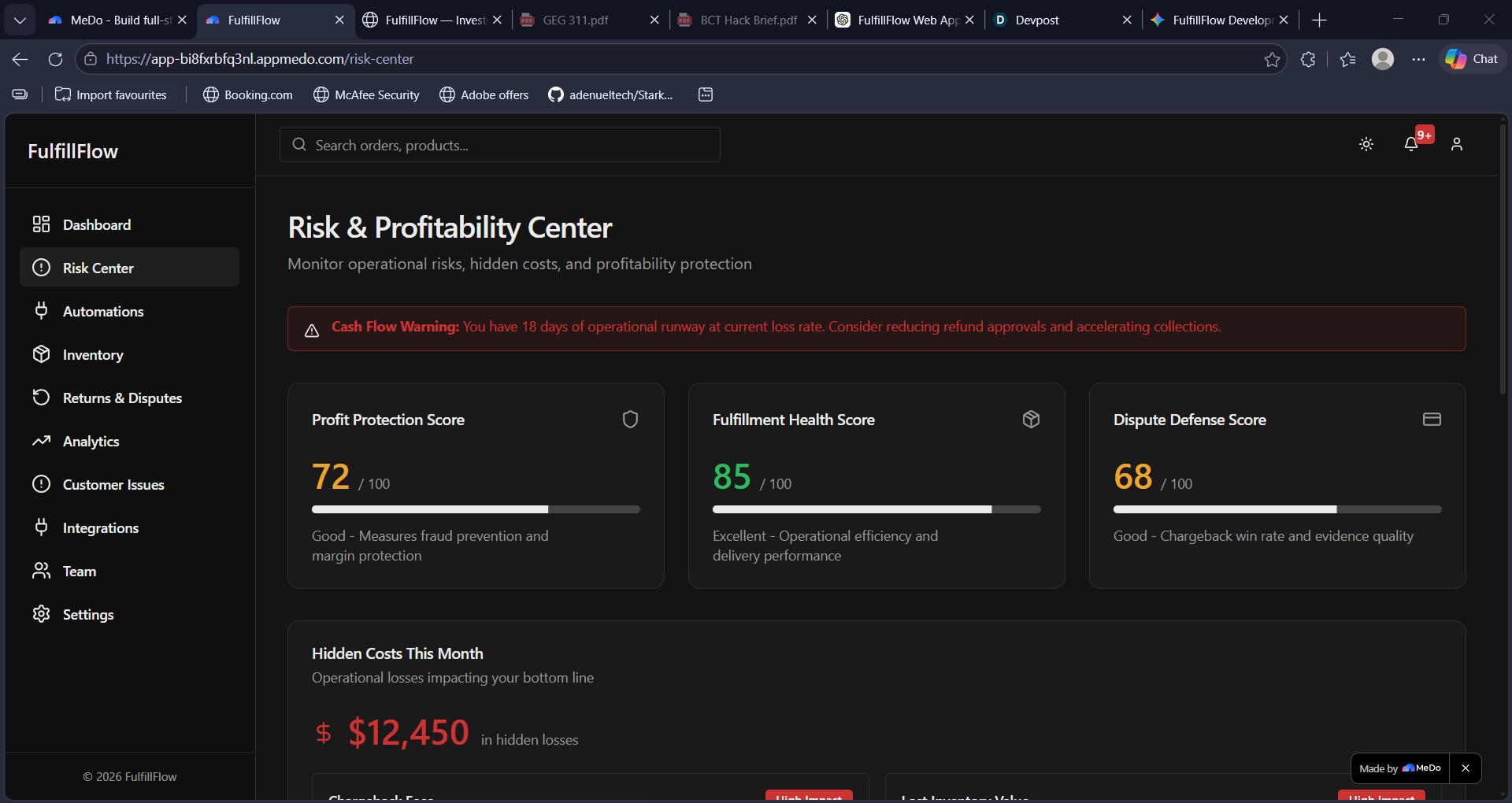
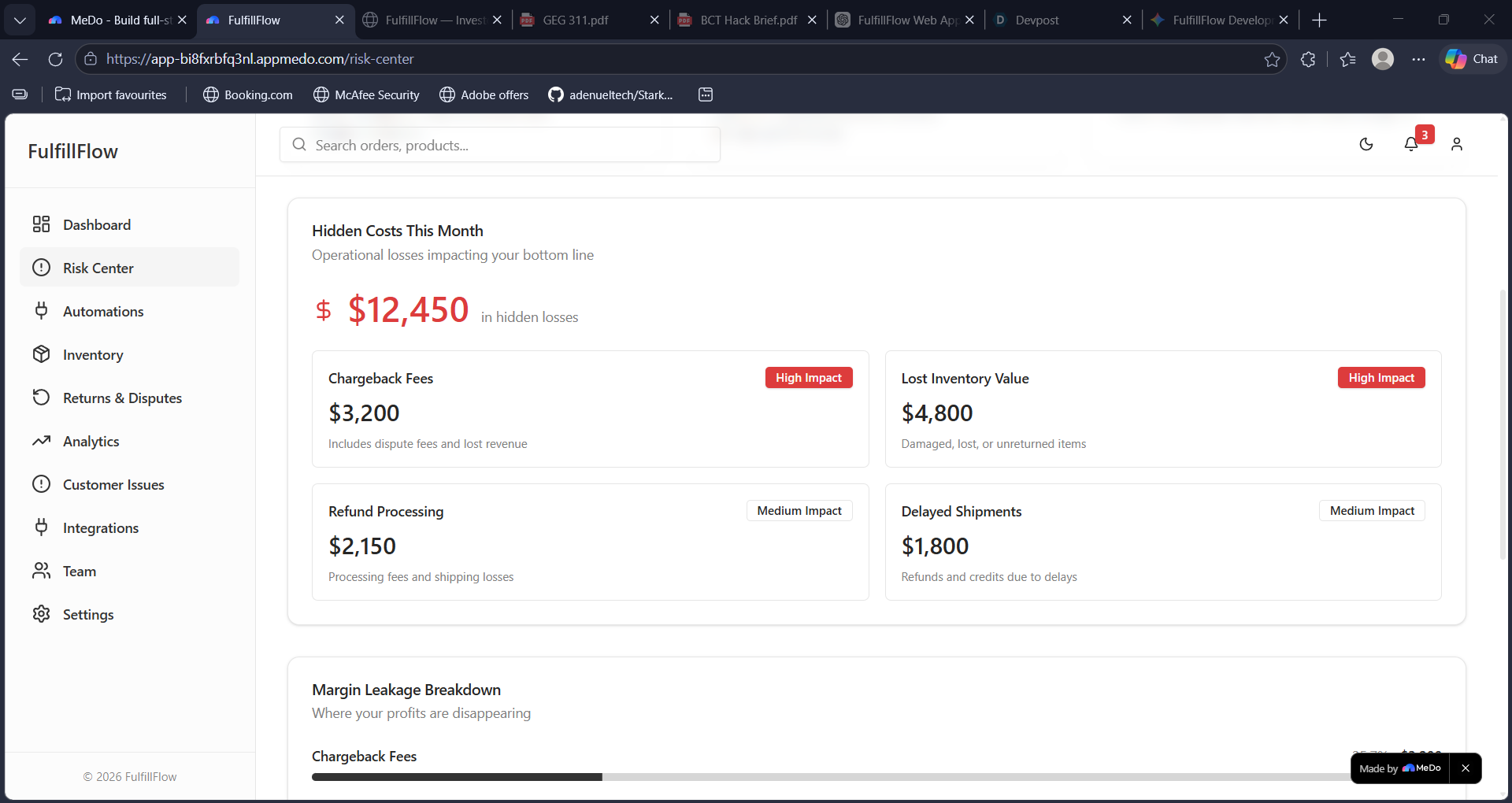
Risk
-
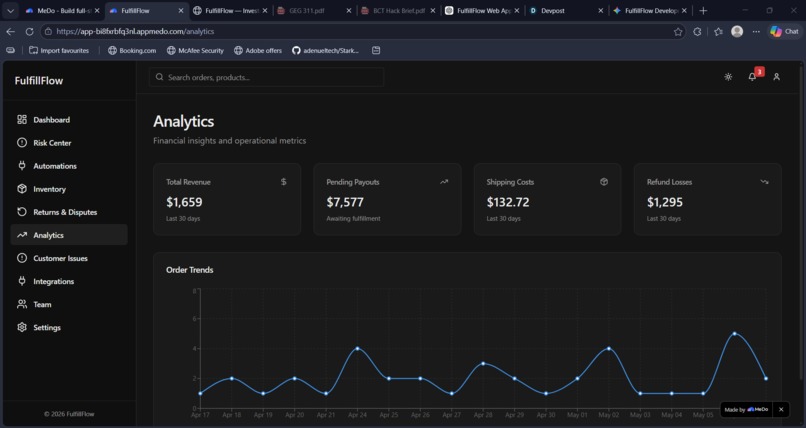
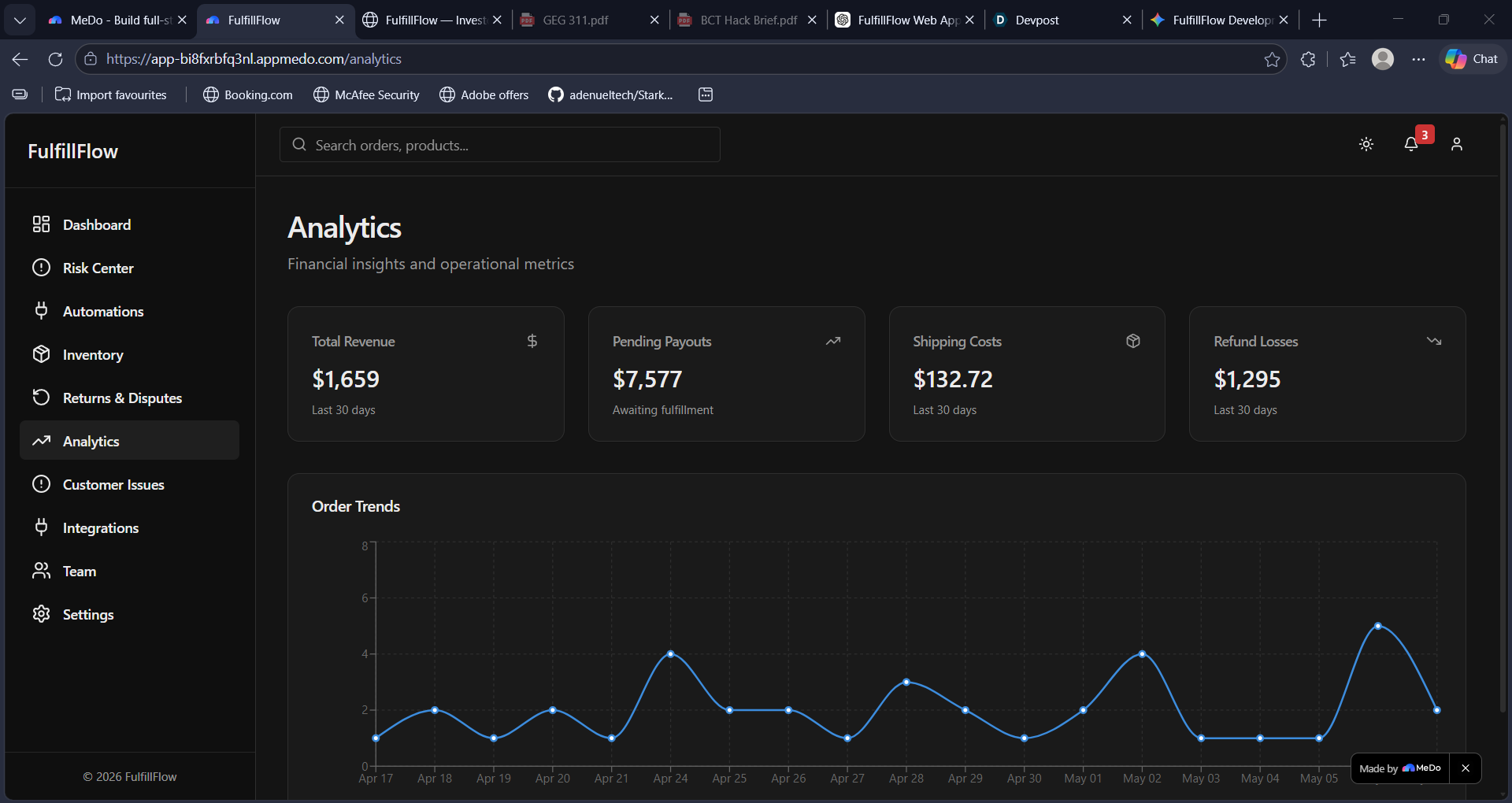
Analytics
-
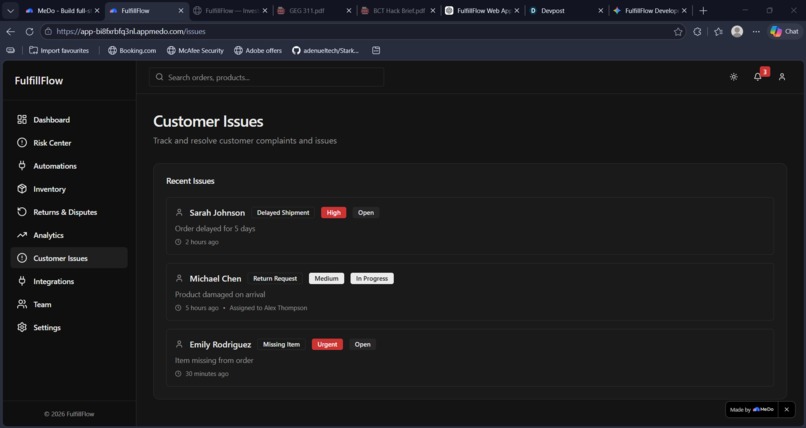
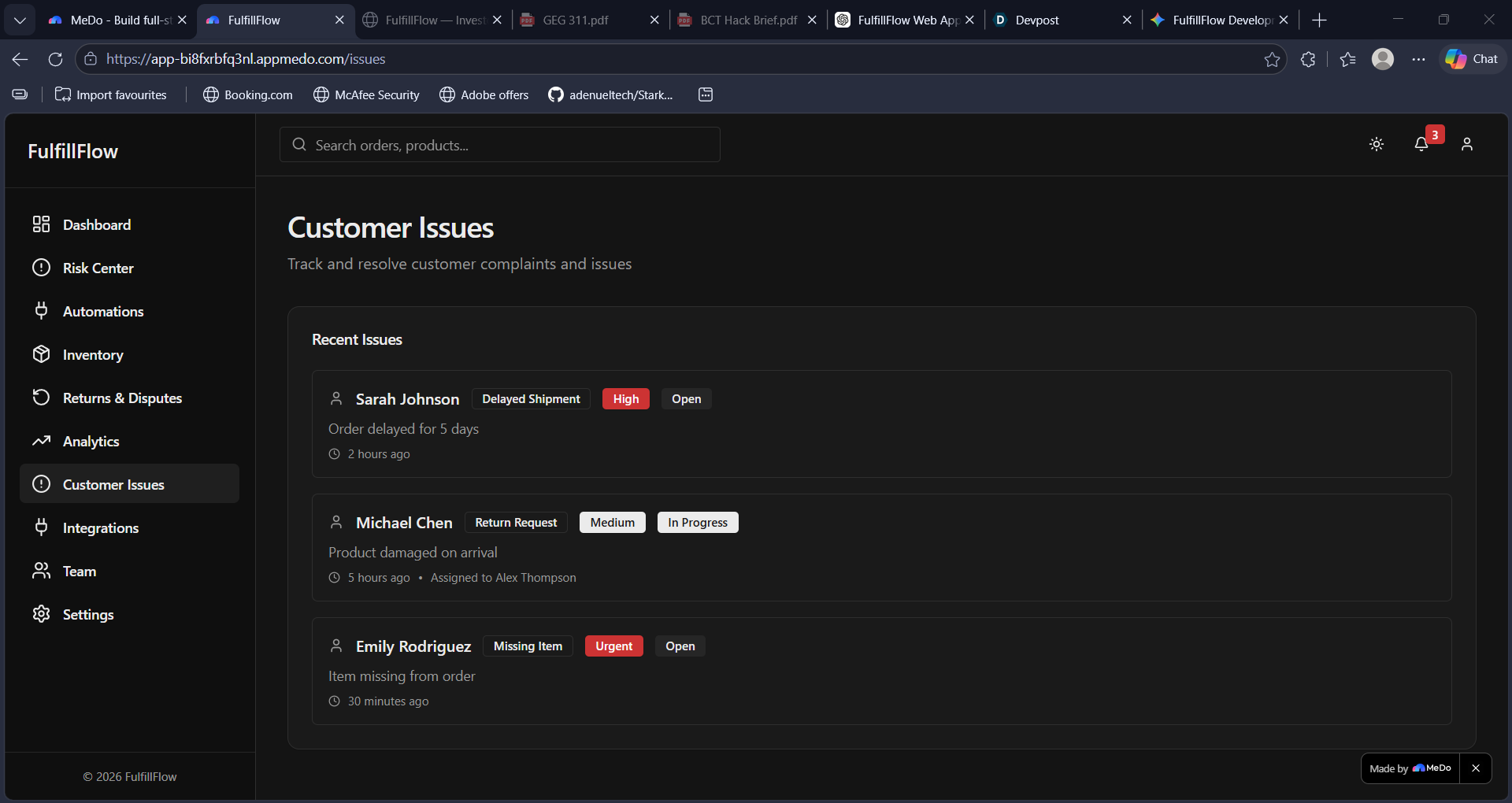
Customer issues section
-
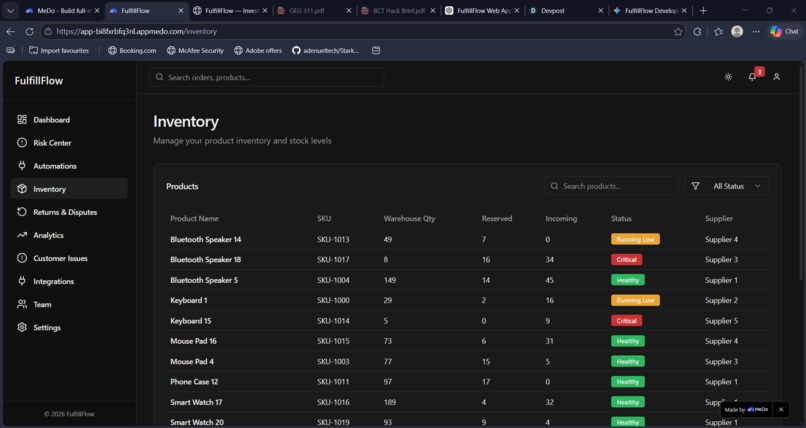
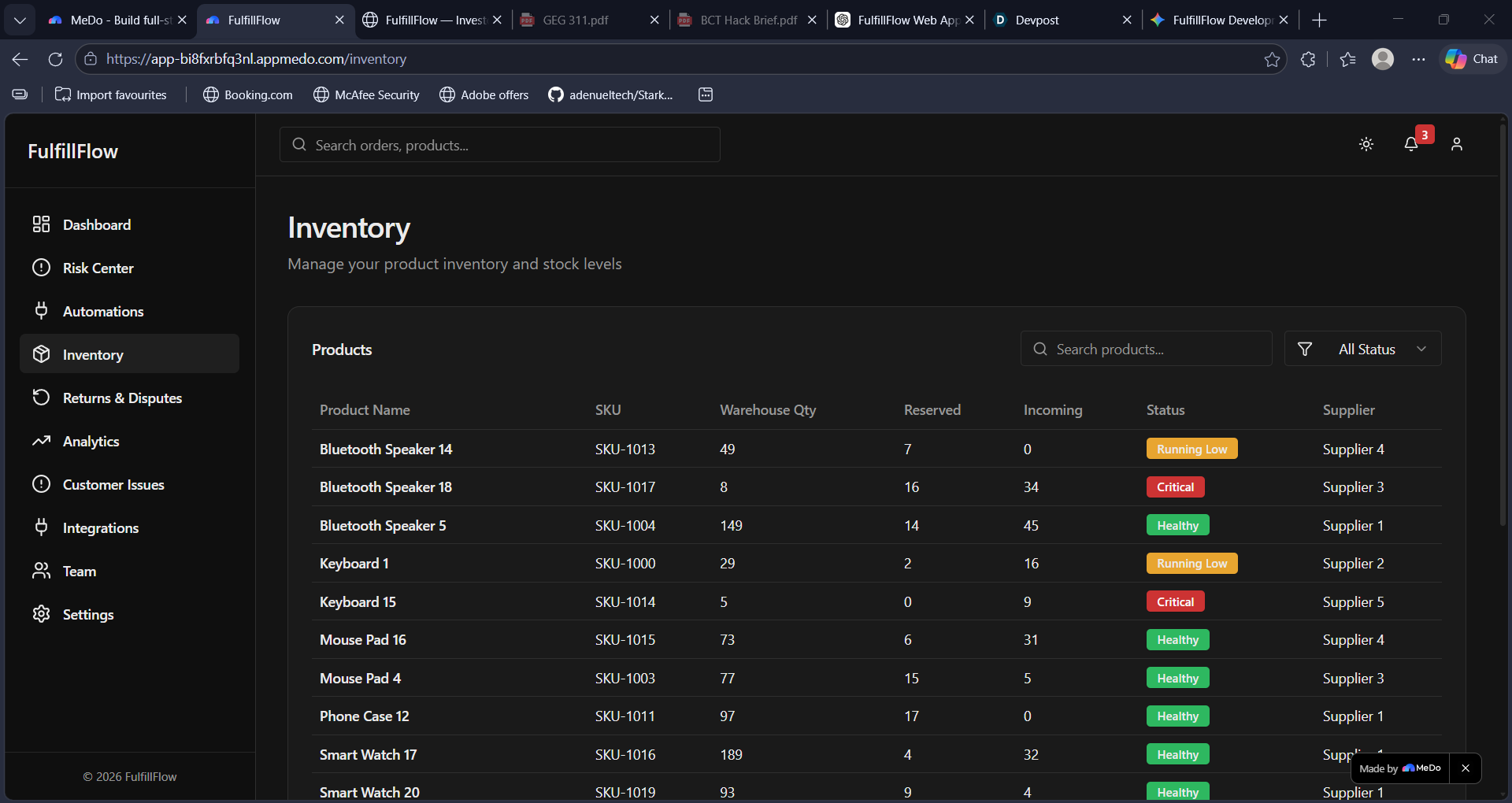
Inventory
-
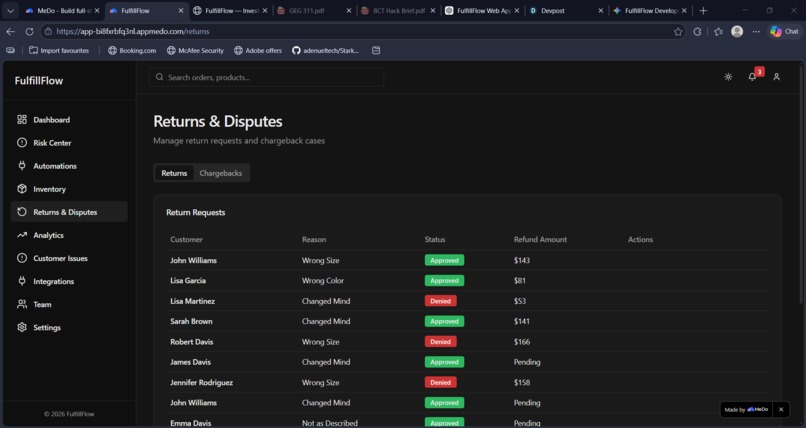
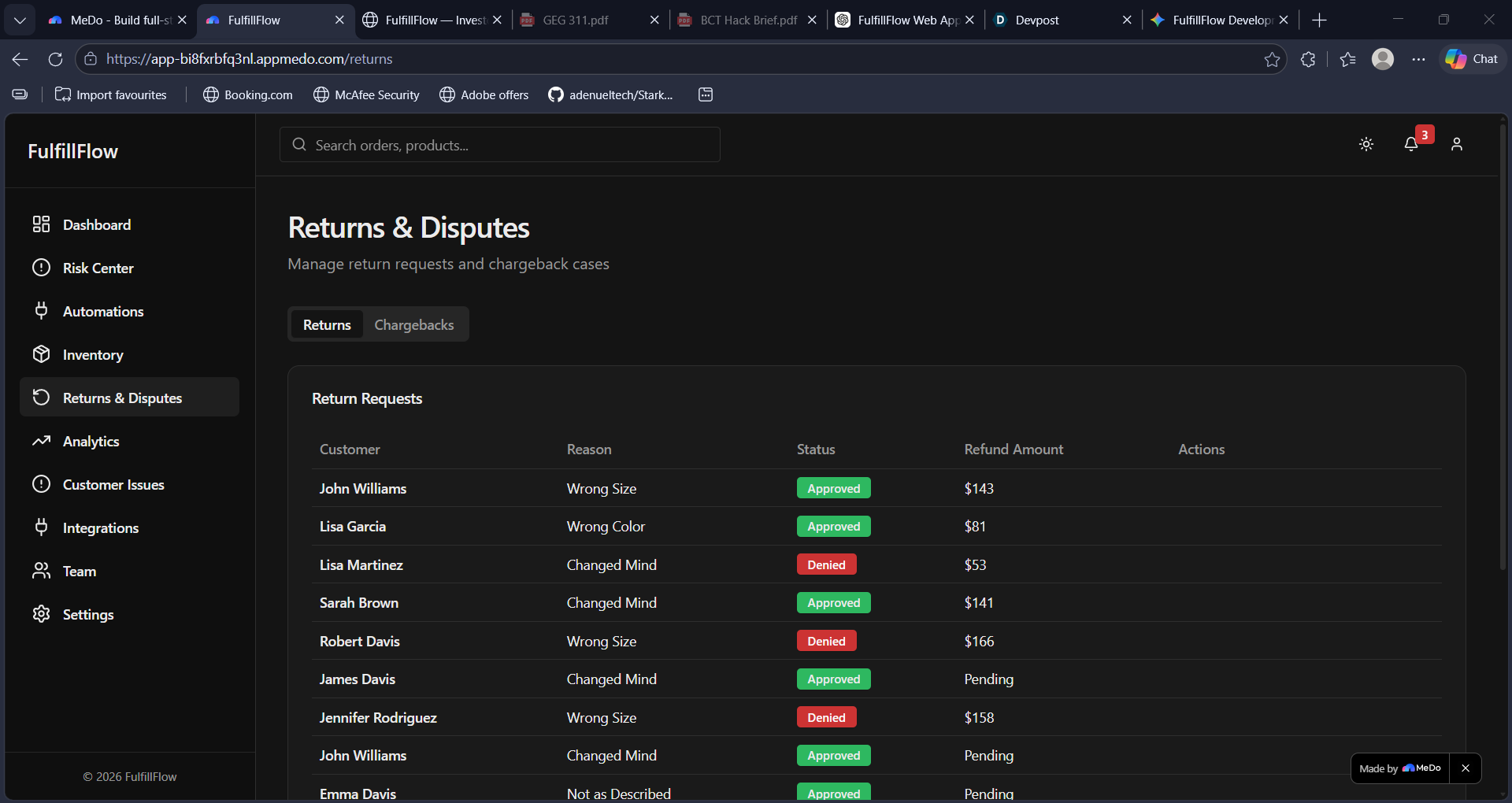
Return and Disputes
-
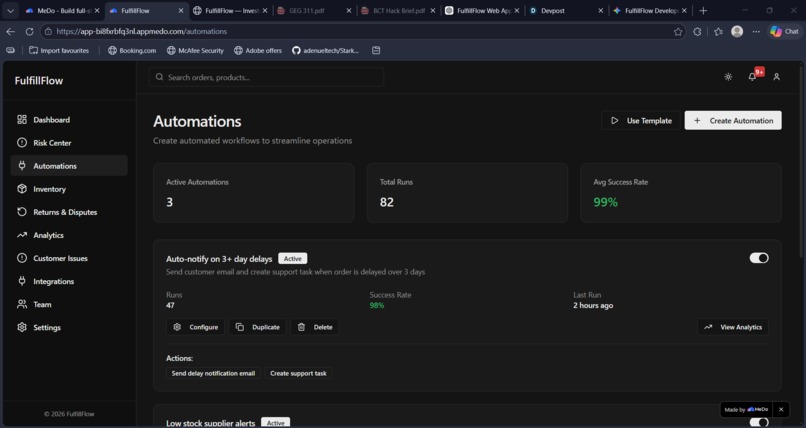
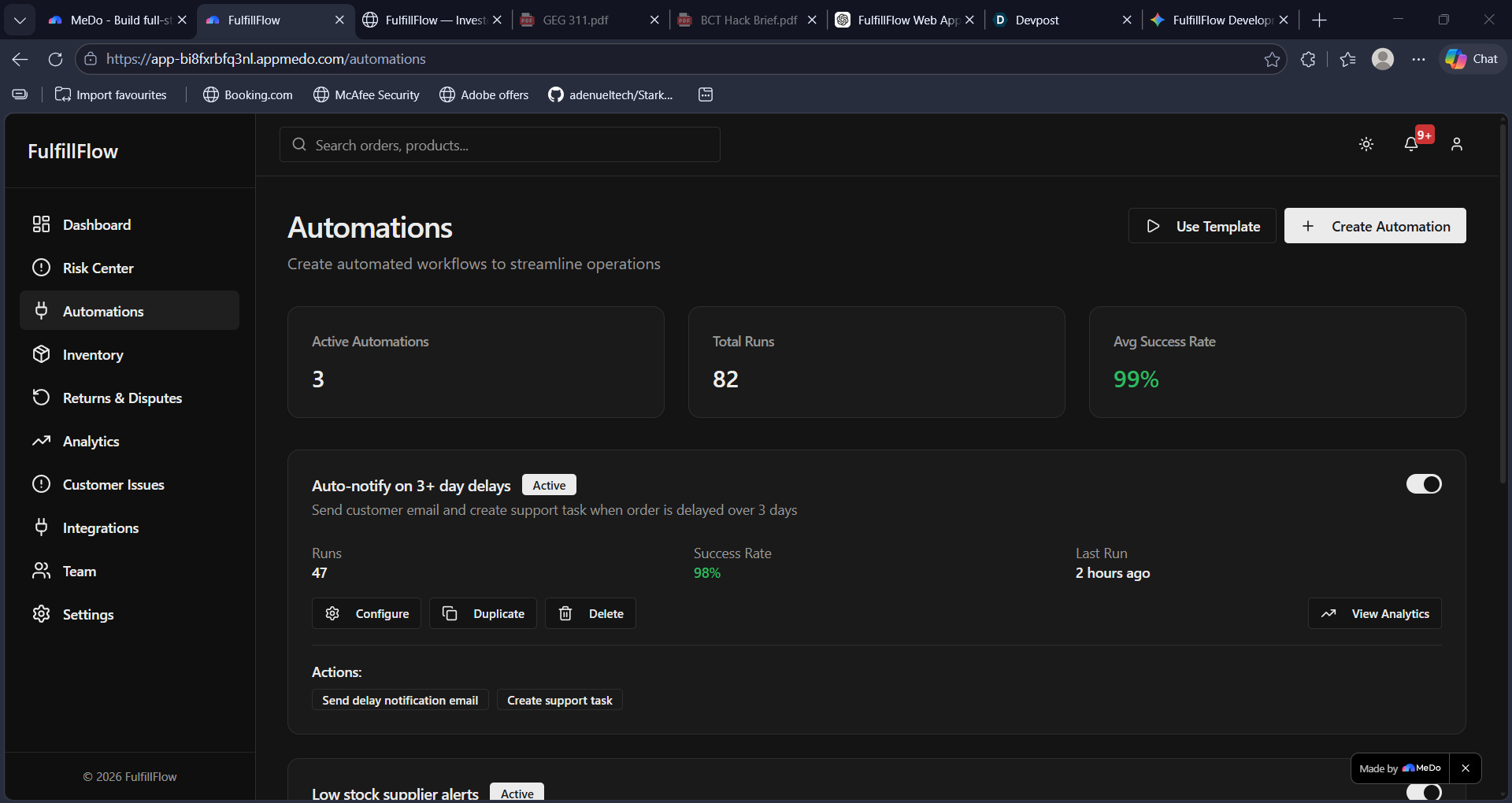
Automation
-
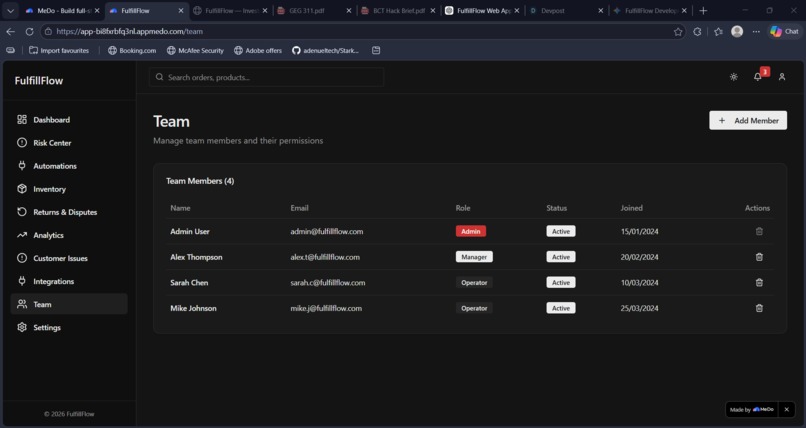
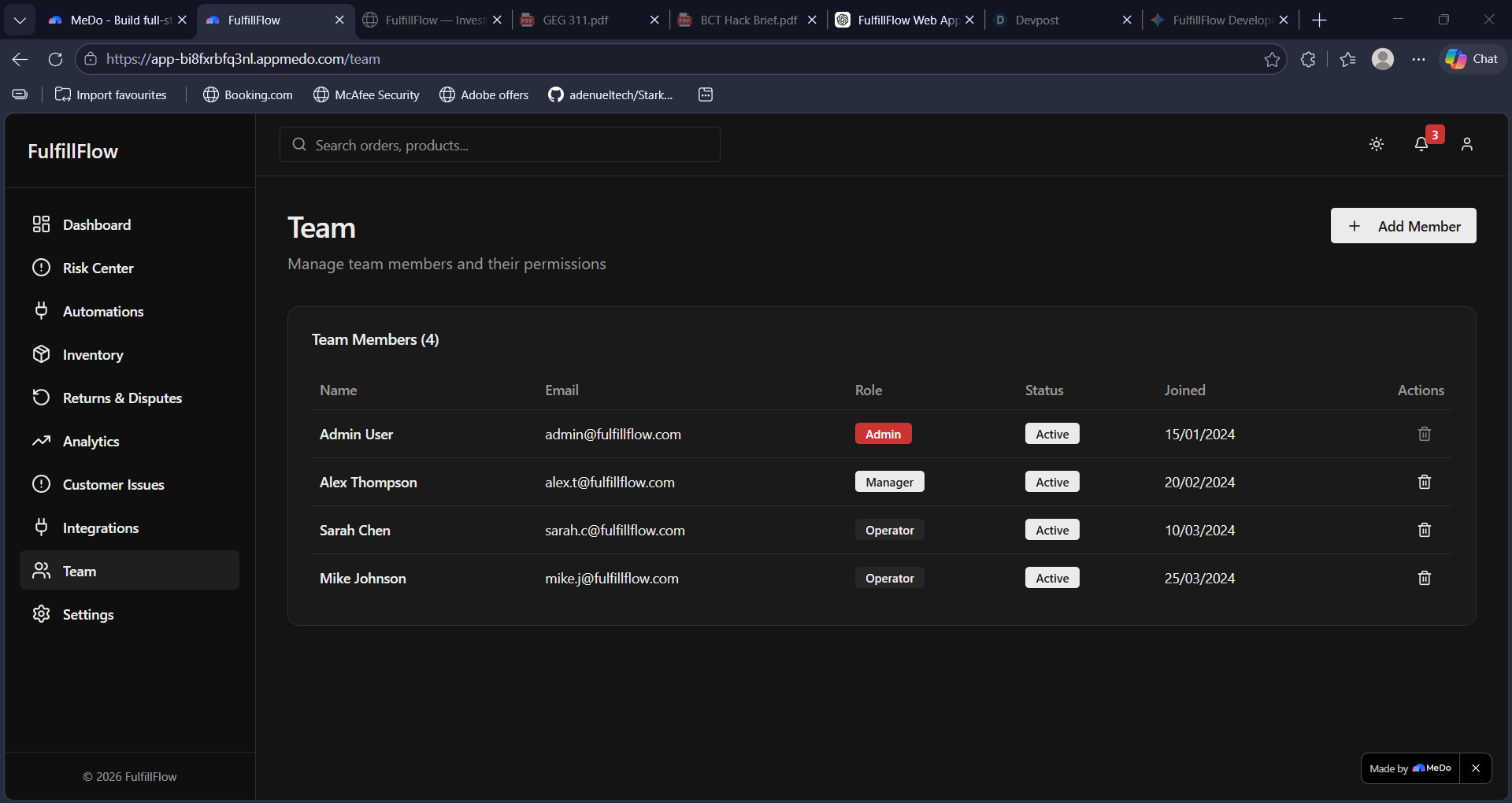
Team
-
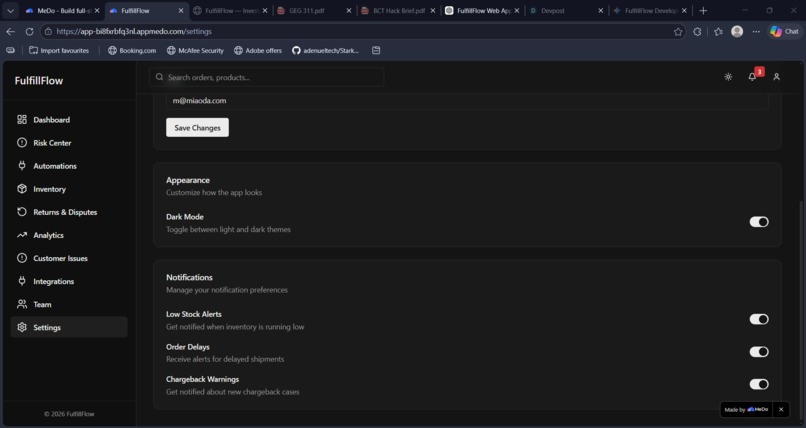
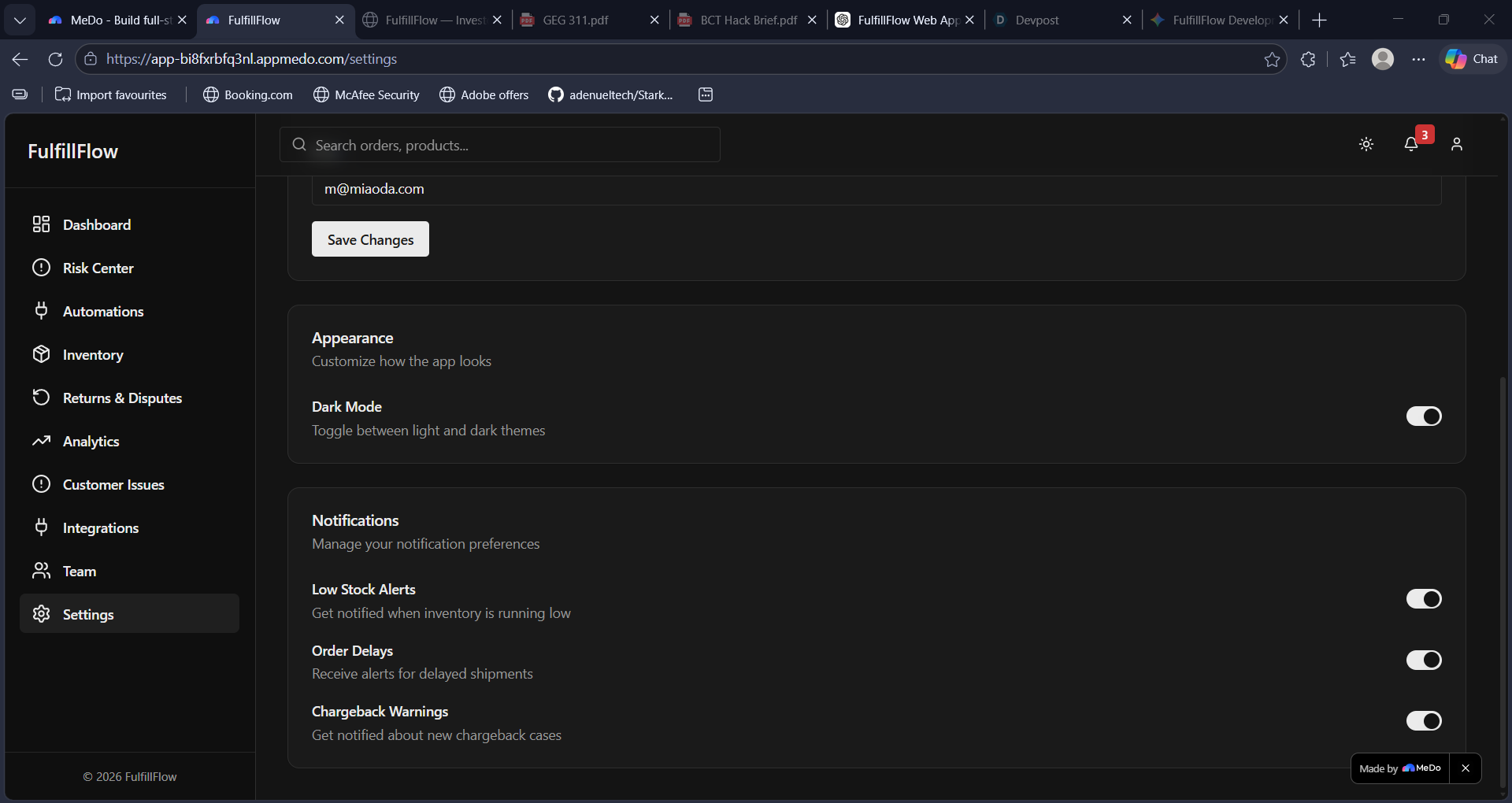
Setting
-
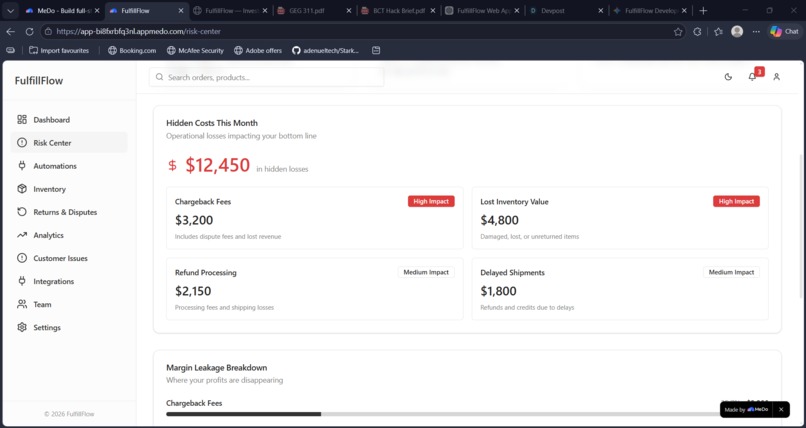
Light mode
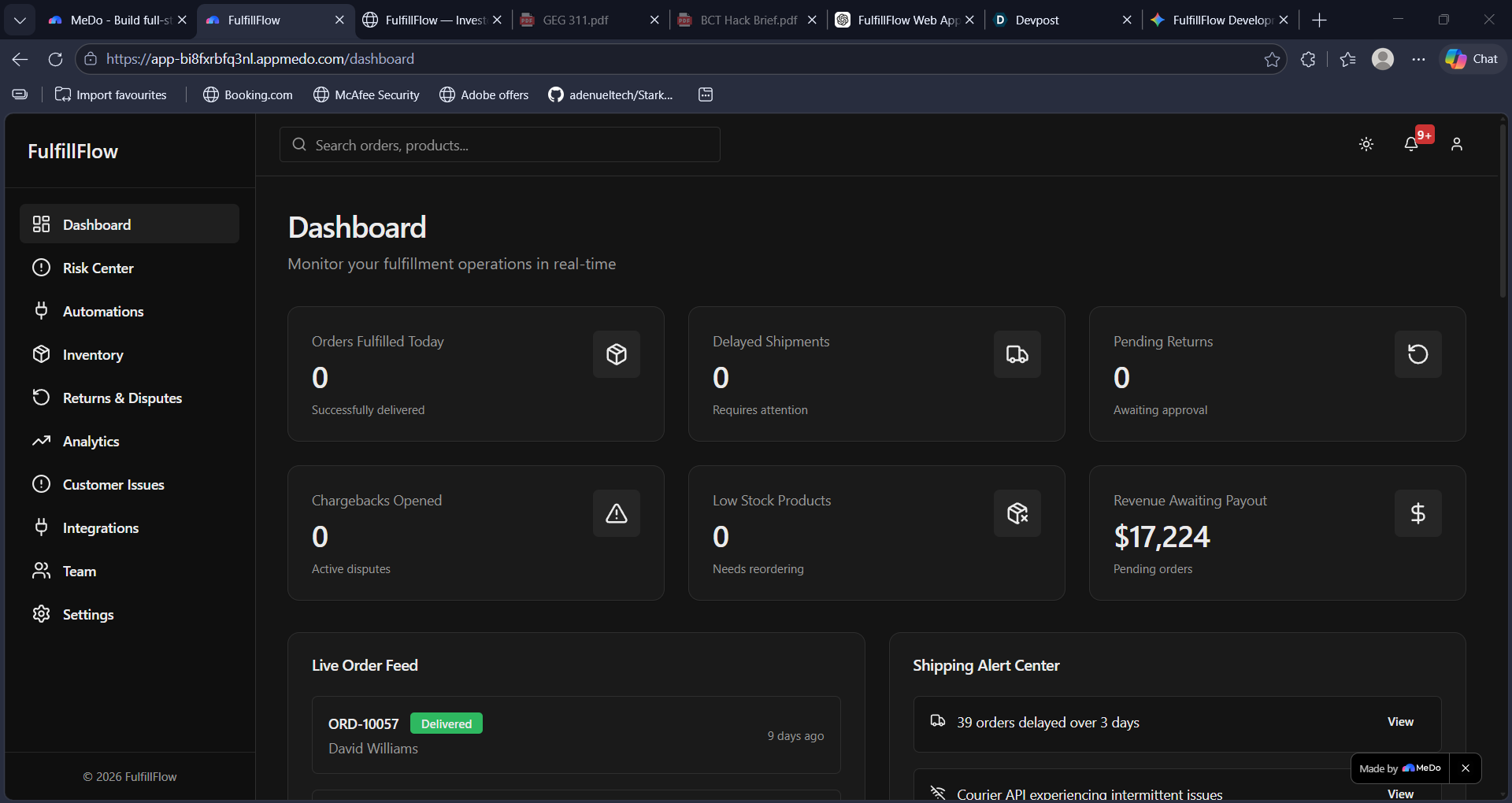
FulfillFlow, AI Powered Operational Intelligence Platform for Modern Commerce
The Problem
Modern e-commerce operations are fragmented.
Today, most online businesses are forced to constantly switch between multiple platforms just to understand what is happening inside their business.
They open:
- Stripe to monitor payments
- Shopify or WooCommerce to track orders and revenue
- Logistics dashboards like FedEx or DHL to monitor deliveries
- Support tools to manage disputes and customer complaints
- Spreadsheets to track inventory and profitability
As businesses scale, operational complexity scales even faster.
The result:
- Delayed shipments
- Inventory mismatches
- Operational blind spots
- Increasing customer support volume
- Return fraud
- Chargeback losses
- Lost profitability
Most existing tools are reactive dashboards.
Businesses now need operational intelligence.
That is why I built FulfillFlow.
What is FulfillFlow?
FulfillFlow is an AI powered operational intelligence platform and multi-channel commerce command center for e-commerce businesses.
It centralizes:
- Orders
- Payments
- Logistics tracking
- Inventory intelligence
- Customer issues
- Return fraud monitoring
- Chargeback workflows
- Operational analytics
- Automation systems
into one unified operational control center.
The platform helps businesses:
- Monitor operations in real time
- Detect operational risks early
- Reduce manual workflows
- Automate repetitive tasks
- Improve fulfillment visibility
- Protect business profitability
Why This Matters Right Now
E-commerce businesses are growing rapidly, but operations tooling has not evolved at the same pace.
Small and medium businesses now face enterprise-level operational complexity without enterprise-level operational infrastructure.
At the same time:
- Return abuse is increasing
- Chargebacks are becoming more common
- Customers expect faster fulfillment
- Multi-channel selling creates synchronization problems
- Operations teams are overloaded with repetitive manual tasks
FulfillFlow was designed to become the intelligence layer that modern commerce businesses now need.
How I Used MeDo
FulfillFlow was built entirely with MeDo through multi-turn natural language conversations.
Instead of manually engineering every component from scratch, I used MeDo as an AI engineering collaborator to progressively generate and evolve the platform.
Using MeDo, I was able to:
- Generate a full-stack SaaS application
- Build complex dashboard systems
- Create production-style operational workflows
- Generate responsive UI architecture
- Build real-time operational simulations
- Implement automation systems
- Integrate multi-channel commerce workflows
- Build notification systems
- Add fraud detection experiences
- Create customer issue workspaces
- Rapidly iterate through multiple product versions
One of the most impressive aspects of MeDo was the ability to continuously refine the platform through iterative conversations.
The application evolved from:
- A simple fulfillment dashboard into
- A production-style operational intelligence platform for commerce businesses.
The Most Impressive Features MeDo Helped Create
1. Automation Workflow Engine
One of the strongest features generated with MeDo was the Automation Rule Engine.
Businesses can create operational workflows such as:
- Auto-escalating delayed shipments
- Sending low-stock alerts
- Flagging high-risk customers
- Triggering operational notifications
- Creating automated support actions
The system includes:
- Visual workflow building
- Configurable triggers
- Dynamic action blocks
- Workflow templates
- Real-time automation analytics
- Interactive state updates
2. Fraud Detection & Profitability Intelligence
FulfillFlow includes operational risk intelligence features such as:
- Return fraud scoring
- Customer risk indicators
- Chargeback monitoring
- Profitability tracking
- Operational loss visibility
- AI operational insight cards
This transforms the platform from a dashboard into a proactive commerce operations co-pilot.
3. Real-Time Operational Dashboard
The platform includes:
- Live operational notifications
- Real-time style order updates
- Dynamic activity feeds
- Multi-channel monitoring
- Inventory alerts
- AI-generated operational insights
The goal was to make the application feel operationally alive instead of static.
Technical Depth
FulfillFlow demonstrates advanced use of MeDo’s full-stack generation capabilities.
The project includes:
- Multi-page SaaS architecture
- Interactive operational dashboards
- Real-time simulation systems
- Complex workflow interactions
- State-driven UI systems
- Reusable modal and drawer architecture
- Dynamic notifications
- Multi-channel operational views
- Customer issue management systems
- Automation workflow logic
The application was built through continuous iterative refinement using MeDo’s conversational generation workflow.
Challenges I Solved
Challenge 1, Scaling Complex UI Interactions
As the application evolved into a large operational platform, managing interactions across dashboards, automations, notifications, and customer issue systems became increasingly complex.
To solve this, I refactored the application into reusable state-driven systems with dynamic workflow handling and reusable interaction architecture.
Challenge 2, Making the Platform Feel Operationally Alive
Static dashboards feel unrealistic for operational software.
I solved this by implementing:
- Real-time style simulations
- Dynamic notifications
- Live operational events
- Workflow activity feeds
- Interactive operational updates
This significantly improved the realism and usability of the platform.
Challenge 3, Building Complex Systems Through Natural Language
One of the biggest experiments in this project was proving that complex SaaS platforms can be built conversationally.
Using MeDo, I continuously refined:
- Workflows
- Architecture
- Operational systems
- Interaction logic
- Automation experiences
- Business intelligence features
through structured natural language conversations.
Plugins, APIs & Deployment
Using MeDo’s API and plugin integration capabilities, I implemented:
Mock webhook events for order updates, returns, disputes, and inventory changes Real-time notification systems Multi-channel order feeds Automation triggers and workflow actions Integration health monitoring Live operational activity simulations
These integrations allowed FulfillFlow to behave like a real commerce operations platform where operational data flows across multiple systems in one unified dashboard.
MeDo made it possible to:
- Integrate operational workflows quickly
- Simulate multi-channel commerce systems
- Build plugin-style operational modules
- Deploy the platform instantly with one click
- Iterate rapidly without traditional setup complexity
This dramatically accelerated development speed and experimentation.
Why MeDo Was Important
What impressed me most about MeDo was not just code generation.
It was the ability to:
- Think iteratively
- Build conversationally
- Refine architecture continuously
- Generate production-style systems rapidly
- Evolve ideas into real operational software *Summon the "Test Engineer" agent to start a comprehensive quality analysis!
MeDo transformed the development process from traditional implementation into collaborative AI-assisted engineering.
Future Vision
FulfillFlow is designed to evolve into:
- The operational intelligence layer for modern commerce businesses
- An AI powered commerce operations co-pilot
- A proactive automation platform for e-commerce operations
Future versions could include:
- Real Shopify integrations
- Predictive operational forecasting
- AI-powered customer support agents
- Advanced fraud detection models
- Carrier optimization systems
- Autonomous operational workflows
Final Thoughts
FulfillFlow demonstrates how AI-assisted full-stack generation platforms like MeDo can accelerate the creation of complex, production-style business software.
This project was built to show that modern commerce businesses no longer need fragmented dashboards and disconnected workflows.
They need operational intelligence.
And that is exactly what FulfillFlow was built to provide.
Built With
- medo
- nextjs
- react


Log in or sign up for Devpost to join the conversation.