-
-
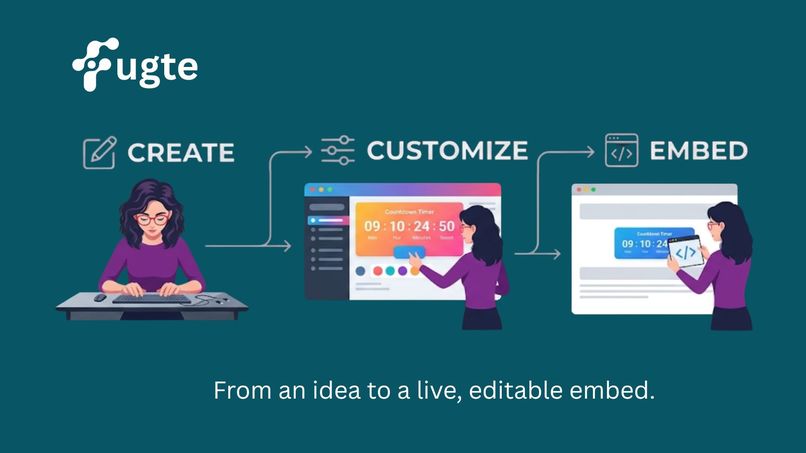
Fugte - Create, Customize, Embed
-
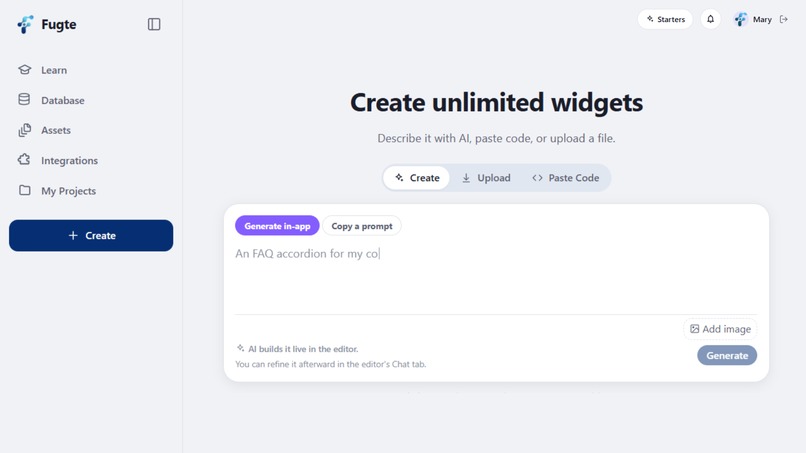
Fugte App
Inspiration
AI can write web code in seconds. But for the person who runs both the website and the business, raw code is useless: hard to embed, risky to edit, and every tiny change means another invoice. Small businesses do not need a code generator. They need the thing agencies actually sell: a working, embeddable, maintainable piece of software. We built Fugte to close that gap.
What it does
Fugte turns a plain-English description into an embeddable widget a non-technical owner can run themselves:
- Describe it. "A package finder that asks five questions and recommends one of my three plans." Gemini compiles a complete widget: markup, logic, and a settings schema.
- It checks its own work. Every generation passes a deterministic lint. When the linter finds a blocking defect (a button that leads nowhere), Gemini is asked to repair exactly that, and the repair is only adopted when re-linting proves it fixed the defect. This runs in production on every build.
- Customize without code. Gemini extracts the editable properties (prices, questions, colors, scoring weights) into an auto-generated no-code panel with a live preview.
- Embed anywhere. One hosted URL and iframe snippet work on WordPress, Webflow, Shopify, Carrd, Notion, and Canva. Publishing again updates every live embed at the same stable link.
- Own the data. Form widgets collect submissions into the owner's Database tab: leads, waitlists, and messages, with spam filtering and CSV export.
- Maintain it in plain English. "Rename the Growth package to Business Growth and set its price to $1,499." Gemini edits the code without touching the owner's saved brand settings, and every embed updates on the next publish.
How we built it
- Gemini API end to end. Every LLM stage in production runs on
gemini-3.5-flash: flagship generation, draft edits, the vision pass, and validate-and-repair. Model-aware credit billing prices each call from its real token usage. - Google Cloud. Nightly database backups write to Google Cloud Storage; Firebase Auth signs in every user.
- Edge runtime. The API and the widget CDN run on Cloudflare. Widgets render with zero per-visit AI cost: the AI builds and repairs at authoring time, and a deterministic runtime serves visitors.
- Editor. A web app we built from scratch, pairing code panels with a no-code settings panel kept in sync with the widget's schema. It reads and writes the widget format.
AI-native operations
Production AI executes decisions, not just text. On every build a deterministic linter returns a verdict, and Gemini's repair is adopted only when a re-lint proves the blocking defect is gone: the model's output never ships on its own say-so. Gemini also decides what an owner may edit, by extracting the editable properties into the no-code schema, and how a plain-English maintenance edit merges against saved settings so customization survives. Execution logs record the whole chain: generation request, blocking finding, repair, and the re-lint that accepted it.
Challenges we ran into
- Making generated code trustworthy. The answer was not a better prompt but a contract: deterministic linting, targeted repair, and adoption only on proof. The repair loop exists because generations genuinely fail sometimes.
- Embedding everywhere is a compatibility grind. Canva and Notion cache and proxy embeds, so we version published URLs to guarantee freshness.
- Editing code without destroying customization. Settings merge so the owner's saved values always beat regenerated defaults.
Accomplishments we're proud of
- Two thirds of everyone who signs up goes on to publish a widget, and 15.2% come back to edit one after creation day. Publishing means a business put our output live under its own name, which is a commitment step rather than a trial.
- About half of our published widgets run inside Canva, a concentration we found in our own embed data rather than assumed.
- Our first paying subscribers inside the competition window, documented in the P&L and Stripe records submitted with this entry.
- Three verified five-star customer testimonials, live on fugte.com; two of the three name Canva as where they embed.
- The validate-and-repair pipeline catching and fixing real defects in production, on the record.
What we learned
Small businesses do not buy AI. They buy outcomes with a maintenance story. The moment we made "edit it yourself later, in plain English" the product promise, retention and word of mouth followed.
What's next for Fugte
Richer widget categories, shipping the Shopify storefront app we prototyped during the window, and a move past one-size-fits-all embeds: the same widget adapting to the context it's viewed in, so an owner gets targeted variants without maintaining five copies.
Prior work disclosure
Before the competition window we ran webdyi.com, a service-website builder with booking for local service businesses (repos March to early May 2026). That product included an embeddable booking form for the sites it generated. The entry here is a different product: a platform where anyone creates a customizable, embeddable widget from a prompt or pasted code. Its first line of code was committed May 25, 2026, inside the window, and the four repos that make up the submitted product were initialized June 17 to 22, 2026. Our earlier WebDYI build began as a fork of the open-source LiveCodes project (MIT) on May 25, 2026, also inside the window; the submitted API and CDN workers are ports of that codebase, while the editor is a from-scratch Qwik rewrite that keeps its config format so existing widgets still render. We kept the brand, domain, and audience from webdyi (now rebranded to fugte.com), and we disclose that continuity deliberately.


Log in or sign up for Devpost to join the conversation.