Inspiration We have all been there: driving 20 minutes out of our way to save a few cents per gallon on gas. It feels like a win, but psychologically, we ignore the hidden costs. We burn extra fuel to get there, we wear down our tires, and most importantly, we waste our time.
I wanted to build an application that breaks this irrational cycle. I asked myself: "What if an AI could act as a brutal financial coach that does the math I'm too lazy to do?" That was the spark for Fuel Logic.
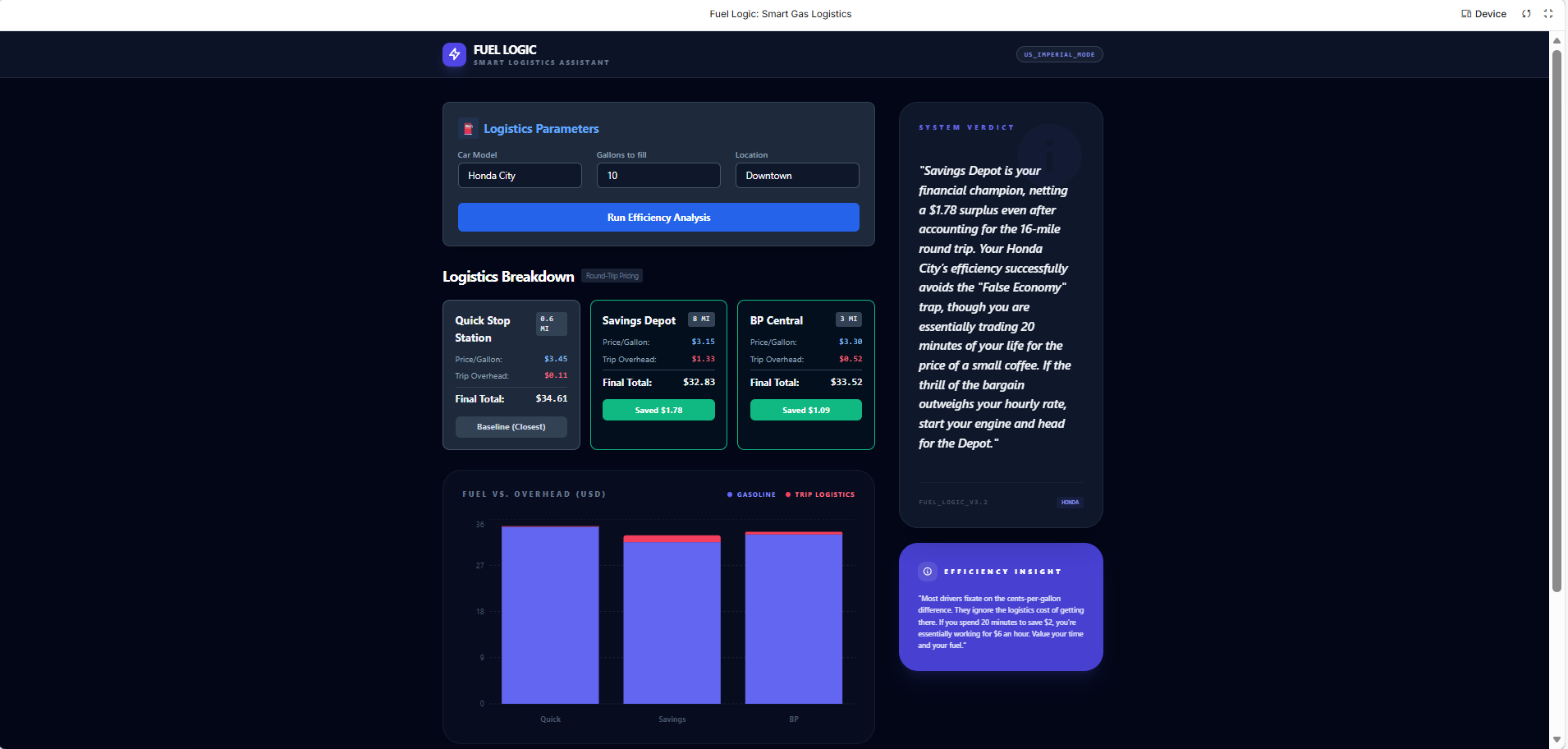
What it does Fuel Logic is not a navigation app; it is a Financial Reasoning Agent.
Data Analysis: It takes your specific car model (to estimate MPG efficiency), the amount of fuel you need, and your location.
The Math: It compares local gas stations against cheaper, distant ones. It calculates the "Trip Overhead" (the real cost of driving there and back).
The Gemini Verdict: This is the core feature. Instead of boring charts, Gemini 3 analyzes the financial outcome and delivers a "Verdict" with a distinct personality. It acts as a witty, slightly sarcastic financial advisor. If you make a bad choice, it will politely roast you (e.g., "Don't value your time at $0.50/hour just to save pennies").
How we built it I built this entire application using the "Vibe Coding" methodology with Google AI Studio and the Gemini 3 Flash model.
As a student, I didn't write the React code line-by-line manually. Instead, I acted as the System Architect:
System Prompting: I designed a complex System Instruction that forces the model to perform multi-step mathematical reasoning before generating a response.
Iterative UI Design: I used natural language prompts to generate the dashboard, refining the "Dark Mode" aesthetic and the layout of the comparison cards.
Persona Tuning: I spent time calibrating the AI's tone, moving from "rude" to "smart & witty" based on feedback from user testing.
Challenges we ran into The biggest challenge was hallucination in unit conversions. Initially, the model would mix Liters with Gallons and Mexican Pesos with US Dollars, resulting in gas tanks costing $1,800 USD! To fix this, I had to refine the System Instructions with strict constraints: "Use ONLY Imperial Units" and "Sanitize all currency inputs to US Market standards." It taught me that prompt engineering requires as much precision as traditional coding.
Accomplishments that we're proud of Zero-Code Deployment: Creating a fully functional, visually professional React application solely through AI prompting.
The "Personality" Engine: Successfully giving the AI a unique voice. It doesn't feel like a robot; it feels like a smart friend giving you advice.
Real Reasoning: The app doesn't just look up data; it understands the relationship between distance, efficiency, and time value.
What we learned I learned that Gemini 3 is a reasoning engine, not just a text generator. By giving it the right context and constraints, it can perform complex logic that usually requires backend scripts. I also learned the power of "Vibe Coding" to prototype ideas at lightning speed—allowing me to focus on the logic rather than the syntax.
What's next for Fuel Logic Real-Time API Integration: Connecting the app to a live gas price API (like GasBuddy) instead of simulated data.
EV Support: Adding logic for Electric Vehicles (charging time vs. energy cost).
Voice Mode: Allowing users to talk to Fuel Logic while driving to get real-time advice.
Built With
- gemini
- geminiflash3


Log in or sign up for Devpost to join the conversation.