-
-
Report
-
Fraud detection
-
Datasets
-
Data selection
Inspiration
We were inspired by finance dashboards, trying to implement visual and agentic tools in fast paced analyst workflow. Community-bank fraud analysts get about three minutes per case, and their rules fire on single transactions — so coordinated rings that keep every transfer under the alert threshold and fan money across mules never trip a flag. We wanted a system that hunts that invisible ring on its own and hands the analyst a confirmed, justified verdict instead of raw rows.
What it does
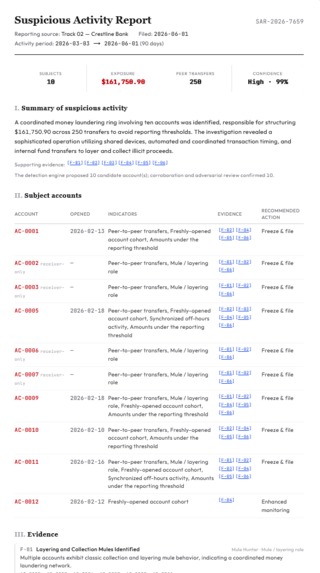
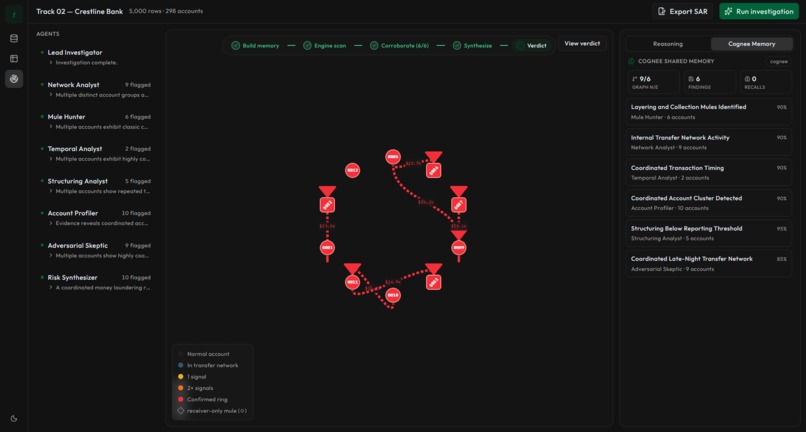
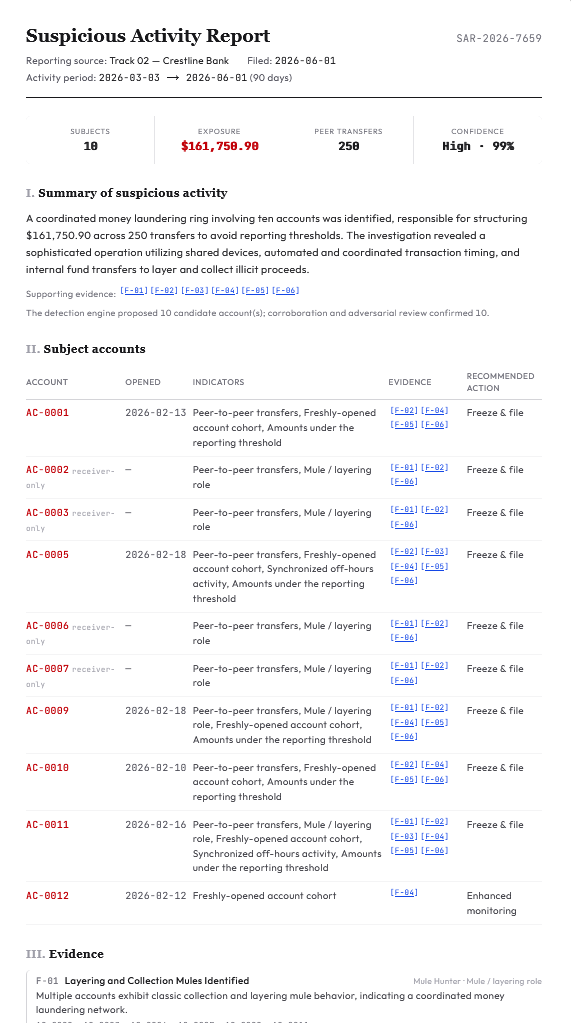
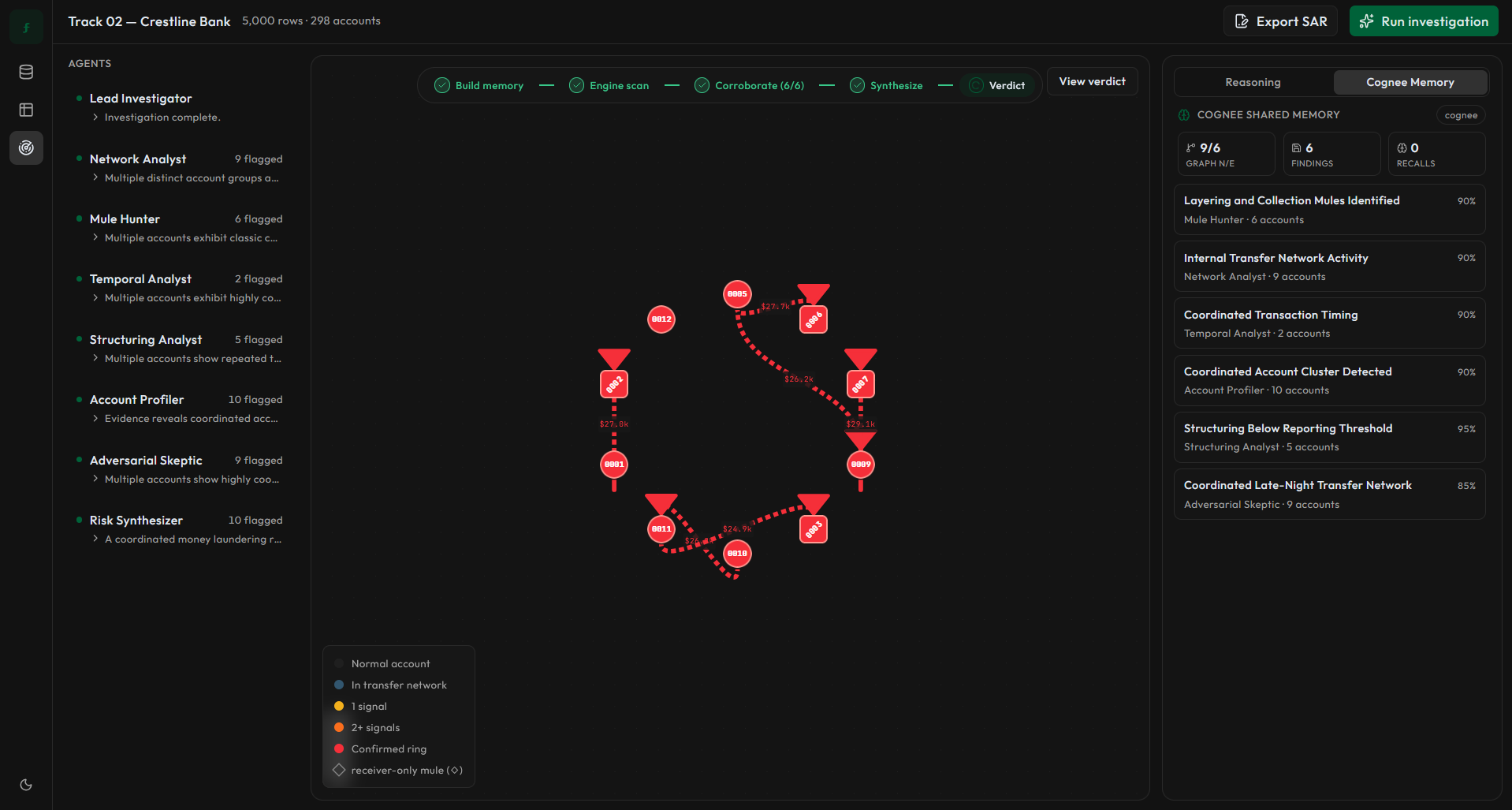
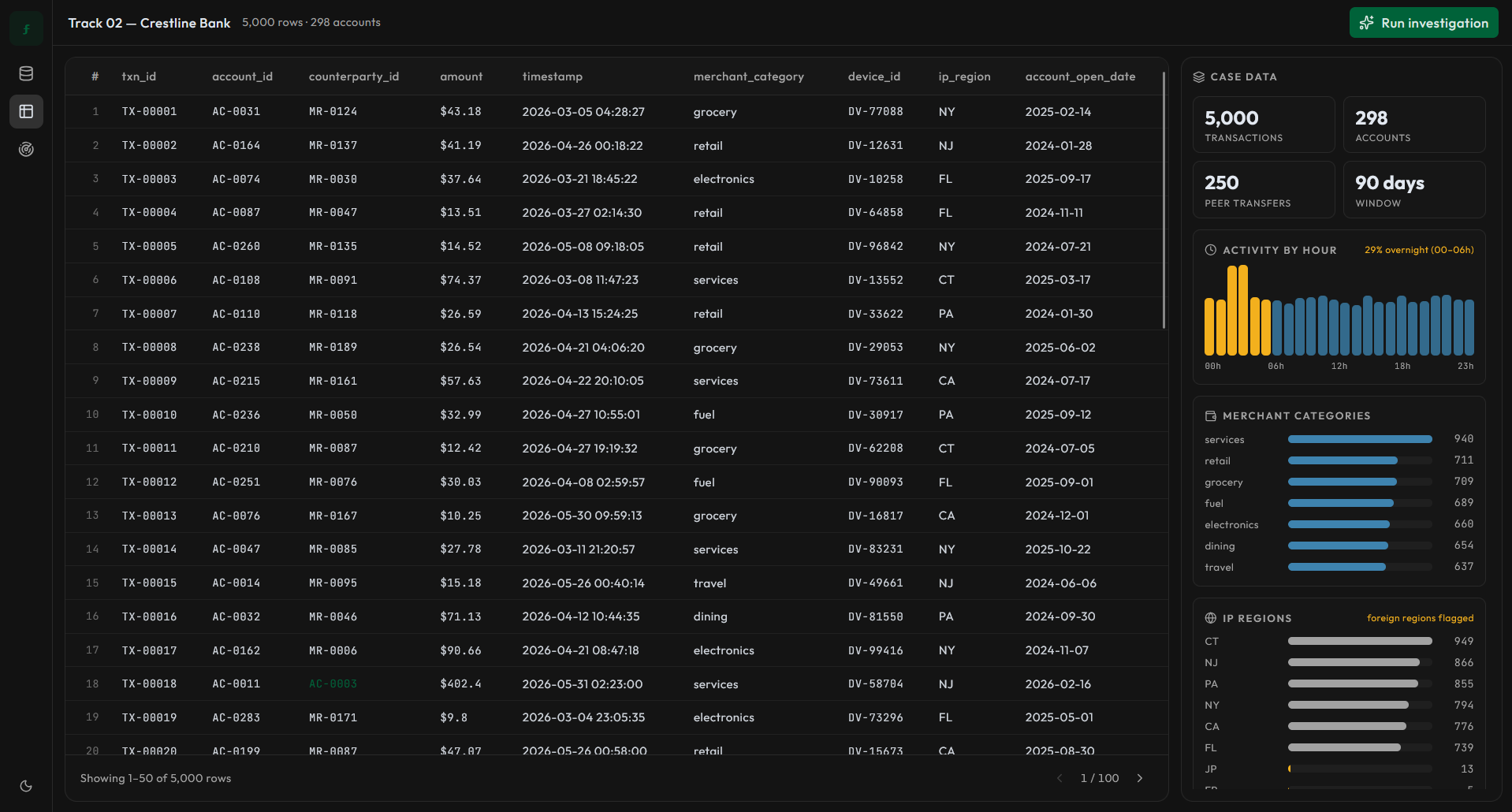
FRTC autonomously investigates 90 days of bank transactions and finds a coordinated fraud ring no threshold caught. An unsupervised engine surfaces a candidate cluster; then six specialist agents plus an adversarial Skeptic examine it concurrently, each writing findings to a shared Cognee memory graph and recalling each other's. A Risk Synthesizer fuses the verdict and streams it over WebSocket to a live UI where the agents light up the graph in real time. On Track02 it confirms a 10-account ring moving $161,750.90 across 250 peer transfers — matching the benchmark to the cent, nothing hardcoded.
How we built it
We built with diverse agentic models such as Claude Code, OpenAI, Opencode, Gemini. So, we integrated our ideas with diverse models, first building the prototypes separately. Hybrid by design: LLM agents (Google Gemini via OpenRouter) decide what to look at, deterministic Python does the exact math, and ring membership is anchored to the engine's candidate so model variance can never drop a real member. Memory is Cognee (Kuzu graph + LanceDB vectors, fastembed embeddings running locally/offline). Backend is FastAPI + WebSocket; frontend is Next.js 16 + React Flow + Framer Motion. Deployed on DigitalOcean App Platform (Docker). With no API key it runs fully deterministic and still passes the benchmark.
Challenges we ran into
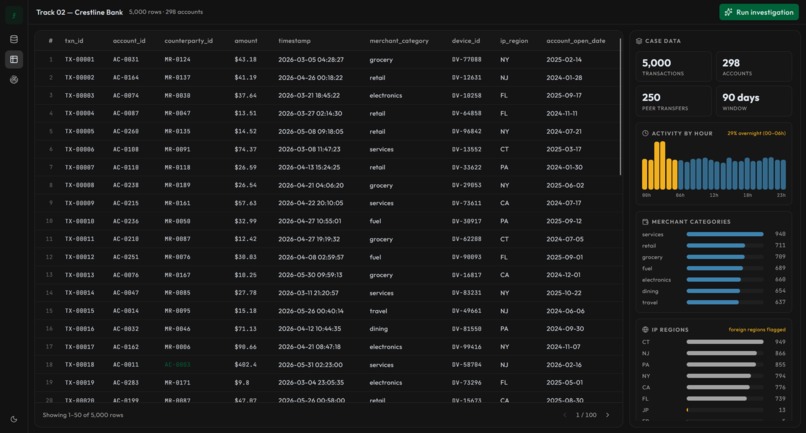
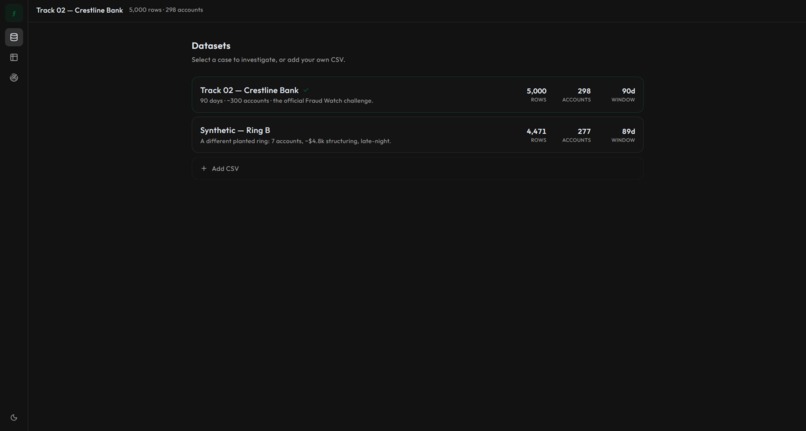
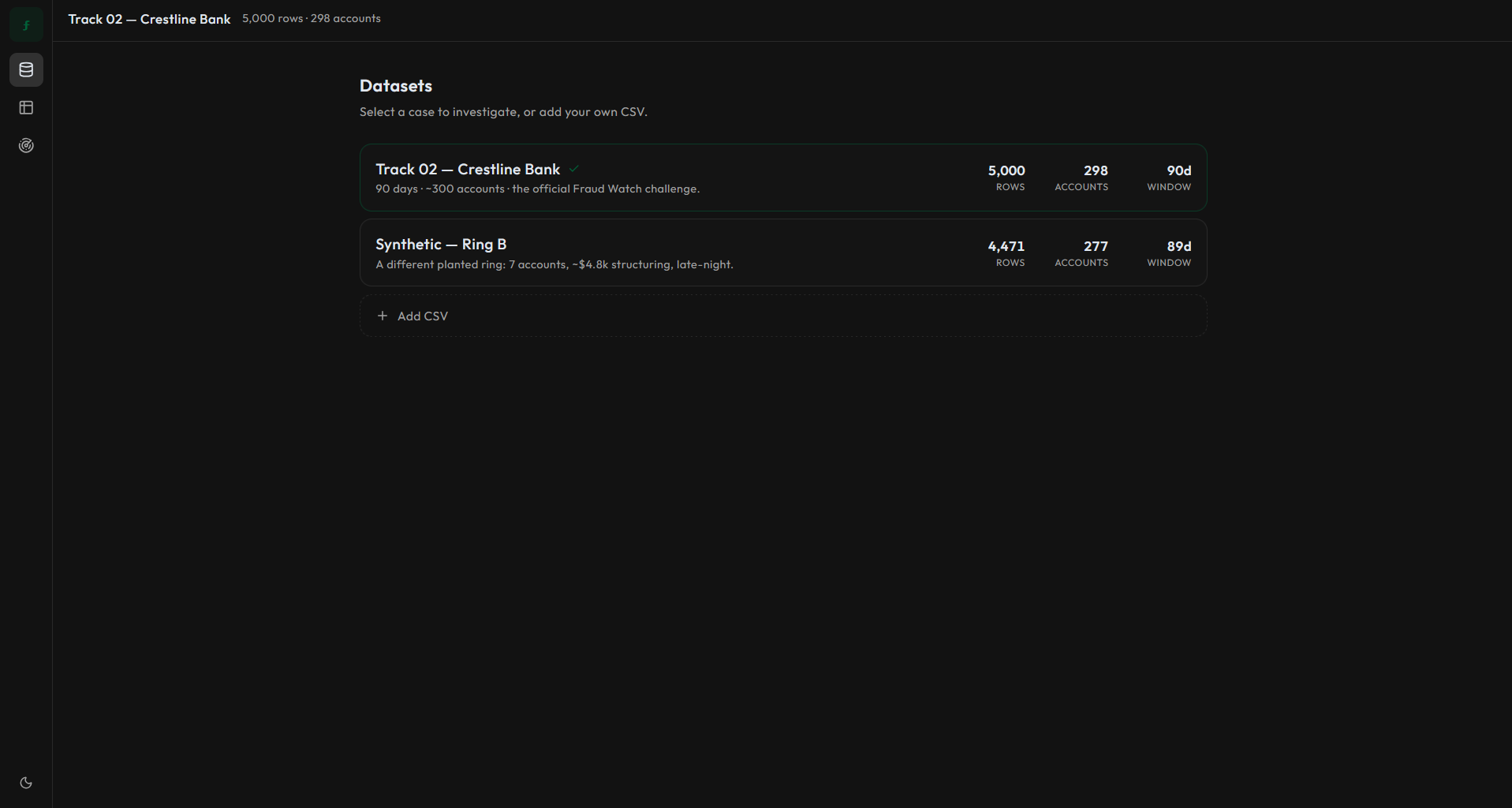
First we had only one dataset. Making detection content-agnostic—every cutoff is a percentile or gap of the data at hand, so nothing is baked in (a ring-free dataset yields zero candidates). Getting genuine cross-agent shared memory (concurrent agents reading/writing Cognee semantically, not isolated runs). Keeping the LLM honest by anchoring membership to the engine candidate and letting the Skeptic only prune weakly-linked members. And deploying the heavy stack (cognee/lancedb/kuzu/onnxruntime) on a 2 GB instance.
Accomplishments that we're proud of
Graphical interface. 100% precision and recall on two datasets (Track 02 exposure to the cent, plus a synthetic Ring B), genuine multi-agent shared memory, a fully content-agnostic engine, a live real-time reasoning UI, and a deterministic fallback that passes the benchmark with zero API keys and zero token cost.
What we learned
Working on different projects separately and merging together works. Fraud is a coordination/graph problem disguised as rows. Anchoring LLM agents to a deterministic candidate gives output that's both smart and trustworthy. Memory-as-handoff (Cognee) beats glue code, and local fastembed embeddings keep it cheap and offline.
What's next for FRTC
We will integrate more functionality. Real-time/streaming ingestion, more drill-down tools and detectors, an analyst feedback loop, and production SAR e-filing with multi-tenant access.


Log in or sign up for Devpost to join the conversation.