Froyou
Arm AI Optimization Challenge 2026 — Track 3: Mobile AI
Setup, build and validation instructions are in the README on GitHub. A TestFlight link is on the submission page if you'd rather just run it.
A local-first iOS journal that notices what you keep coming back to. You talk or type; it transcribes, reads the mood, embeds every sentence, groups those embeddings across everything you've ever written, and names the groups — so it can tell you that six logs written six different ways, with no word in common, were all the same worry.
It runs four on-device models on the Arm silicon already in your phone and ships zero bytes of model weights to do it. The download is 38.8 MB, and the largest thing in it is the font. No server, no account, no network call.
Inspiration
I deal with anxiety sometimes, and the hard part isn't the feeling — it's the loop. The same worry arrives wearing a different outfit every day. Monday: "I think I said the wrong thing in standup." Wednesday: "I don't think they're happy with the timeline." Sunday: "I should probably talk to my manager." Three sentences with almost no words in common; no keyword search connects them. But they're one thought, and I'd been carrying it a week without noticing, because each instance felt reasonable on its own.
That's what I wanted a computer to do: not advise, not diagnose, not score my mood out of ten — just notice, and say it back.
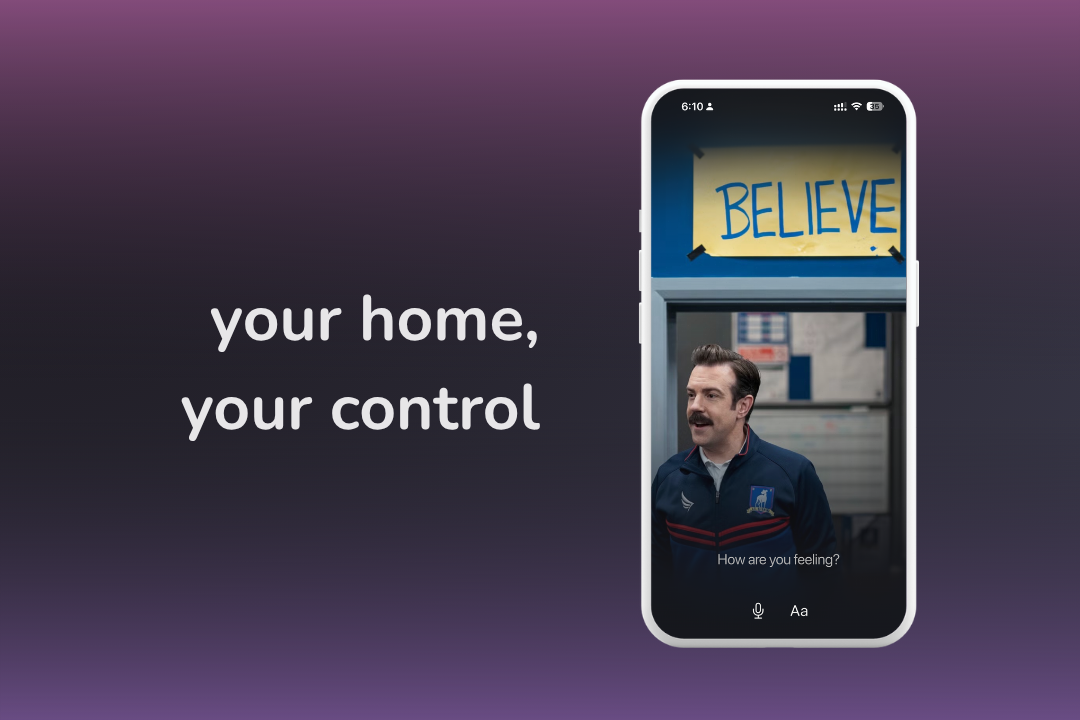
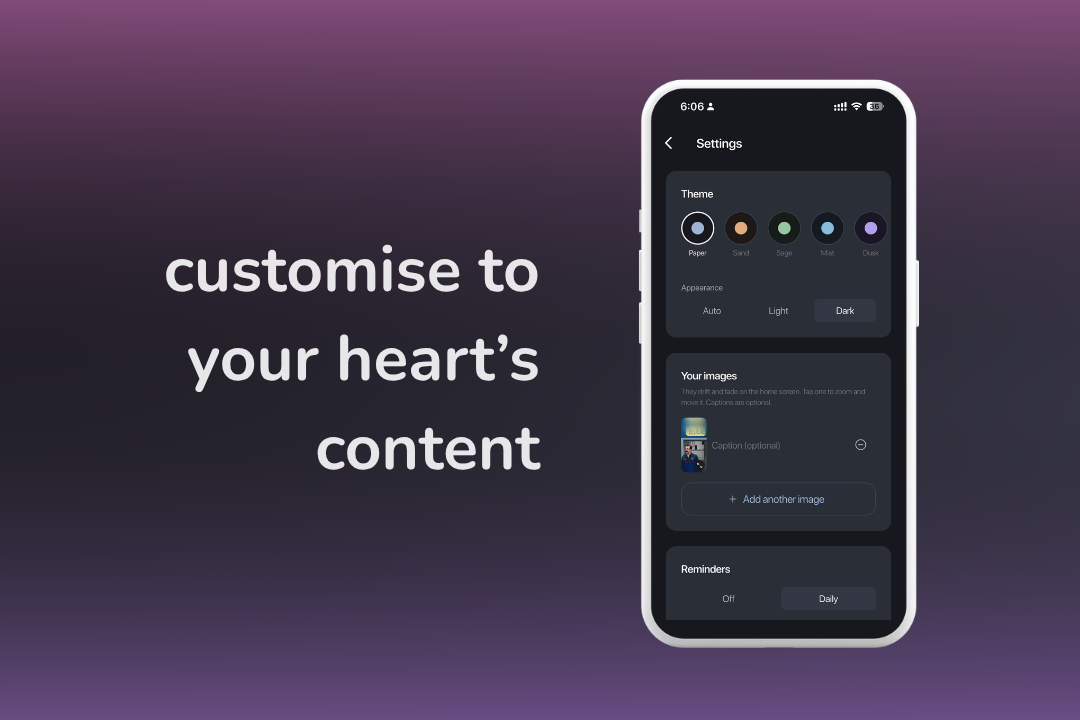
Three things followed. It had to be boring to use (every journalling app I tried wanted a mood emoji, a prompt, a tag, a sleep rating — when you're already in a loop, a form is another loop). It had to check on me with a question that knows what yesterday was like, not a generic 9 p.m. push. And it had to be comforting to open — your own photos behind a caption you wrote, not a dashboard with a streak counter.
What it does
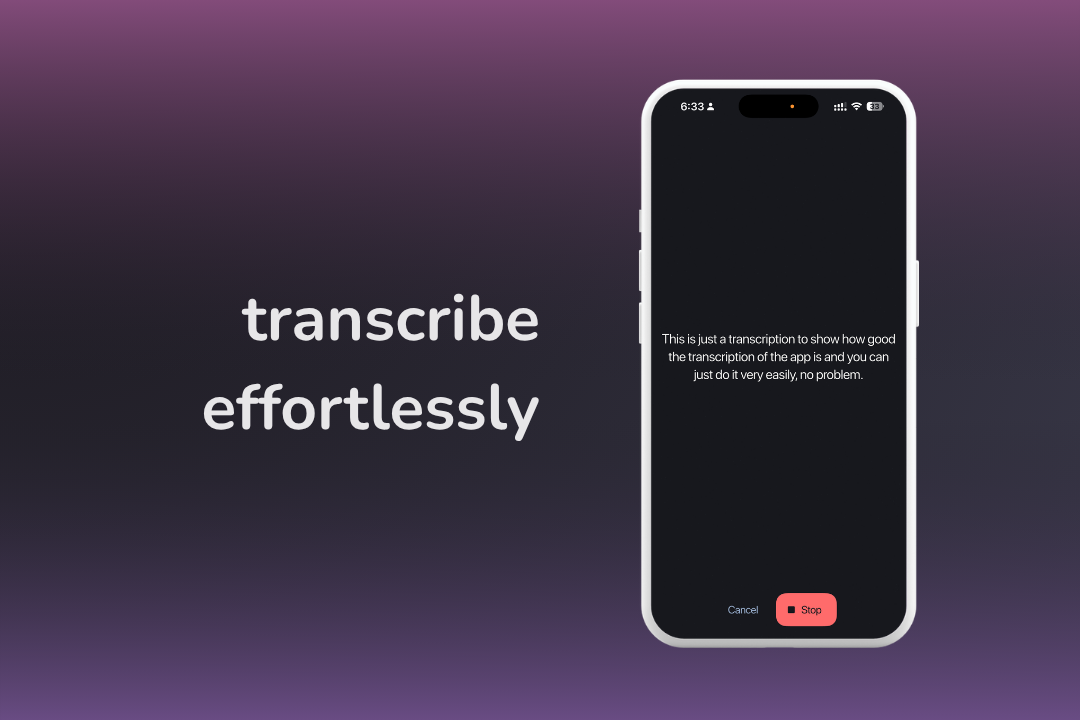
Talk or type. Recording streams live from iOS 26's SpeechTranscriber, each
word fading in as it lands and quietly revising itself when the recognizer
changes its mind.
It finds the loops. Every sentence becomes a 512-dim NLContextualEmbedding
vector in ObjectBox. Vectors are grouped by similarity against a threshold
derived from your own writing, and the whole corpus is regrouped from scratch
when it's grown or shifted enough to matter. Apple's on-device language model
names each group: "Deadline moved." "Not sleeping." "The conversation I keep not
having."
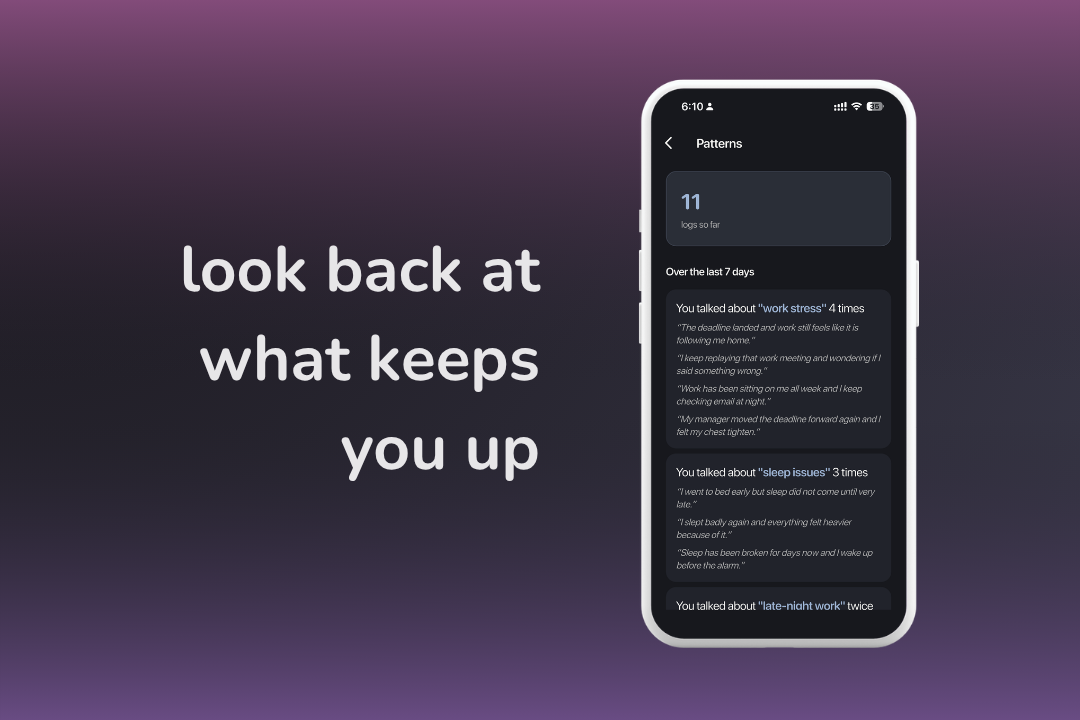
It shows you the week. After five logs, an analytics view lists themes that recurred in the last seven days — the name, how many entries touched it, and the sentences that produced the count, always one tap away. A claim about your own week should be checkable.
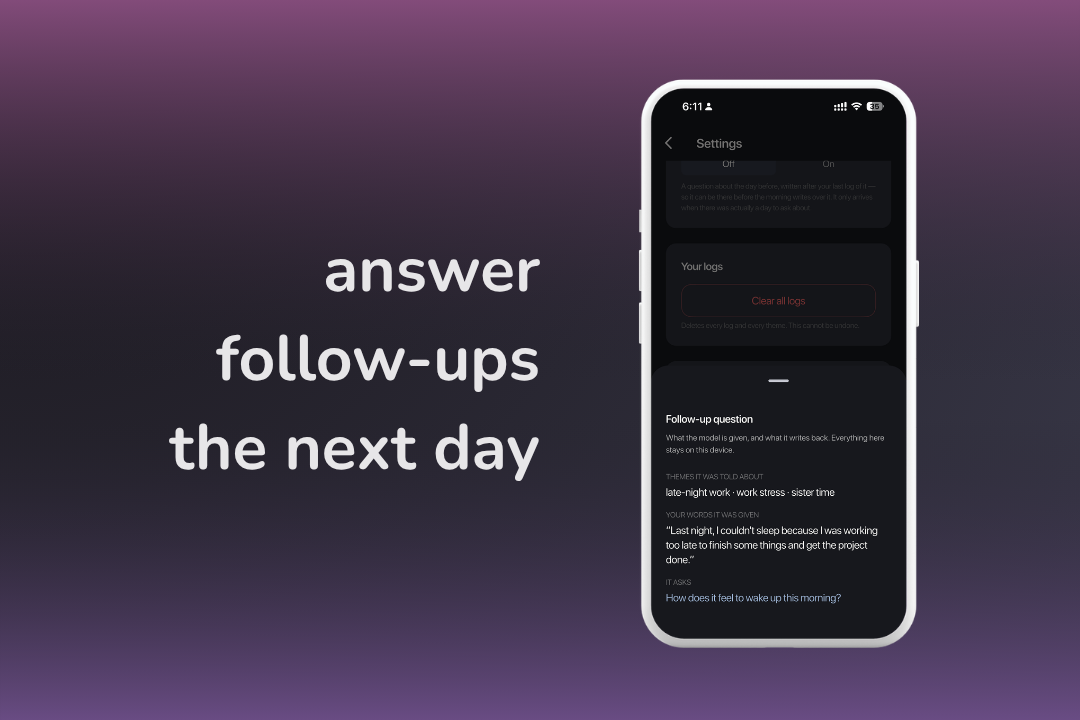
It checks in. If yesterday averaged below −0.15 sentiment, today's home screen carries one short, warm, open question written by the on-device model from yesterday's themes. Never in the moment — always the day after. Never on one bad entry inside a fine day — always on the day's average. It clears when you log. A second notification can deliver the same question at 9 AM. If the model isn't available, no question appears at all — a canned one would be worse than silence.
It stays yours. Airplane mode changes nothing. No account, no sync, no telemetry, no network code to audit.
How we built it
The strategy is: rent the models, own the pipeline.
The conventional private-AI app bundles quantized models and then fights to keep
the download under half a gigabyte. Froyou takes the opposite bet. iOS 26 ships
SpeechTranscriber, NLTagger, NLContextualEmbedding and
SystemLanguageModel as system services — compiled for the Arm CPU and Neural
Engine, resident once for every app on the device. The marginal disk cost of the
AI is 0 MB, the memory cost is the OS's, and the inference path is Apple's own,
already scheduled onto the ANE by code that knows the hardware far better than
we could.
The cost is real and shapes everything below: you cannot fine-tune, quantize, swap, or properly profile a model you don't own. Every optimization has to happen upstream or downstream of it.
| Channel | Framework | What it does here |
|---|---|---|
app/speech |
SpeechAnalyzer / SpeechTranscriber |
Streaming transcription with live revision. EventChannel for the stream, MethodChannel for control. |
app/nlp |
NLTokenizer, NLTagger, NLContextualEmbedding |
Sentence splitting, sentiment, 512-dim embeddings, mean-pooled natively. |
app/genai |
SystemLanguageModel (Foundation Models) |
Theme names, entry keywords, the follow-up question — @Generable guided generation. |
| — | ObjectBox | On-device vector store. An HNSW index is declared and deliberately not used — see Challenges. |
The interesting part: none of these models knows about the others. The embedder doesn't know it's feeding a clustering algorithm; the language model doesn't know the groups it's naming came from cosine similarity. Making four independent black boxes into one coherent product is where the work — and the optimization opportunity — turned out to be.
What happens when you save a log
text ─┬─> KeywordNamer → SystemLanguageModel ──> entry.keywords ──► [log card]
      ├─> NLTagger sentiment ────────────────> entry.moodScore ──► [mood dot]
      └─> NLContextualEmbedding ──centred cosine ≥ Otsu──> ThemeCluster
                └─> ClusterNamer.relabelAll → SystemLanguageModel ► [Analytics]
The three branches are independent. A device where the embedding assets never finish downloading still gets a mood dot and card keywords; the entry is just stored unclustered. Nothing in the fan-out is a chain.
The card is written twice, on purpose. Keywords get a synchronous value the instant the entry saves, so a card is never blank; the model's answer overwrites it. Phase 1 of a save cannot wait on an inference and must not fail with one.
Theme naming is deferred and global. relabelAll renames every group in a
single request, never just the one that changed — the model can only make names
distinguish each other if it sees them side by side.
Zero bundled weights: the numbers
No model files at all. Not a quantized encoder, not a GloVe table, not an ONNX
runtime. The shipped flutter build ipa --release:
| Component | Size | What it is |
|---|---|---|
flutter_assets/fonts |
21.0 MB | SF Pro Rounded, four weights |
Flutter.framework |
9.8 MB | the Flutter engine |
App (Dart AOT snapshot) |
7.3 MB | all of Froyou's own code |
ObjectBox.framework |
2.7 MB | the on-device vector database |
Assets.car |
0.5 MB | the app icon, 15 sizes |
Runner |
0.5 MB | the three Swift channels + bootstrap |
| everything else | ~0.4 MB | plugin frameworks and resource bundles |
Total .app |
43 MB | uncompressed on disk |
Shipped .ipa |
38.8 MB | what a user downloads |
| Model weights | 0 bytes |
The largest asset in this AI app is the typeface. Four SF Pro Rounded weights outweigh the Flutter engine, the Dart snapshot, the vector database and the Swift channels combined. Cutting the fonts would shrink the download 49%; cutting the AI would shrink it 0%.
What the same app would cost with bundled weights. Take the modest version — a MiniLM-class sentence encoder at INT8 (~25 MB), a WhisperTiny/Small-class speech model (~40–250 MB), and drop generative naming entirely because you can't afford it:
| Build | Download | Weights |
|---|---|---|
| Froyou as shipped | 38.8 MB | 0 |
| Same features, small bundled encoder + tiny ASR | ~105 MB | ~65 MB |
| With a real speech model and a 3B INT4 LLM | ~1.8 GB | ~1.75 GB |
The third row is the honest comparison, because it's the only one that ships what Froyou actually does. A 3B-parameter model at 4-bit is ~1.6 GB of weights — roughly 41× the entire Froyou download. That's why on-device apps that start out wanting a language model almost always abandon it and fall back to embeddings. Froyou never had to make that trade: a model of that class was already installed.
And the App Store cellular-download limit was 200 MB until Apple raised it to 500 MB — the bundled version of this app is on the wrong side of both.
The memory argument is stronger than the disk one
Disk is the visible number. Resident memory is the one that decides whether the app runs.
Weights you bundle are weights you page into your own address space, against your own jetsam limit. iOS gives a foreground app a hard memory ceiling in the hundreds of megabytes; exceeding it isn't swapping, it's an immediate kill. A 3B INT4 model needs ~1.6 GB resident during generation — an app cannot hold that. Even the small build pays: an INT8 encoder is tens of MB resident for as long as you keep the session warm, plus the runtime's arena, plus the KV cache if you generate. Every one of those bytes counts against you, and every one is paid again by the next app on the phone that wants the same thing.
Froyou's inference happens outside the app. Foundation Models and the Natural Language embedding stack run as system services; the app sends a request and receives a result. The weights are resident to the OS, not to us — so the model does not appear in our footprint, does not compete with the ObjectBox page cache or the decoded backdrop photo, and cannot jetsam us. Our own AI-related resident cost is the request and the reply: 512 doubles per sentence, and a handful of short strings.
Three consequences that matter more than the megabytes:
- Memory is shared across apps, not duplicated per app. Three apps using the system embedder cost the device one copy. Three apps bundling their own cost three.
- Cold start doesn't pay a model load. There is no multi-hundred-MB mmap before first use, so the app is interactive immediately; the first inference may wait on assets, which is why phase 1 of a save never depends on phase 2.
- The memory budget goes to the product. The photo pipeline — a two-pass Gaussian at full pane height, a decoded full-resolution backdrop, a snapshot raster for the breathing scale — is genuinely memory-hungry and exists only because nothing is competing with it for the ceiling.
How the grouping actually works
Sentences are grouped on centred cosine similarity — the average direction of all stored embeddings is subtracted before any comparison, because raw embeddings all point roughly the same way regardless of meaning. The threshold isn't a constant: Otsu's method reads it off the pairwise similarity distribution on every pass, with a 4/√512 noise floor underneath so a genuinely varied journal can't collapse into one theme.
Grouping is redone from scratch rather than patched, because incremental
assignment is order-dependent — a theme drifts as it absorbs sentences, and one
that has swallowed everything becomes a magnet. But not on every save:
maybeRecluster rebuilds once per launch, then only when the corpus has grown
by half again or the average has actually moved.
And that average comes from the themes, not the sentences — the single most
expensive thing in the pipeline before it was fixed. Computing it directly means
loading thousands of sentences and their 512 floats each, on every save. Each
theme instead carries a running sumVector, so summing tens of themes gives
exactly the same answer — not an approximation — for a fraction of the I/O and
none of the peak memory.
Speed, latency and energy
Perceived save latency is decoupled from inference entirely. Raw text commits synchronously and the UI updates; sentiment, embeddings, clustering and naming run unawaited afterwards on a 30-second budget. Time to "my words are safe" is a local write.
Round-trips are batched where it matters. embedSentences splits and
embeds natively in one channel crossing instead of N+1, and detects language
once over the whole text rather than per sentence (detection on a short sentence
is unreliable — a quality win as well as a latency one). Each sentence is still
embedded separately inside that call: the model is contextual, so embedding a
paragraph in one pass would make the same sentence produce different vectors
depending on its neighbours. Mean-pooling happens in Swift, so the channel
carries 512 doubles per sentence rather than tokens × 512. Embedding instances
are cached per language — loading one is expensive and the language rarely
changes.
Guided generation as a decode-time optimization. @Generable + @Guide
constrain output to a schema, removing the parse-retry loop. The schemas are
shaped to minimize generated tokens: ThemeNames is a flat [String] matched
back by position rather than {id, label} pairs — making the model echo an
integer costs tokens and risks a hallucinated id silently renaming the wrong
theme. The ids never leave Swift.
A failure latch protects the battery. SystemLanguageModel reporting
.available is necessary but not sufficient — generation additionally needs
Apple's safety classifier, and where that asset is missing every call fails while
the model still advertises itself. GenAiService counts consecutive failures and
after two stops asking for the session. Without it, a device in that state
pays a full failed inference on every save, forever.
Designing for a model that might not be there
Availability is a hardware-and-settings question, not an OS-version one.
SystemLanguageModel is absent on devices without the neural capacity, absent
when the user switched it off, and absent while assets download — three states
demanding different product responses, so they're distinct enum values.
deviceNotEligible is permanent and never mentioned to the user;
appleIntelligenceNotEnabled is a setting they control; modelNotReady is worth
retrying.
And every path degrades rather than breaking. Speech falls back to typing; a device whose embedding assets never arrive still gets sentiment and keywords and simply stores the entry unclustered. The follow-up question is the deliberate exception — with no model there is no question at all, because a warm open question about a day you didn't have is worse than silence.
Notifications compose their text at scheduling time. iOS wants the body when you schedule, and nothing of ours runs when it fires — there's no hook to write a line at 9 AM. So the question is composed at the end of a save, the only moment the day's mood and themes are known and the model is warm. Consequence: the armed question describes the day your last log belongs to, and a later log rewrites it.
Why this compounds
Every optimization in a bundled-model app is a one-time purchase that starts depreciating on ship. Your INT8 encoder is as good as it will ever be; improving it means a new model, re-quantizing, re-validating, and more megabytes.
Froyou's model layer is a subscription to Apple's roadmap, paid in lock-in.
A better SpeechTranscriber in iOS 27 means every install transcribes better. A
less anisotropic embedder means the centring step keeps working and the groups
get cleaner. Apple ships a new Neural Engine roughly annually, and an app that
calls the system model gets that speedup in full, for free.
Challenges we ran into
Cosine similarity didn't work, and it took a while to believe it.
An embedding turns a sentence into a direction in 512-dim space, and cosine similarity measures the angle: 1.0 identical, 0 unrelated. So the obvious design is embed, compare, join above a threshold.
It fails because of anisotropy — the vectors don't use the space. They're crammed into a narrow cone, all pointing roughly the same way before you consider what they say. Picture a crowd where everyone happens to face north: which way people face tells you nothing about who's talking to whom.
Measured on a real device, sentences about cooking, an audiobook and a
relationship scored 0.86, 0.91 and 0.94 against the same theme — three
unrelated topics in a band 0.076 wide, all above 0.85. No threshold fits in
there. This also rules out the obvious optimization: ObjectBox has an HNSW index
and nearestNeighborsF32 right there, but it can only rank raw vectors —
exactly the ones carrying no signal. The first tool everyone reaches for is the
one this problem forbids.
Centring is the fix. Compute the average direction of every stored embedding — the "north" they're all facing — subtract it, rescale. What's left is only the part that makes a sentence different. The same device data then reads unrelated pairs at a median of −0.036 and related pairs out at p99 0.513.
Then the threshold ate three more attempts:
| Value | Where it came from | How it failed |
|---|---|---|
| 0.55 | the synthetic seed, where same-topic vectors score 0.88 | 26 sentences → 25 themes |
| 4/√512 ≈ 0.177 | the noise floor — four sigma past chance | sat below the real user's p90; filed an audiobook under work |
| p90 | "the top tenth of pairs are related" | the seed's share is a fifth — broke the seed |
The noise floor is the instructive failure: it's what the mathematics hands you, it's provably beyond chance, and it's still wrong — "beyond chance" and "about the same subject" are not the same question.
What works is Otsu's method, borrowed from image scanning where it decides which greys are ink and which are paper. Plot every pairwise similarity and you get two humps — a big one near zero for sentences that merely share a language, a smaller one further right for sentences that share a subject. Otsu finds the dip, assuming nothing about where it sits or how big either hump is, which is why it survives both a real journal and a synthetic seed whose distributions look nothing alike. On the seed it picks 0.333, catches exactly the 13 same-topic pairs out of 66, and rebuilds exactly the 4 seeded topics.
Then, with the groups finally correct, the names were still wrong. The original design had no language model in it — c-TF-IDF named the themes. It's a good algorithm that produced useless names, for a reason invisible while building it: a statistical extractor can only return terms that literally appear in the text. That's precisely what this app exists to defeat. The embedding notices that "my manager pushed the date again" and "the timeline slipped" belong together; the labeler then takes that correct group and, having only those sentences' vocabulary, calls the theme "pushed" or "timeline." Grouping solved the synonym problem and naming immediately reintroduced it.
So naming was rewritten model-first: SystemLanguageModel gets the group's most
central sentences and writes a name that need not contain any word from any of
them. There's now a kModelOnlyLabels switch, currently on, that disables every
statistical fallback so a blank label means the model declined rather than the
statistics quietly filling in.
A model that reports itself available and then fails every call. In the
Simulator SystemLanguageModel reports .available and generation still fails —
SensitiveContentAnalysisML Code=15 → ModelManagerError 1026, Apple's safety
classifier, unprovisioned there. That lesson is now the failure latch, and it
means real model output can only be verified on a physical A17 Pro or newer,
which shapes the whole test strategy.
A performance regression that looked free. Home had a slow Ken Burns drift on
the backdrop — a transform above a RepaintBoundary, which every mental model
says is compositor-only and therefore free. It was the most expensive thing in
the app: a raster cache will not hold a layer whose transform changes every
frame, so the entire backdrop, two-pass Gaussian included, re-rendered at full
DPR on every frame Home sat idle. Deleting it made idle Home actually idle.
Finding it required disbelieving the abstraction.
Timezone-correct reminders are a trap. The timezone package ships the zone
database but can't tell where the device is, so tz.local stays UTC and a 21:00
reminder fires at 21:00 UTC — plausible enough to ship and only detectable by
waiting. flutter_timezone supplies the IANA name; if it fails, reminders
switch off rather than firing at the wrong hour.
Testing an app built on models that don't exist in CI. Anything that saves a log asks the model if it's available; unmocked, that never completes under the fake clock and the test hangs to its timeout — this once turned an 80-second suite into twenty minutes. Both the genai and speech mocks are now first-class and documented as landmines.
Accomplishments we're proud of
Generative theme naming on a phone at zero bundle cost — the feature a bundled-model app has to abandon as too heavy, in a 38.8 MB download that a single quantized speech model would have dwarfed.
A model-quality fix on a model we don't control. From an unusable 0.076-wide band — every topic scoring 0.86–0.94 against every other — to unrelated pairs at a median of −0.036 and related pairs at p99 0.513, achieved entirely in the pipeline. This is the part that generalizes: anyone using pooled contextual embeddings for similarity has this problem, probably without knowing it.
Offline as a structural property. Not a toggle — there is no network code to audit.
Three degradation tiers invisible from the UI. The same build is coherent on an A17 Pro with Apple Intelligence on, on an older iOS 26 device, and in a Simulator where generation is impossible. Only the boot log knows which you're in.
An interface you're glad to open. 190 tests, golden-covered, contrast-verified at 4.5:1 across every preset × brightness × tint. A journalling app that doesn't look like a form.
What we learned
The best mobile-AI optimization available today is often not shipping a model. Everyone benchmarks tokens/sec; nobody benchmarks the 500 MB download that made a user abandon the install, or the resident gigabyte that gets the app jetsammed. On Arm specifically, platform models are the only way to get the vendor's own ANE scheduling for free.
Embeddings are geometry, and the geometry isn't what you assume. Anisotropy is a property of every pooled contextual embedding model and it silently destroys threshold-based systems. Centre your vectors before you compare them.
A defensible constant is still a constant. Every threshold we derived from first principles was wrong on some corpus, because each quietly assumed the shape of a distribution it had never seen. What worked was refusing to pick a number and letting an algorithm read the valley out of the data on every pass.
Grouping and naming are two different jobs. Embeddings are excellent at deciding what belongs together and structurally incapable of saying what it is. The tell was that the groups were right while the names were nonsense.
Availability is a spectrum, not a boolean — including one state where the model claims to be there and isn't.
Restraint is the feature. In a mental-health context the design work is mostly deciding what not to do. No auto-detected distortions, no streaks, no score, and no question at all rather than a canned one.
What's next
CBT structure on top of the logs — tagging entries against the vocabulary of Cognitive Behavioural Therapy so a theme reads "the conversation I keep not having · mind-reading · anxious." Non-negotiable: suggested, never asserted.
Enhanced transcription — speaker-aware segmentation, disfluency handling,
custom vocabulary for the names in someone's own life. Most of it arrives free as
SpeechTranscriber improves.
Multimedia notes — voice memos kept as audio, photos read with Vision, all embedded into the same 512-dim space so a photo can join a theme like a sentence.
Import from elsewhere — Apple Notes, Day One, Journal, markdown, Health's State of Mind. Three years of journalling should show you your loops on day one.
Better analytics — months rather than a week, which themes are heating and cooling, mood trajectory within a theme. "This got easier" is more useful than "you were sad on Tuesday."

Log in or sign up for Devpost to join the conversation.