-
-
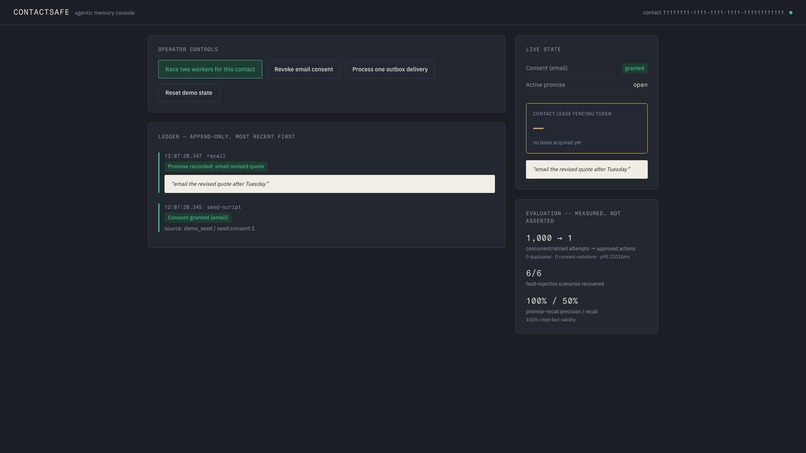
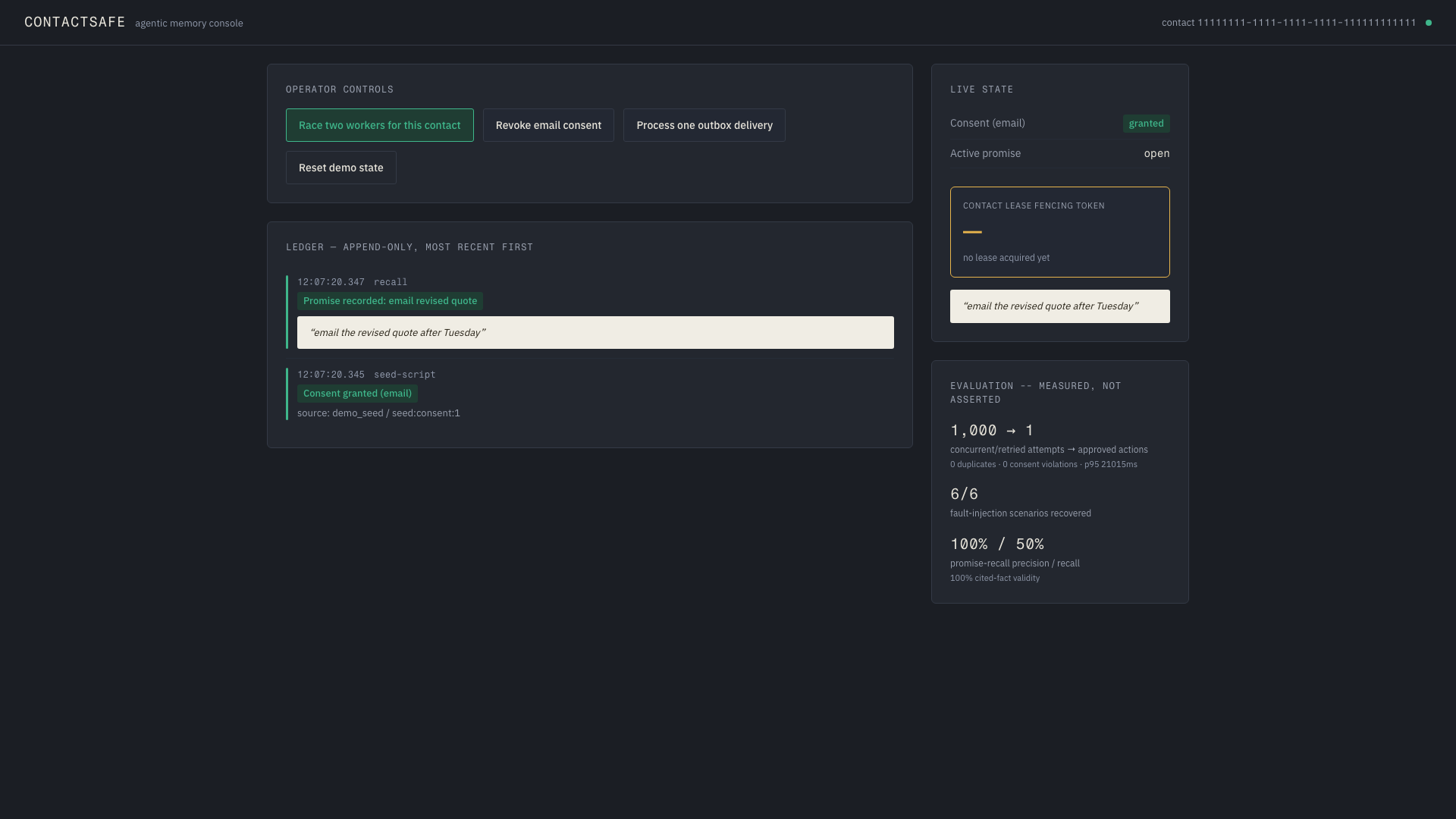
Shared memory with evidence. Two agents retrieve the same synthetic promise and current consent, with source citations visible.
-
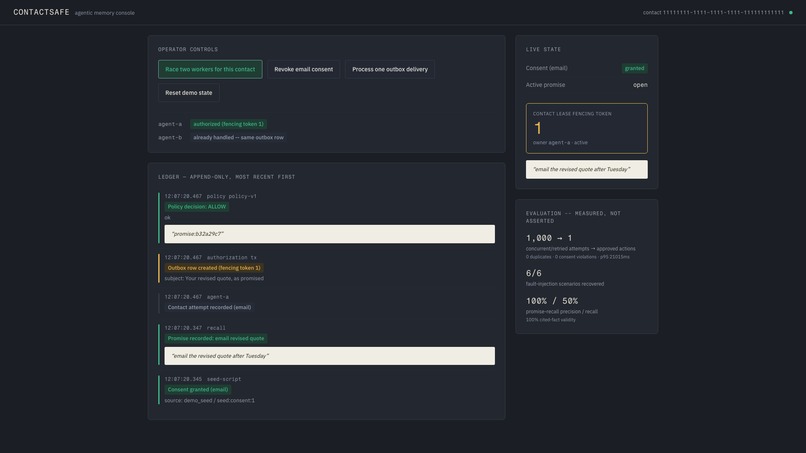
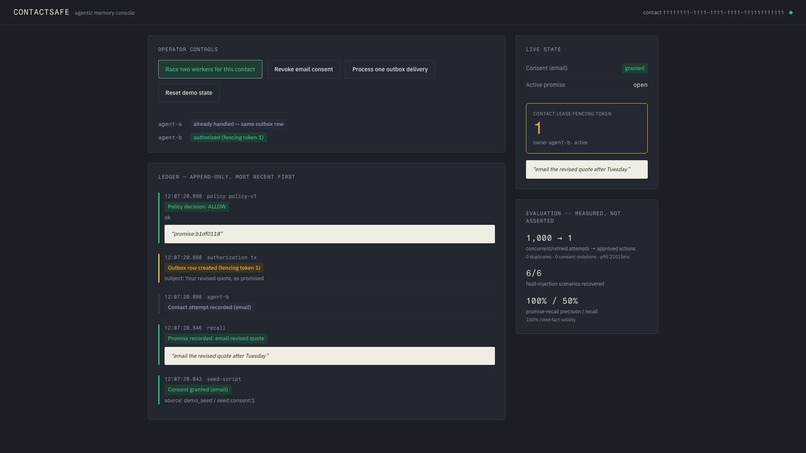
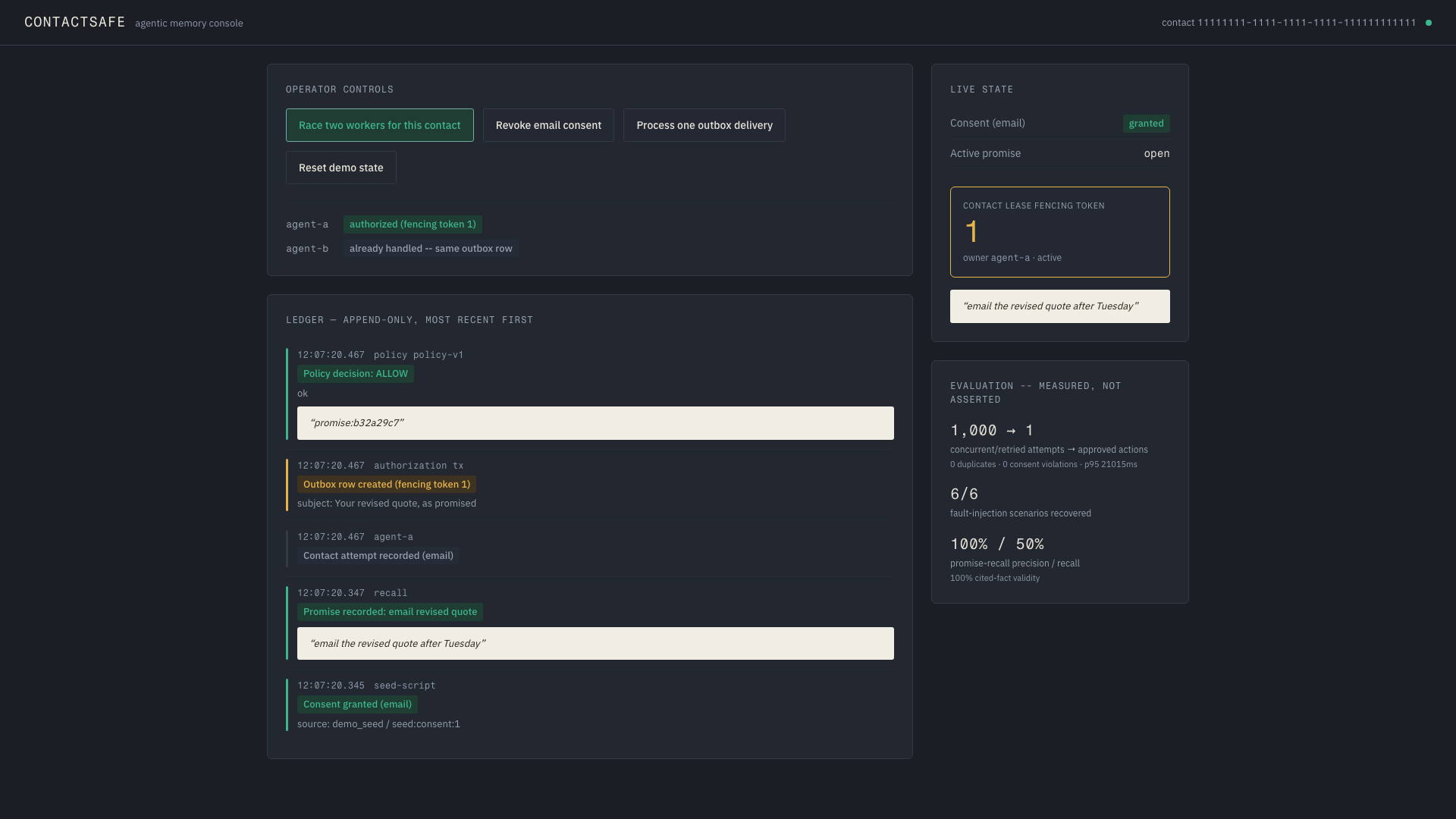
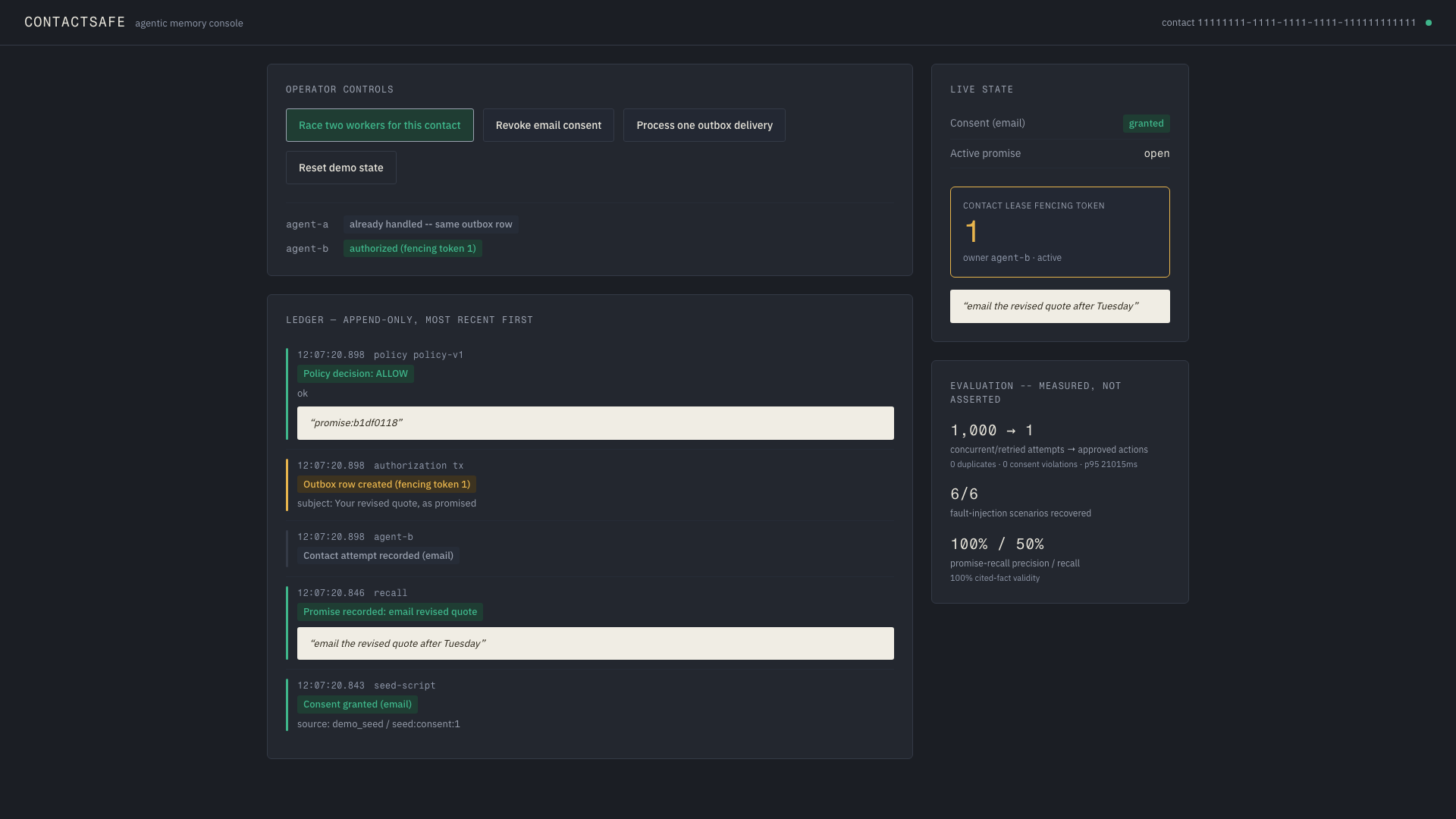
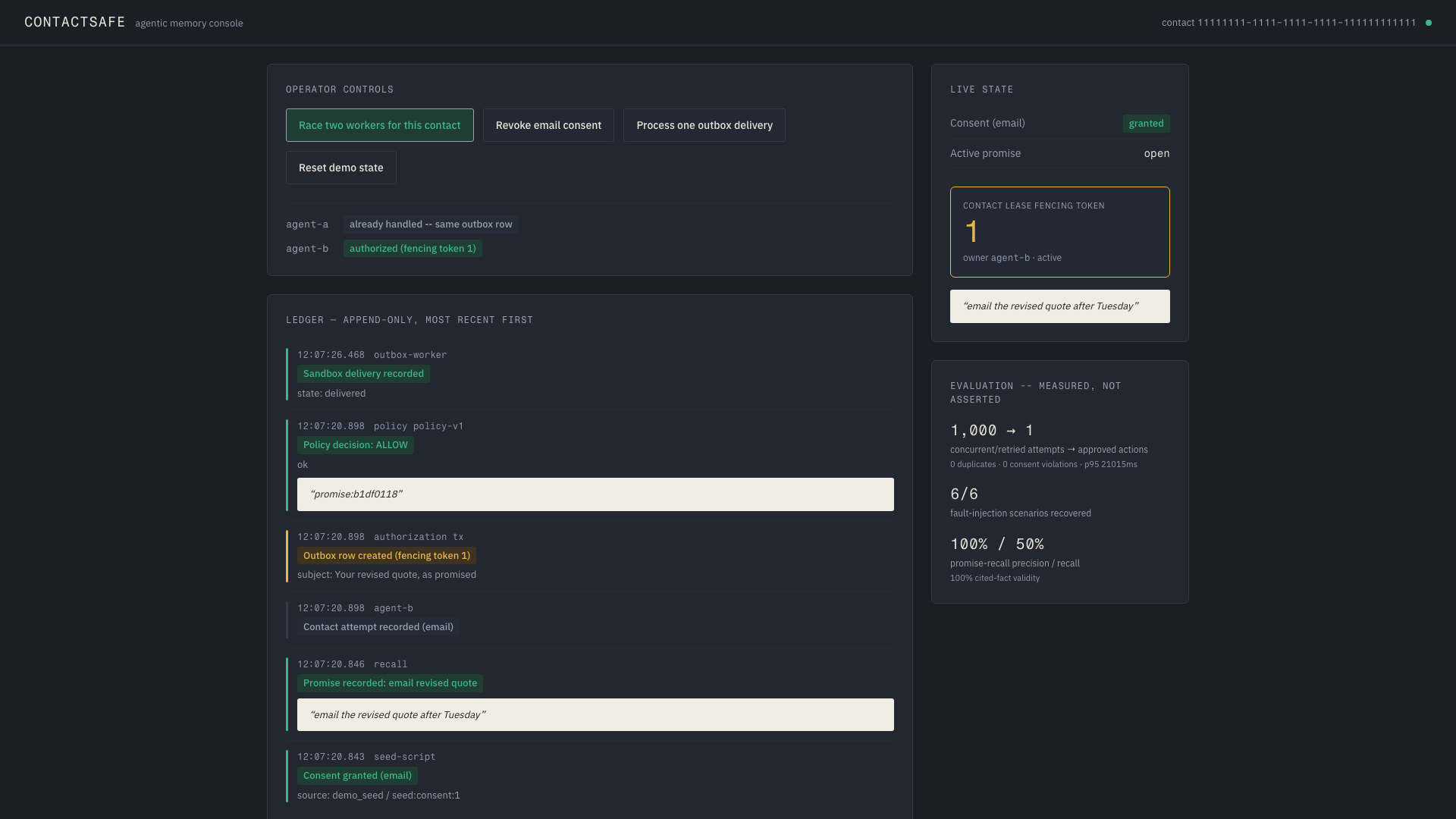
One transactional winner. A serializable transaction gives one worker the fenced lease and outbox row; the other resolves safely.
-
Inspectable crash state. A sandbox outbox item is claimed before an injected worker crash, preserving the exact recovery point.
-
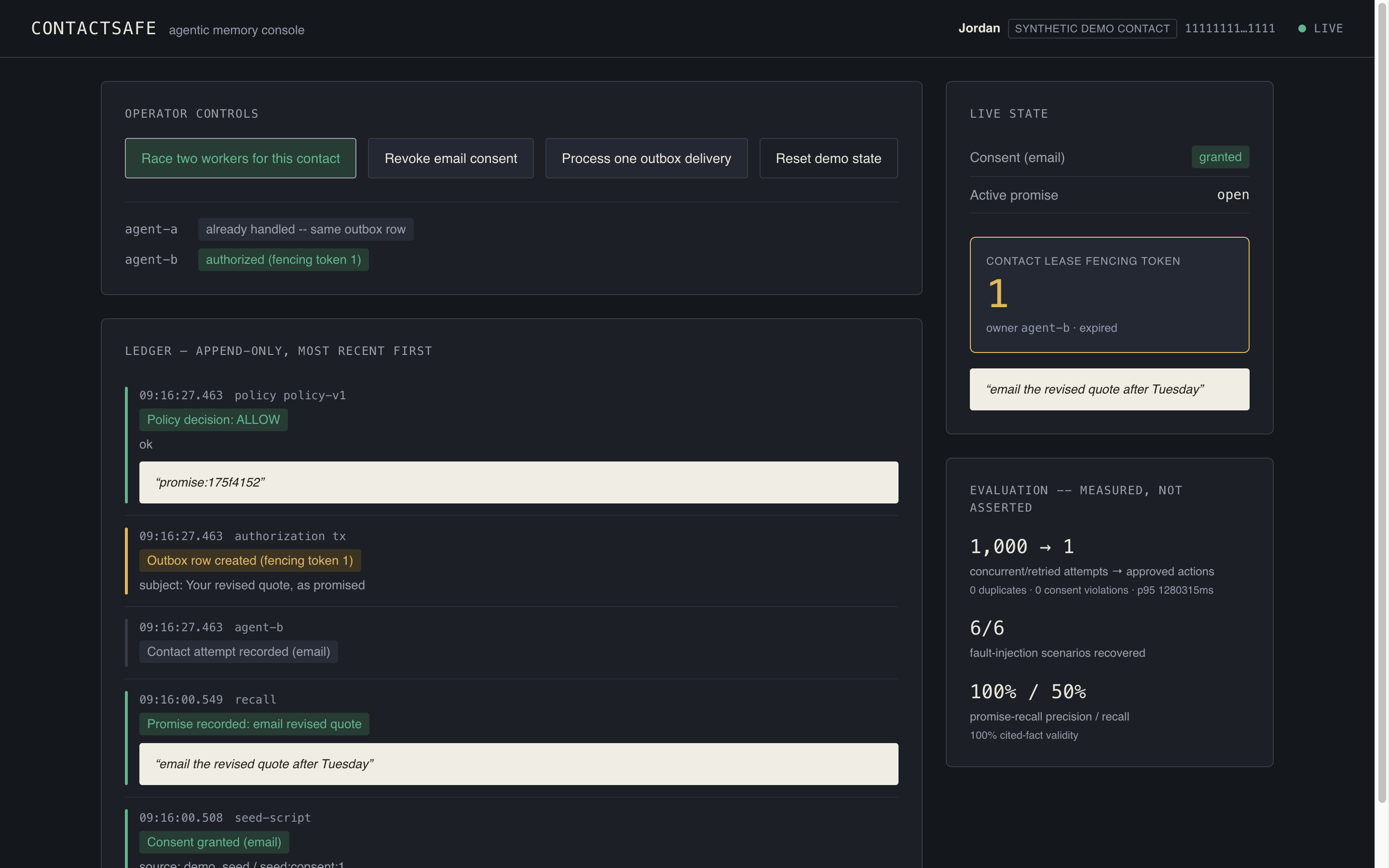
Measured cloud results. One approval, 999 replays, zero duplicates, zero consent violations, and six recovered fault scenarios.
-
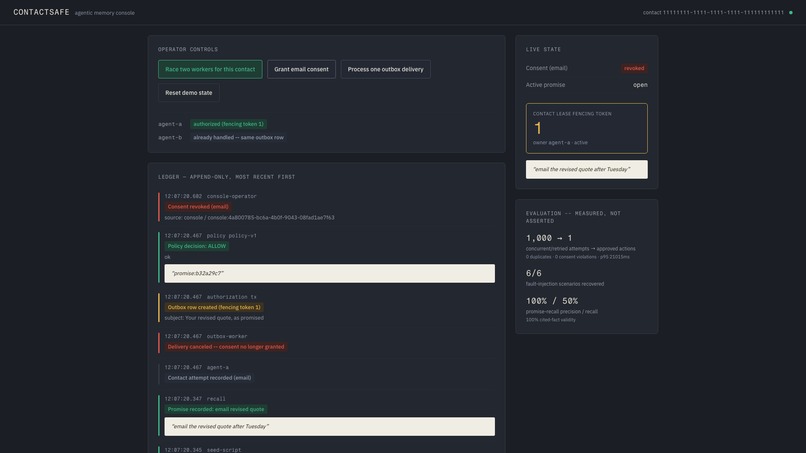
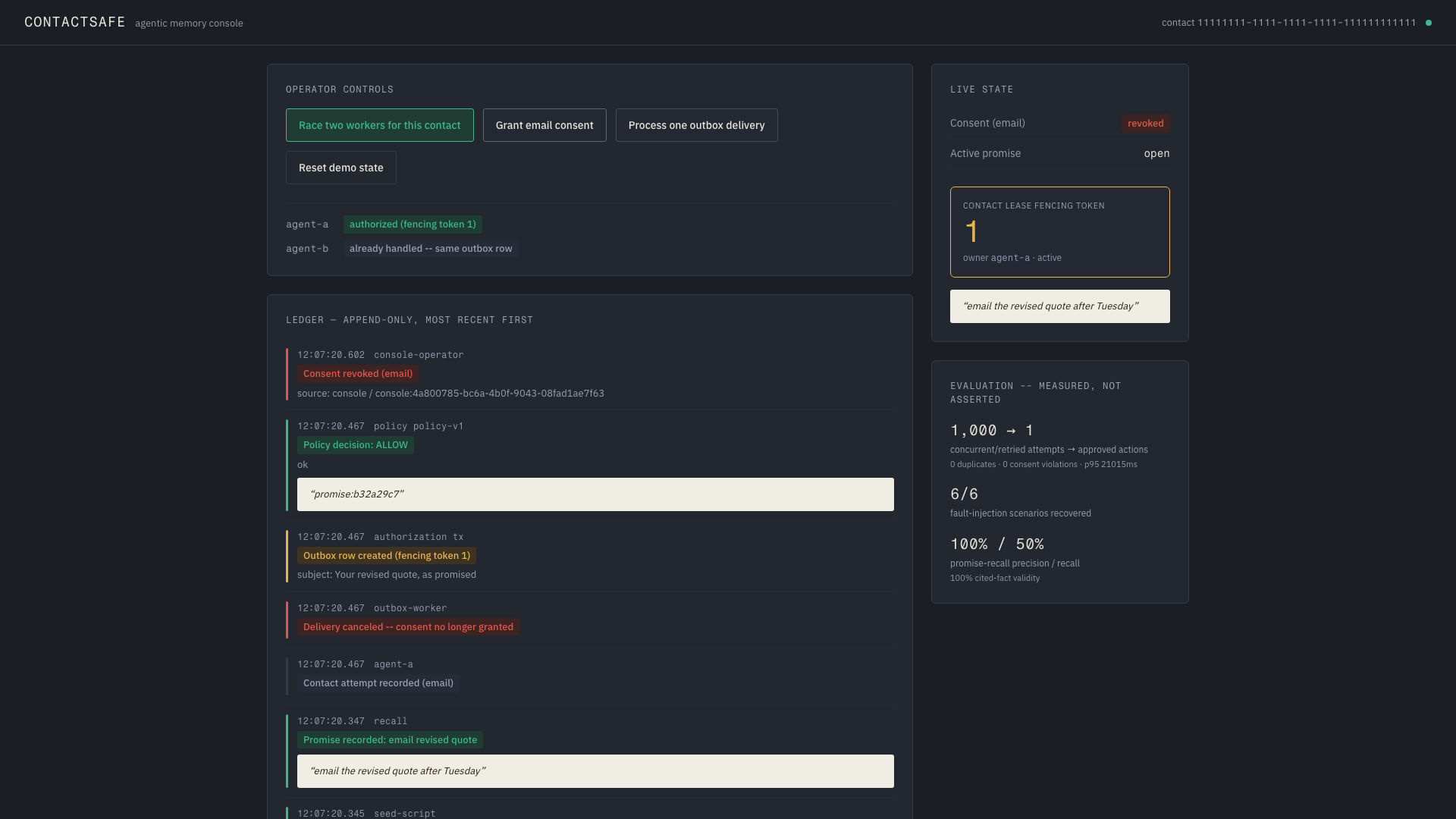
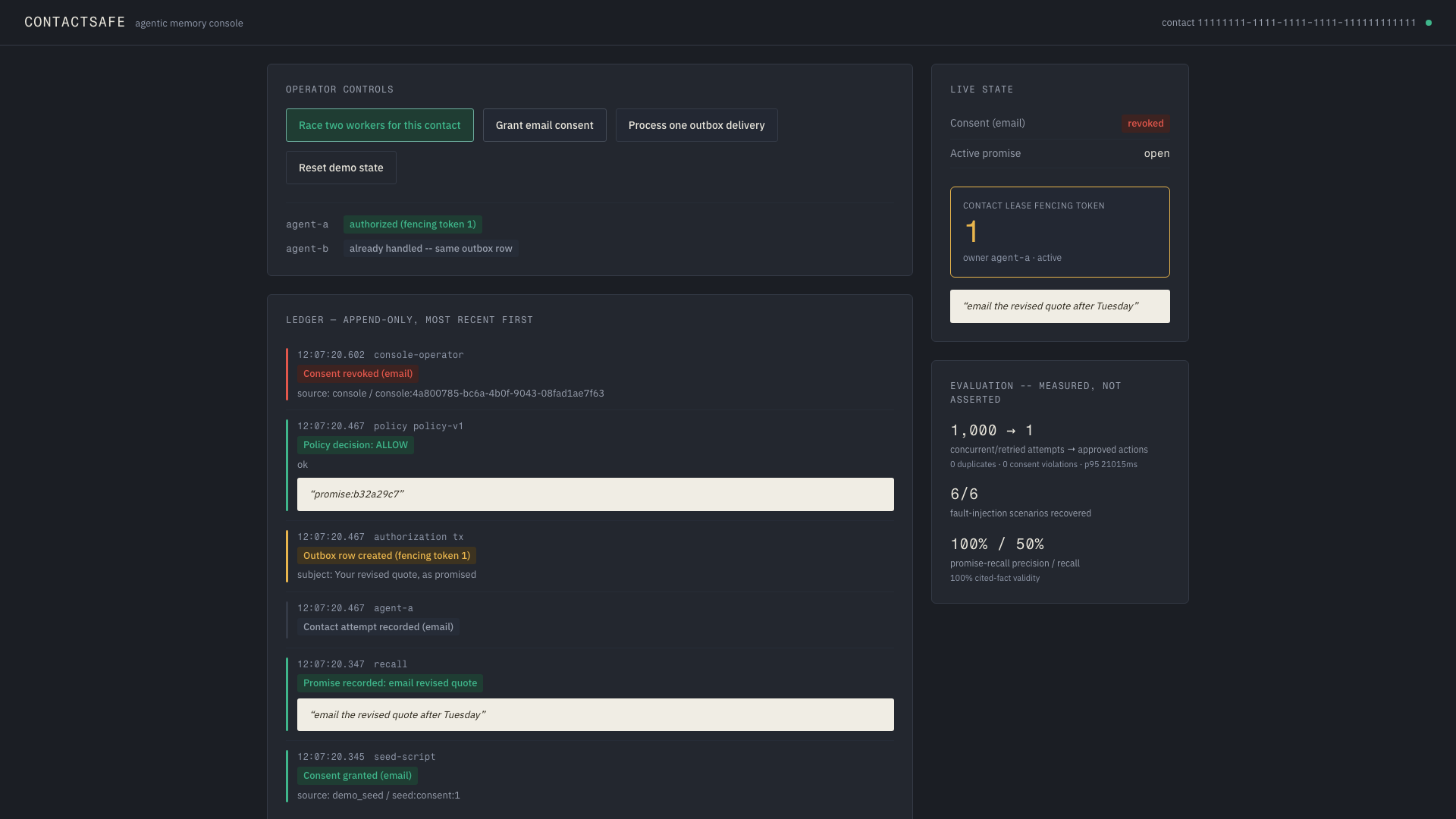
Recheck before the side effect. The worker sees revoked consent and cancels the approved sandbox row before anything is sent.
-
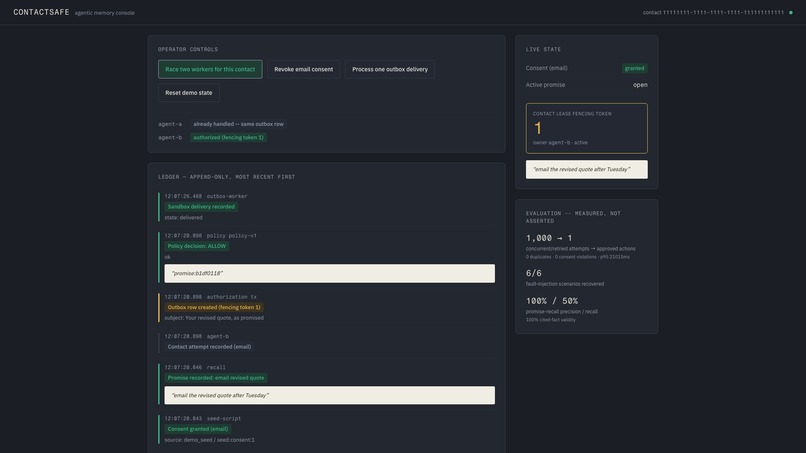
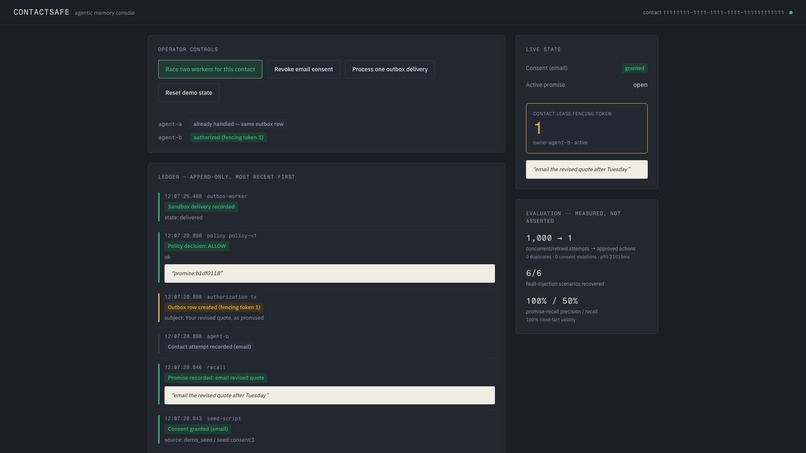
Idempotent recovery. After restart, the worker resumes the same action key and records exactly one sandbox delivery.
-
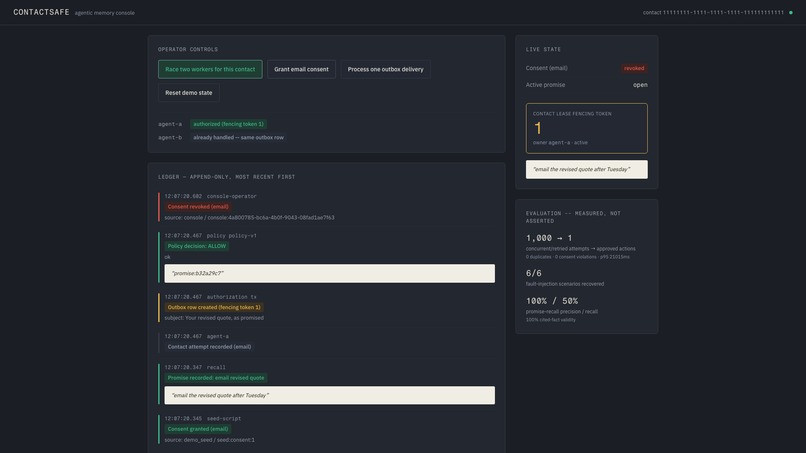
Revocation remains authoritative. Email consent is revoked while the older promise stays visible only as non-authoritative context.
-
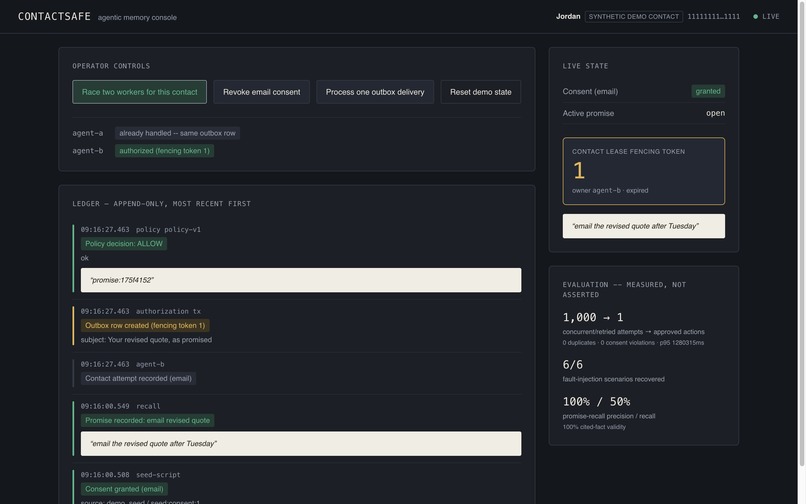
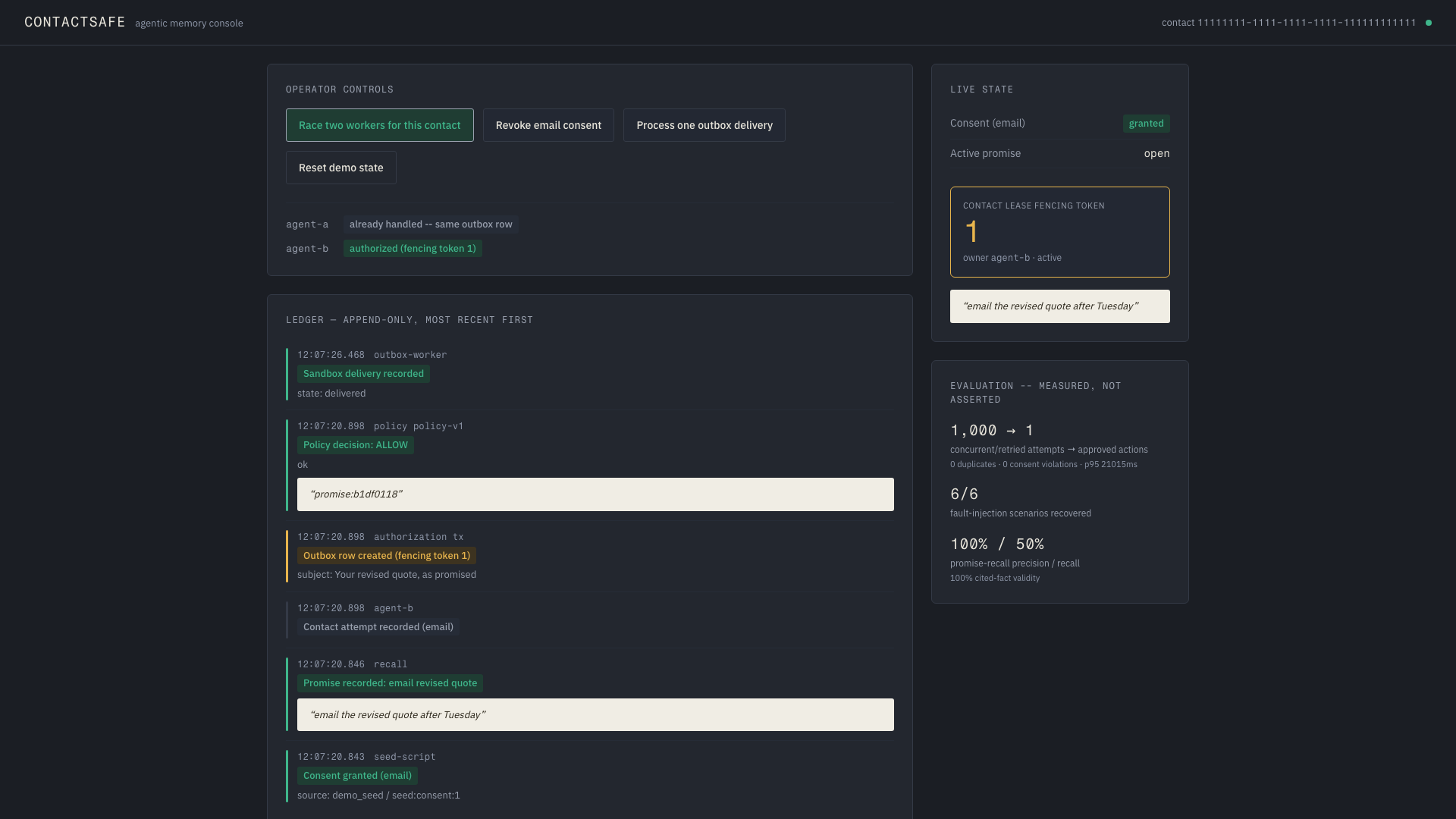
Live AWS judge console. The public Lambda app runs on CockroachDB Cloud after a full race, revocation, and sandbox delivery flow.
Inspiration
An outreach agent can remember a customer conversation and still behave unsafely. Two workers can retrieve the same promise, both decide to follow up, and send twice. A stale summary can also miss that consent was revoked after planning. ContactSafe started from a simple question: what if shared agent memory were treated as a safety boundary, not just a better prompt?
What it does
ContactSafe gives multiple outreach agents one durable record of consent, promises, contact attempts, task state, leases, decisions, and side effects. Agents can use vector search to recall relevant context with citations, but recalled text never authorizes a send.
Before any action, ContactSafe re-reads current consent and policy inside a CockroachDB serializable transaction. It grants one fenced lease and inserts one idempotent transactional-outbox row. A second worker or retry sees the committed action and resolves as an idempotent replay. The delivery worker checks consent and fencing again immediately before delivery, so a late revocation can still cancel an approved but unsent action.
The public judge console lets reviewers run the synthetic race, revoke consent, deliver to a non-sending sandbox ledger, and inspect the audit trail. No real customer or inbox is used.
How we built it
CockroachDB Cloud is the system of record for both semantic and authoritative memory. A distributed vector index retrieves cited promise context, while ordinary relational tables hold append-only consent events, leases, task versions, policy decisions, and the transactional outbox. Keeping these records together avoids a consistency gap between a separate vector store and the database that controls side effects.
The official ccloud CLI v0.8.23 provisioned and verified the Cloud database, SQL identity, connection details, and network allowlist. AWS Lambda runs the Node.js 22 API and React judge console. AWS Secrets Manager supplies the database URL, Amazon S3 stores commit-addressed deployment bundles, and CloudFormation owns the deployed stack.
The Bedrock Converse adapter is implemented and schema-tested, but this AWS organization explicitly denies Bedrock actions through an Organizations service control policy. The deployed planner therefore uses a deterministic, evidence-grounded fixture. We do not claim Bedrock as a live integration. Managed MCP is also not used or claimed.
Challenges
The hardest part was keeping model output and vector recall outside the authorization boundary. Similar text can help an agent find a promise, but it cannot prove current consent or ownership. The transaction had to stay short, retry safely on CockroachDB serialization conflicts, fence stale workers, and create the audit decision and outbox action atomically.
Crash recovery created another subtle boundary. A worker can stop after approval but before delivery, or after a provider accepts an idempotency key but before the response is recorded. ContactSafe makes those states inspectable and resumes only the original sandbox action.
Accomplishments
The release ran 1,000 concurrent and retried authorization attempts against CockroachDB Cloud. The measured result was one approved action, 999 idempotent replays, zero duplicate approved actions, and zero consent violations. All six injected fault scenarios recovered. The memory evaluation reported 100% cited-fact validity and a 0% unsupported-plan-claim rate on the checked-in synthetic corpus.
The same build is publicly deployed on AWS Lambda, and every number shown in the console and video comes from committed JSON evaluation reports.
What we learned
Agent memory needs types. A promise recalled through embeddings is useful evidence; a current consent event is authority; a lease is coordination state; and an outbox row is a side-effect commitment. Treating all four as chat history hides the exact failures production systems need to prevent.
We also learned that an honest unavailable-integration boundary is more useful than a simulated success. The live AWS organization denies Bedrock, so the product records that fact, keeps the tested adapter, and demonstrates the working CockroachDB and Lambda paths without overstating them.
What's next
The next production step is a provider with a documented idempotency contract and a consenting pilot workspace. We would also add tenant-scoped service accounts, richer observability for ambiguous provider outcomes, and a live Bedrock deployment in an AWS organization where the service is permitted. ContactSafe will continue to keep model planning separate from transactional authorization.
Built With
- amazon-web-services
- aws-cloudformation
- aws-lambda
- aws-secrets-manager
- ccloud-cli
- cockroachdb-cloud
- distributed-vector-indexing
- fastify
- node.js
- playwright
- postgresql
- qwen3-tts
- react
- remotion
- typescript
- vitest
- zod

Log in or sign up for Devpost to join the conversation.