Inspiration
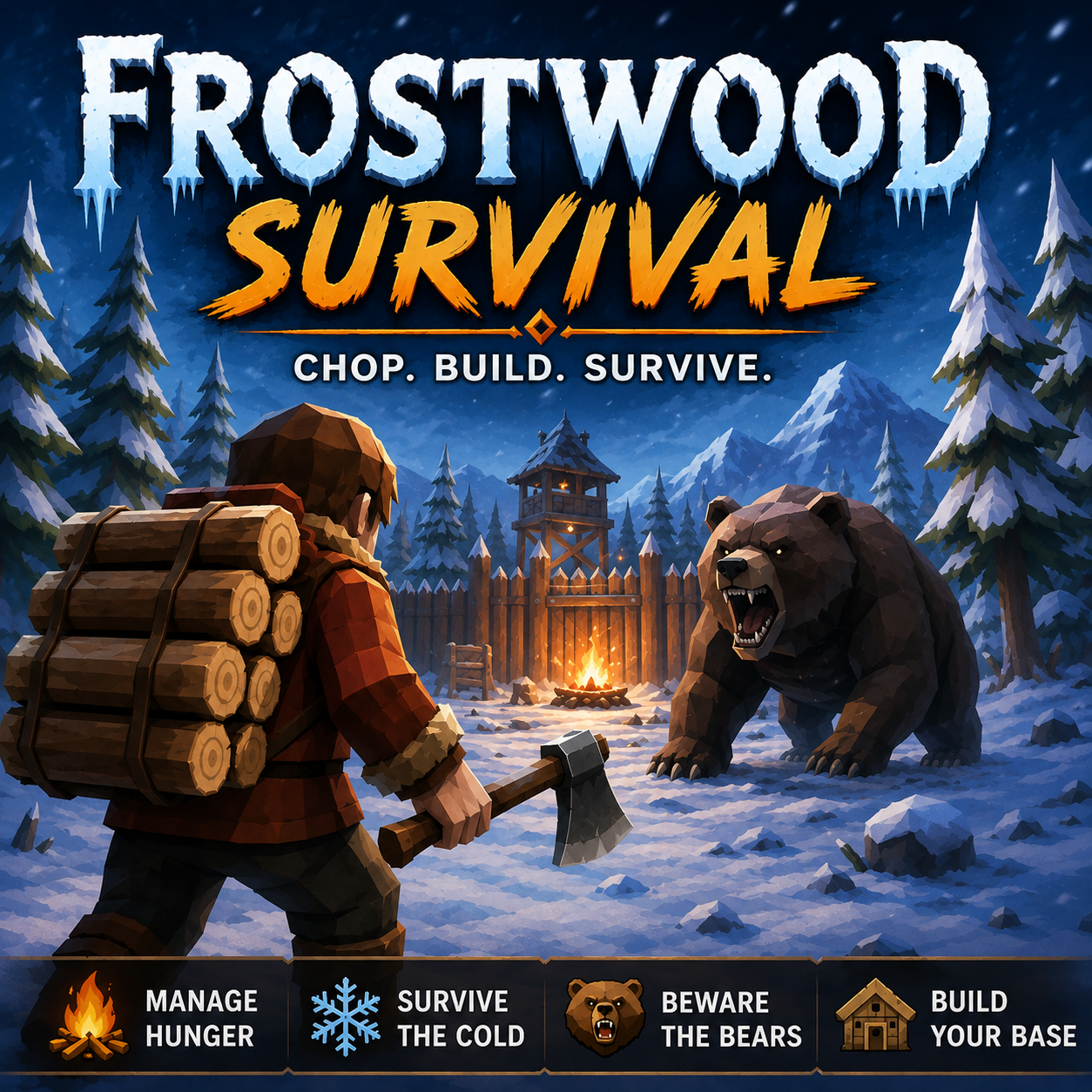
Frostwood Survival was inspired by the idea of creating a simple survival experience where gathering resources, exploring the wilderness, and returning safely to your base all feel connected. We wanted to focus on a small number of mechanics that naturally create tension: chopping finite trees, carrying resources on your back, building up the base, hunting bears for meat, cooking food, and managing hunger and cold.
What it does
Frostwood Survival puts the player in a snowy forest with an axe and a small construction site. Trees can be chopped automatically when the player gets close, with each axe hit visibly shrinking the tree and adding wood to the player's back. Wood is physically represented on the character, stacking into rows as more is collected.
The first goal is to collect enough wood to construct the base. Once the base is completed, a bear portal becomes active and bears begin appearing in the world. Bears patrol the area, chase the player when they get close, and can be defeated with the player's axe.
Defeated bears provide meat and gold. Meat can be carried back to the bonfire, where it is automatically cooked. Once cooked, the player can eat it by approaching the food, restoring hunger.
The base also contains additional construction projects requiring increasingly large amounts of wood, while the player must manage health, hunger, and, during snowstorms, body heat.
The game ends when the player dies, with a final survival time, score, and statistics shown on the game-over screen.
How we built it
We built Frostwood Survival as a self-contained HTML5 game using Three.js. The game uses procedural geometry for the environment and characters, allowing us to create the prototype without relying on elaborate external art assets.
The project was developed incrementally over multiple sessions. We started with the core world, player movement, trees, and automatic harvesting, then added the carrying system, base construction, bears, combat, hunger, cooking, additional buildings, the bear cave and rescue mechanic, snowstorms, and audio.
The player uses both keyboard controls and a virtual on-screen joystick, allowing the same prototype to be tested on desktop and mobile.
We also maintained a running build log throughout development, recording the decisions, implementation changes, bugs, playtesting results, and pivots made during each session.
Challenges we ran into
One of the main challenges was keeping the many interacting survival systems reliable while continuing to expand the prototype. Resource carrying, automatic harvesting, construction deposits, bear AI, hunger, cooking, and the safe base zone all had to work together without breaking previously implemented mechanics.
We also encountered several gameplay and implementation issues during development, including bear spawning interactions between portal bears and cave guards, mountain and gate collision, the child rescue trigger at the base entrance, restarting cleanly after a snowstorm, and keeping the audio system from duplicating across restarts.
Another challenge was making the game readable on a phone-sized screen. We repeatedly adjusted the camera, UI dimensions, joystick, progress bars, and contextual panels to make the important information visible without overwhelming the gameplay area.
Accomplishments that we're proud of
We are particularly proud of the physical resource-carrying system. Wood and meat are represented directly on the player's back, with resources arranged into rows as the carried amount increases. This makes gathering immediately visible instead of relying purely on an inventory number.
We are also proud of how many systems are connected into one continuous survival loop: chopping trees, carrying resources, constructing the base, fighting bears, collecting meat and gold, cooking food, managing hunger, and expanding the base.
The prototype also evolved beyond the initial concept with additional systems including the bear cave and child rescue, snowstorms with heat management, axe progression through the anvil, distinct bear types, a palisade gate that can be attacked, and a rescued-child bonus system. These were added during the later development sessions and are documented in the build log.
What we learned
We learned that small mechanical improvements can have a surprisingly large impact on how understandable and satisfying the game feels. Visual feedback such as shrinking trees, hit effects, health bars, construction progress, and carried resources helped make the systems much easier to understand.
We also learned the importance of testing every new change instead of assuming that a feature works simply because the code runs. Several of our later sessions were focused specifically on fixing interactions between systems that only became apparent during playtesting.
Most importantly, we learned that a focused survival loop becomes much more interesting when resources have competing purposes and the player constantly has to decide whether to stay safe or venture farther into danger.
What's next for Frostwood Survival
The current prototype establishes the main Frostwood Survival experience, but there is significant room to expand it.
The next step would be to deepen the survival and progression systems while keeping the core loop focused. This could include more wildlife, additional resources, more meaningful base structures, additional axe progression, more environmental events, stronger snowstorm escalation, and additional reasons to explore the wilderness.
The longer-term vision is to turn Frostwood Survival into a richer survival adventure where building and improving the base provides a growing sense of safety and progress, while the world outside continuously becomes more dangerous and rewarding to explore.
Built With
- chatgpt
- claude
- gemini
- sonnet
- suno


Log in or sign up for Devpost to join the conversation.