Inspiration
When hearing the words “Dig in,” our team thought a little differently. Some thought literally, in terms of the earth; others thought about it figuratively. Given that we hadn't eaten breakfast, we thought about… food. But there's a reason why we can dig in without fearing that the food isn't safe. That's why we built FrostIQ.
The Problem
Large food storage facilities are subject to many regulations to keep us safe. However, we are all human, and some things can go under the radar. We thought, why not automate this? You may think, aren't systems built to detect problems already used today? While that is true, they require people to look at the data and create a solution, but haven't we already proven that humans make mistakes?
What it does
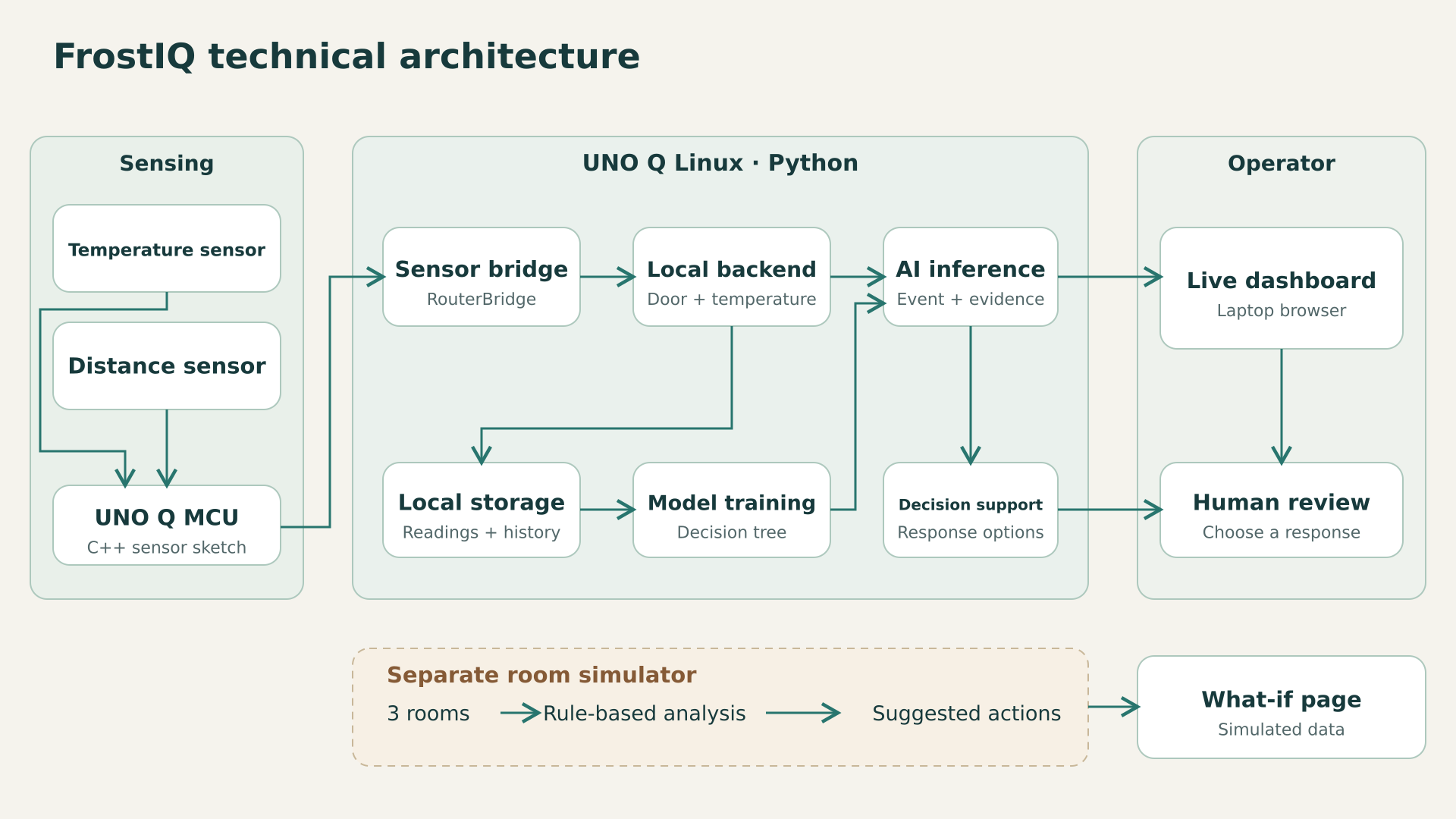
Our solutions connect sensors like temperature and motion sensors to detect issues and connect them to fixes. We log the temperature of the room over time, the number of times the door is opened, and how long the door is open. At the same time, we make relationships as to why the temperature is rising. Our sensor automatically sends an alert whenever the temperature increases above the allowed threshold for a given item. Using the information gathered, we trained an AI model to make an inference as to what action to take. The AI can choose one of the following: move the affected item to a specific room, reduce the amount of time a door can be opened at a time, or reduce the number of times a door can be opened for a load.
How we built it
We first created a dashboard inspectors can access when needed. This dashboard logs and displays the current temperature. The state of the door (open/closed), and whether a door has been open for too long, resulting in a temperature spike. We used various scenarios to train our AI model to be as precise as possible when making a choice. We used a cabinet as a door to simulate a door opening and closing. We also heated and cooled the temperature sensor to simulate the change in temperature caused by the door's status. Since doors don't open at a fixed time, we had to account for different opening speeds and how to calculate when a door is closed or open.
Challenges we ran into
For many of us, this was the first time we had ever worked with this kind of hardware. Setting up the Arduino and recalculating how we determine the door status was what took the majority of the time. Many of the times, the sensors would refuse to work, and we would have to reopen the software.
Accomplishments that we're proud of
We got a model that trains and runs entirely on the board and explains its own decisions. We also built door detection that handles different opening speeds, and a simulator that turns single-room sensing into recommendations for a whole facility.
What we learned
Most of the engineering lives before the model: calibration, windowing and data validation matter more than the classifier. We learned that leakage between adjacent time samples makes a model look better than it is, and that failing safely, with null readings, uncertain states and freshness gates, matters as much as accuracy.
What's next for FrostIQ
We plan to connect the simulator to live sensor data and extend the model to more item types and temperature limits. We also want to move from a staged possible_cooling_failure pattern to real equipment-fault data and to test the system in an actual cold room.
Built With
- arduino
- arduino-uno-q
- i2c
- json
- machine-learning
- messagepack-rpc
- python
- scikit-learn


