What it does
Small shops lose customers they never meet: the phone rings while the owner is under a car, and the caller books with the shop down the street. FrontDesk is a config-driven front desk template. One JSON config describes a local business — services, intake, reminders — and FrontDesk turns it into a working app: a missed call or text becomes a booking, intake is collected, reminders go out, and the owner watches it all on a dashboard.
Two apps prove the template is versatile, and both are live:
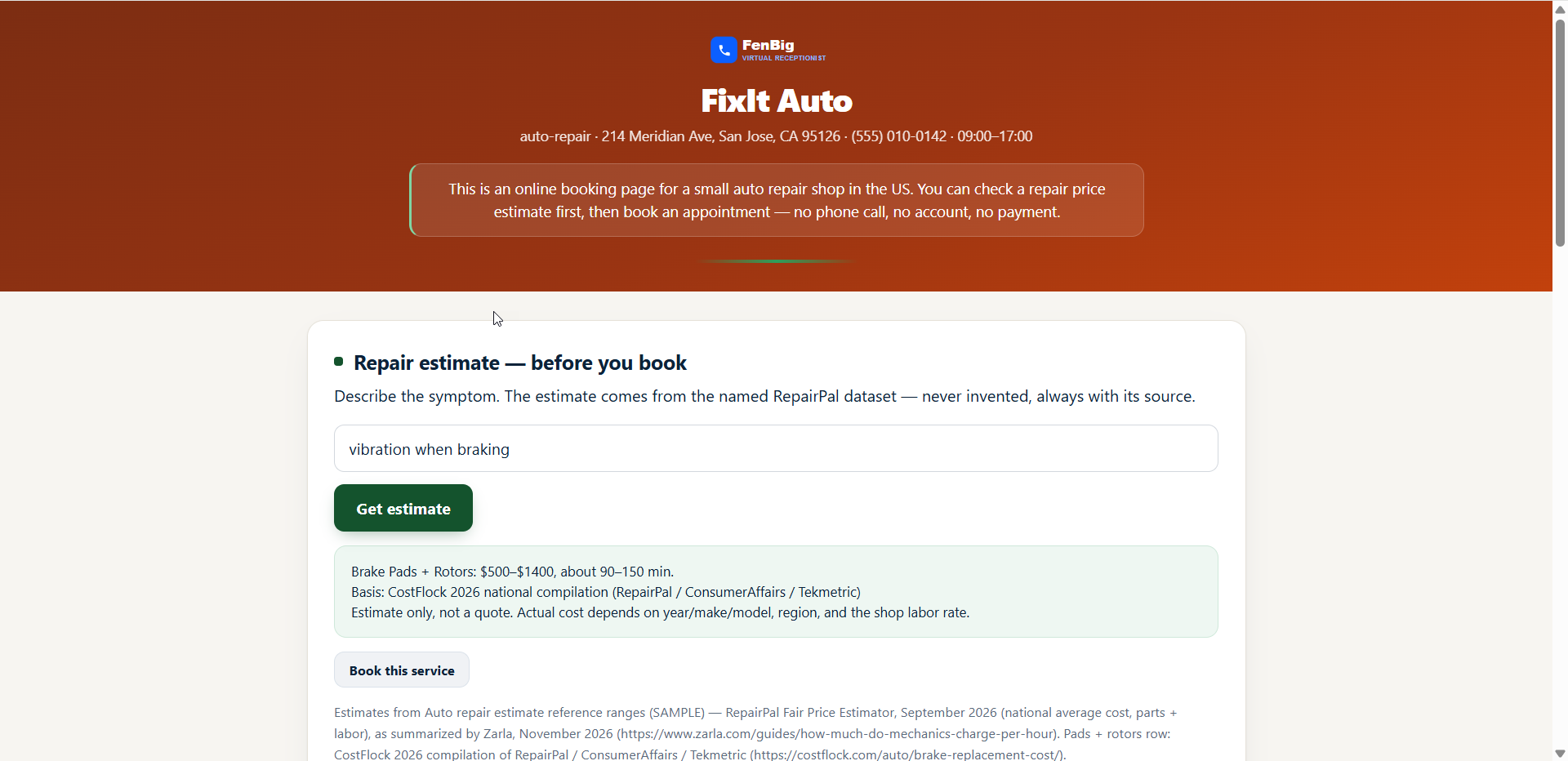
- FixIt Auto (auto repair) — a driver types a symptom and gets a dynamic repair estimate (price + time range) from a named dataset before booking. Example, verified live: "vibration when braking" → Brake Pads + Rotors, $500–$1400, about 90–150 min, basis: CostFlock 2026 national compilation (RepairPal / ConsumerAffairs / Tekmetric). Then one click books it.
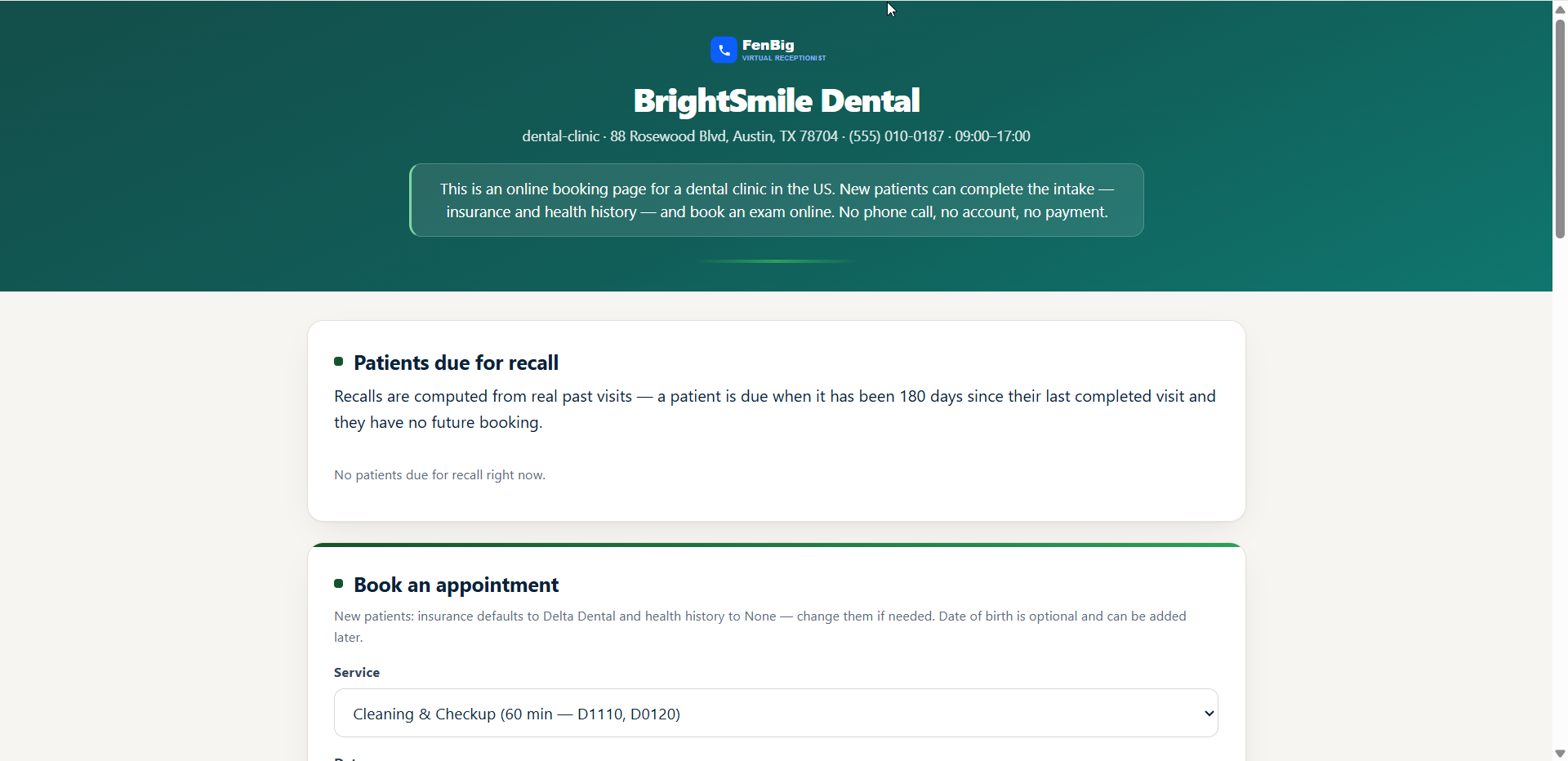
- BrightSmile Dental (dental clinic) — new-patient intake (insurance + health history) and 180-day recall reminders: patients whose last visit was 180+ days ago are flagged and the recall goes out by itself. Services carry real ADA CDT 2026 procedure codes (D0120, D0150, D0274, D1110, D2391, D2740, D4341).
A third vertical — Paws & Claws Veterinary Clinic (wellness exams, vaccinations, 365-day recall) — is generated live in the demo video from a single new config file, to prove the template generalizes.
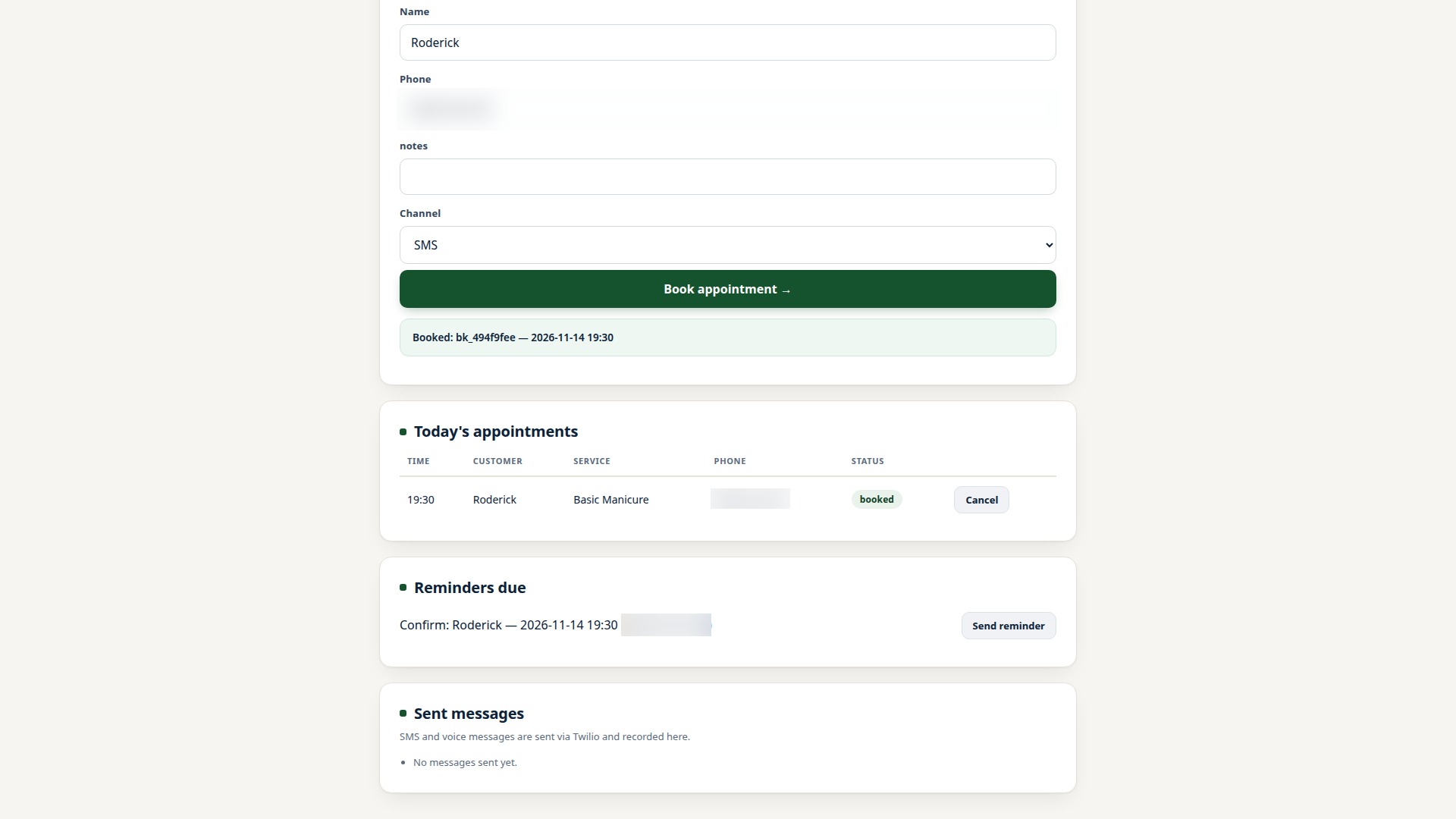
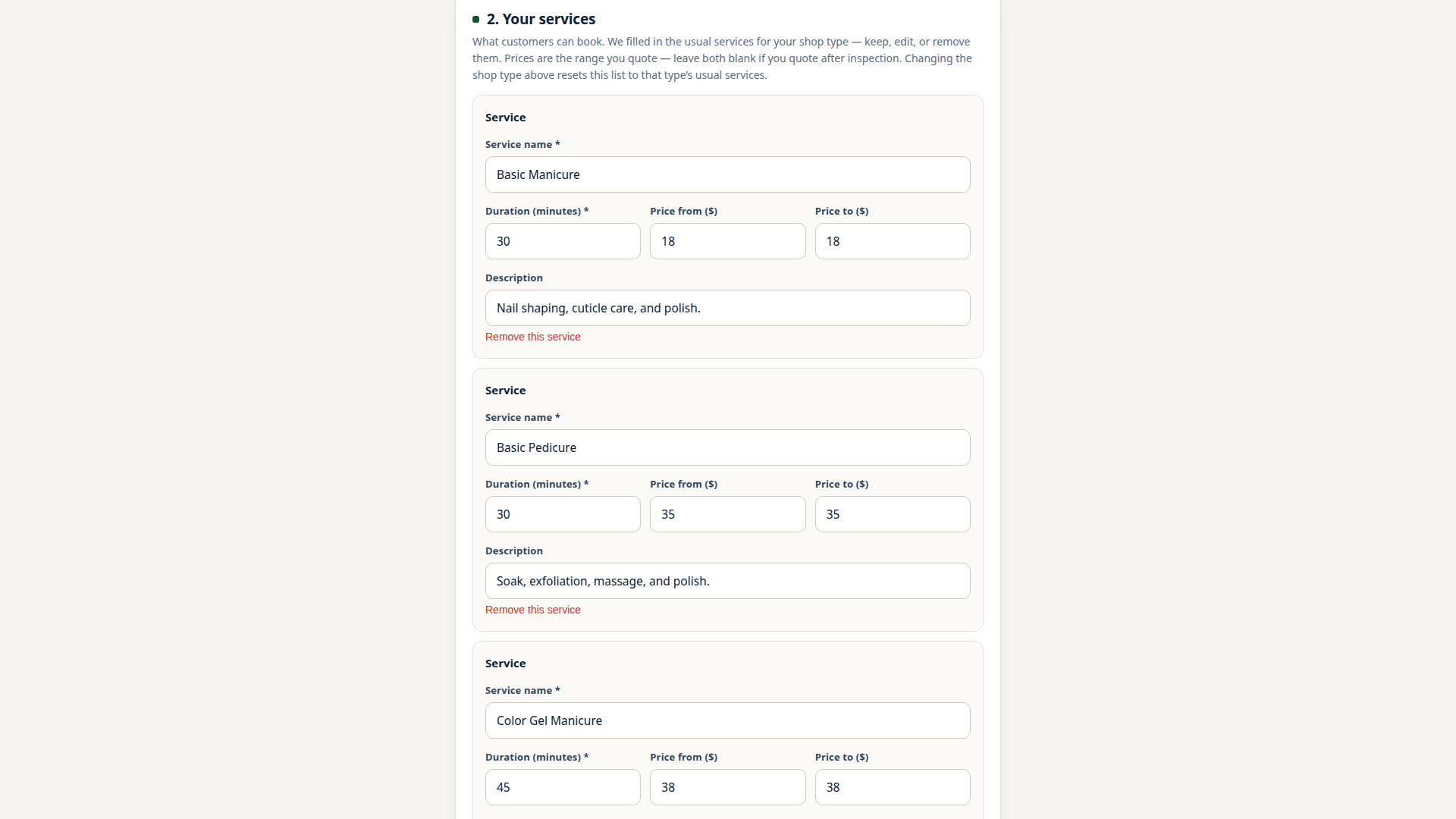
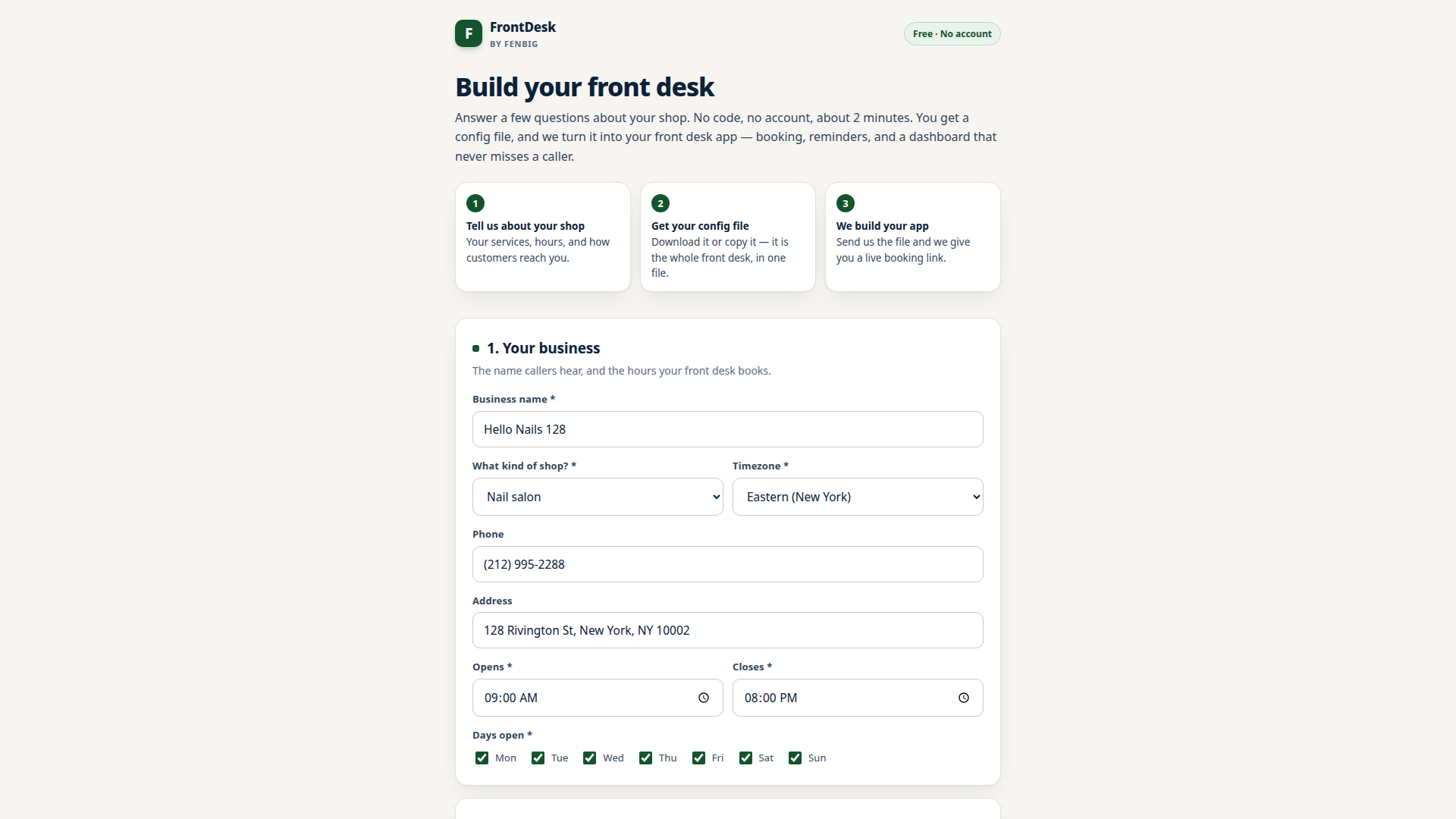
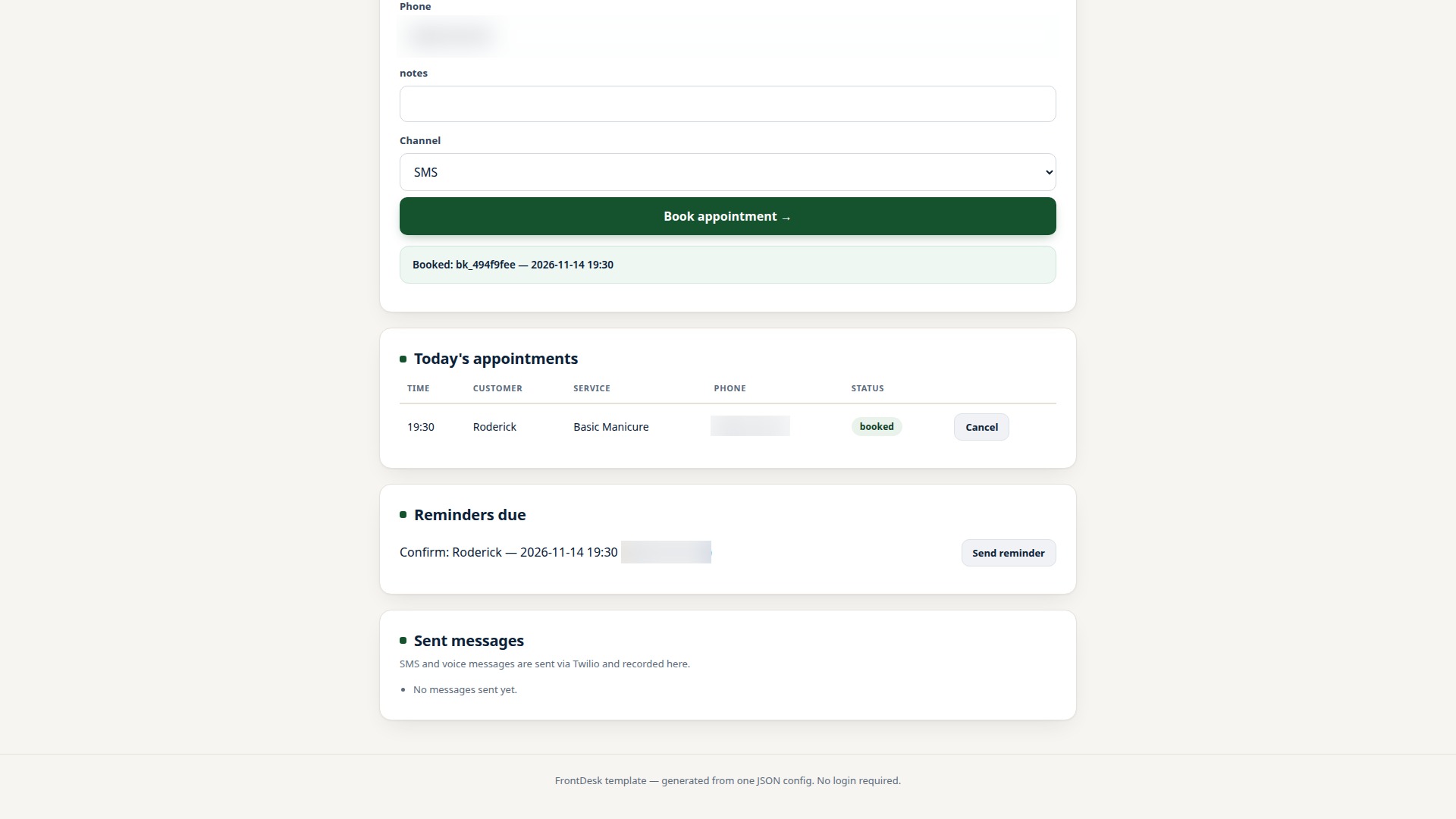
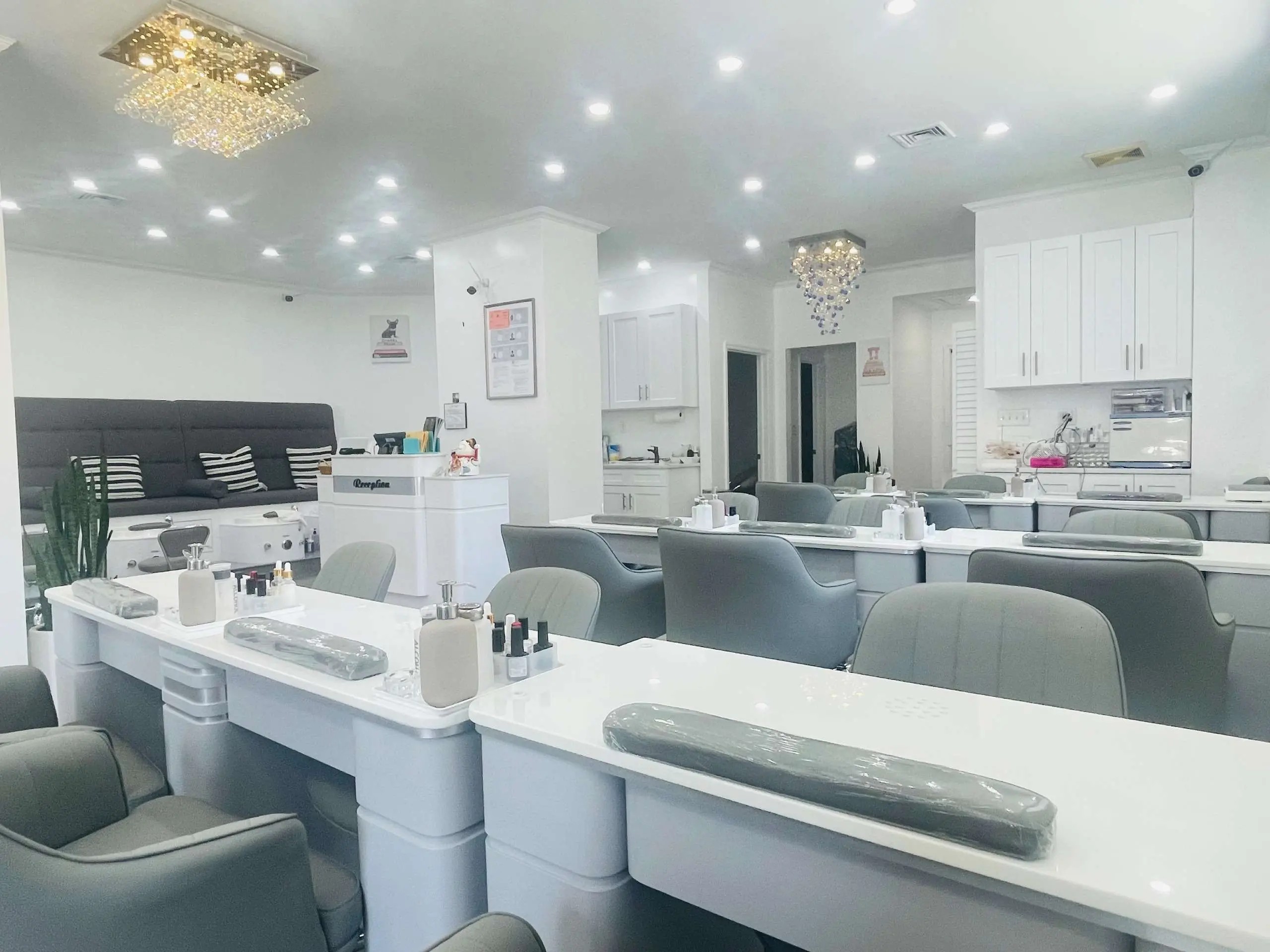
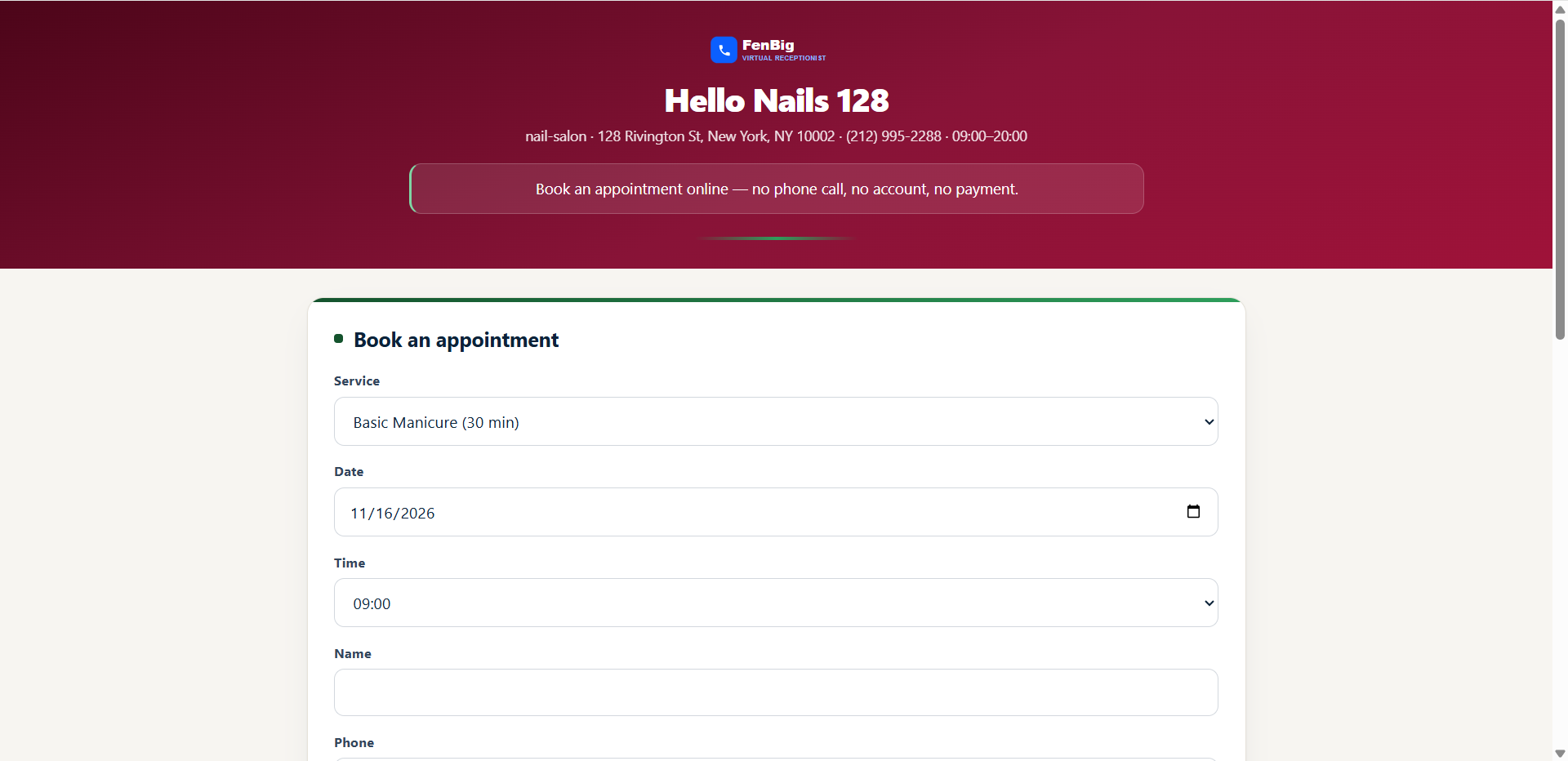
Real shop owner + real customer (2026-11-14/15): Hello Nails 128 (128 Rivington St, New York NY), the first real shop owner, filled in the config builder herself and her front desk went live the same day. The first real customer, Roderick, booked a Basic Manicure for 2026-11-14 19:30 through it (bk_494f9fee) and left the testimonial in the video: "I love this place. The staff are awesome. And the website is easy to book." Reminders and confirmations go out as real SMS via Twilio.
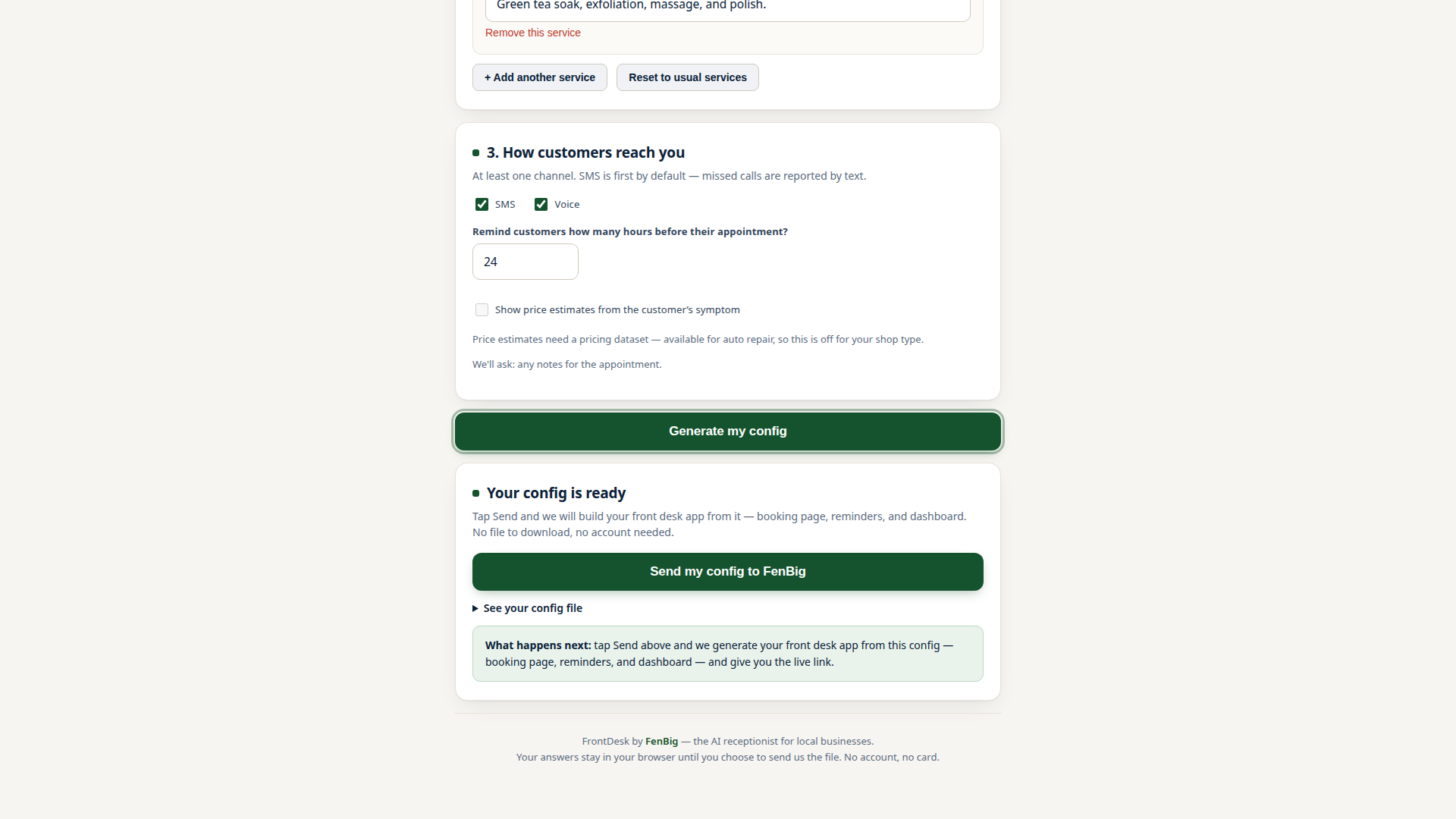
Beyond the two apps in the video, the template has since generalized further, without any code change: a self-contained config-builder page lets a shop owner fill in their own business and download a config, and four more verticals were generated from it on 13/11 — three cafés (Black & White Coffee Roasters, Wake Forest NC; Cafe Grumpy, New York NY; Sightseer Coffee Bar, Austin TX) and Nashville Auto Repair (Nashville TN). Cafe Grumpy is live; all four validate, generate, and book through the real API. No template code changed for any of them.
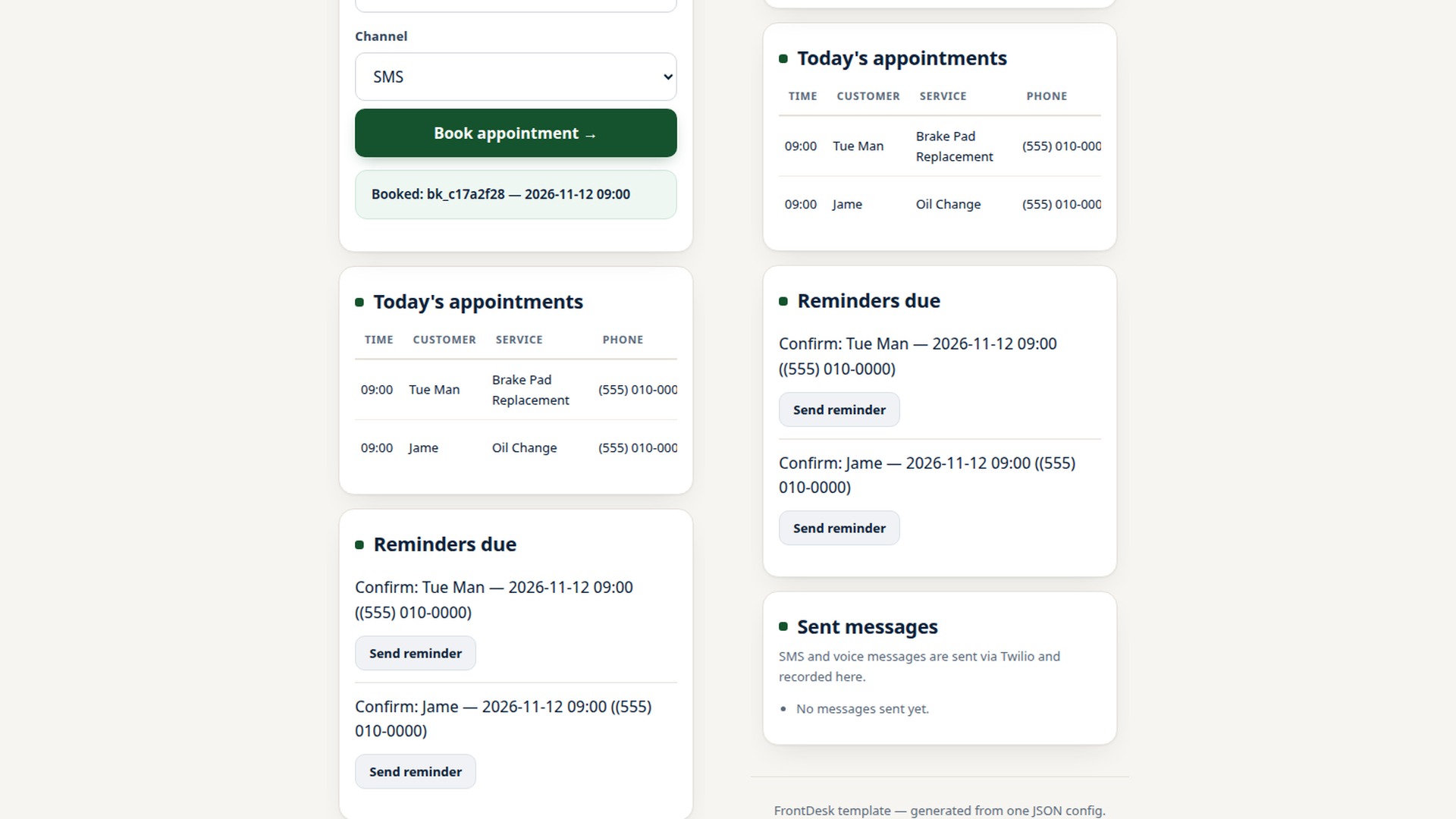
Pilot (2026-11-12, 3 real people): Three real people booked in 14 seconds on average — 3 out of 3, first try. Tue Man (FixIt Auto, Brake Pad Replacement, 2026-11-12 09:00, bk_708ecf45): 15 seconds. Dental pilot (BrightSmile Dental, New Patient Exam, 2026-11-13 09:00, bk_5d6fb20d): 17 seconds. Jame (FixIt Auto, Oil Change, 2026-11-12 09:00, bk_c17a2f28): 9 seconds, no help given.
How we built it
Built spec-first with Kiro — the Kiro workflow is visible in the repo, not just claimed: Specs in .kiro/specs/frontdesk-template/ (requirements in EARS format, design, tasks); Steering in .kiro/steering/ (product, tech and structure rules); Hooks in .kiro/hooks/ (run test suites after every spec task, syntax-check JS on save, restate ground rules at session start); a custom agent .kiro/agents/vertical-config-reviewer.md that reviews a new vertical config and ends with VERDICT: PASS | FAIL; and the FrontDesk CLI (template/cli.js): validate, generate, slots, estimate, bookings, serve. Property-based tests (template/tests/properties.test.js) with a seeded PRNG caught a real bug on Day 2 (bookings accepted on Sundays even though the shop is closed) — fixed, with a negative control proving the property fails without the fix.
The mechanism: template/generate.js validates a config against config/schema.json and scaffolds apps// — a config copy, a thin server wrapper, a package.json, a README, and a generated smoke test. The template core (template/server.js + lib/) never changes between verticals: booking engine, intake validation, estimate engine, reminders, store, dashboard. Every difference between FixIt Auto and BrightSmile Dental lives in one config file each.
Stack: Node.js built-ins only (http, fs, path, crypto) plus node:test. Zero dependencies, no build step, no login. Both apps run on Render free tier with Neon Postgres (free tier, no expiry) as the store — bookings survive restarts. Sends go out as real SMS/voice via Twilio when TWILIO_SID/TOKEN/NUMBER are set, and are recorded in the outbox.
Datasets — named, sourced, honest: Auto repair — RepairPal Fair Price Estimator, September 2026 and the CostFlock 2026 compilation (brake pads + rotors $500–$1400). National averages, not a quote. Dental — ADA CDT 2026 procedure codes; fee ranges are typical US ranges (ADA Survey of Dental Fees 2024/2025) and vary by region — not a quote. Full sourcing decision: datasets/README.md. No fabricated row is presented as real data anywhere in this repo.
Verification: 47/47 tests green. The suite runs green in three server timezones (UTC, America/New_York, Asia/Ho_Chi_Minh). Both live apps return 200 on /api/health and on their dashboards, no login required.
Kiro surprised us on Day 2: the property-based tests it generated caught a real bug we hadn't thought of — bookings accepted on Sundays when the shop is closed.
Challenges we ran into
Config-swap alone does not win. Each vertical executes on a named dataset with a real source (RepairPal, ADA CDT), not on swapped labels. The template had to prove it generalizes: two apps from one template is a claim; generating a third vertical live on camera is the proof. A property test caught a real bug (Sunday bookings). Timezones are the quiet killer: all time math now runs in the business's wall-clock timezone.
What's next
More verticals from the same template: the config builder already generated four (three cafés + Nashville Auto Repair) with no code change, one live. Next is a hosted generator so a shop can paste a config and get a URL.
Known limits
The live apps run on Render free tier: they sleep after ~15 minutes idle (first load takes 30–60 seconds). Bookings live in Neon Postgres and survive restarts; if Postgres ever becomes unreachable the apps fall back to the local JSON store, in which case bookings become ephemeral again. There is no "mark visit complete" action in the dashboard yet.
Built With
- kiro
- node.js
- render
