-
-
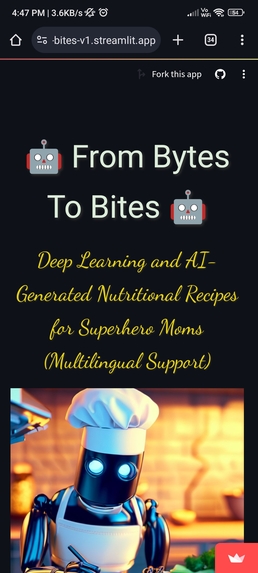
Starting Page
-
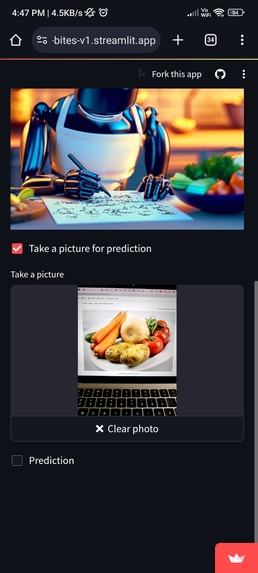
User Need to Capture the Vegetables for detection
-
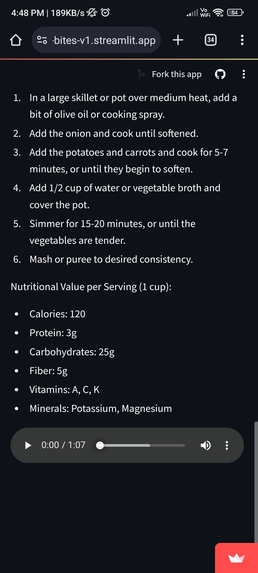
Application is also providing the audio version of the generated recipes
-
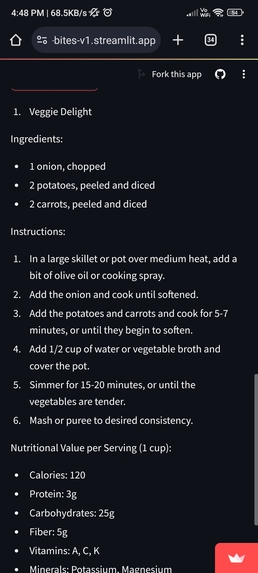
Applicaton generating the recipes in user interested languages along with the user selected variates count


FROM BYTES TO BITES (Deep Learning and AI-Generated Nutritional Recipes for Superhero Moms (Multilingual Support))
PROBLEM STATEMENT
Mothers often struggle to prepare nutritious meals, especially in the mornings. To address this, we launched 'From Bytes to Bites,' an initiative that uses AI and deep learning to simplify meal preparation and provide detailed nutritional information. Our goal is to empower mothers to make informed dietary choices and promote a healthy lifestyle by generating delicious and nutritious recipes.
CURRENT SOLUTION
- ChefGPT The above hyperlinked website enables users to create personalized recipes based on their selected preferences. Initially, access is limited to free trials, after which a subscription fee of $2 per month is required. Additionally, the platform does not currently support the uploading of vegetable images by users; instead, vegetables must be selected from dropdown lists. Furthermore, it does not provide audio versions of recipes in the user's preferred language.
PROPOSED SOLUTION & IT'S BENFITS
Our approach offers users two input options: they can either capture a photo using the camera or upload an existing image. Additionally, we provide fields where users can specify the language in which they want the recipe to be generated, as well as another field to indicate the desired quantity of recipes. * The process begins by inputting the collected image into our model, which then generates text files containing information about detected vegetable classes within the image, along with their corresponding bounding box values . * Following this step, a validation check is performed. * If the model doesn’t produce any text files, then an error message is displayed, prompting the user to review their image. Our model exclusively generates text files for correctly formatted images from the user . The another possible error is the user image doesn’t trained on the class of the vegetable available in the image.* Assuming the model successfully generates the text files, we move on to the next step: recipe generation using generative AI. We extract unique class labels from the image and combine them with the user's selected language and desired number of recipes to create a prompt template. This template is then inputted into the Google Palm’s model using the API key, resulting in the generation of recipes based on our template. These recipes are presented on the user's screen, and users also have the option to store them locally for future reference. Note:- (*- positive case, *-negative case)
ARCHITECTURE
PROTOTYPE
TECHNOLOGIES USED
- YOLOv8: We employed YOLOv8 for model training, enabling precise detection of vegetable classes and bounding box values in images.
- Streamlit: Our web application has been developed using Streamlit, which offers an intuitive and user- friendly interface for capturing images and displaying generated recipes.
- Streamlit Cloud: We have deployed our application on Streamlit Cloud, ensuring seamless accessibility for users without the need for local installations.
- Google Palm: To generate recipes based on user inputs, we harnessed the power of Google Palm using API keys, allowing for dynamic and context-aware recipe creation.
CHALLENGES
- Challenges in Model Building:
- Limited GPU Resources (Google Colab's free-tier): Constraints on computational resources result in longer model training times.
- Resource-Intensive Deep Learning: Developing large deep learning networks demands substantial computational power, which affects optimal performance.
- Difficulties in Data Annotation:
- Labor-Intensive Annotation: The data annotation process is time-consuming.
- Ensuring Quality for Diverse Vegetable Classes: This is a complex task that demands meticulous attention to detail.
- Limitations of the Recipe Generation API:
- Dependence on the Google Palm Free API: There are usage limitations when it comes to recipe generation.
MIGITATIONS STRATEGIES
- For Model Building:
- Model Optimization: Fine-tuning deep learning networks for improved resource efficiency and performance.
- Data Augmentation: Implementing advanced techniques to expedite model training and optimize resource utilization.
- Exploration of Cloud Resources: Consideration of cloud-based GPU solutions to overcome resource limitations.
- For Data Annotation:
- Quality Assurance Protocols: Implementing rigorous protocols to ensure accurate and reliable data annotations.
- Collaborative Annotation: Facilitating collaborative efforts and providing expert supervision to streamline the process.
- For Nutrition Recipe Generation:
- Usage Optimization: Optimizing API utilization within constraints for generating high-value recipes.
- By addressing these challenges and implementing effective mitigation strategies, we showcase our adaptability and resilience. Our team remains dedicated to delivering a successful solution that empowers mothers while navigating these complexities.
FUTURE ENHANCEMENTS
Our commitment to innovation drives us to envision the following future enhancements:
- Personalization: We will tailor recipes based on individual preferences and dietary needs.
- Ingredient Substitutions: We will provide real-time alternatives for ingredients to offer flexibility in your cooking.
- User Community: We aim to foster user interaction through a community platform designed for sharing recipes.
- Smart Appliances Integration: We are exploring integration with existing smart kitchen devices to provide a seamless cooking experience.
- Dedicated Mobile App: We are in the process of developing a mobile app for image capture and easy access to recipes.

Log in or sign up for Devpost to join the conversation.