A multi-modal tech AI Agent
A multimodal AI agent that detects and troubleshoots home issues on your behalf, escalates to maintenance, books service appointments, make any payment and generates repair tickets — seamlessly integrated with your existing favorite AI Assistant such as ChatGPT, Claude or Mistral AI Le Chat.
- Here is the demo of the multimodal AI agent: https://www.youtube.com/watch?v=IUR9vc1vbdk
- You can try it out here: https://techie.devailab.work/mcp but you must (1) connect to your AI assistant (ChatGPT, Claude, or Mistral AI Le Chat) and (2) be authenticated.
To make it connect to your existing AI Assitant - you can follow this tutorial: https://www.youtube.com/watch?v=qwtwGqpXluE&feature=youtu.be
No more apps. All from the AI assistant you already use: ChatGPT, Claude or Le Chat.
The main security question is then how do we enable AI assistants (such as Open AI ChatGPT, Mistral AI Le Chat or Anthropic Claude) to execute end‑to‑end actions on behalf of users — in real time and transparently — while preserving identity, consent, and trust across multiple providers?
Who owns the transaction when ChatGPT (or others) becomes the interface and every app becomes a backend — and how do we monetize that securely?
This is not a UX convenience story - it's a multi-party authorization problem: connecting these 3 systems into a single seamless user action — "repair my Washing machine" — requires solving an identity chain that does not exist out of the box.
The vision:
You wake up. Coffee. Breakfast. You load the washing machine and press Start. Nothing happens. The situation:
- You’re renting a condo.
- Your washing machine breaks.
You don’t want to:
- download another app
- chase your landlord
- call repair companies
- pay first and deal with admin later
You open your favorite AI Assistant such as - ChatGPT, Claude or Mistral AI and explains the situation.
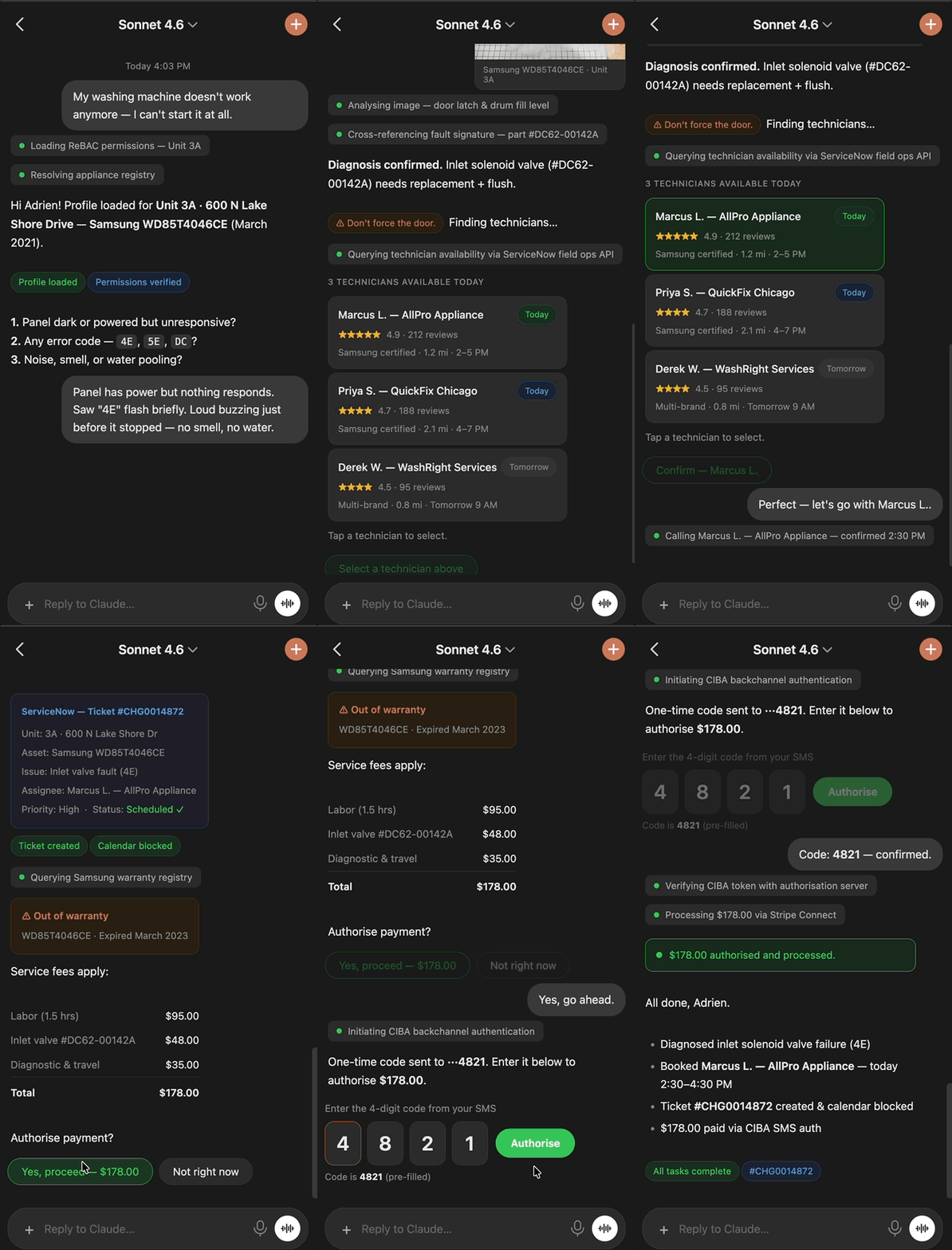
A multimodal AI agent instantly analyzes the issue — it detects the problem, diagnoses the issue, and creates a repair ticket automatically. It can call the technician on your behalf, explain the problem, share diagnostics, and book the service appointment. You don’t troubleshoot it. You don’t call anyone. Your AI agent handles it — seamlessly, silently. It can even approve payments and track the repair.
No apps. No phone calls. No hassle. No switching, No friction.
- ChatGPT becomes the interface.
- Any 3rd parties API or application become the backends.
- The AI agent orchestrates everything.
Within seconds it:
- Creates a repair ticket
- Contacts maintenance via phone
- Books the earliest appointment
- Sends diagnostics to the technician
- Processes the payment if needed
What has it been developed for this hackaton?
- The user says the washing machine is broken.
- The AI loads only their machine data using ReBAC (Relationship-Based Access Control).
- It checks the user identity with Auth0 authentication.
- The AI asks questions to understand the problem.
- The user uploads a photo; access is verified using token-based permissions.
- The AI identifies the faulty part.
- It contacts external technician APIs using a secure Token Vault.
- The AI fetches available technicians, secured with dynamic client credentials.
- The user selects a technician.
- The AI confirms the selection using DCR (Dynamic Client Registration).
- A repair appointment is booked through a client-initiated backchannel authentication (CIBA) flow.
- A service ticket is created in the system with auditable logs.
- The AI updates the user’s calendar with scoped access tokens.
- It checks if the machine is under warranty using secure 3rd-party API tokens.
- The AI shows the repair cost to the user.
- The user approves payment via CIBA backchannel flow.
- A one-time code is sent via MFA/SMS for verification.
- The user enters the code to confirm payment.
- The AI verifies the CIBA token with Auth0.
- Payment is processed securely using tokenized payment credentials.
- All actions are logged for auditing and traceability.
- Access tokens expire after use to prevent leaks (token lifecycle management).
- The AI confirms the repair is booked and paid.
Full-stack Python implementation of the agentic AI demo with Auth0-backed security, Jira ticketing, CIBA payment flows, MFA/SMS verification, and Twilio voice calls.
Architecture Overview
washfix/
├── auth/               # All Auth0 / identity flows
│   ├── auth0_client.py     — Management API client, token exchange
│   ├── ciba.py             — CIBA backchannel authentication
│   ├── dcr.py              — Dynamic Client Registration
│   ├── mfa.py              — MFA / OTP / SMS dispatch
│   ├── rebac.py            — Relationship-Based Access Control
│   ├── token_vault.py      — Secure third-party token storage
│   └── middleware.py       — JWT / Bearer middleware (FastAPI)
│
├── services/           # External integrations
│   ├── jira_service.py     — Jira ticket creation & updates
│   ├── technician_service.py — Technician lookup & availability
│   ├── calendar_service.py — Google Calendar scoped-token updates
│   ├── warranty_service.py — Samsung warranty registry check
│   ├── payment_service.py  — Stripe Connect tokenized payment
│   ├── sms_service.py      — Twilio SMS one-time codes
│   └── voice_service.py    — Twilio outbound voice calls + WebSocket
│
├── core/               # Business logic / orchestration
│   ├── agent.py            — Main AI agent loop (Claude / Gemini)
│   ├── diagnosis.py        — Fault code analysis & part lookup
│   ├── audit_log.py        — Immutable audit trail (structlog)
│   └── session.py          — Per-user session state management
│
├── api/                # FastAPI routers
│   ├── chat.py             — /api/chat  (WebSocket + REST)
│   ├── photo.py            — /api/photo (upload + vision analysis)
│   ├── booking.py          — /api/booking (appointment + calendar)
│   ├── payment.py          — /api/payment (CIBA + MFA + Stripe)
│   └── webhooks.py         — /api/webhooks (Twilio, Auth0 events)
│
├── models/             # Pydantic data models
│   ├── session.py
│   ├── technician.py
│   ├── ticket.py
│   └── payment.py
│
├── workers/            # Background / async workers
│   ├── token_refresh.py    — Proactive token rotation
│   └── audit_flush.py      — Periodic log flush to cold storage
│
├── utils/
│   ├── crypto.py           — AES-256 encryption helpers
│   └── http.py             — Retry-aware httpx client factory
│
├── config/
│   └── settings.py         — Pydantic-Settings (env vars, secrets)
│
├── templates/          — Jinja2 HTML for the demo UI
│   └── index.html
│
├── main.py             — FastAPI app entry point
├── .env.example        — All required env vars
└── requirements.txt
Auth0 Flows Implemented
| Flow | Location | Purpose |
|---|---|---|
| JWT / JWKS verification | auth/middleware.py |
Verifies every API request using signed JWTs and JWKS validation |
| ReBAC (FGA) | auth/rebac.py |
Ensures each user can only load appliance data they are authorized to access |
| Token Vault | auth/token_vault.py |
Securely stores and retrieves third-party refresh/access tokens |
| DCR (Dynamic Client Registration) | auth/dcr.py |
Registers ephemeral OAuth clients for partner APIs |
| CIBA | auth/ciba.py |
Handles out-of-band payment and booking authorization |
| MFA / OTP | auth/mfa.py |
Sends SMS one-time passcodes for payment confirmation |
| Scoped Access Tokens | services/calendar_service.py |
Requests minimal Google Calendar permissions based on least-privilege access |
| Token Lifecycle / Expiry | auth/token_vault.py |
Invalidates tokens after single use or expiration |
Flow Details
1. JWT / JWKS Verification
File: auth/middleware.py
Used to validate incoming bearer tokens on every protected API request.
Responsibilities:
- Extract JWT from the
Authorizationheader - Verify token signature using JWKS
- Validate issuer, audience, and expiration
- Reject unauthorized or malformed requests
Why it matters:
This is the first line of defense for API security and ensures only trusted, signed tokens are accepted.
2. ReBAC (Fine-Grained Authorization)
File: auth/rebac.py
Implements relationship-based access control (ReBAC), likely backed by FGA (Fine-Grained Authorization).
Responsibilities:
- Determine whether a user can access a specific appliance or resource
- Enforce per-user data boundaries
- Prevent cross-account or cross-tenant data leakage
Why it matters:
Authentication proves who the user is; ReBAC determines what they are allowed to access.
3. Token Vault
File: auth/token_vault.py
Provides secure storage and retrieval of third-party OAuth tokens.
Responsibilities:
- Store refresh/access tokens for external providers
- Retrieve tokens when calling partner APIs
- Support secure token rotation and lifecycle enforcement
Why it matters:
Centralizing token handling reduces accidental leakage and makes external API integrations safer and easier to manage.
4. Dynamic Client Registration (DCR)
File: auth/dcr.py
Registers temporary or per-session OAuth clients for partner systems.
Responsibilities:
- Dynamically register clients with partner APIs
- Support ephemeral client credentials
- Reduce manual client provisioning overhead
Why it matters:
Useful when integrating with APIs that require dynamic onboarding or per-tenant/per-session OAuth registration.
5. CIBA (Client-Initiated Backchannel Authentication)
File: auth/ciba.py
Implements out-of-band authorization flows for sensitive actions like payments or bookings.
Responsibilities:
- Initiate a backchannel authentication request
- Trigger user approval on a separate trusted device or channel
- Poll or receive confirmation once the user approves
Why it matters:
CIBA is ideal when the user should confirm a high-risk action outside the current browser or app session.
6. MFA / OTP
File: auth/mfa.py
Adds a second authentication factor using SMS one-time passcodes.
Responsibilities:
- Generate one-time passcodes
- Deliver OTPs via SMS
- Validate submitted codes during confirmation flows
Primary use case:
- Payment confirmation
- Step-up authentication for sensitive actions
Why it matters:
Provides an extra layer of user verification for high-risk transactions.
7. Scoped Access Tokens
File: services/calendar_service.py
Uses OAuth access tokens with the smallest required permission set.
Responsibilities:
- Request only the necessary Google Calendar scopes
- Minimize exposure to unnecessary user data
- Follow least-privilege access principles
Why it matters:
Restricting scopes improves user trust and reduces blast radius if a token is compromised.
8. Token Lifecycle / Expiry
File: auth/token_vault.py
Enforces expiration and one-time-use rules for sensitive tokens.
Responsibilities:
- Invalidate tokens after use
- Prevent replay attacks
- Enforce TTL / expiry windows
- Support revocation and cleanup
Why it matters:
Short-lived and single-use tokens significantly reduce risk in payment, booking, and delegated access flows.
Bonus Blog Post - Agentic AI That Actually Gets Work Done
Most AI today is still trapped in the chat window. It can answer, summarize, and recommend — but it rarely completes real-world tasks. We’re building the next layer: AI that can securely take action across fragmented systems and deliver outcomes, not just conversation.
In this demo, a user reports a broken washing machine. From that single prompt, the AI verifies identity through Auth0, retrieves only the user’s authorized appliance data using fine-grained access controls, asks diagnostic questions, analyzes an uploaded image, identifies the likely failed component, finds an available certified technician, books the repair, creates a service ticket, updates the user’s calendar, checks warranty status, and securely completes payment authorization.
What looks like a simple consumer experience is actually a trust and orchestration platform underneath.
The system is built with ReBAC authorization, secure token vaulting, dynamic client registration, CIBA backchannel authentication, MFA confirmation, scoped access tokens, auditable workflows, and strict token lifecycle controls. This gives AI the ability to act across third-party APIs and transactional systems without compromising identity, permissions, or user trust.
The market opportunity extends far beyond appliance repair. The same architecture can power home services, healthcare, travel, insurance, financial operations, and enterprise support — any category where users want problems solved, not just explained.
The real opportunity isn’t another chatbot.
It’s building the trusted execution layer for the agent economy.
We’re not just making AI more helpful.
We’re making it operational.
Built With
- api
- auth0
- ciba
- federated
- kubernetes
- mcp
- payment
- python
- stripe
- terraform
- token


Log in or sign up for Devpost to join the conversation.