-
-
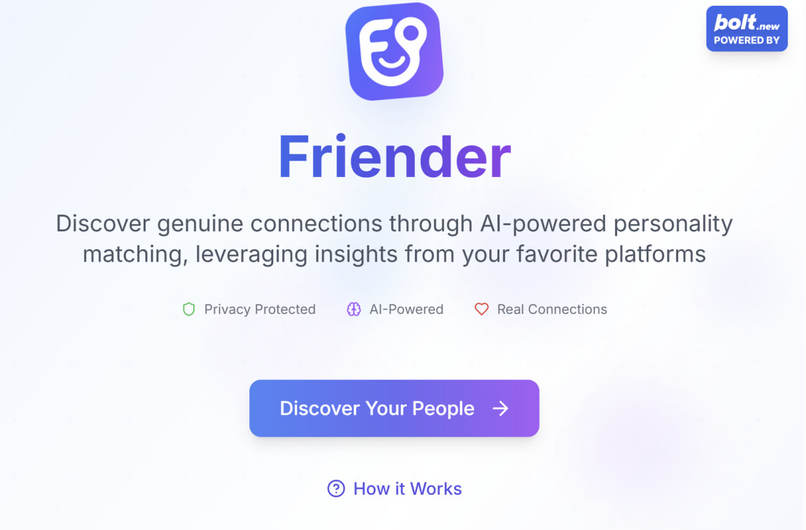
The landing page with the powered by bolt page
-
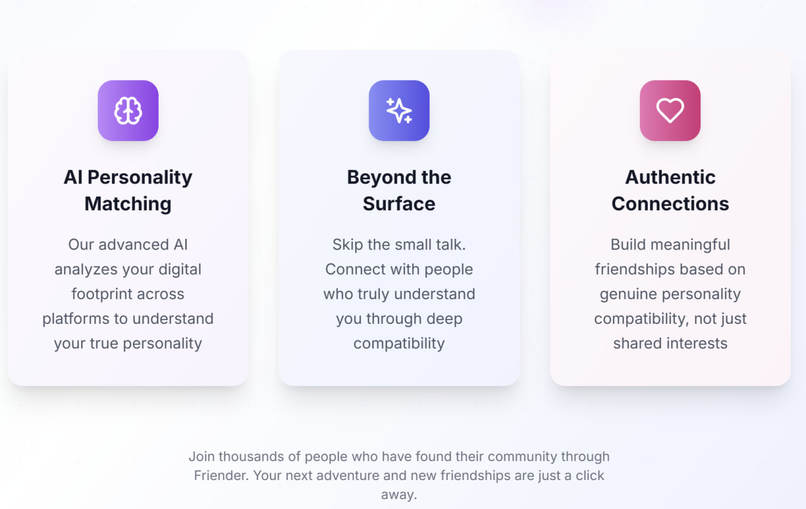
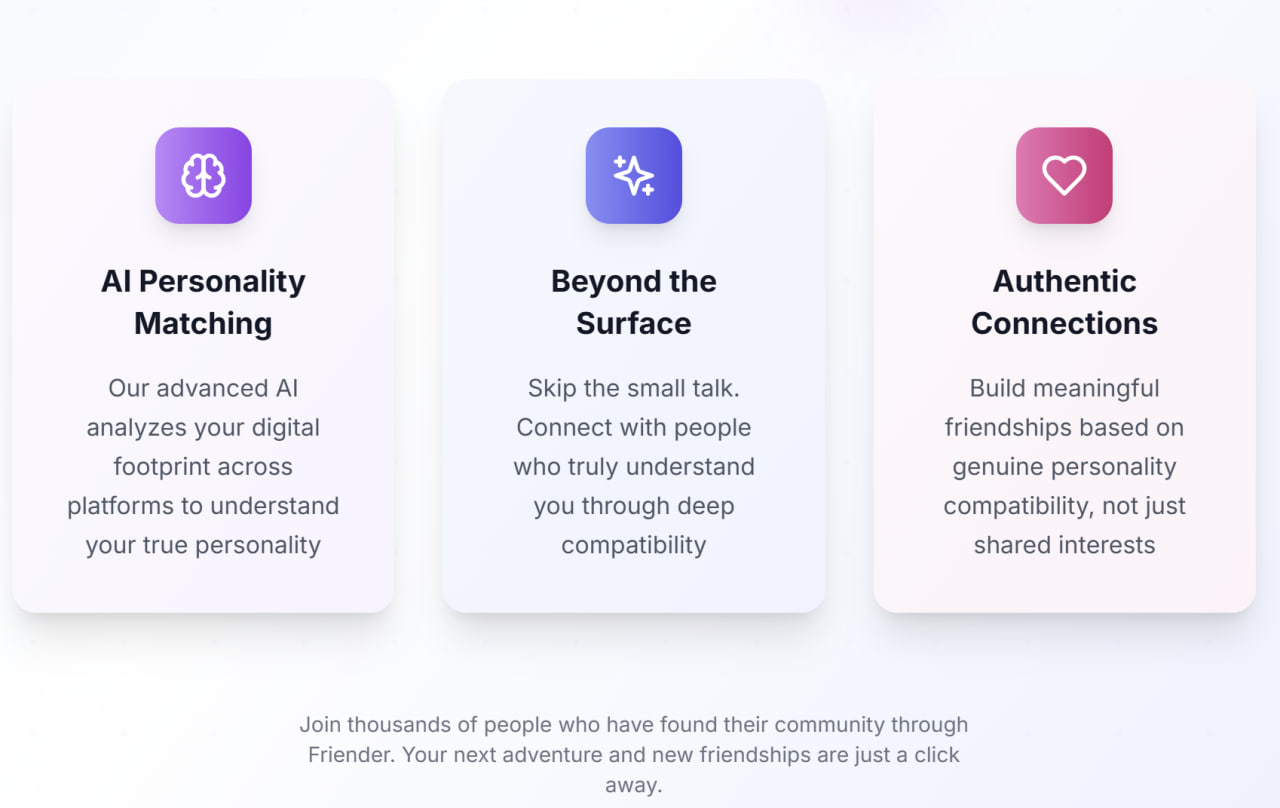
App features
-
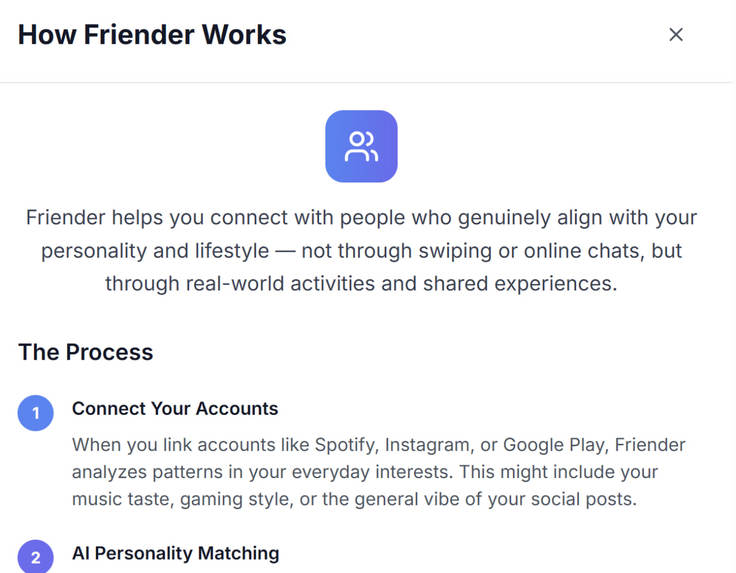
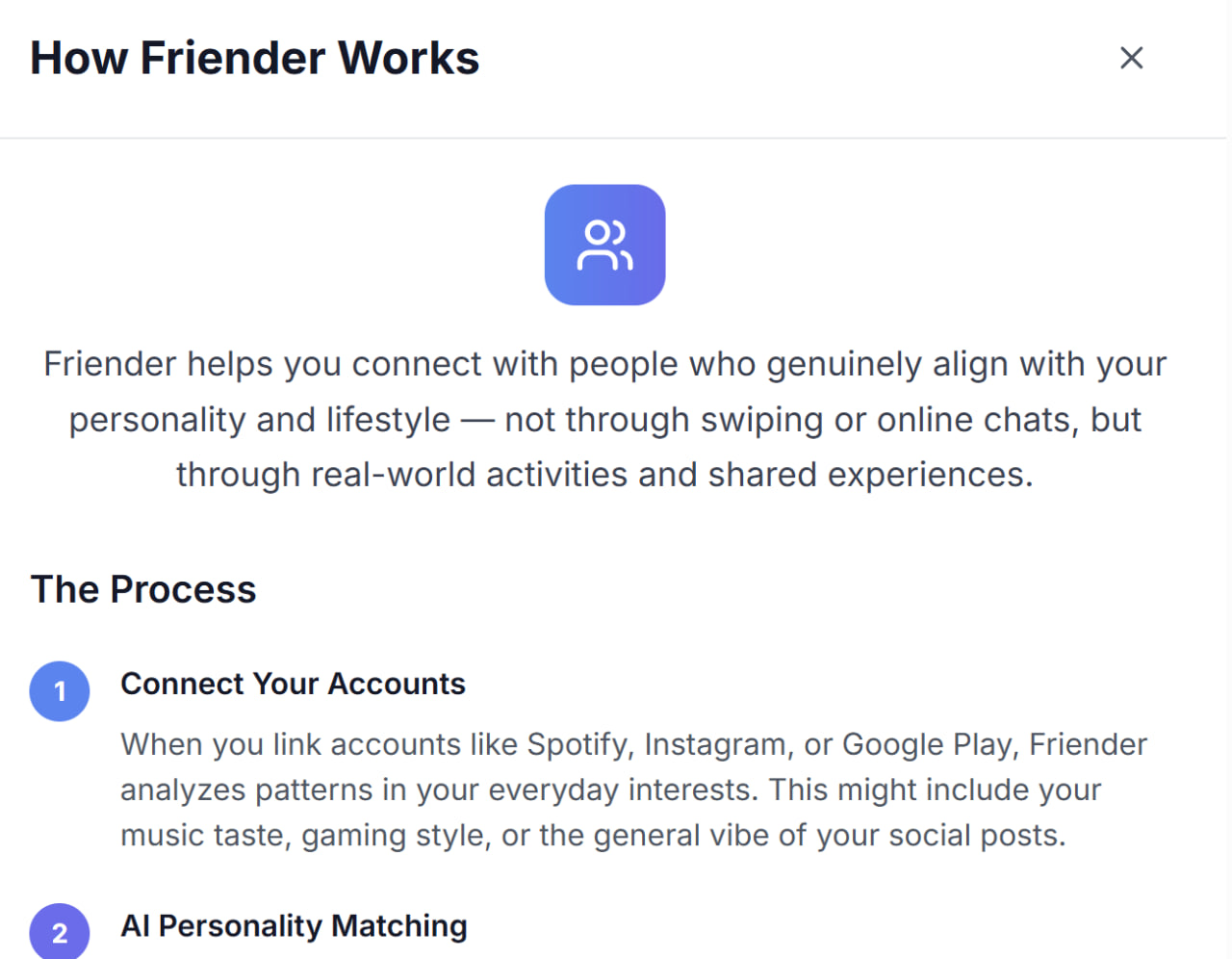
How Friender works
-
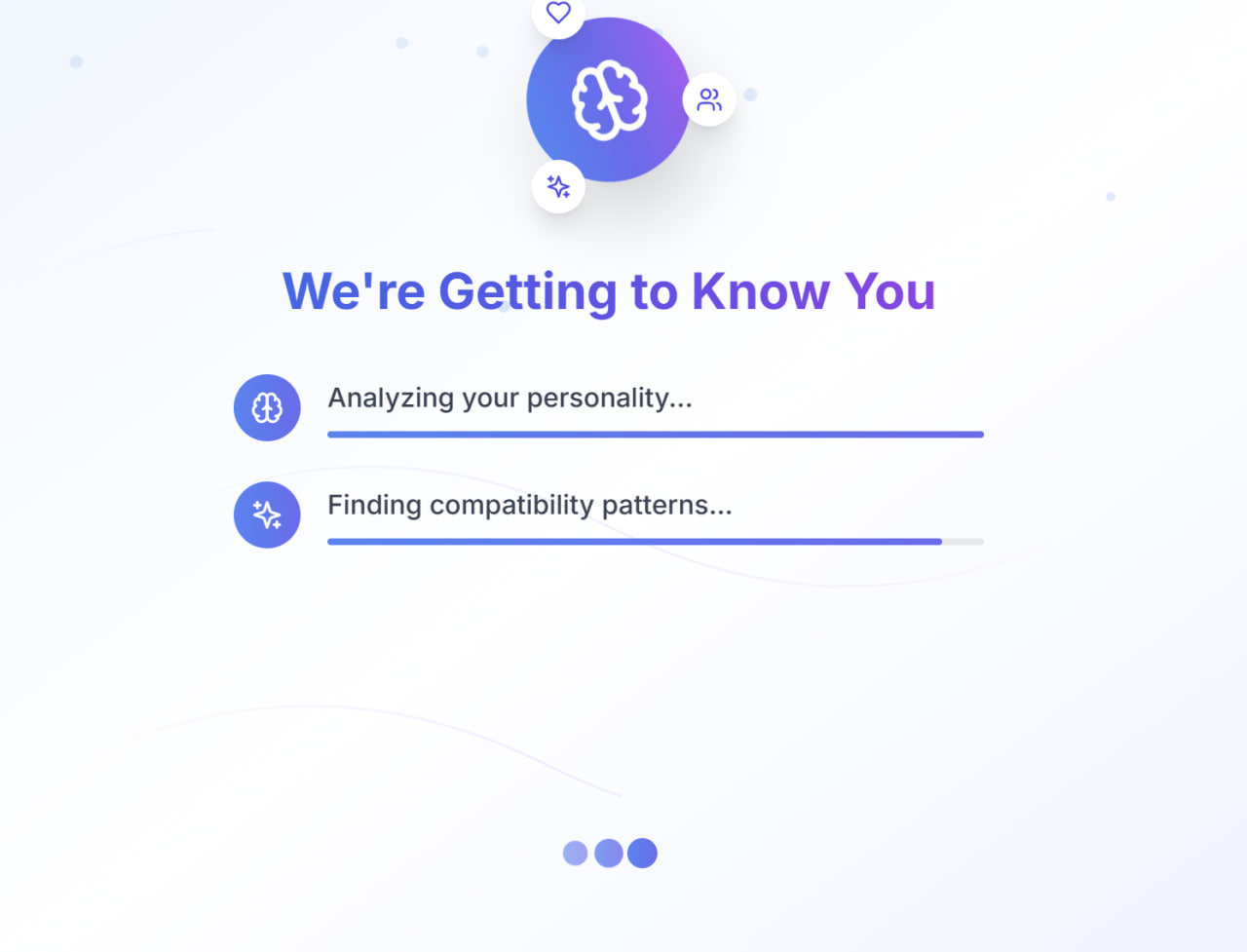
loading page

Inspiration
Moving to a new country can be exciting; but also incredibly isolating. We realized how hard it was to make genuine, meaningful friendships in a new place, especially when most platforms focus on dating or superficial connections. That’s what inspired us to create Friender; an app that helps people connect based on who they truly are.
What it does
Friender matches users based on deep personality insights, not just hobbies or selfies. It uses a combination of OpenAI chat data, Spotify preferences, Google Play activity, and other integrations to create a psychological profile of each user. Based on this, we recommend compatible friends and nearby social activities. It’s not about dating; it’s about belonging.
How we built it
Everything in Friender was powered and built using Bolt, our collaborative development platform that made it easy to manage front-end, back-end, and data integrations in one place. With Bolt, we were able to quickly prototype, test, and iterate as a team. Frontend: Built in Vite + React, hosted and deployed via Bolt, giving us a fast and responsive user experience across devices. Backend: Powered by Node.js and Supabase, integrated seamlessly through Bolt. We used Supabase for managing user authentication, session tracking, and activity data. Integrations: OpenAI (for personality extraction), Spotify & Instagram APIs (for preference modeling), and Google Games (for behavioral insights). Bolt handled auth tokens, data pipelines, and unified access. Matching Logic: We designed custom compatibility scoring using MBTI, Enneagram, and psychological clustering—all implemented and deployed via Bolt.
Challenges we ran into
Getting data from other platforms like Spotify, Instagram, and Google Play was tricky due to different API structures and permissions.
We had to normalize all incoming data into a unified JSON format for compatibility scoring—for example, extracting music taste, playtime, or interaction style into structured fields like { music_energy: 0.8, night_owl: true }.
Integrating third-party APIs through Bolt required careful OAuth setup, token management, and respecting rate limits and user privacy.
Balancing user trust and transparency was essential—users needed to see what data we used and why they were matched with someone.
Making matches feel meaningful, not robotic, was an ongoing design and logic challenge.
Accomplishments that we're proud of
We successfully matched users based on compatibility scores calculated from real psychological traits.
Built an MVP that works across mobile and desktop.
Created an inclusive space where friendship—not flirting—is the focus.
What we learned
Social apps often overlook the complexity of human personality—we wanted to fix that.
API limitations can be frustrating, but creative workarounds (like clustering Spotify genres or analyzing message tone) can produce powerful results.
Users crave authenticity and purposeful connections, especially in new environments.
What's next for Friender
Payment features for premium activity creators or verified community hosts.
A marketplace of local social experiences—users can see featured hosts (like yoga instructors, artists, language tutors) and join their events.
Better privacy controls and customizable personality visibility.
AI-powered group formation (e.g., study groups, introvert-friendly outings, weekend adventures).
More scientific validation of our matching model with real user feedback and psychological benchmarks.
Built With
- api
- bolt
- database
- github
- javascript
- json-schema-mapping
- mbti/enneagram
- mbti/enneagram-inference)-other-tools:-github
- node.js
- node.js-platform:-bolt-(end-to-end-dev-&-deployment)-cloud-services:-supabase-(auth
- oauth-2.0
- openai-(personality-analysis)-databases:-supabase-postgres-apis-&-integrations:-spotify-api-(music-preferences)-instagram-graph-api-(social-signals)-google-play-games-services-(behavioral-traits)-openai-api-(chat-analysis
- openi
- react
- session
- spotify
- storage)
- supabase
- typescript
- typescript-frameworks:-react-(vite)
- vite


Log in or sign up for Devpost to join the conversation.