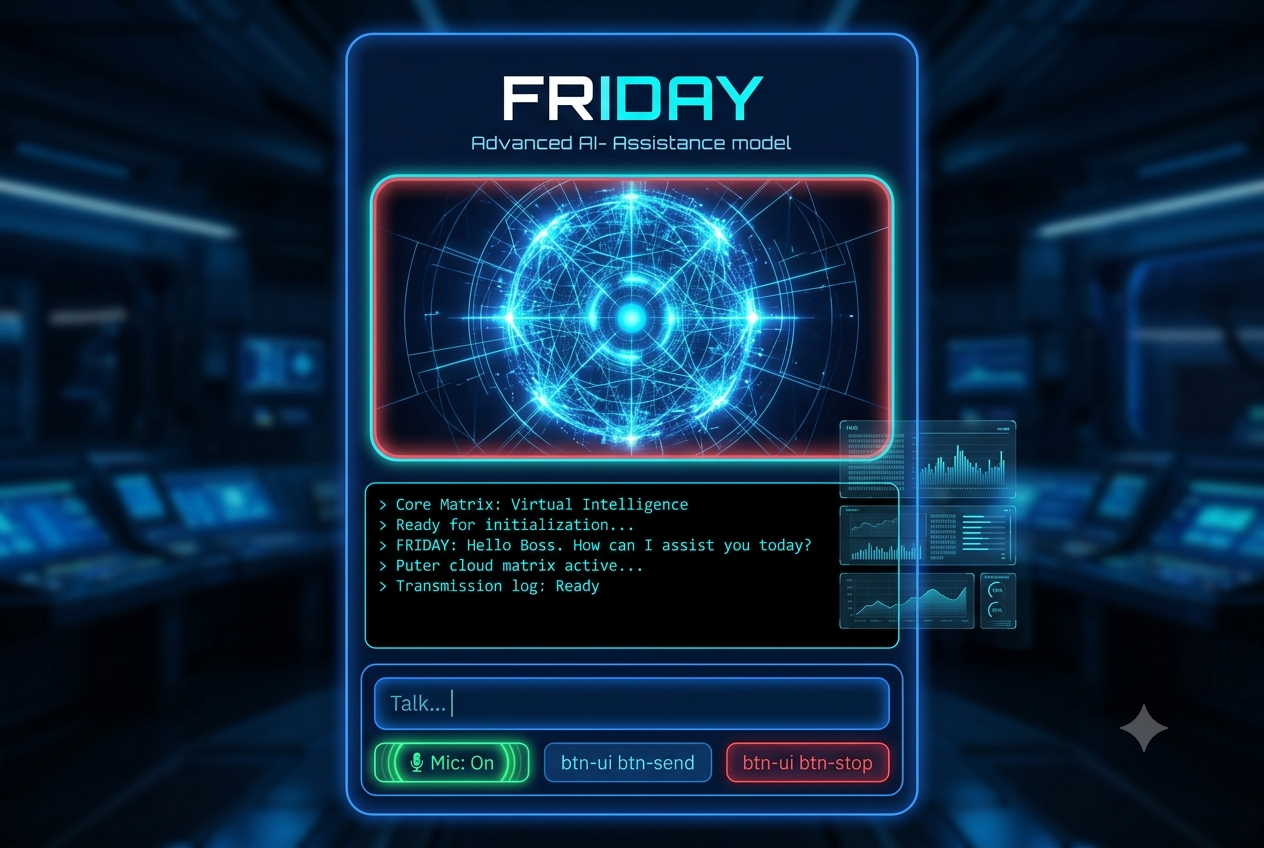
Inspiration
The Sci-Fi Reality Gap Growing up, many of us marvelled at the idea of ambient, highly-responsive AI interfaces—the kind of systems like an advanced VI i.e. Virtual Intelligence that act as seamless extensions of human intent. However, when we look at the real world, the current state of consumer AI is largely restricted to sterile, flat text boxes, clunky browser extensions, or heavy applications that demand premium hardware and complex deployment environments. Furthermore, a massive digital accessibility gap persists. Individuals with motor or visual impairments struggle with typing-dominated workflows, and semi-urban or multi-lingual users are often left behind by voice models that fail to handle cross-lingual script shifts smoothly.
I inspired to build FRIDAY: a fast, zero-install, serverless, and completely multimodal tactical HUD designed to democratize web accessibility while keeping the nostalgic thrill of sci-fi engineering alive.
What it does:
FRIDAY is an immersive, client-side tactical Virtual Intelligence (VI) workspace operating natively inside the browser. It unifies vocal commands, manual inputs, and generative cloud execution matrices into a zero-latency conversational loop. Dual-Input Mode Matrix: Allows seamless switching between keystroke inputs and continuous ambient microphone streams. Intelligent Tool Routing: Understands contextual requests to execute browser operations locally—such as querying hardware system metrics (time arrays) or dynamically spinning off navigation paths (Google, YouTube). Real-Time Log Telemetry: Bridges black-box LLM processing into transparent, real-time diagnostic feeds via an integrated glassmorphic HUD scrolling terminal. Context-Aware Speech Layer: Synthesizes incoming knowledge streams to speak back answers conversationally, automatically swapping linguistic models based on the prompt's origin.
How we built it
To keep the application entirely serverless and bypass resource-heavy execution runtimes, the build utilizes an entirely client-side decoupling strategy:
[ Ambient Mic / Text Input ] │ ▼ [ Dynamic Text Parsing Layer ] ──(Regex Match)──► [ Devanagari Hindi Filter ] │ │ ▼ ▼ [ Puter Cloud Asynchronous SDK ] [ Web Speech API (hi-IN) ] │ │ ▼ ▼ [ Core Matrix Processing Engine ] ──────────────► [ Audio Matrix Synthesis ] The Cloud Matrix: We integrated the Puter AI JavaScript SDK, calling generative models directly through an asynchronous client loop (puter.ai.chat), completely avoiding heavy node-modules or expensive backend infrastructure. The Linguistic Engine: We used the native browser-level Web Speech API (SpeechRecognition & SpeechSynthesisUtterance) to process raw voice fields without transmitting audio files to external processing servers. The Visual Deck: Styled with raw HTML5 and an explicit CSS viewport height budget (height: 520px), using CSS keyframe matrices and background blurs (backdrop-filter) to mimic an integrated sci-fi overlay that wraps fluidly on both desktop screens and mobile displays.

Log in or sign up for Devpost to join the conversation.