-
-
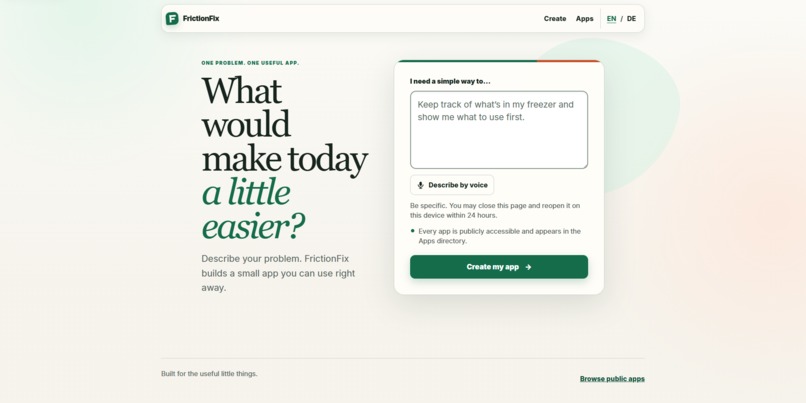
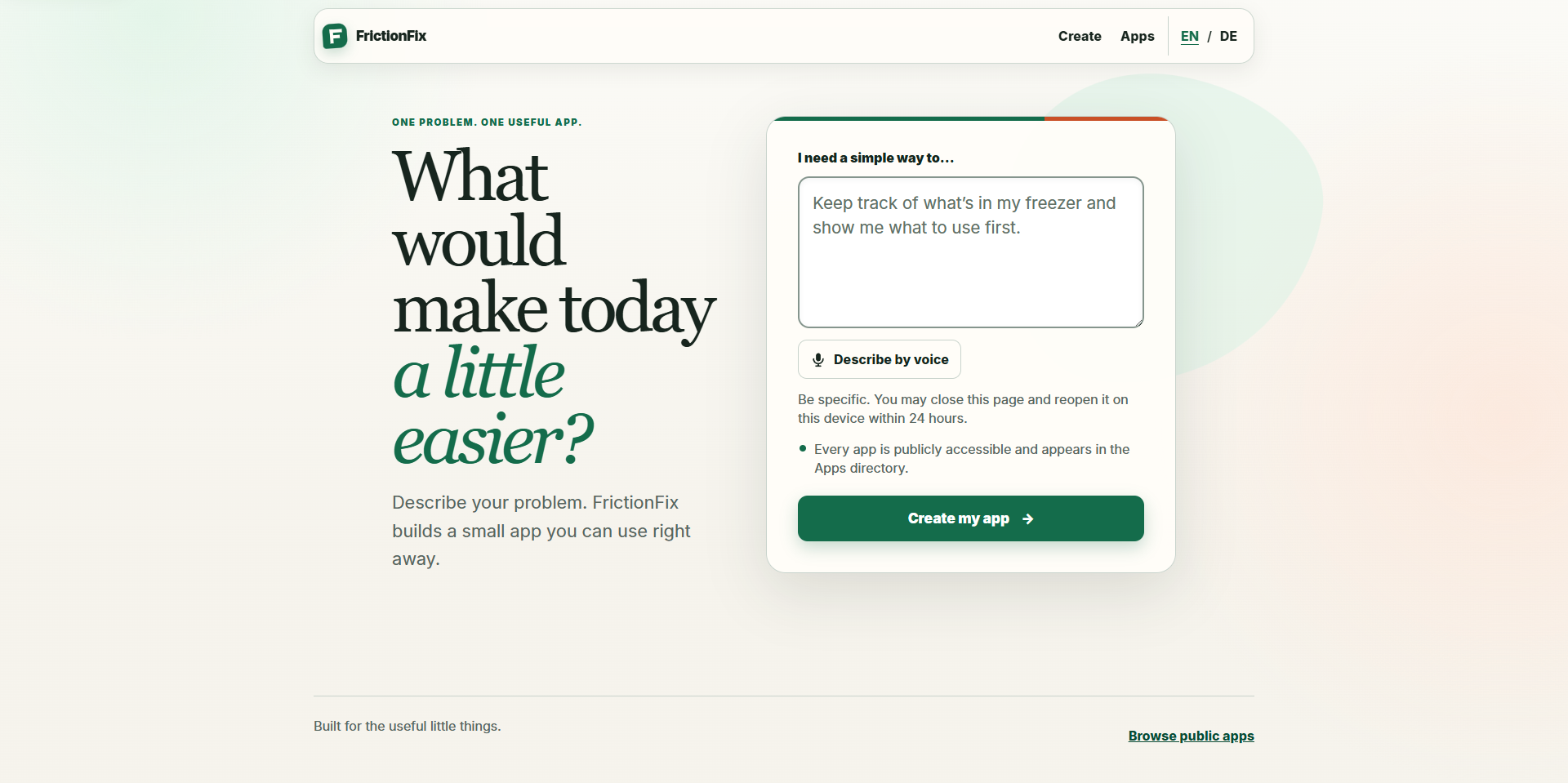
Main Page
-
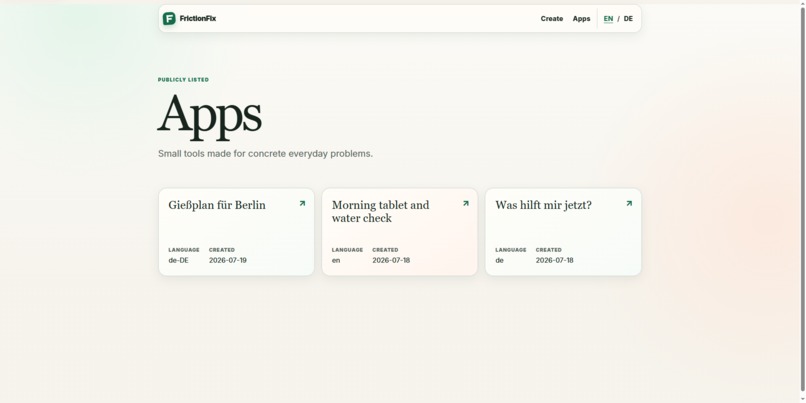
App Gallery
-
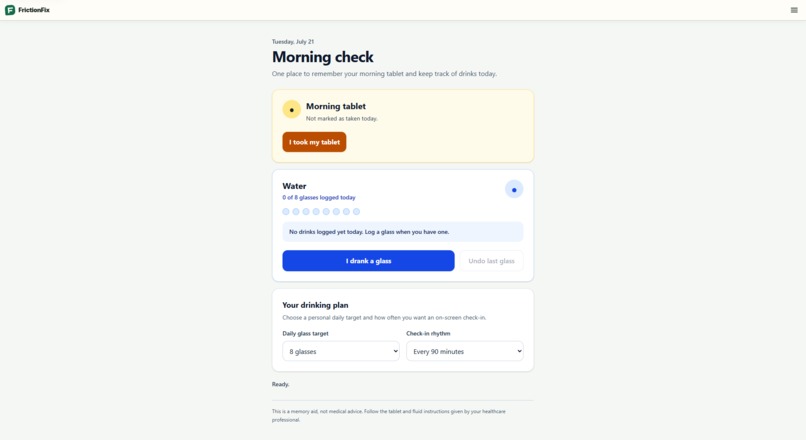
Example App
Inspiration
FrictionFix started with a very specific observation.
My wife works in a residential support setting for mothers, fathers, and children. Some of the people there live with cognitive disabilities and face small but meaningful problems in everyday life: remembering medication, keeping track of information from kindergarten, or following recurring routines.
Many of them can use a smartphone and familiar apps without difficulty. But they cannot realistically open ChatGPT, write and refine prompts, evaluate generated code, fix errors, and turn the result into reliable software.
That creates a new kind of digital divide.
AI can now generate highly personalized tools, but mainly for people who already know how to instruct, evaluate, and manage AI systems.
FrictionFix is meant to close that gap.
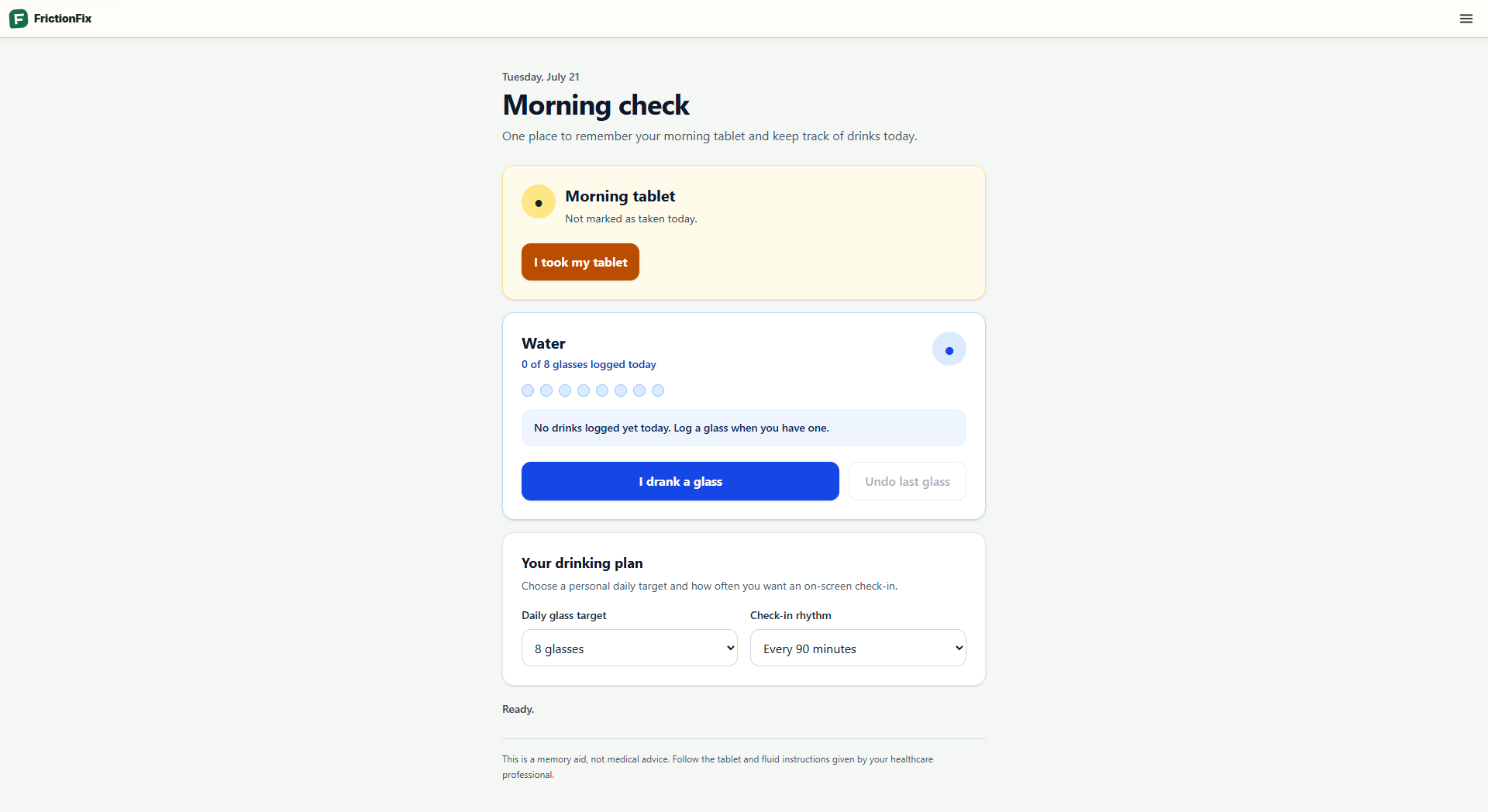
A person describes an everyday problem in their own words and receives a focused personal app in the same language, ready to use on their phone.
The goal is not another app generator for developers or experienced AI users. The goal is to make personalized software accessible to people who are currently excluded from creating it themselves.
What FrictionFix does
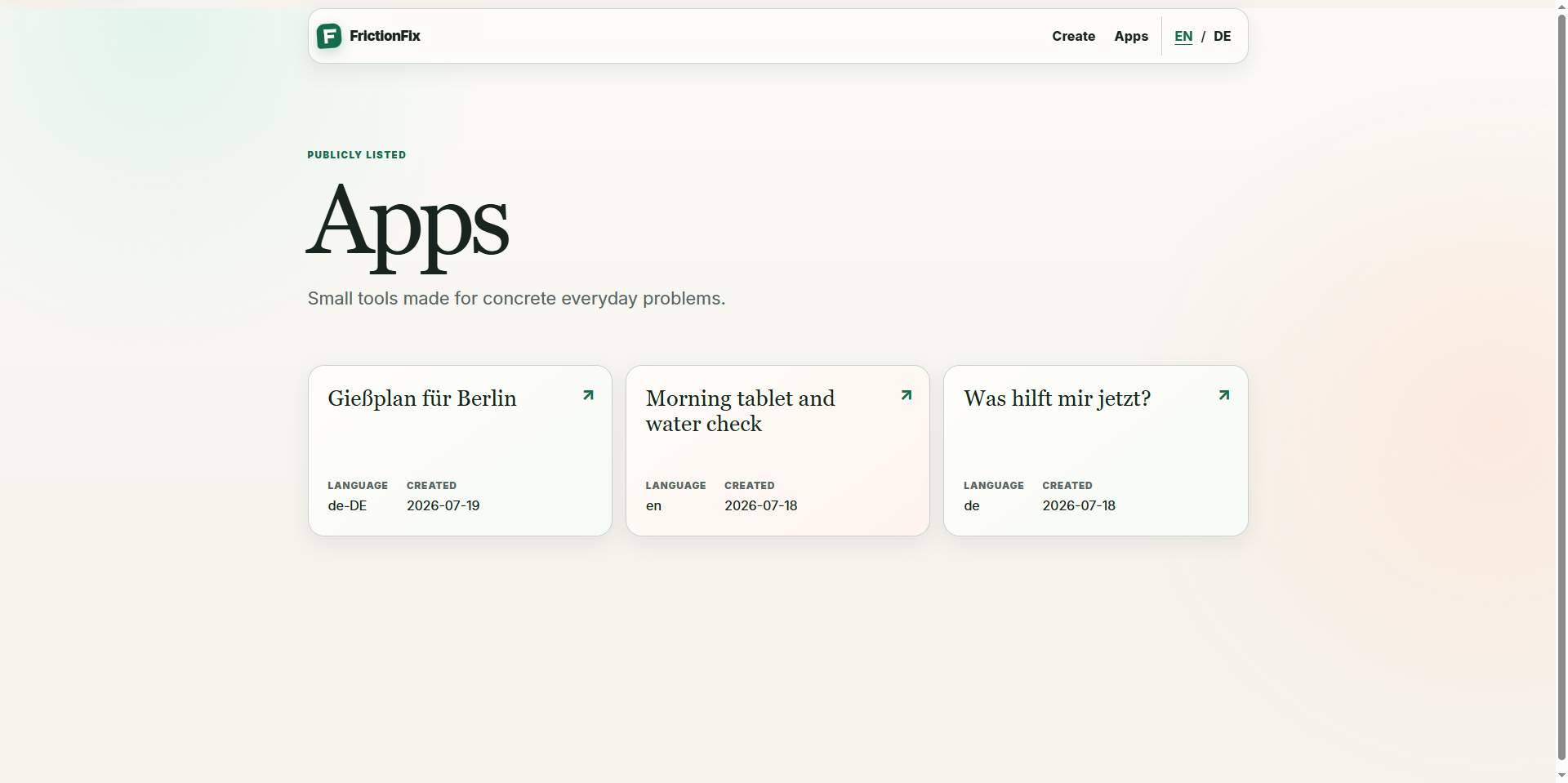
Users describe a problem in English, German, or another language. FrictionFix generates a small web app designed around that specific need.
The app can be used immediately, shared by URL, improved later, or forked into a separate version.
Each generated app receives its own URL, edit token, and isolated storage. Generation continues even if the page is reloaded, so users do not have to understand or manage the underlying process.
How I built it
I built FrictionFix primarily with Codex and GPT-5.6 as development partners.
They supported the implementation, architecture reviews, debugging, testing, and repeated iteration. My process was simple: define the next real problem, build the smallest working version, test it, challenge the result, and improve it.
The application is built with PHP 8.5, Slim 4, MariaDB, and vanilla JavaScript. OpenAI models handle moderation and structured app generation. PHPUnit and Playwright provide automated and end-to-end testing.
The generated output is not accepted as arbitrary code. FrictionFix expects a narrow structure and validates each result before making it available.
The biggest challenge
The hardest part was balancing speed, cost, and isolation.
When several people request the same app at the same time, FrictionFix should not pay for several identical model calls. It generates the result once and safely reuses it.
At the same time, every person still needs a separate app instance with an independent URL, edit token, and storage.
Solving that required transactional coordination in MariaDB and a clear separation between the reusable generated result and the personal app created from it.
This was important because FrictionFix should remain affordable without turning different users’ apps or data into shared state.
What I learned
The biggest lesson was that accessibility is not only an interface problem.
A simple screen is not enough if the user still has to understand prompting, generation, technical errors, storage, or deployment.
The system itself has to absorb that complexity.
I also learned that the most important product decision was not which model or framework to use. It was deciding who the product is for.
Without that focus, FrictionFix would be another AI app builder.
With it, FrictionFix becomes a bridge between people who can use software and people who have so far been excluded from creating software that fits their own lives.
What comes next
The next step is to test FrictionFix with the people it is intended to support, together with professionals who understand their everyday context.
The key questions are not only whether the apps work technically, but whether they are understandable, useful, and safe in real situations.
Future work will focus on more accessible generated interfaces, guided problem descriptions, stronger safeguards for sensitive use cases, and reusable patterns for common everyday challenges.
FrictionFix is not intended to replace professional or social support. It is meant to provide one more practical tool for the small frictions that can make everyday independence unnecessarily difficult.
Built With
- codex
- css
- gpt-5.6
- guzzle
- html
- javascript
- mariadb
- openai
- openai-api
- php
- slim

Log in or sign up for Devpost to join the conversation.