-
-
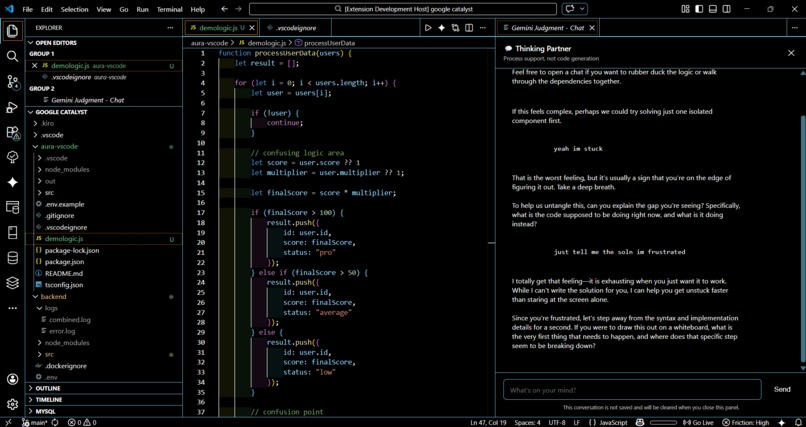
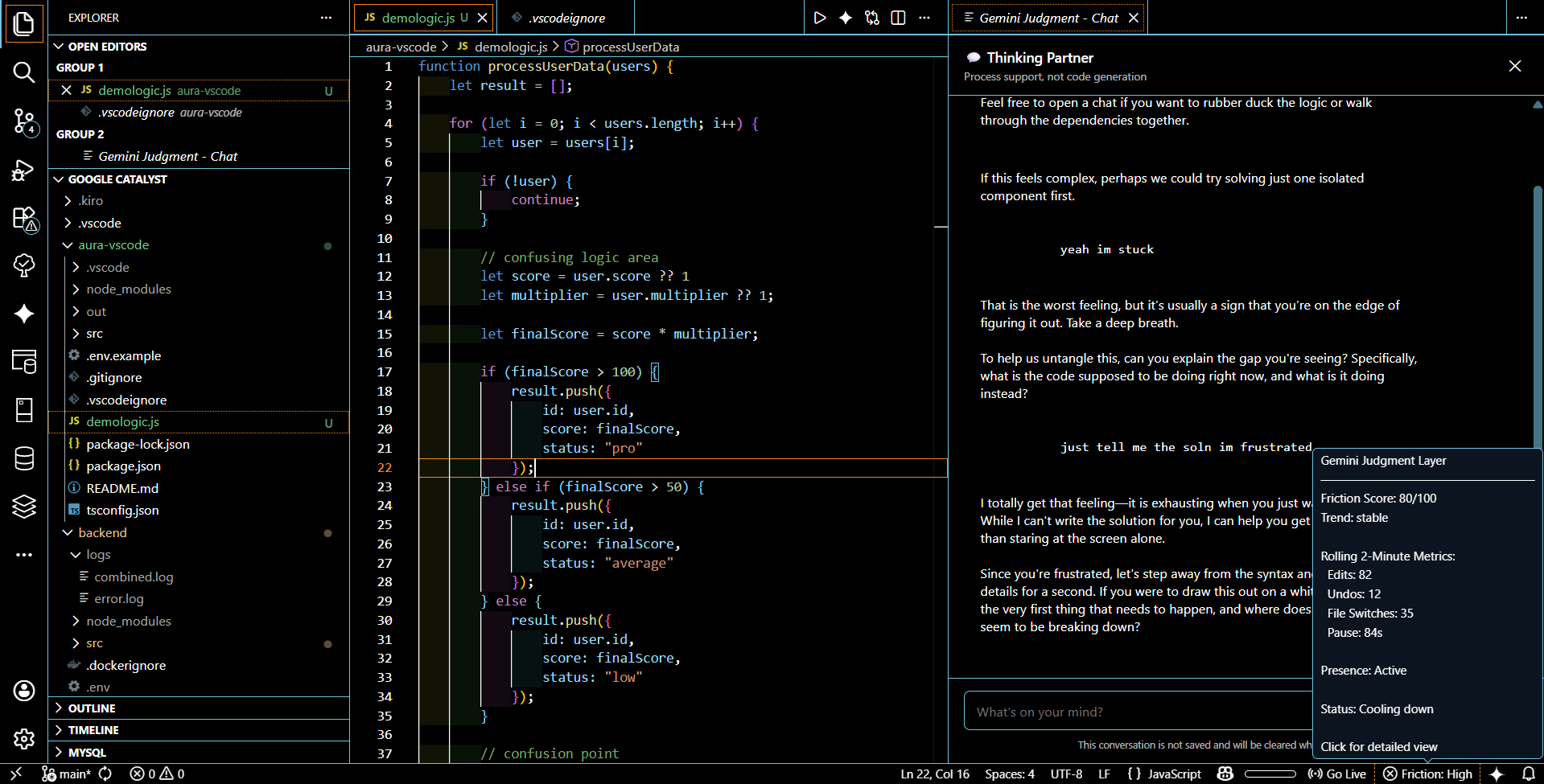
Autonomous Intervention in Action
-
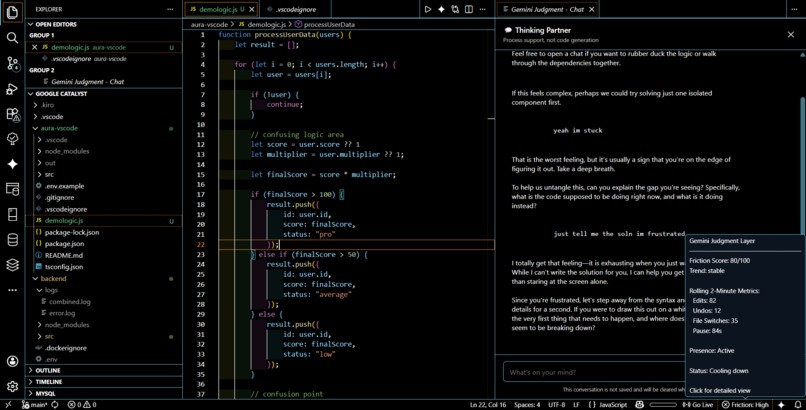
Real-time Cognitive Friction Detection
-
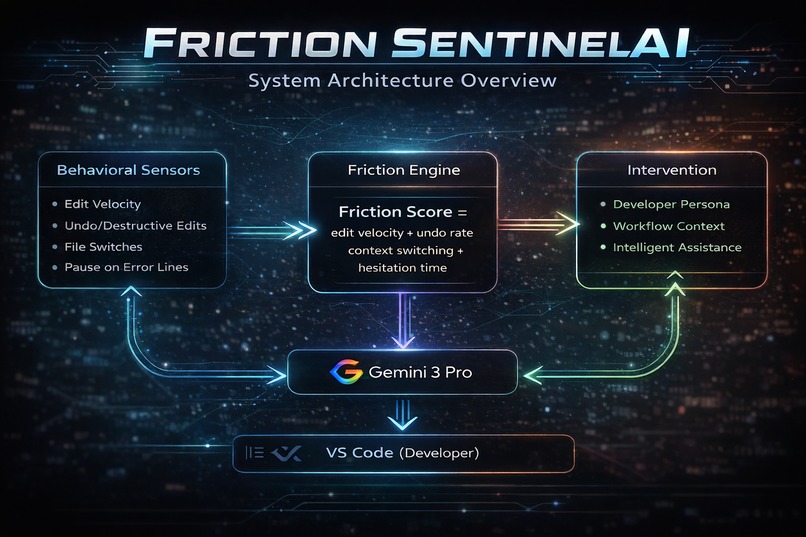
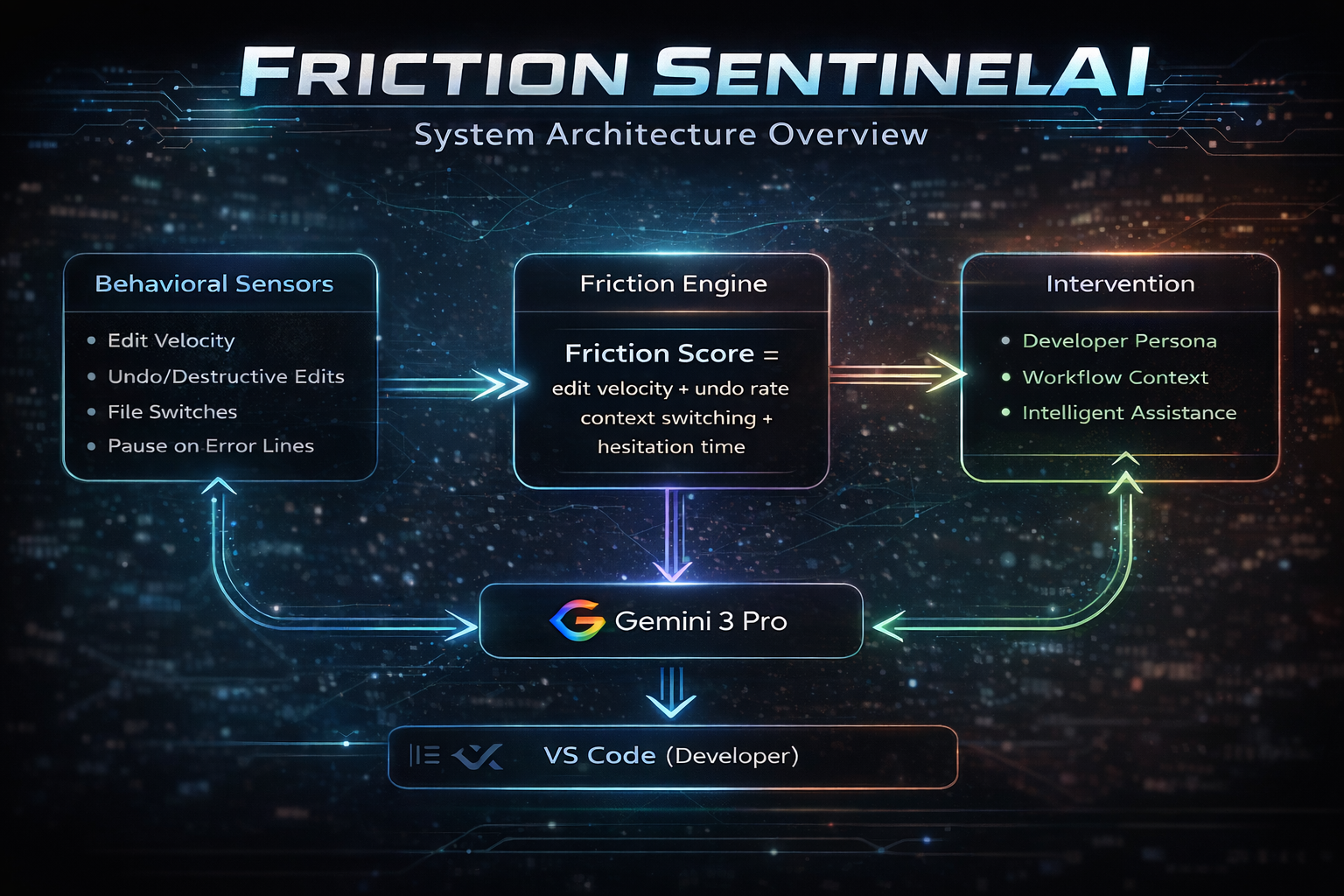
Architecture Diagram
Inspiration
Today’s AI coding assistants are powerful — but passive.
They wait for prompts. By the time a developer stops to ask for help, they’ve often already spent 20 minutes stuck in frustration loops.
We asked a simple question: What if AI could detect when you’re stuck before you even ask?
Inspired by real pair-programming — where a teammate senses confusion without words — we built Friction Sentinel: an autonomous cognitive-support layer that observes how you work and intervenes exactly when needed.
What it does
Friction Sentinel transforms VS Code from a passive editor into an intelligent observer of developer cognition.
Instead of waiting for prompts, it continuously analyzes behavioral signals:
- Typing Velocity
- Undo/Backspace Rate
- Rapid File Switching
- Hesitation on Error Lines
Using these signals, it computes a real-time Cognitive Friction Score.
When friction crosses a critical threshold:
- The system consults Gemini 3 Pro
- It analyzes developer context and persona
- It intervenes automatically with the right level of help
No prompt required.
The result: AI that helps at the moment of struggle — not after frustration peaks.
How we built it
We designed Friction Sentinel as a cognitive “nervous system” for VS Code.
Behavioral Sensors (Local)
Using the VS Code Extension API:
- Edit velocity tracking
- Undo/destructive edit detection
- File switching patterns
- Pause detection on error lines
All processing happens locally to preserve privacy.
Friction Engine
We built a mathematical friction model that quantifies struggle as a weighted combination of behavioral signals: $$ \text{Friction Score} = w_e \cdot V_{edit} + w_u \cdot R_{undo} + w_s \cdot S_{switch} + w_p \cdot T_{hesitation} $$ This allows the system to distinguish:
- Productive Flow (High Velocity + Low Undo)
- Genuine Confusion (High Velocity + High Undo)
Gemini Intelligence Layer
When friction exceeds a threshold, Gemini analyzes:
- Friction pattern data
- Developer persona (e.g., "Beginner" vs "Pro")
- Workflow context
It then decides:
- Whether to intervene
- How to intervene (Hint vs Direct Solution)
This transforms Gemini from a reactive chatbot into an autonomous cognitive partner.
Challenges we ran into
Avoiding the “Clippy Problem” Autonomous help can become annoying if poorly timed. We implemented adaptive sensitivity, cooldown logic, and persona-based interruption control.
Privacy vs Intelligence All behavioral analysis runs locally. Code is only shared with Gemini when intervention becomes necessary.
Detecting Panic vs Productivity High typing speed alone is meaningless. High speed + high undo rate = cognitive thrashing. This distinction became core to our friction model.
Accomplishments that we're proud of
- True Autonomous Intervention without prompts
- Real-time Cognitive Friction Modeling
- Seamless Gemini Reasoning Integration
- Zero-Latency Background Operation
Seeing the AI step in at the exact moment of confusion felt like a glimpse into the future of human-AI collaboration.
What we learned
Understanding developer behavior is more powerful than analyzing code alone.
AI shouldn’t just generate answers. It should understand the human behind the keyboard.
Gemini proved exceptionally strong at interpreting behavioral context and delivering precise, situational help.
What's next for Friction Sentinel AI
Friction Sentinel is just the beginning.
Cognitive-aware AI could expand beyond IDEs into:
- Operating systems
- Research workflows
- Writing environments
- Next-generation assistants like Gemini
The future of AI isn’t just smarter models. It’s AI that understands when humans need help — without being asked.
Built With
- google-gemini-3-pro
- node.js
- typescript
- vs-code-extension-api

Log in or sign up for Devpost to join the conversation.