-
-
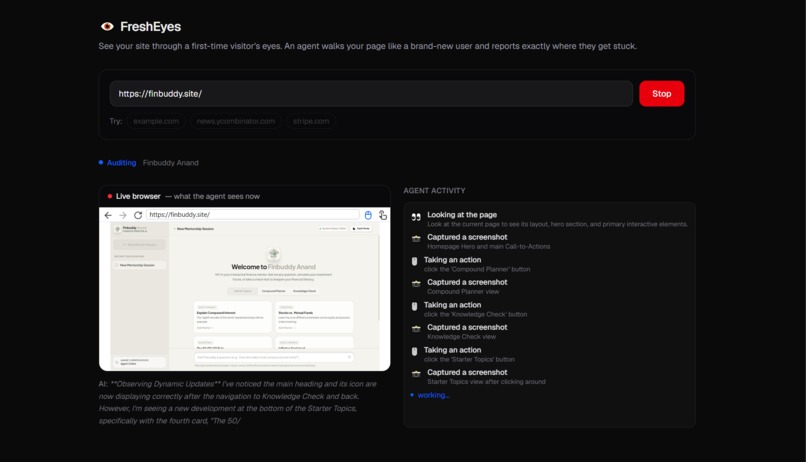
hompage
-
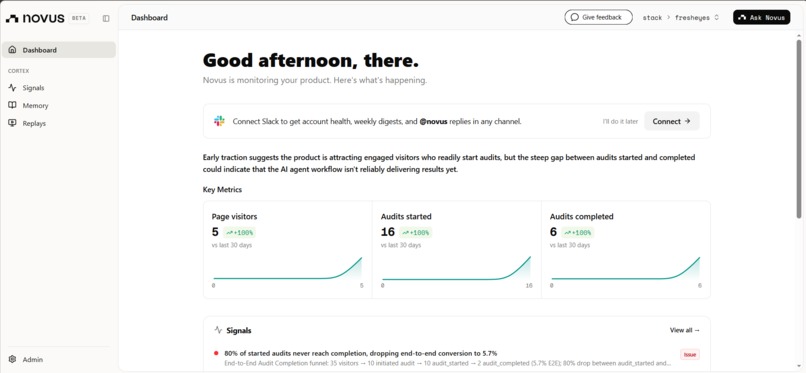
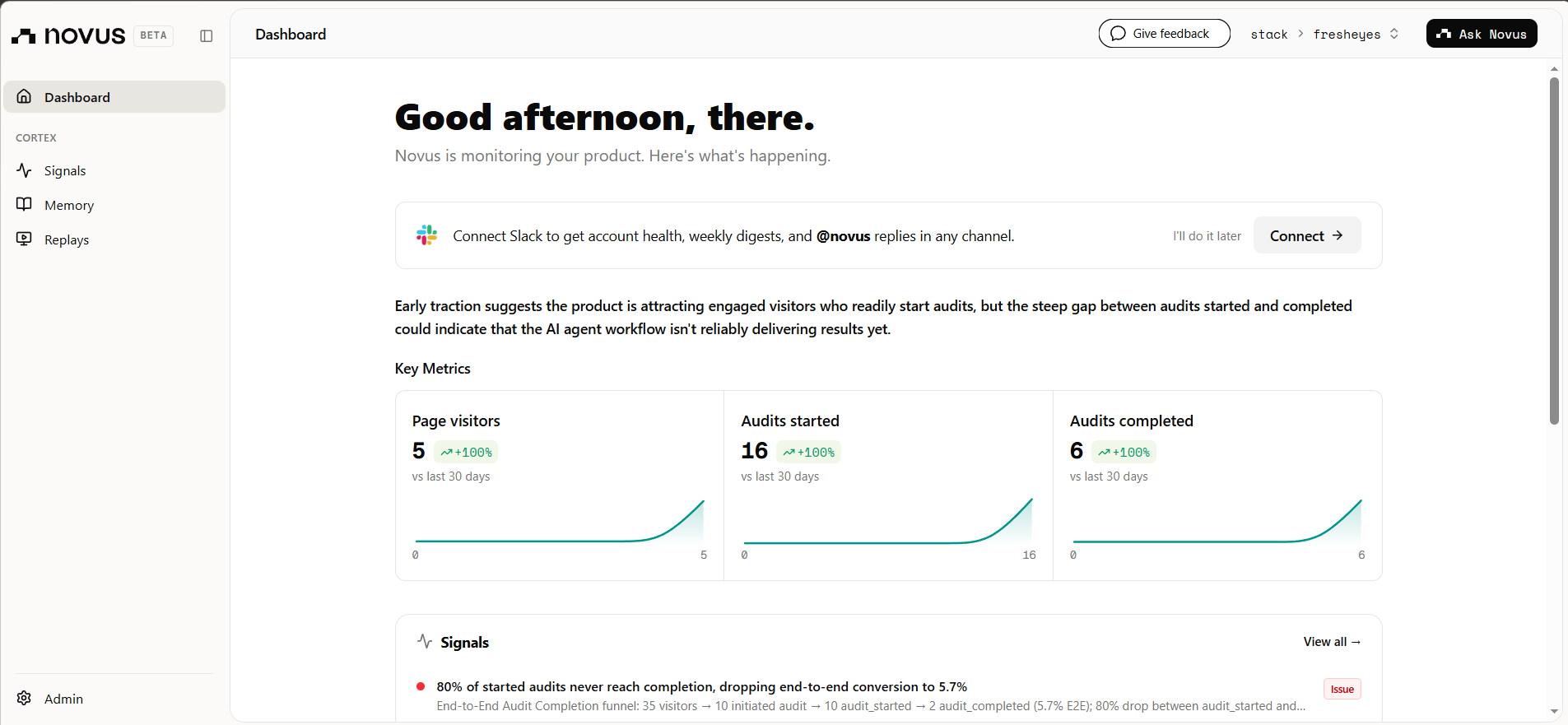
novus-dashboard-preview
-
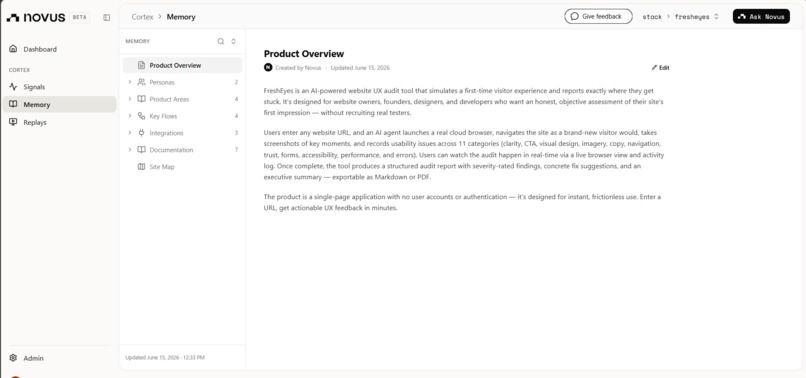
novus-memory-page-preview
-
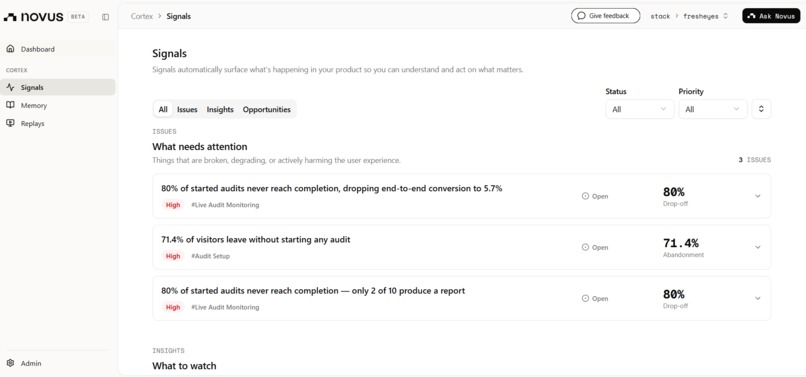
nouvs-signals-page-preview
-
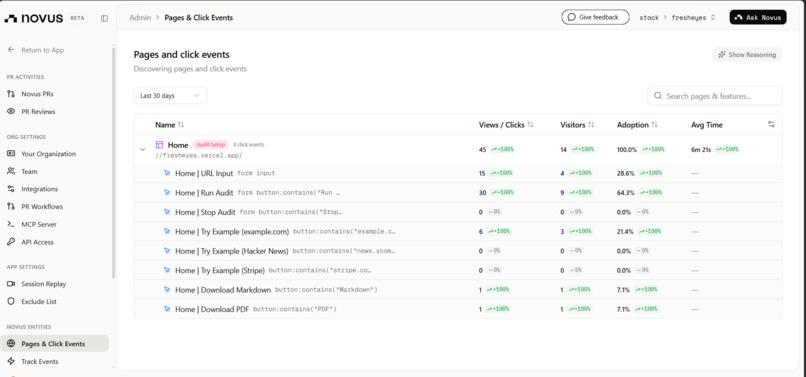
novus-page-event-preview
-
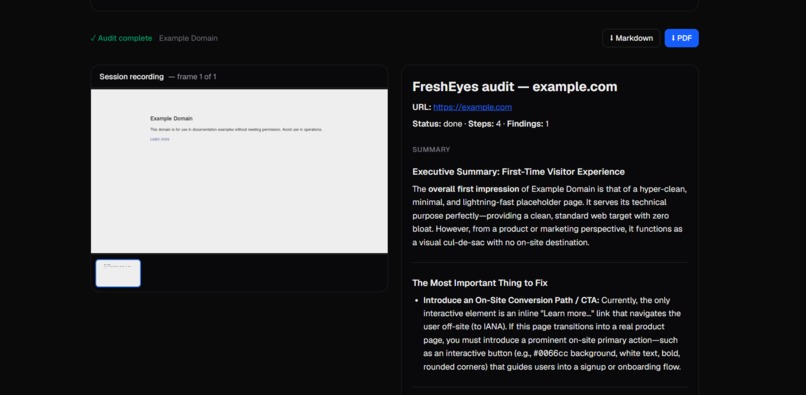
report-preview
FreshEyes
An AI agent that walks your website like a brand-new visitor and reports exactly where they get stuck — with concrete fixes and screenshot evidence.
🔗 Try it
- Live app: https://fresheyes.vercel.app/
- Demo video (2–3 min): https://youtu.be/Q598AuZNlkk
- Full audit of a larger site (~15 min, end-to-end): https://youtu.be/1sqHTFl_Npw
- Code: https://github.com/rushibhosalepro/fresheyes
- Novus dashboard proof: https://github.com/rushibhosalepro/fresheyes/tree/main/novus-proofs
Mission
Everyone ships now — but shipping isn't the finish line; being understood is. FreshEyes exists to give every builder the one thing they can't get on their own: an honest, first-time look at their own product. We want a stranger's confusion to be visible before it costs you a user — so anyone, on any budget, can see their product through fresh eyes and fix the first impression early.
Inspiration
Everyone ships now — developers, PMs, and designers can all build and put a site live. But you can't un-see your own product: the people who build a website already know what it is, who it's for, and where every button leads. So they're the worst judges of the first 10 seconds a stranger spends on it, even though those 10 seconds decide whether the stranger stays.
The usual ways to close that gap are bad: real user testing is slow and expensive — and by the time that feedback reaches you, you've already lost users; "audit" tools just run Lighthouse and hand you performance scores; and asking friends gets you politeness instead of the moment they got lost. There's a gap between "technically works" and "a real person lands on it and actually gets it." FreshEyes lives in that gap — it sends an AI through your site as a confused newcomer and tells you what it found.
What it does
Paste any URL. FreshEyes:
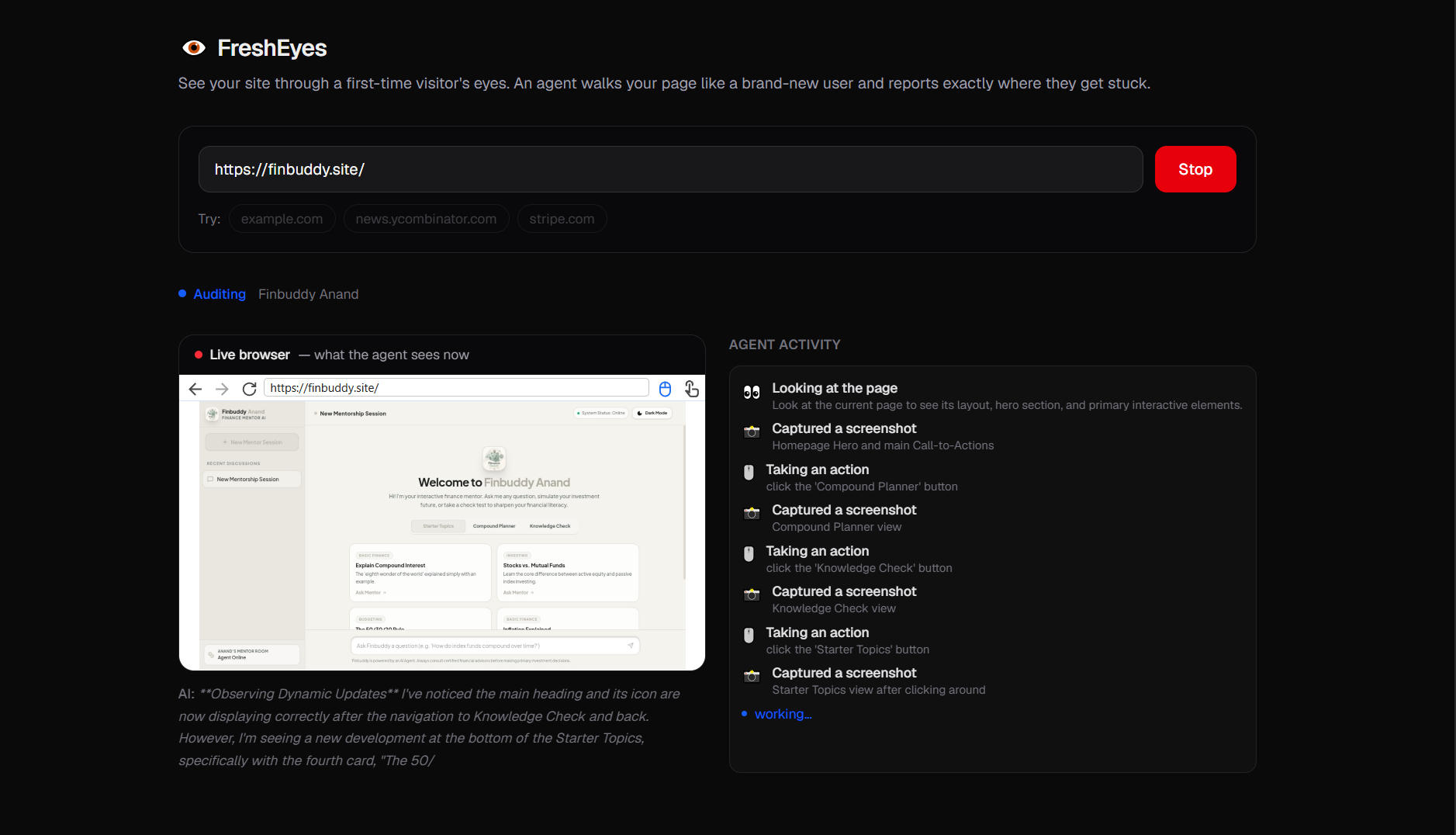
- Opens a real cloud browser and visits your site as a first-time visitor — no logins, no assumptions.
- Streams every action live — you watch it look, click, and react in real time, with its reasoning shown as it goes.
- Judges the whole first impression across 11 dimensions — clarity, CTA, visual design, imagery, copy, navigation, trust, forms, accessibility, performance, and errors.
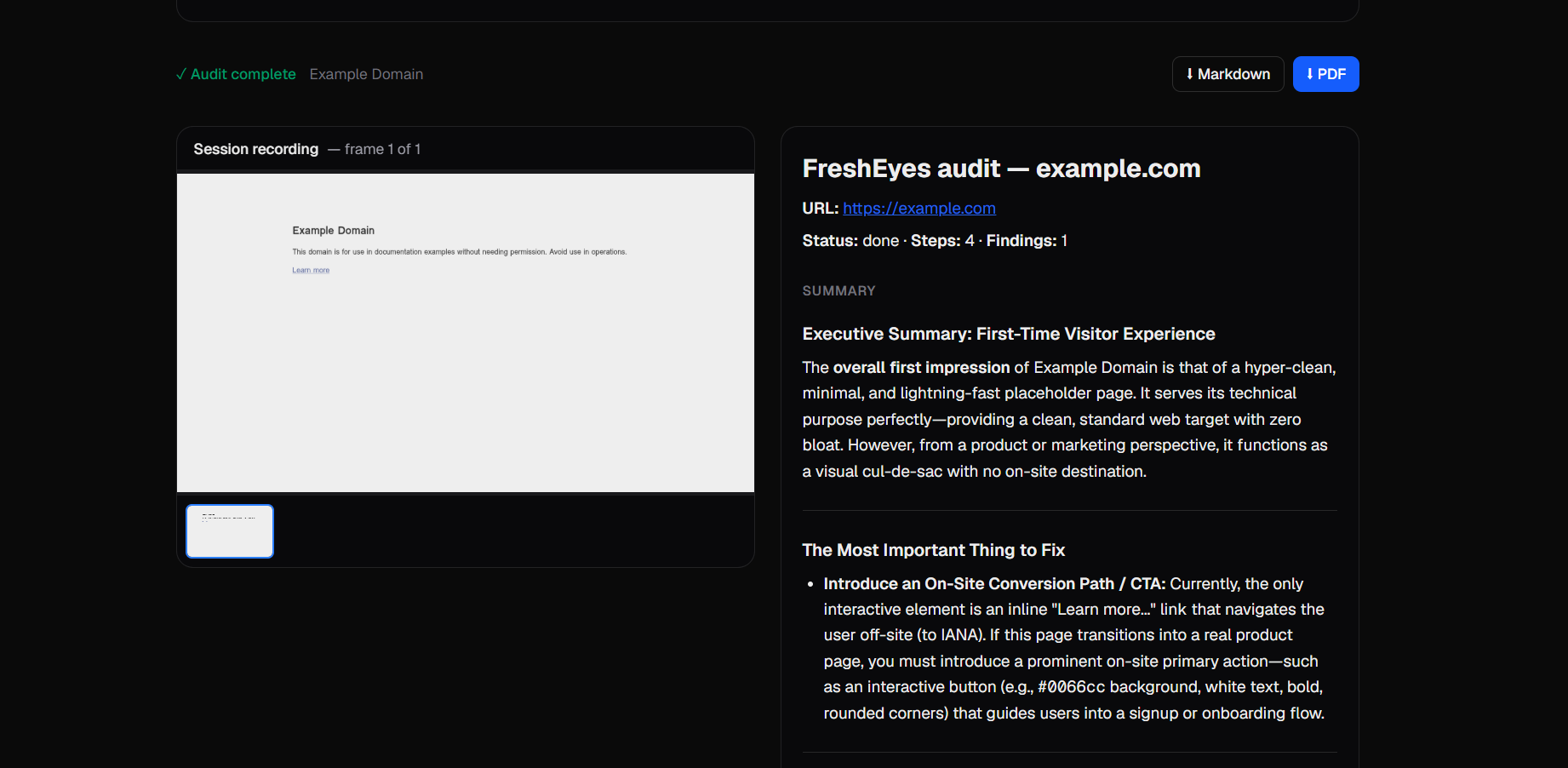
- Records each friction point with a severity, the page URL, a screenshot as evidence, and a concrete fix (actual colors, button styles, copy — not "improve the design").
- Returns a Markdown report you can read inline, scrub frame-by-frame, and export to Markdown or PDF.
Crucially, it's calibrated, not padded: it first figures out what kind of page this is — a throwaway placeholder vs. a real product page — and matches the depth and severity of its audit to reality.
How I built it
FreshEyes is a brain + hands agent. An LLM does the reasoning; a real cloud browser does the doing; everything streams to the UI live.
- Brain: the OpenAI SDK pointed at OpenRouter, running a hand-rolled, bounded tool-calling loop. The model decides the next browser action one step at a time.
- Hands: Stagehand on Browserbase — a managed remote browser with a live view. The model's tools are
observe,act,screenshot,record_finding, andfinish. - The rubric is a file: the agent's judgment lives in
skill.md, a first-time-visitor audit guide loaded into the system prompt — so the product's "taste" can be tuned without touching code. - Backend: Bun + Express, streaming the agent's steps, reasoning, screenshots, and findings to the browser over Server-Sent Events.
- Frontend: Next.js + Tailwind — a live browser view, a streaming activity feed, and a Markdown report with PDF/Markdown export.
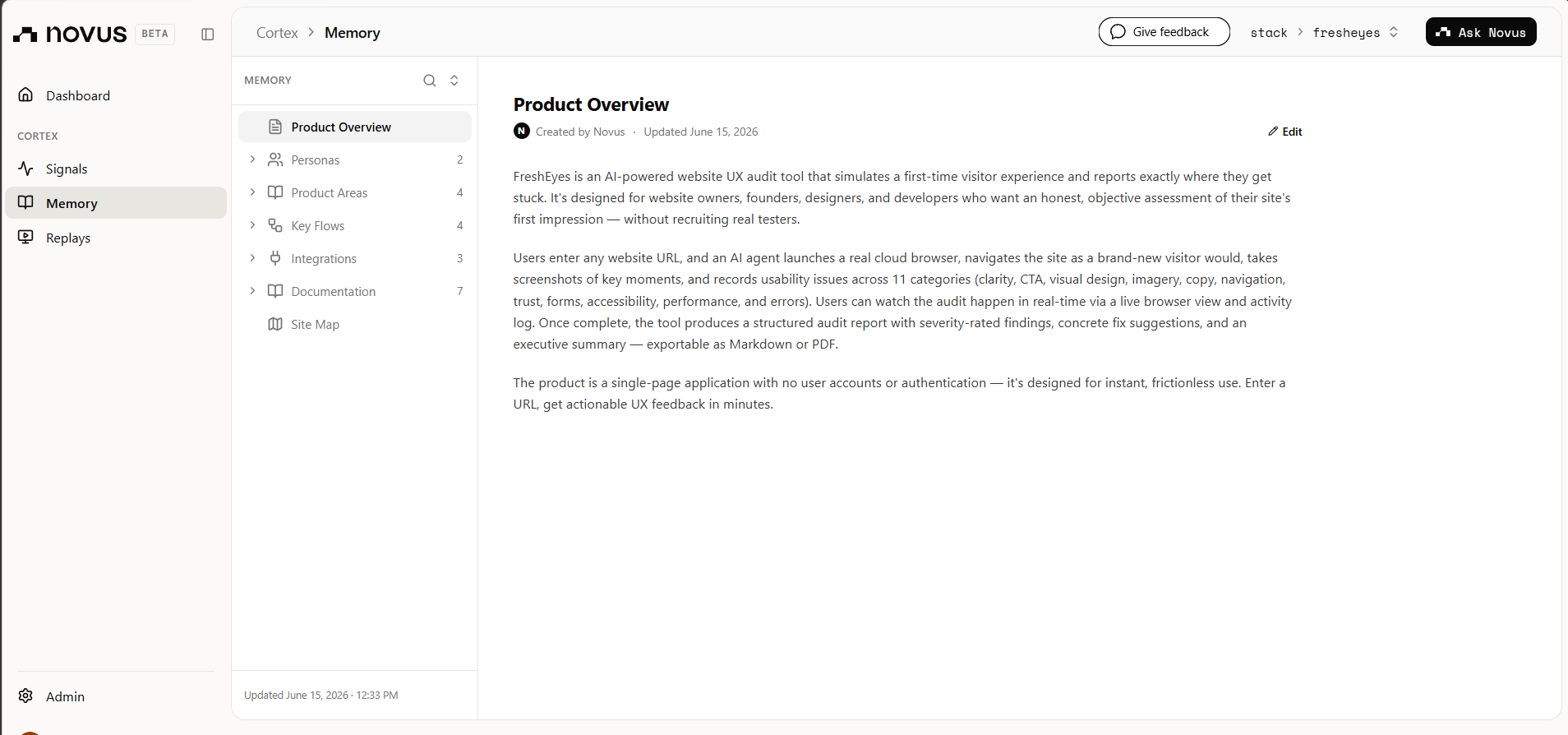
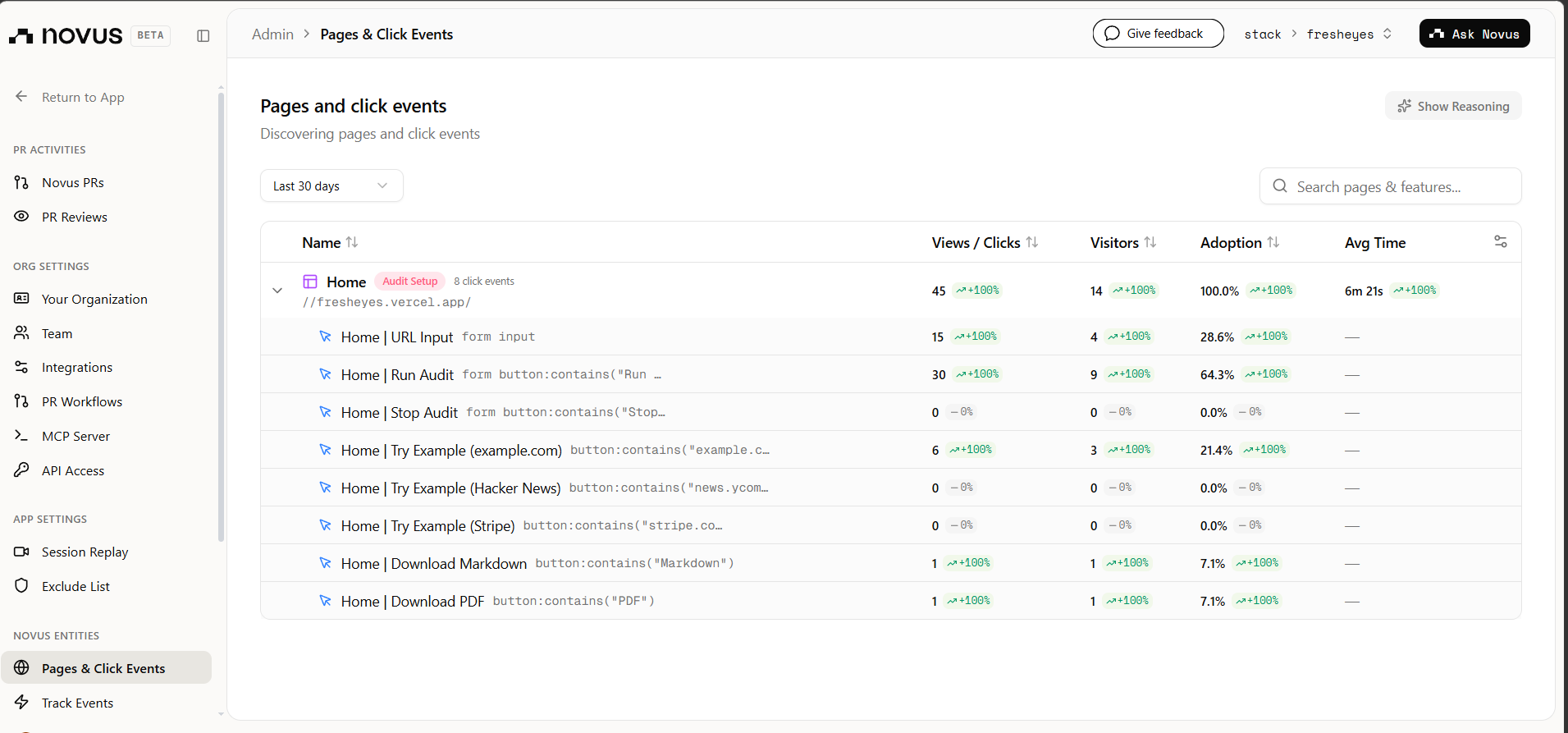
- Analytics — Novus: the app is instrumented with Novus (Pendo's product agent, the hackathon's sponsor tool). Novus connected to the repo, auto-detected pages and click events, and instruments the full audit funnel (
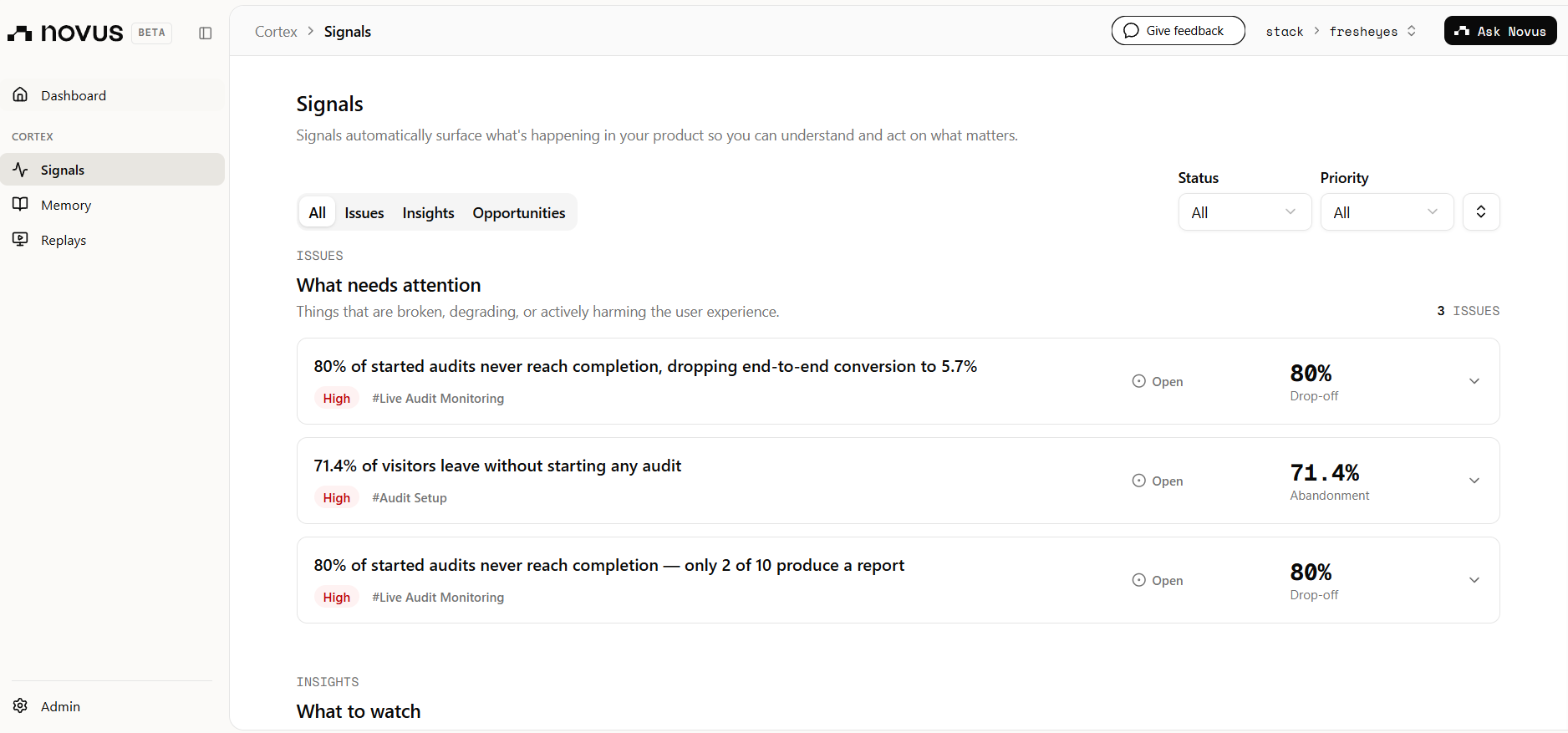
audit_started → audit_completed) plus AI-agent analytics on the audit interaction itself — so real user behavior is measurable the moment the first stranger lands, without hand-writing tracking code. Novus even raised a signal on the gap between audits started and completed — which pointed straight at the session-timeout report-delivery bug I then fixed, so the analytics directly drove a product improvement. Novus dashboard proof: https://github.com/rushibhosalepro/fresheyes/tree/main/novus-proofs
Challenges I ran into
- Driving a real browser reliably. An agent clicking through arbitrary sites fails in a hundred ways — logins, bot-checks, timeouts. The fix was to treat a block as a finding (not a crash), cap the loop, capture the live view immediately so it never looks stuck, and guard the run so a dropped connection can never re-trigger a second audit.
- Surviving the session timeout. A long audit can hit the cloud browser's session cap mid-run. Instead of failing, FreshEyes builds the final report from everything gathered so far and reliably delivers it to the UI even after the live stream drops.
- Making the model behave reliably as an agent. Models can emit malformed tool calls. The loop had to feed every error back as a message the model could read and self-correct from, instead of dead-ending.
- Proportionate judgment. Early versions over-reported — four findings and a "HIGH" on a placeholder page. Moving the calibration logic into
skill.md("figure out the page type first, then audit to that") was the biggest jump in quality. - Streaming an agentic loop to the UI. Surfacing the agent's reasoning, actions, screenshots, and findings as distinct live events — and letting the user truly cancel mid-run — took real iteration.
What I learned
- The rubric is the product. A plain "review this site" prompt produces generic, padded feedback. A calibrated
skill.mdis what turned it into something useful. - A defensive loop matters more than the model. Feeding tool errors back so malformed calls self-correct is what made the agent reliable, and routing through OpenRouter let me swap models with a one-line change.
- Reliability beats cleverness for a demo. Live view, block-as-finding, a real Stop, and a run-once guard are what keep a stranger's URL from ever hitting a blank screen.
- Watching is the magic. Streaming the agent's actions live turned "an AI looked at your site" into "I watched an AI get confused by my site" — far more convincing.
What's next
- Background jobs for long audits — large sites can take anywhere from ~5 minutes to an hour to crawl fully. Move audits onto a durable background job queue with persistent run storage, so a scan keeps running independent of the browser connection and users can close the tab and come back to a finished report.
- Vision by default — pair a vision-capable model with the existing screenshot path so visual-design and imagery findings come from real pixels, not the DOM.
- Multi-page journeys — follow a full funnel (landing → pricing → signup), not just the first screen.
- Before/after re-audits — track a score over time as you ship fixes.
- Persona modes — audit as a "skeptical buyer," a "mobile user on slow data," or an "accessibility-first" visitor.
- Shareable report links — a public URL per audit to hand to your team.
Built With
- browserbase
- bun
- events
- express.js
- jspdf
- next.js
- novus
- openai
- openrouter
- pendo
- react
- react-markdown
- sdk
- server-sent
- stagehand
- tailwind
- vercel

Log in or sign up for Devpost to join the conversation.