Inspiration
Food insecurity and budget anxiety are real problems for many people. We wanted to build something that removes the guesswork from eating well on a tight budget; a tool that doesn't just suggest recipes, but actually tells you where the best deals exist in your area.
What it does
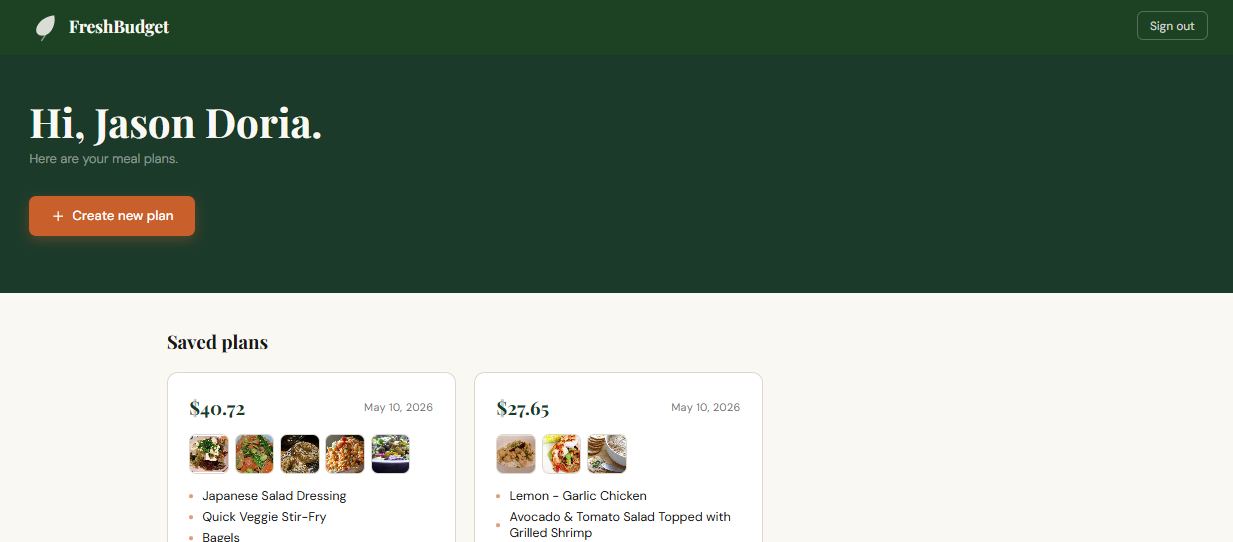
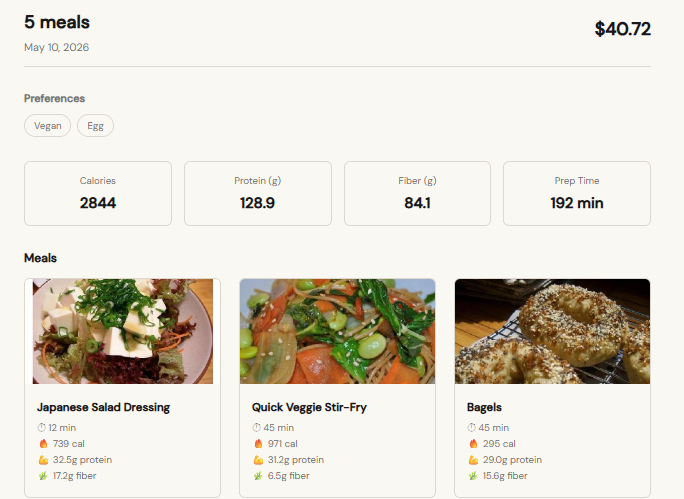
FreshBudget lets you set a budget, max time to prep, dietary preferences, intolerances, and nutrition goals (protein, fiber), then generates personalized meal plans with real ingredient pricing pulled live from the APIs of a variety stores. A Gemini-powered ranking layer lets users further sort their meal plans by querying the AI-model with criteria like "high protein and quick to make," and can save their favorite plans to their account to reference later.
How we built it
- Frontend: React 19 + TypeScript, built with Vite, styled with custom CSS using a design token system
- Backend: Python Flask REST API with Flask-CORS
- Recipe data: Spoonacular API (
complexSearchwith nutrition) with a local file cache to avoid redundant calls - Grocery pricing: Kroger API (OAuth2 client credentials) for live ingredient pricing with in-memory caching; four additional stores (Safeway, Trader Joe's, Whole Foods, Costco) use curated static catalogues
- AI ranking: Google Gemini (
google-genai) to rank and explain meal plan recommendations based on user-defined criteria - Auth: JWT-based signup/login with bcrypt password hashing via Werkzeug
- Database: MongoDB (PyMongo) for persisting user accounts and saved meal plans
- Meal plan optimizer: A combinatorial engine that filters recipes by constraints, prices every ingredient, then scores all valid meal combinations against nutrition goals
Challenges we ran into
- Kroger API unit conversions — matching Spoonacular ingredient amounts (e.g. "2 cloves garlic") to Kroger package sizes (e.g. "3 ct") required building a full unit conversion system across weight, volume, and count units
- Combinatorial explosion — generating all valid meal combinations grows fast; we had to cap the candidate pool and deduplicate combinations to keep response times reasonable
- API quota management — Spoonacular charges points per request, especially with
addRecipeNutrition=True; we built a persistent file cache keyed by filter params to avoid burning quota on repeated queries - Pricing coverage gaps — not every Spoonacular ingredient maps cleanly to a Kroger product; we had to gracefully handle misses without crashing the optimizer
Accomplishments that we're proud of
- A fully working end-to-end pipeline: preferences → real recipe search → live grocery pricing → AI ranking → saved plans
- The Kroger OAuth integration working seamlessly with automatic token refresh
- A clean, polished UI that feels like a real product, not a hackathon prototype
- The combinatorial meal plan optimizer correctly enforcing budget, allergen, and prep time constraints simultaneously
- Learning to generate code with Claude. This helped us focus on ideating and letting Claude brings them to life.
What we learned
- How to integrate multiple third-party APIs (Spoonacular, Kroger, Gemini) in a single coherent data pipeline
- The complexity of unit normalization across culinary and grocery measurement systems
- How to use Gemini for structured ranking with natural language input
- JWT auth and MongoDB used to secure created users and personal meals/plans
What's next for FreshBudget
- User location input to find the nearest grocery store instead of using a hardcoded ZIP code for Kroger
- Live pricing for all stores — replace static catalogues with real APIs for Safeway, Whole Foods, etc.
- Shopping list export — generate a consolidated grocery list from a saved meal plan
- Nutritional tracking — log meals and track daily intake against goals over time
- Mobile app — the use case is inherently mobile (planning at the store, on the go)

Log in or sign up for Devpost to join the conversation.