
Fresh Internet Theory
Track: Siren’s Call
The Dead Internet is here. We built a reality shield.
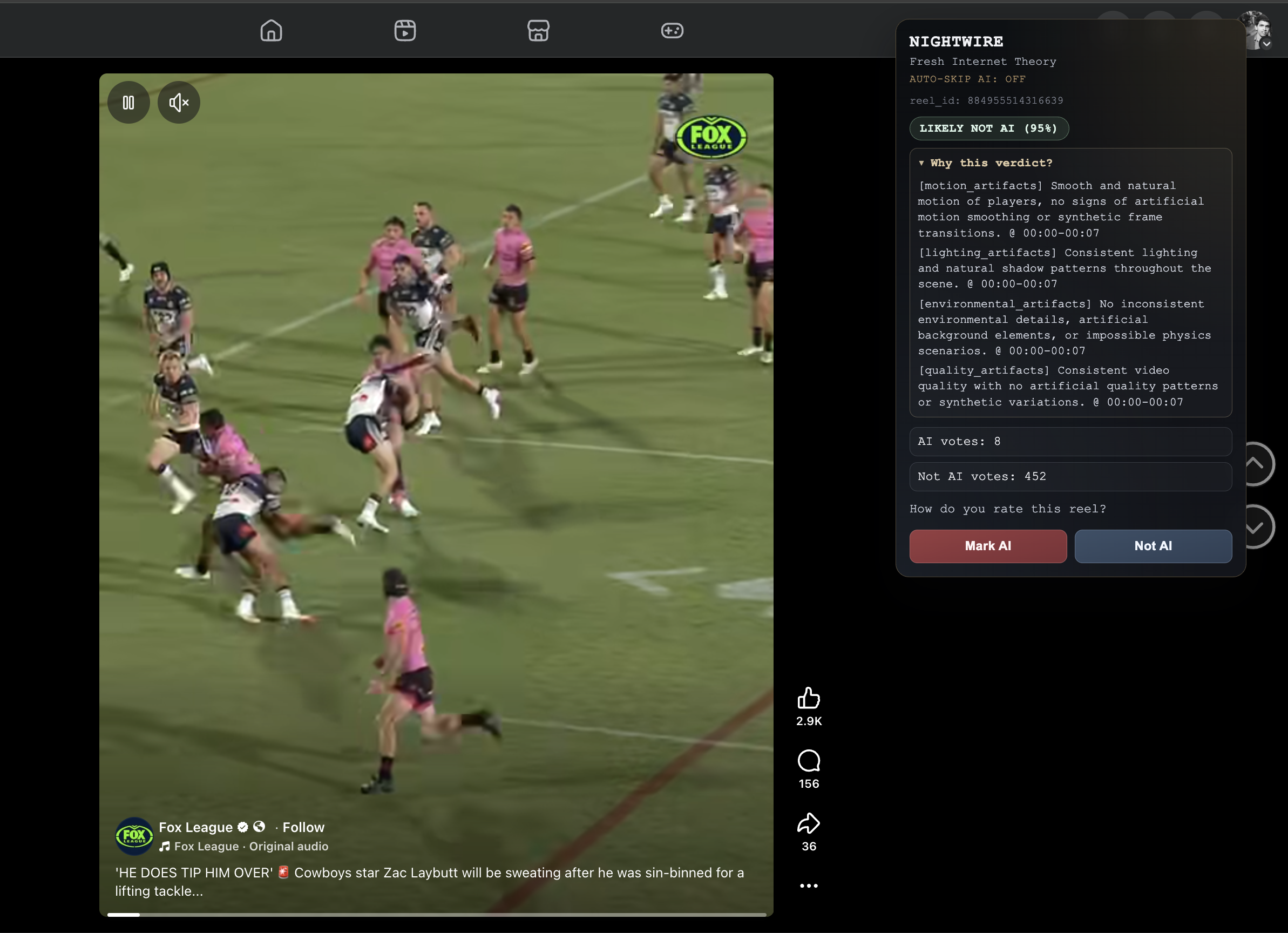
Fresh Internet Theory is a Chrome extension that sits on top of Facebook Reels and helps people decide whether what they’re watching is likely AI-generated or not. We combine two signals:
- Crowd intelligence (real users voting
ai/not_ai) - Twelve Labs video analysis (artifact-level evidence + confidence)
The goal is simple: give people a way to sanity-check viral reels before fear, outrage, or fake scandals spread.
Inspiration
We kept seeing the same pattern: a shocking reel goes viral, people react emotionally, and by the time someone fact-checks it, the damage is already done.
In the Siren’s Call theme, that felt like the core problem: misinformation is no longer just text-based; it is increasingly visual, fast, and emotionally manipulative.
We wanted a tool that works inside the scrolling loop itself, not a separate fact-checking website nobody opens in time.
Problem
People scrolling short-form video often have:
- no time for deep verification,
- no trusted signal in the UI,
- no easy way to contribute to community truth.
This creates real social harm:
- public panic from fake events,
- reputational damage from synthetic scandal videos,
- manipulation through highly believable AI-generated content.
Our solution matters because it inserts trust signals where decisions are actually made: at the reel level, in real time, during consumption.
What it does
We didn't just “run an AI detector.”
We took a different route: federated human + AI consensus, with explainability.
Our approach:
- instant on-platform overlay for every reel,
- user voting loop that continuously improves signal quality,
- forensic-style AI evidence output (not just a binary label),
- a hybrid verdict strategy that can prioritize people when crowd signal is strong.
How we built it

This is fully coded and running end-to-end (localhost only)
Extension (extension/)
content_script.jsinjects an overlay on Facebook Reels.- It fetches current reel state and shows:
- AI / Not-AI vote counts
- verdict badge
- evidence snippets when available
- Users can vote
aiornot_aidirectly in the overlay.
Backend (backend/, FastAPI + Valkey)
The extension uses:
GET /reels/{reel_id}: fetch reel state, votes, and analysisPOST /reels/{reel_id}/vote: save user votePOST /reels/{reel_id}/post: enqueue analysis for unknown reel
Analysis Worker (12labs/)
reel_downloader.py: downloads reel videoupload.py: uploads/indexes video in Twelve Labsworker.py: runs AI analysis, extracts evidence, writes results back to datastore
Verdict Algorithm (Crowd + AI Analysis)
Right now, we persist raw AI analysis for auditability.
For final verdicting, our intended/active policy is a crowd-first, reliability-weighted hybrid:
Let:
- \(v_i \in {0,1}\) be user vote (
1 = ai,0 = not_ai) - \(w_i\) be reliability weight for voter \(i\)
- \(p_a\) be AI probability (
confidence/100)
Human consensus score: $$ p_h = \frac{\sum_i w_i v_i}{\sum_i w_i} $$
Effective human volume: $$ n_{\text{eff}} = \sum_i w_i $$
Consensus margin: $$ m = |p_h - 0.5| $$
Decision: $$ p_f = \begin{cases} p_h, & n_{\text{eff}} \ge N_{\min} \ \wedge\ m \ge \delta \ \alpha(n_{\text{eff}})\,p_a + (1-\alpha(n_{\text{eff}}))\,p_h, & \text{otherwise} \end{cases} $$
with \(\alpha(n_{\text{eff}})=e^{-n_{\text{eff}}/\kappa}\).
Interpretation:
- if there are enough reliable human votes with clear agreement, trust humans;
- if not, rely more on AI;
- as crowd signal grows, AI influence decays.
This is aligned with established crowdsourcing literature: model annotator reliability, avoid blind majority vote, and use additional labels strategically when uncertainty is high.
Result format
The analysis includes:
is_likely_ai_generatedconfidencekey_evidencewith categories/timestamps/rationalesuser_prior_assessment
Current demo status
- End-to-end flow works locally.
- AI analysis matched majority user feedback ~95% of the time in our testing set.
Challenges we ran into
- Balancing weights between user votes and AI confidence.
- Making UX feel real-time while analysis pipelines are asynchronous.
- Handling Twelve Labs API rate limits during bursty workloads.
What we learned
- Detection trust is more about explanations than raw scores.
- Queue-based systems are essential for AI-heavy moderation workloads.
- Crowd signal quality improves dramatically when you model reliability, not just vote count.
What's next for Fresh Internet Theory
This can scale with more engineering:
- queue-based architecture already handles asynchronous processing and API rate limits,
- worker model can be horizontally scaled,
- similarity reuse in the worker can reduce repeated analysis cost for near-duplicate reels,
- datastore schema already keeps votes + analysis + timestamps in one canonical reel record.
Next production steps:
- anti-brigading controls (rate limits, reputation, device/account trust),
- identity-aware worker reliability updates,
- moderation dashboard and abuse monitoring,
- cloud deployment + observability.
Teamwork & Presentation
- Ashwin Kumar: backend APIs, datastore design, schema normalization
- Sidharth Shambu: Twelve Labs worker pipeline, Chrome extension integration
Collaboration setup:
- rapid WhatsApp loops,
- shared TODO lists for task ownership,
- Tailscale for seamless local environment sharing during integration.
Built With
- fastapi
- manifestv3
- python
- streams
- twelvelabs
- valkey


Log in or sign up for Devpost to join the conversation.