-
-
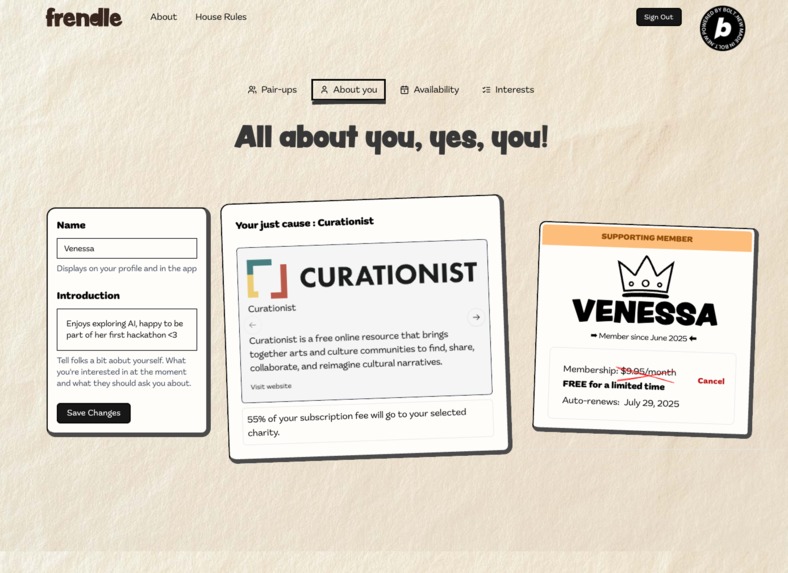
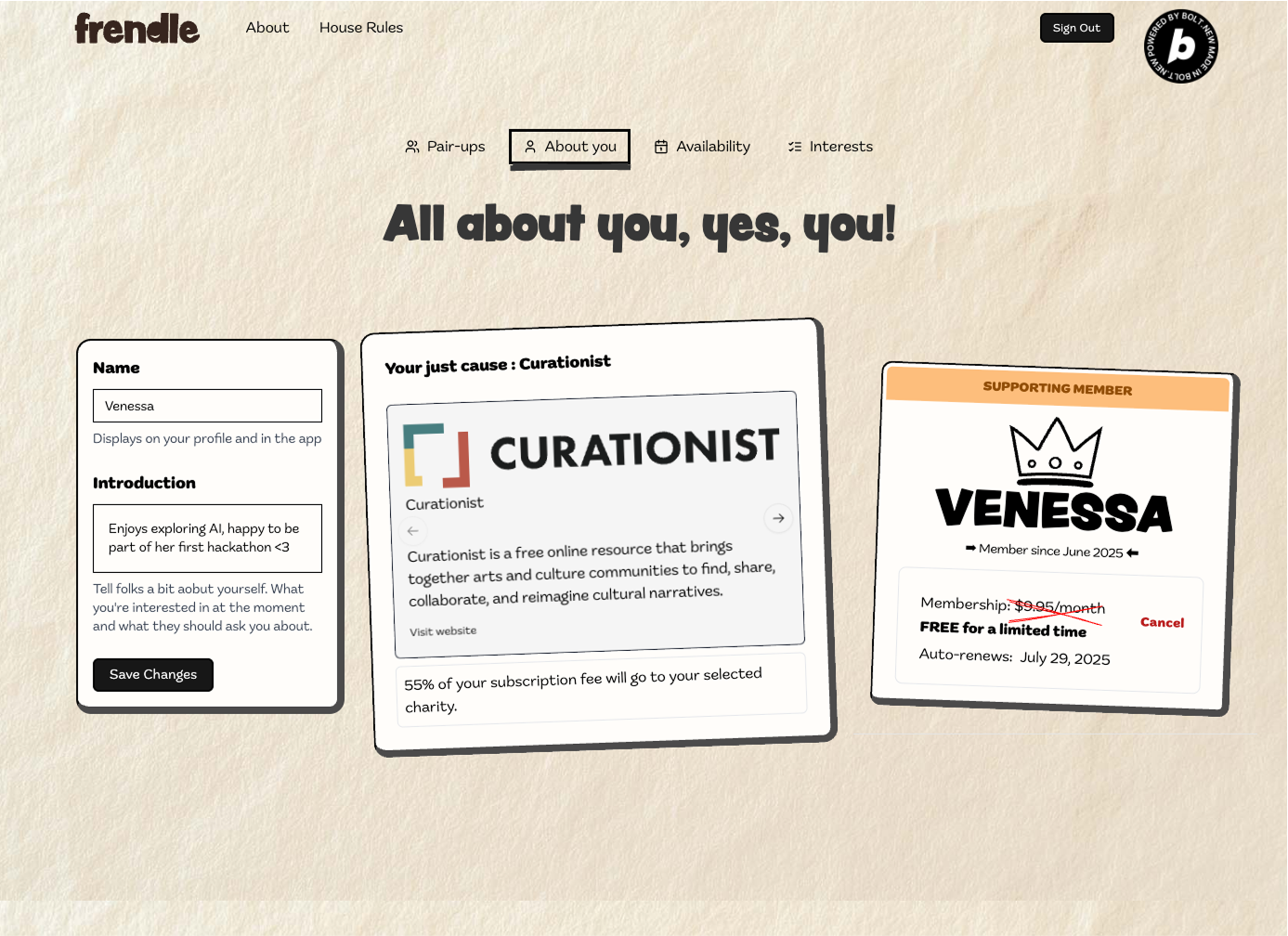
Share about you and pick a charity of choice
-
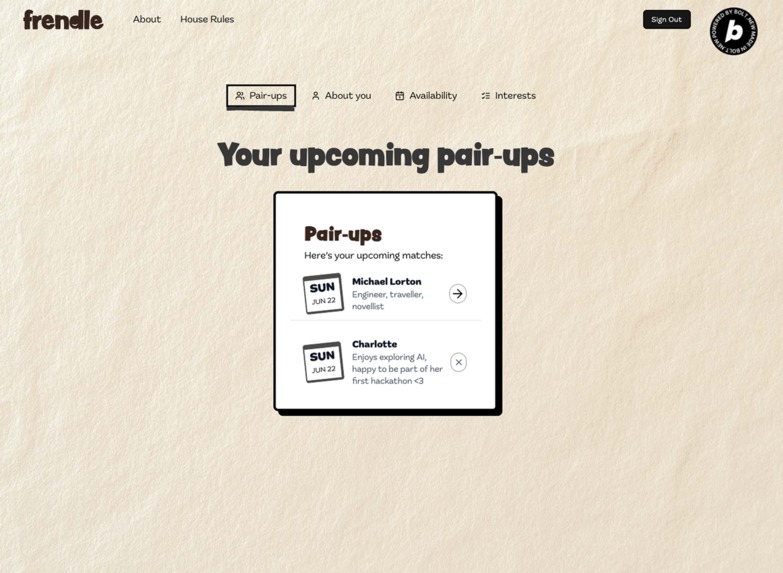
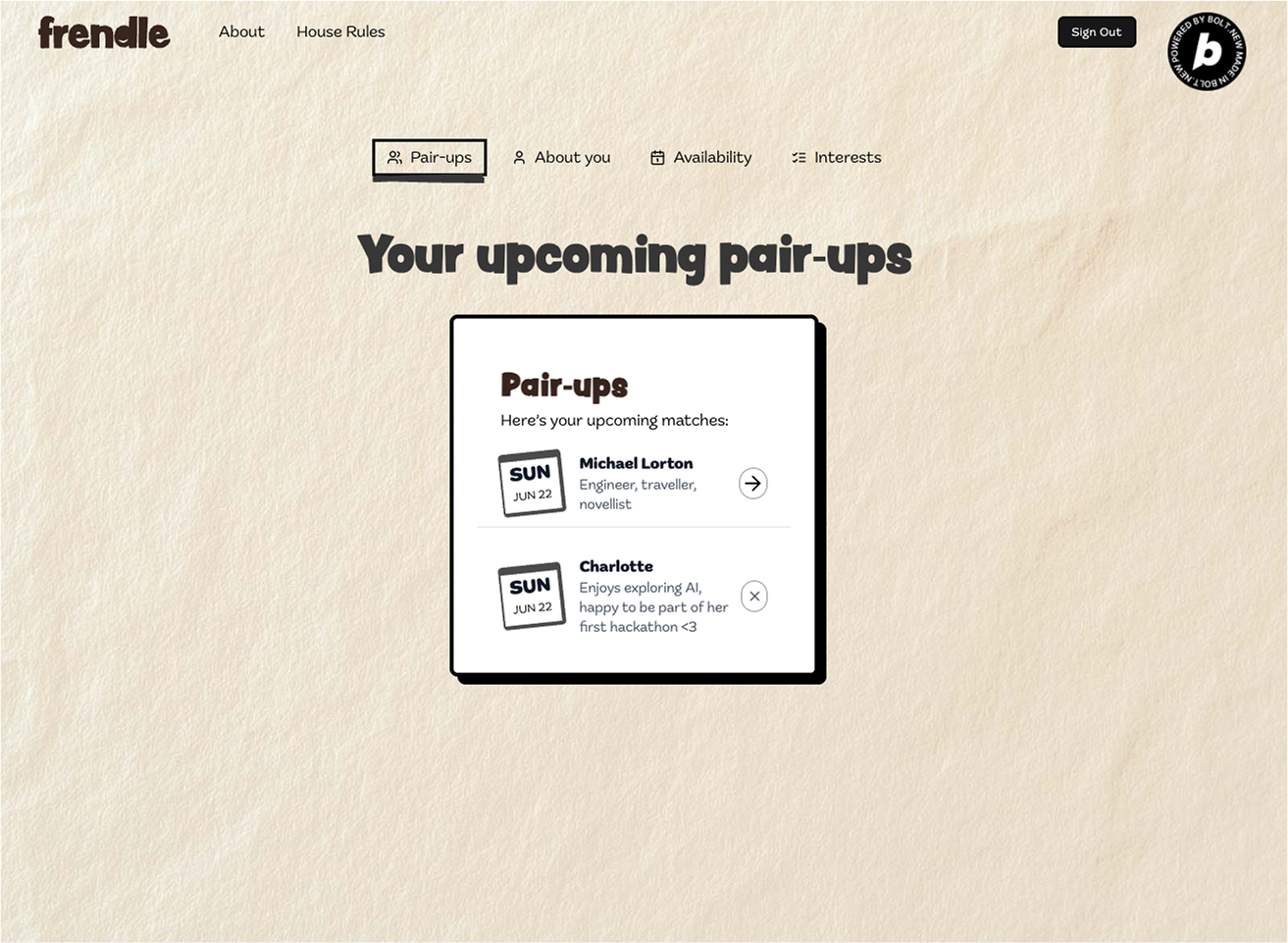
Get automatically paired up for 1:1 video chats
-
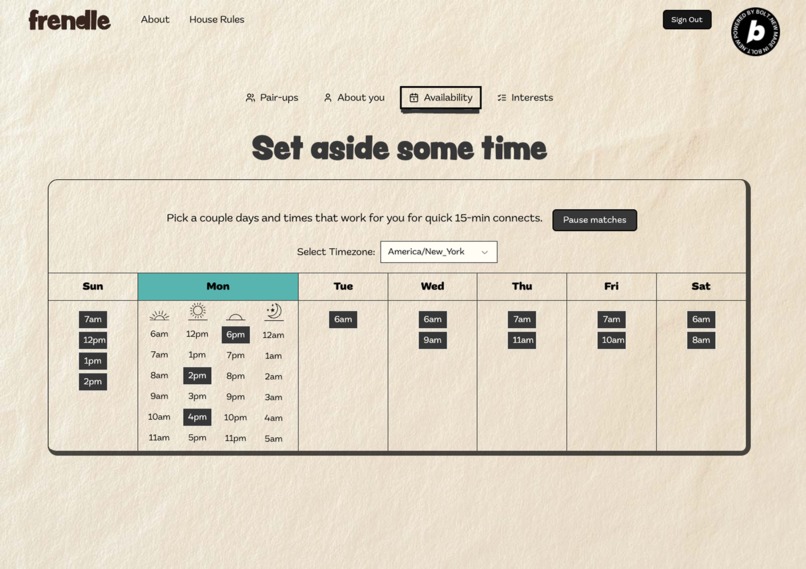
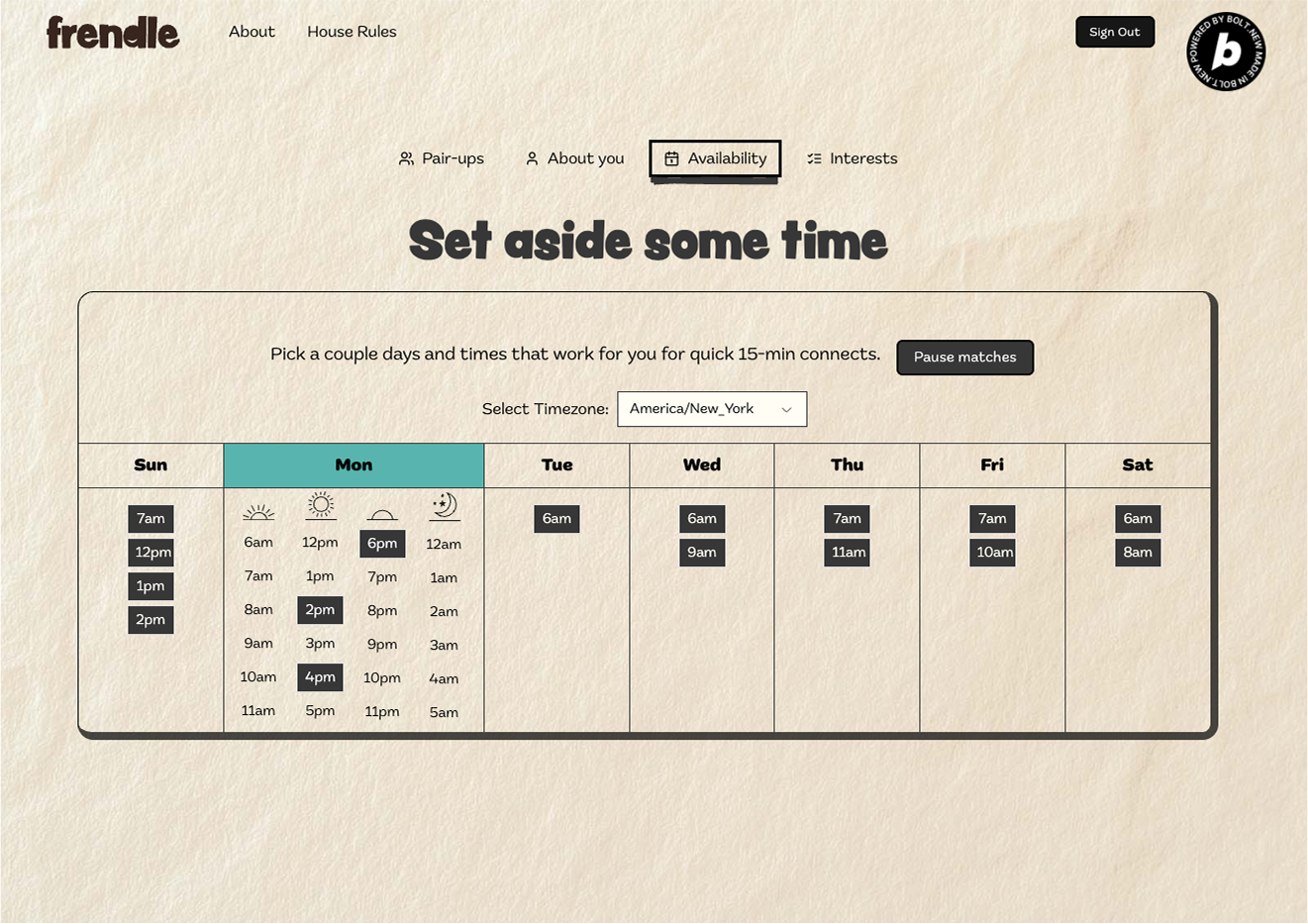
Schedule time for time-boxed chats that work on your schedule
-
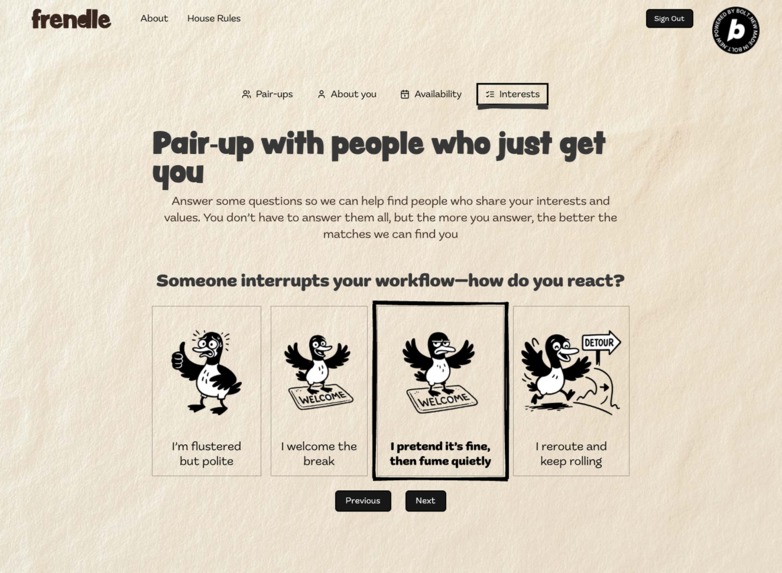
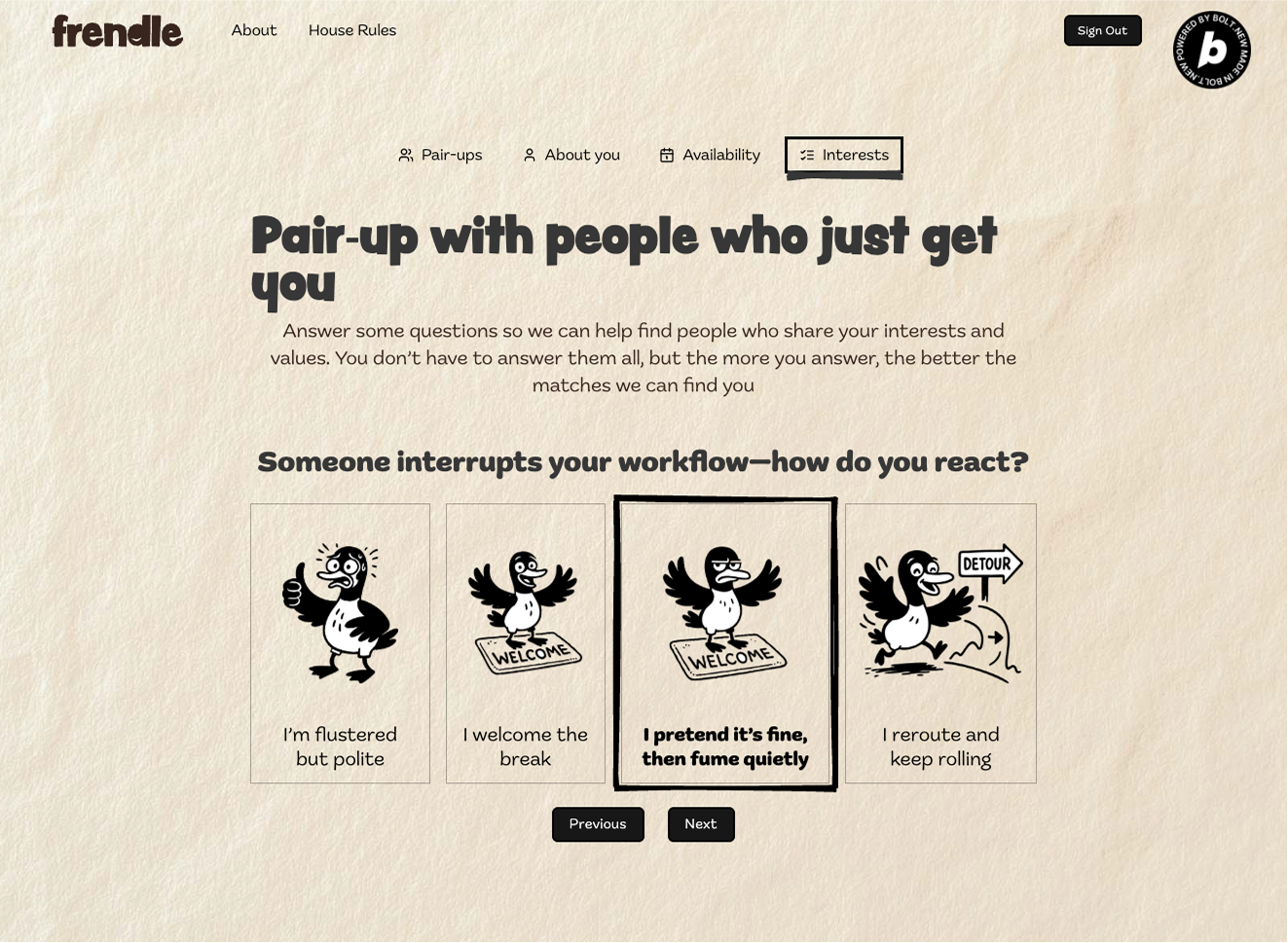
Answer a couple of questions to get paired up with folks who just get you
-
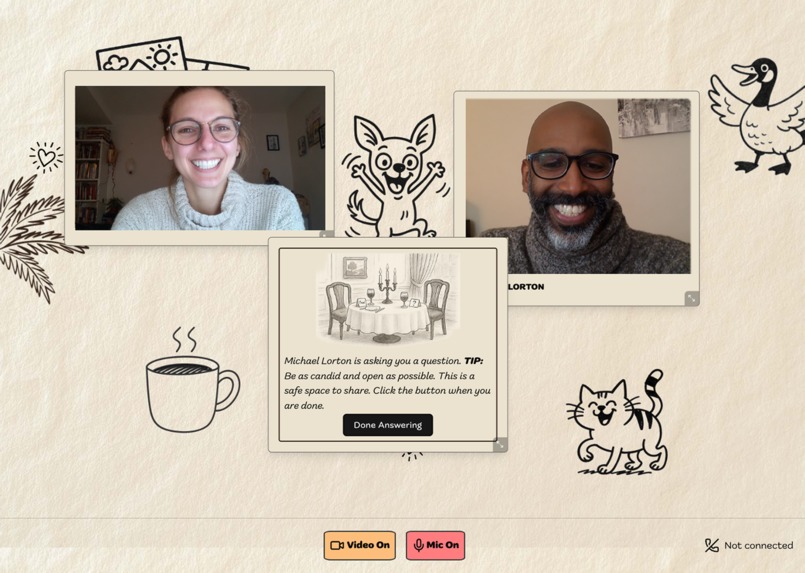
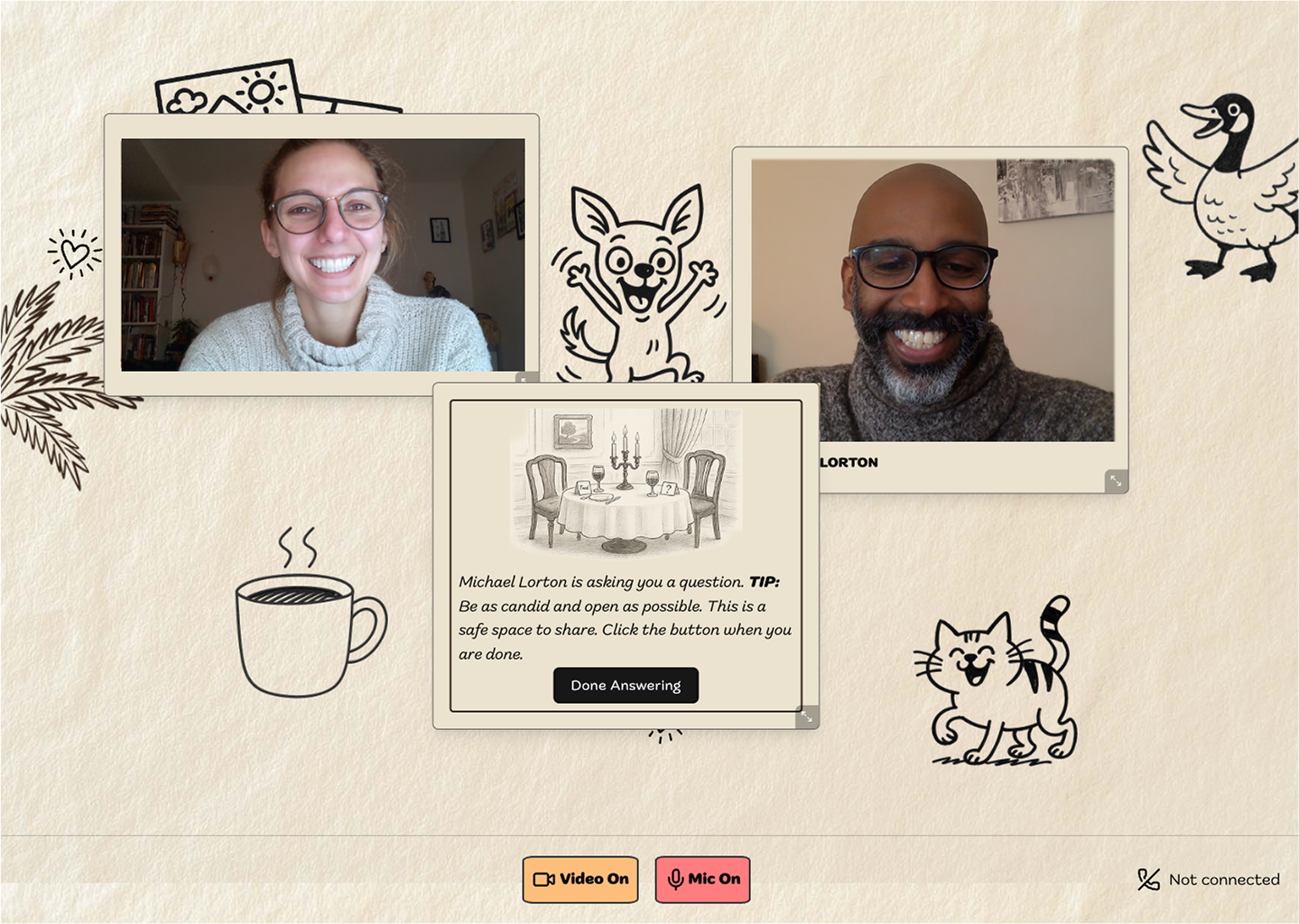
Enjoy time-boxed fun chats with prompts and a shared space designed just for the two of you
-
Frendle logo
Project Story
We came together to build a space for connection
Inspiration
Technology is making us more and more connected. At any hour of the day, we can reach out and communicate with -- or at least “message” with -- anybody: strangers, friends, enemies, celebrities. And yet, more and more individuals feel truly lonely. People, people everywhere -- but nobody to talk to.
We've seen so many attempts to establish "online communities," only to watch them degenerate into digital Lord of the Flies dystopias. The misbehaviors were so varied and creative, they earned evocative names: catfishing, brigading, sock-puppeteering, canceling. It was dismaying.
We asked ourselves: what if we tackled the problem differently? By inviting people to connect one-on-one, based on their personalities, and using AI to gently guide the conversation. We'd provide shared experiences and use prompts from renowned psychologists, all focused on fostering real connection. That's how we decided to create a social app designed for just that.
What it does
Frendle pairs people for 1:1 casual conversations designed to go deeper over time. Studies have shown people feel happier after deeper conversations. Frendle provides a space designed specifically to prompt those deeper connections, and to help them grow over time.
Frendle encourages consistency and ritual by allowing people to set aside regular times for pairings. Having a set time helps with scheduling and fosters regular social contact.
Frendle draws on the Aron et al. (1997) study, which used 36 escalating questions to foster closeness between strangers. As part of our Build-a-Bond series, questions are prompted during chats and become deeper the more often folks are paired together. Frendlers, as we like to call them, can use the prompt or go off script and enjoy a natural conversation. The goal is to remove social awkwardness and ensure we're creating meaningful, engaging exchanges.
How we built it
We started by using Bolt.new to scaffold the project. Venessa took the lead on the UX, using Bolt, Midjourney, and ChatGPT/DALL-E 3 to create the rough, hand-drawn look we envisioned. Michael used Anthropic's Claude to get the backend and more technical pieces working.
We wanted Frendle to feel approachable, casual, and fun -- and we didn't want it to look like it was generated by AI. It was important for us to show how AI can help us be more human, so we aimed for something that felt organic: clean yet imperfect. To get the look and feel right, we used Figma and Adobe Creative Cloud, and supercharged our design by creating a custom ChatGPT to generate on-brand doodles. We used the RoughNotation library to provide that same doodle feel in the UI and tied it all together with Screen Studio and Adobe After Effects for the showcase video.
Challenges we ran into
Getting the video chat working was far more difficult than expected. We originally planned to use Supabase's Postgres as a signaling mechanism, but couldn't get it working reliably. Eventually, we switched to WebSockets, which worked almost instantly. In retrospect, we should have used Supabase Realtime -- and we still might. Once signaling was up, we made the mistake of relying on STUN servers for NAT traversal. We had been warned that TURN servers were more reliable, but didn't realize how stark the difference was until we couldn't get video chat working outside a single local network. Again, switching to TURN servers solved the problem instantly.
Together, these issues ate up more than a week of our month-long build. And of course, we had to navigate the strengths and weaknesses of AI-aided development. Michael had been using AI tools for over two years and considered himself well-seasoned, but full-on vibe coding turned out to be a different skill altogether.
Another major challenge was balancing our passion project with life. Juggling summer family events, jobs, client work, and moving Frendle forward was no small feat. It's still amazing how much we managed to build in such a short time.
Accomplishments we're proud of
We're extremely proud of the whole experience. In just 28 days, we came together and built something that didn't exist before. We not only got to work with new tools like Bolt but also revisited old skills and explored new ones. Frendle's mission is deeply personal to both of us, and whatever happens next, we hope to keep nurturing it.
In particular, the UI is... well, let's call it original. We aimed for something that looked truly hand-made: roughly drawn UI elements, cheerful and simple illustrations. The idea was to create a homey, welcoming space, the opposite of the cold, hyper-polished look of most social platforms. We think we nailed the aesthetic, but of course, whether it lands the way we hope remains to be seen.
What we learned
AI is incredible: we simply couldn't have built a working product without it, not without 10x the time. But humans are incredible too. We leaned into our core skills and lived experiences, building on each other's ideas to make something truly heartfelt and immersive.
What's next for Frendle
Loneliness decreases when people collaborate toward shared goals. (See: Hawkley & Cacioppo, 2010 -- on group volunteering and co-op gaming reducing loneliness.) So our next focus is introducing light-hearted co-op games and shared-experience videos that Frendlers can enjoy together to continue building bonds.
If Frendle grows, we'll also focus on moderation. Trust and conflict repair are essential to a healthy environment. We plan to bring in moderators and introduce a "repair ritual" to ensure safety and restoration when things go wrong.
But first -- we wait to see how the world reacts to Frendle: a space for 1:1 conversations with strangers that might, just maybe, turn into friends.
Built With
- react
- stripe
- supabase
- tailwind
- typescript


Log in or sign up for Devpost to join the conversation.