Inspiration
Global trade moves trillions of dollars of goods annually, yet freight quote generation remains heavily reliant on fragmented spreadsheets, opaque carrier tariffs, and slow manual cross-checks. A single cross-border quotation can take anywhere from 4 to 48 hours as logistics teams manually calculate chargeable weights, assess customs tariffs across thousands of HS codes, verify geopolitical and weather risks, and negotiate carrier spot rates.
We asked ourselves: What if a customer or freight forwarder could receive an auditable, fully compliant, and dynamic market quotation in under 20 seconds?
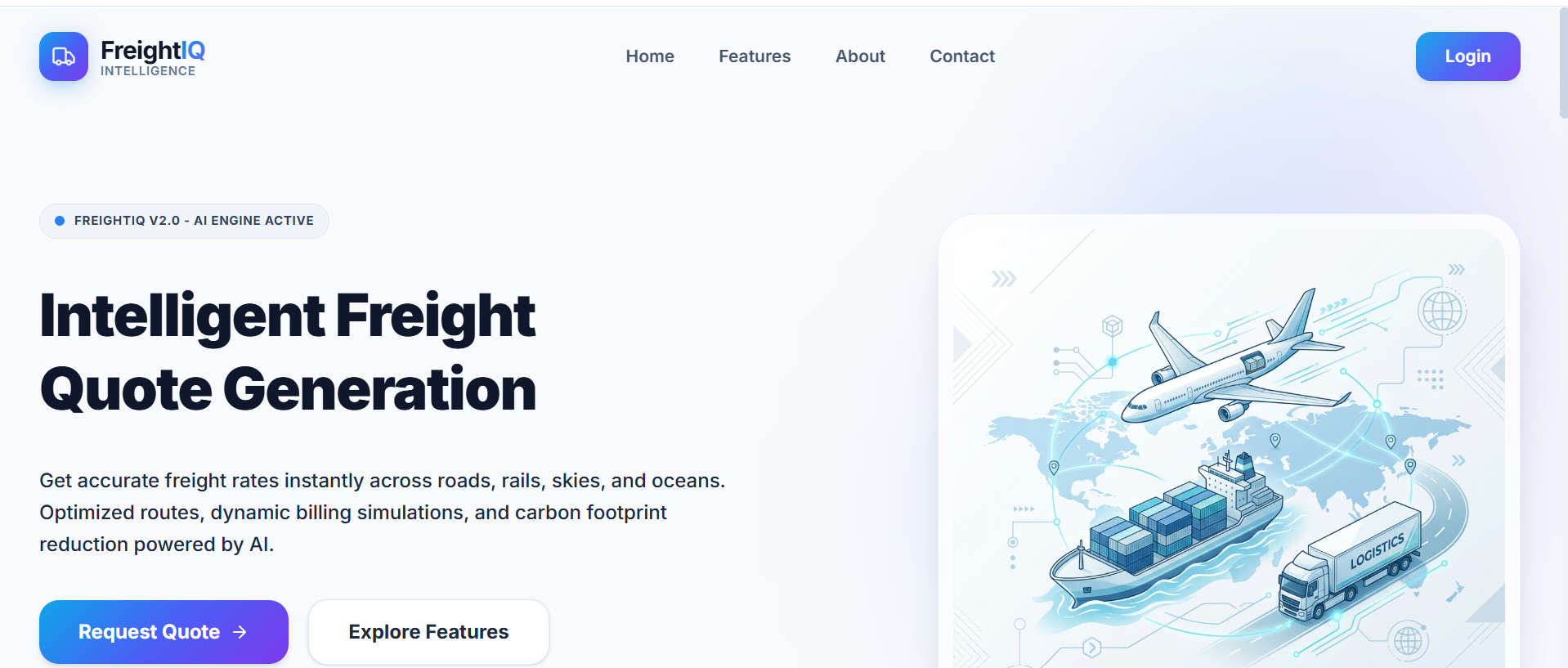
This inspired us to build FreightIQ (Cargo Genius)—an end-to-end autonomous multi-agent platform that streamlines freight forwarding across Ocean, Air, Road, and Rail corridors into a seamless, intelligent workflow.
How We Built It
FreightIQ is built on a modern decoupled architecture featuring an event-driven React + Vite single-page application and a robust Django REST framework backend orchestrator coordinating 5 specialized autonomous agents.
1. The Autonomous 5-Agent Multi-Verification Pipeline
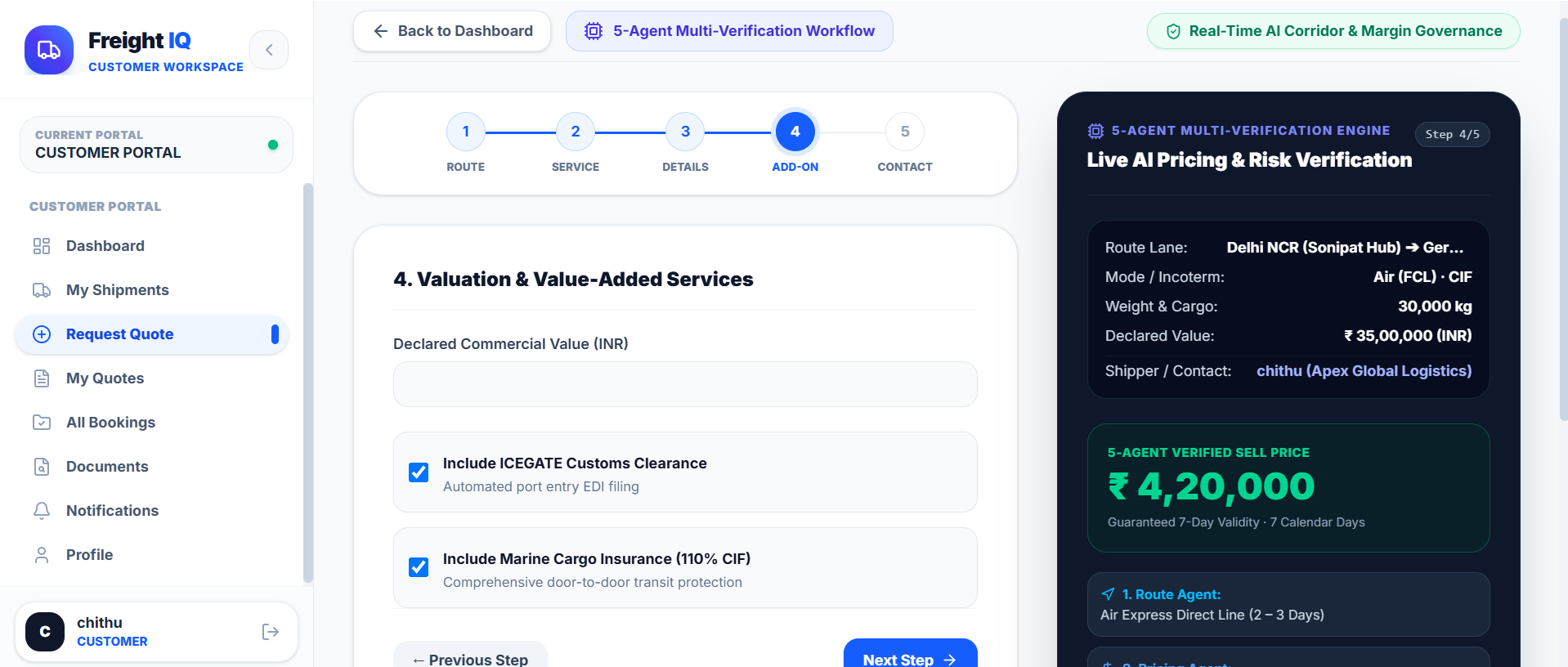
When an enquiry is submitted, our centralized Quote Orchestrator coordinates five parallel specialized agents through an auditable state machine:
- Routing & Corridor Agent: Resolves multimodal waypoints across ocean ports, air cargo terminals, road hubs, and inland container depots (ICDs).
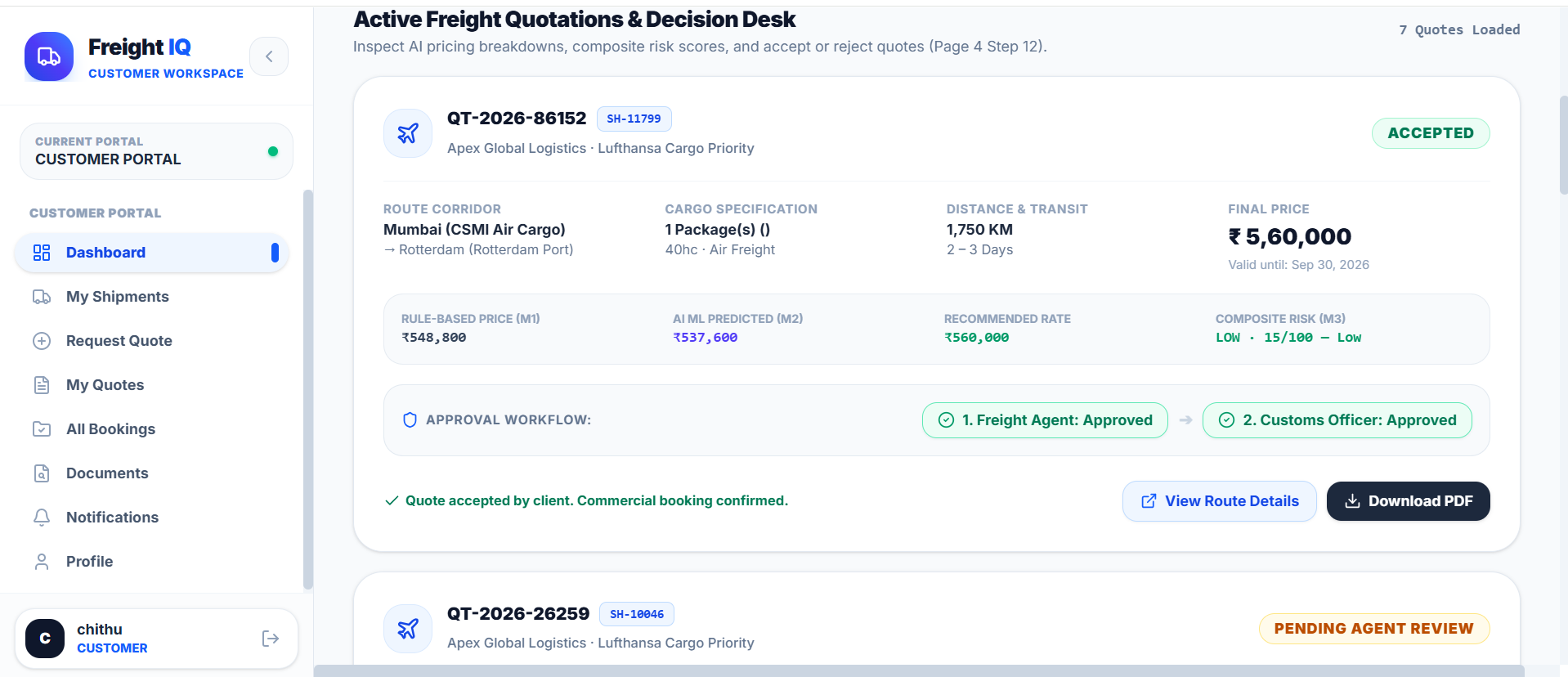
- ML Dynamic Pricing Agent: Employs gradient-boosted decision trees trained on historical spot contracts to predict market-clearing rates alongside deterministic cost-plus policies: $$\text{Quotation Price} = \text{Base Rate} \times (1 + \alpha_{\text{fuel}} + \beta_{\text{congest}}) + \text{Handling Fees} + \text{Margin}$$
- Weather & Delay Assessment Agent: Evaluates real-time oceanic radar, typhoon tracks, and monsoon indices along the voyage corridor to predict delay probabilities.
- Customs Compliance & RAG Agent: Matches 6-digit Harmonized System (HS) codes against international regulatory databases using vector embeddings to automatically generate mandatory document checklists (e.g., Phytosanitary certificates, HazMat declarations, Bill of Lading).
- Composite Risk & Insurance Engine: Computes a transparent $0 - 100$ shipment risk index derived as a weighted summation across operational dimensions: $$\text{Risk}{\text{composite}} = \sum{i=1}^{n} w_i \cdot R_i \quad \text{where} \quad \sum_{i=1}^{n} w_i = 1.0$$
2. Role-Based Collaborative Workspaces
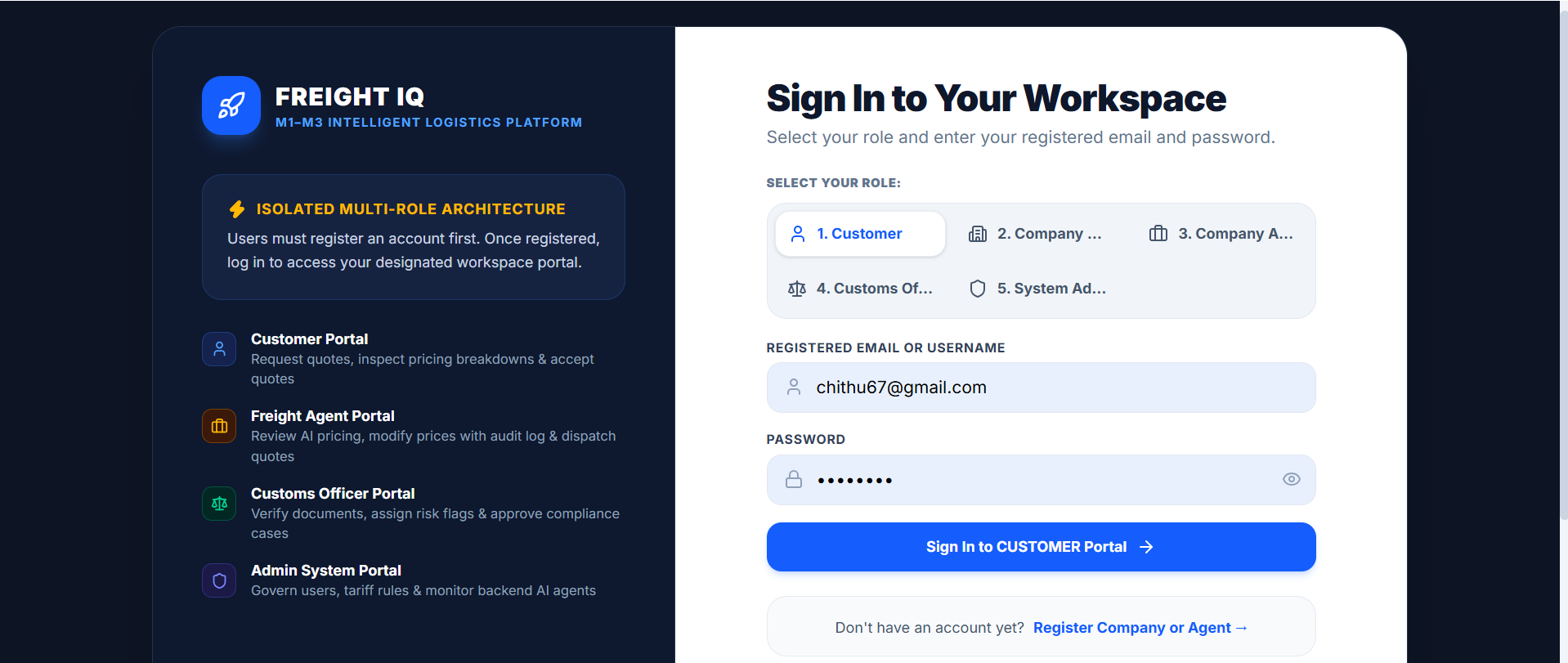
FreightIQ provides dedicated, tailored portals for every stakeholder in the logistics lifecycle:
- Customer Portal: Step-by-step 4-mode enquiry wizard with interactive weight calculations and 20-second instant quote generation.
- Freight & Company Agent Portal: Multi-tab operations desk for reviewing incoming requests, verifying risk scores, and generating downloadable PDF quotations.
- Company Manager Portal: High-level ledger for margin policies, approval rules, and freight team productivity tracking.
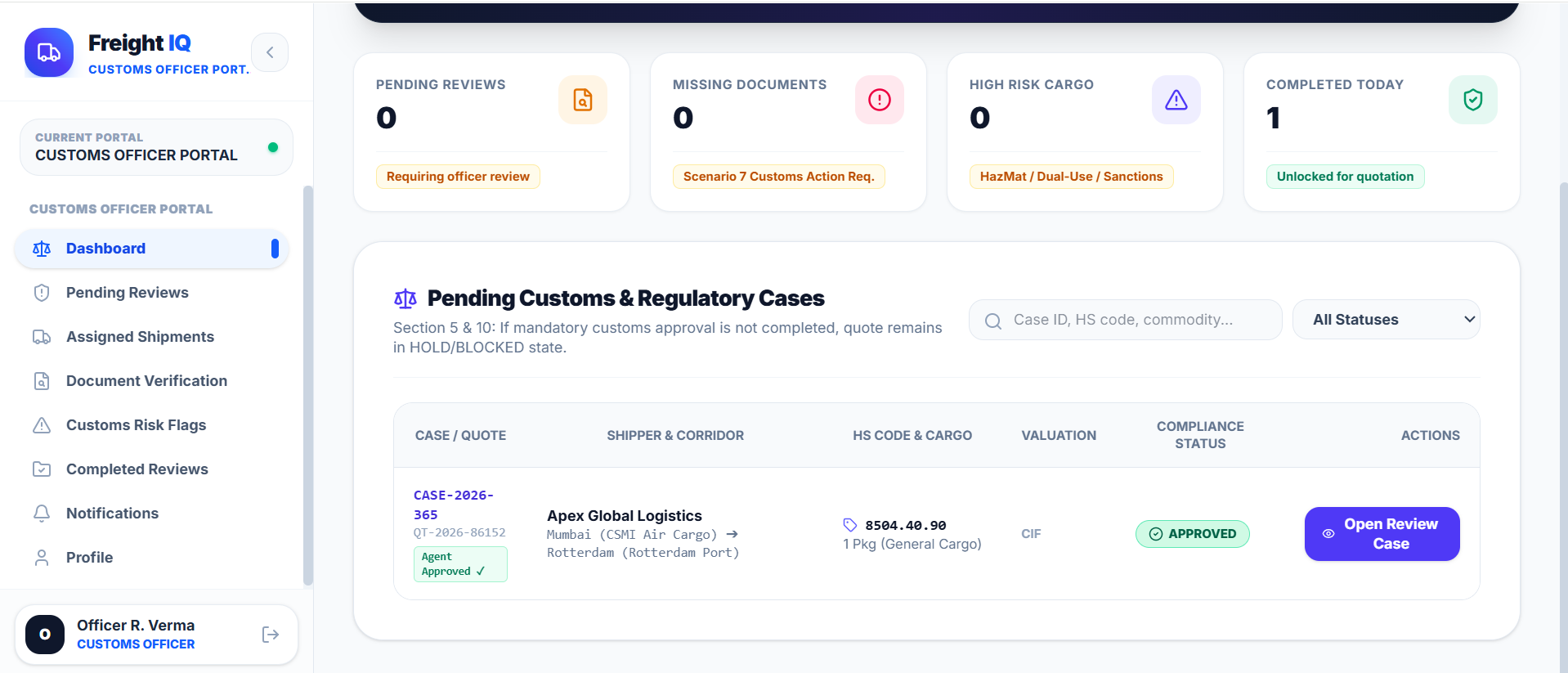
- Customs Officer Portal: Document inspection queue and regulatory alert clearance dashboard.
- Admin Hub: Master data management for routes, carriers, surcharge policies, and audit trails.
Challenges We Faced
- Precision in Pricing & Rounding: Standard floating-point arithmetic can introduce hazardous rounding drift when calculating multimillion-dollar container shipments across multiple currencies. We engineered dedicated Decimal-safe money abstractions and strict ISO-4217 currency conversions.
- Harmonizing Multimodal Transport Locations: Structuring unified origin/destination dropdowns across 4 completely different transportation modalities (Airports, Ocean Ports, Road Freight Centers, and Rail Terminals) required designing a compact, ergonomic selection architecture to prevent UI overflow while maintaining clear modality identification.
- Low-Latency Agent Orchestration: Executing parallel API evaluations across routing algorithms, ML pricing models, and compliance checks simultaneously without blocking the user interface required optimizing our orchestrator to complete the full 5-agent verification loop in under 20 seconds.
What We Learned
- Micro-frontend Ergonomics: How to craft interactive, stateful dashboards that preserve clean empty states and progressively reveal complex financial calculations only when valid cargo inputs are provided.
- Explainable AI in Enterprise Logistics: Pricing algorithms cannot be black boxes. Logistics managers need full transparency into why a surcharge was applied, requiring us to pair ML spot predictions with deterministic rule comparisons.
- State Machine Reliability: Designing atomic transitions ensuring no quotation can be issued without prior compliance sign-offs, risk assessment, and managerial margin approvals.
What's Next for FreightIQ
- IoT Telemetry & Satellite GPS Integration: Live tracking container sensors for temperature-controlled reefer cargo and real-time ETA recalculations.
- Smart Contract Automated Invoicing: Integration with blockchain-based digital Bills of Lading for instantaneous milestone escrow release upon cargo delivery.
- Autonomous Carrier Bidding Engine: Enabling reverse carrier spot auctions where approved carriers can automatically bid on pending container bookings.
Built With
- css3
- data-visualization
- django
- django-rest-framework
- git
- github
- html5
- javascript
- jwt
- lightgbm
- logistic-regression
- lucide-react
- machine-learning
- mongodb
- multimodal-transport
- python
- rag
- react
- rest-api
- scikit-learn
- sqlite
- supply-chain
- tailwind-css
- vector-database
- vite

Log in or sign up for Devpost to join the conversation.