-
-
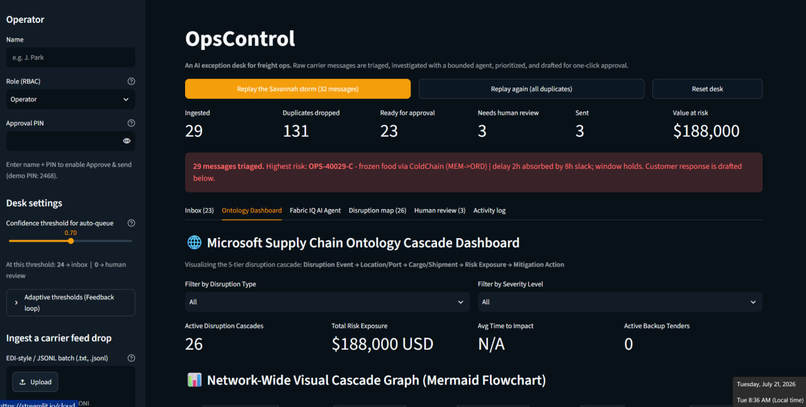
OpsControl_V2
-
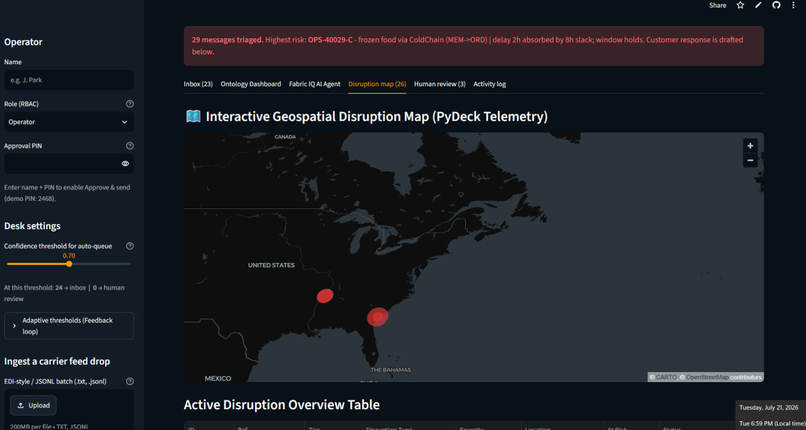
OpsControl_V3
-
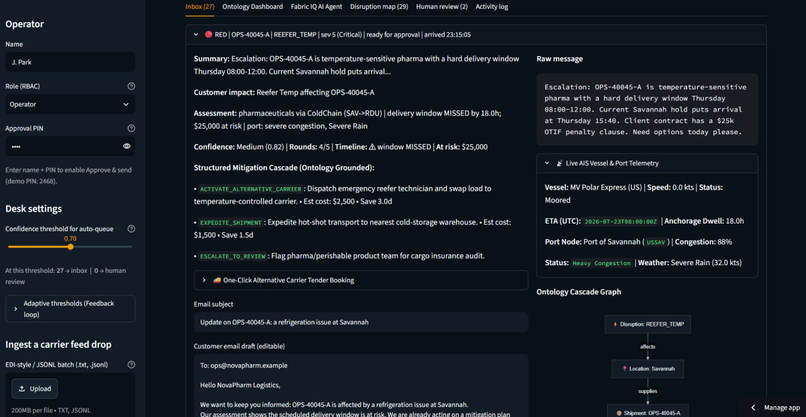
Ops_ontology
-
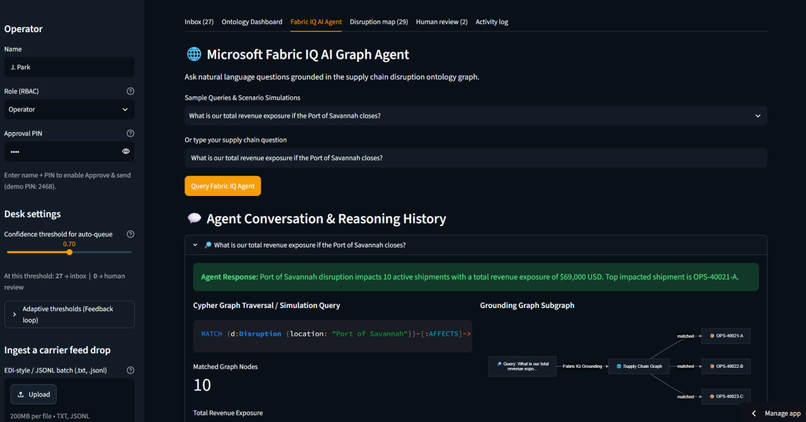
Ops_map

Inspiration
On July 16, I published a case study on asynchronous multi-agent exception management for logistics, an architecture where a delayed container triggers an agent that investigates and drafts mitigations without blocking the ingest path. It was a reference design with simulated data. Build Week was the push to answer the obvious next question: could that architecture become a product a real freight broker would open every morning? Freight operations rarely fail because a team lacks data. They fail because a small team has too much of it at the worst possible moment. One storm can create dozens of carrier updates: terse EDI notices, broker emails, SMS alarms, and duplicate feed deliveries. Each message demands the same urgent questions: Which shipment is this? What is the customer impact? Does it need a response now? OpsControl makes that first pass fast, visible, and reviewable.
What it does
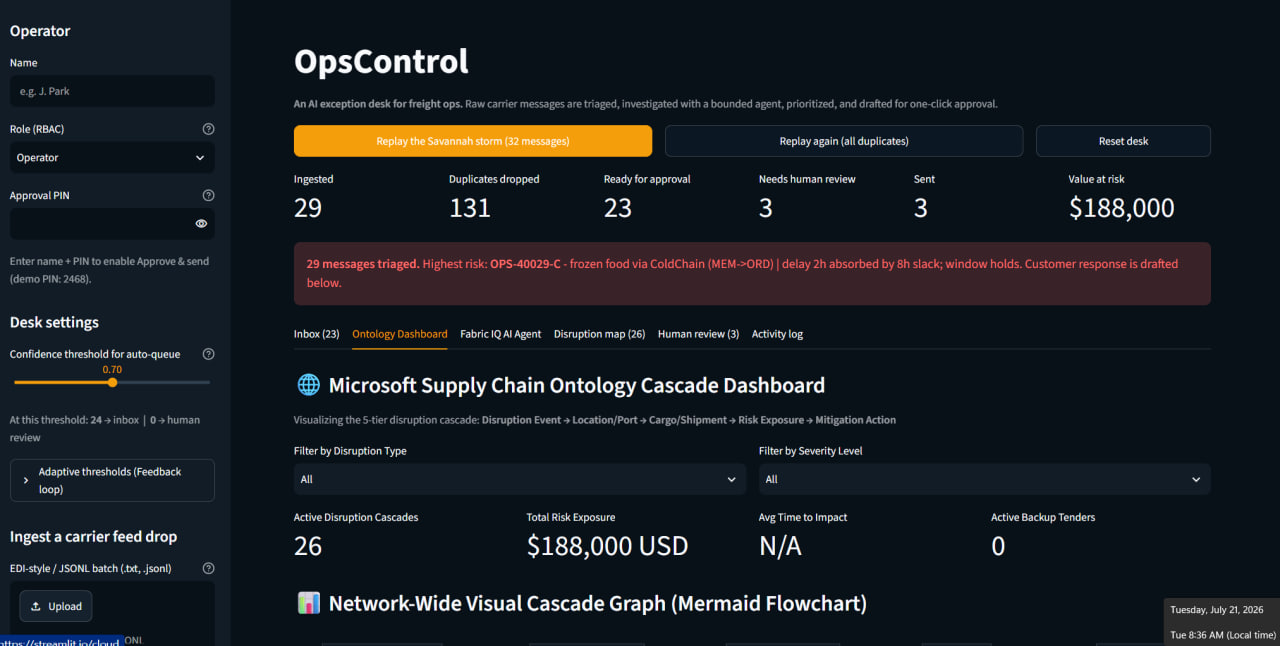
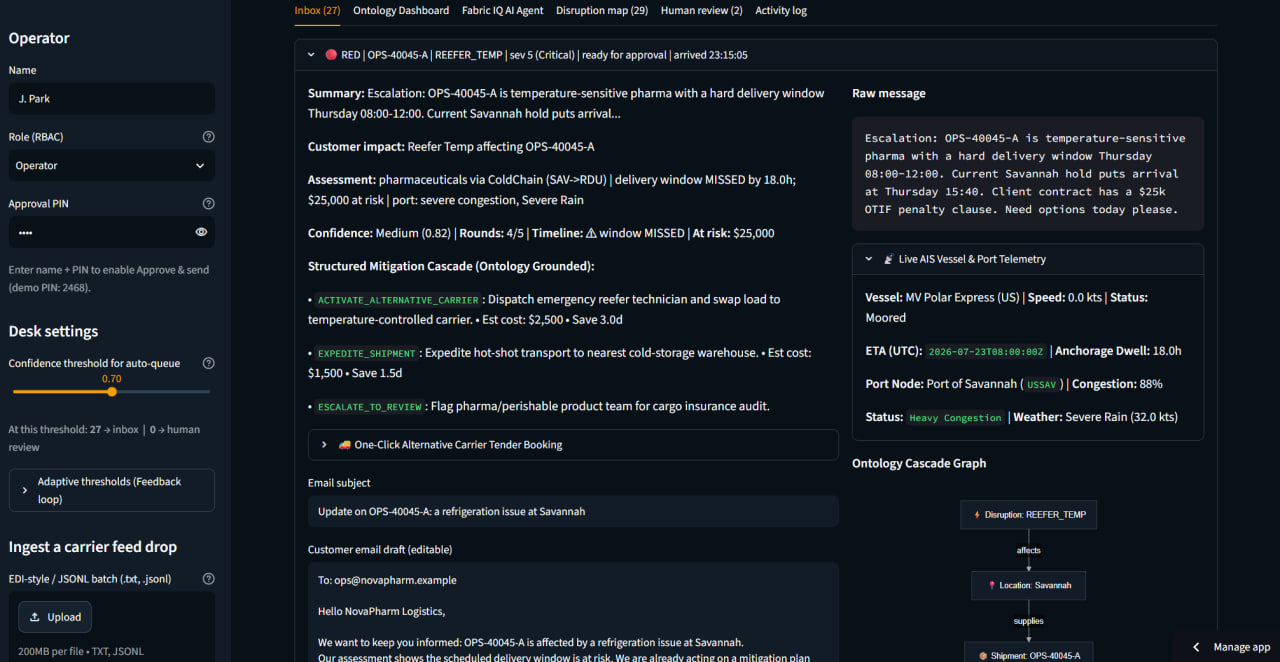
OpsControl is an AI exception desk. Raw carrier messages — terse EDI feeds, rambling emails, driver texts — go in. GPT-5.6 turns each into a structured exception (type, severity, shipment, location) via structured outputs. A tool-calling investigation agent, hard-capped at five steps, works out the blast radius: the new ETA, whether the delivery window breaks, the dollar value at risk. It then drafts the customer email and an internal action plan. High-confidence results wait in an inbox for one-click approval; low-confidence ones route to a human review queue. Duplicate feed deliveries are suppressed by idempotency keys, and a malformed message lands safely in review instead of crashing anything.
How we built it
The build ran from a written PRD with six milestones, executed in Codex with GPT-5.6: FastAPI + SQLite core with structured-output triage, then the bounded investigation agent with function tools (shipment lookup, ETA impact, port conditions), then the confidence-routed mitigation composer, then the inbox UI, then a seed-replay harness and pytest suite.
At runtime GPT-5.6 does three jobs: triage parsing, agent reasoning over tools, and comms drafting. The demo replays 32 realistic seed messages — including three exact duplicates, one garbage feed message, and a coherent Savannah storm cluster with a $25k-penalty pharma escalation.
Challenges we ran into
The interesting problem was not producing a draft. It was deciding when not to trust one. Freight messages can be incomplete, duplicated, or corrupted, so the workflow needed to make uncertainty operationally useful rather than hide it. That led to four core design constraints: suppress repeat signals via SHA-256 hash deduplication, cap investigation work at 5 tool rounds, route low-confidence or unclassified cases to a dedicated human-review queue, and enforce operator authentication (Name + PIN 2468 & RBAC permissions) before external delivery.
We also treated demo reliability as a product requirement. A judge should be able to refresh the page, replay the 32-message scenario, and see the exact same decision flow, live AIS vessel telemetry, and ontology cascade graphs without relying on an external network call or a lucky model response.
Accomplishments that we're proud of
OpsControl turns a flood of carrier updates into a prioritized freight exception queue, customer-ready drafts, and a focused human-review list.
Guardrails as product features, not afterthoughts: Idempotent ingestion, bounded agent loops, PIN-gated approval, and confidence-based escalation are all visible in the UI — the duplicates-dropped counter, adaptive threshold expander, and human-review queue are part of the demo, not buried in server logs.
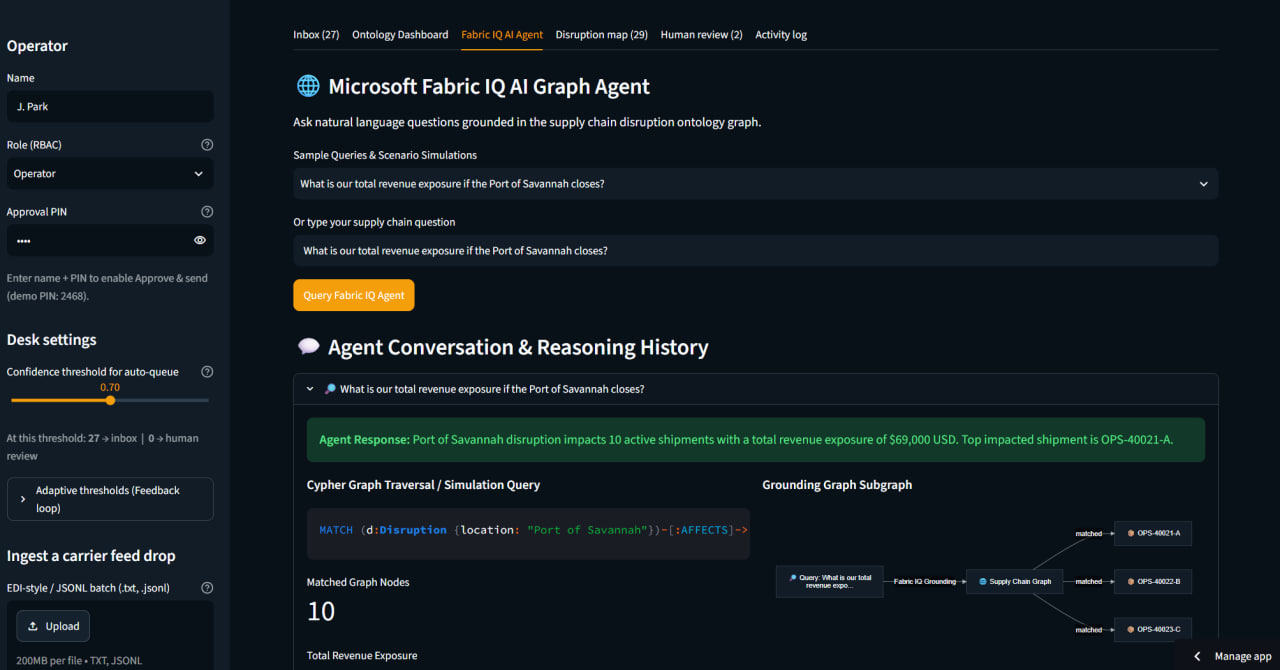
Supply Chain Disruption Ontology Integration: Transforming isolated carrier alerts into structured 5-tier disruption cascades (Disruption → Location → Cargo → Risk USD → Action), paired with an interactive Fabric IQ AI Graph Agent that answers natural language supply chain questions with Cypher queries and subgraphs.
Actionable Operational Remediation: One-click alternative carrier tender booking (ColdExpress, ApexLogistics) issuing confirmed booking IDs (BK-2026-XXXX), live AIS vessel tracking telemetry, and SOC2 WORM compliant audit log exports.
Updated: - Interactive PyDeck Geospatial Disruption Map replacing the flat table in Tab 4 (Disruption map) with 3D color-coded risk markers and interactive hover tooltips.
-Backup Carrier Financial ROI Callout in the One-Click Tender Booking expander (OTIF Penalty Saved, Backup Tender Cost, Net ROI %).
-Fabric IQ Interactive Chat History & Scenario Simulation in Tab 3.
-Cryptographic SHA-256 Hash Chain Verification Badge in Tab 6 (Activity log).
What we learned
For operational AI, trust is earned at the boundaries. The useful product is not a system that always acts autonomously; it is a system that makes routine work easy and makes uncertainty unmistakable. By decoupling multi-channel ingestion, agent investigation, customer preference styling, and operator approval, OpsControl ensures that human operators retain explicit control over external communications while AI absorbs the chaos of carrier data floods.
What's next for OpsControl
OpsControl has successfully implemented its core extension points: feed drop batch ingestion (.txt/.jsonl), PIN-gated approval (2468), SMTP delivery adapters, customer-specific communication profiles (NovaPharm, Atlanta Retail), adaptive feedback loops for auto-queue threshold tuning, and a Microsoft Supply Chain Disruption Ontology layer that transforms isolated carrier alerts into visual 5-tier disruption graphs.
Our next production evolution includes:
- Enterprise TMS & Satellite AIS Integration: Direct EDI 214/315 webhooks, monitored inboxes, and live satellite AIS tracking APIs (MarineTraffic / Spire) replacing simulated telemetry.
- Microsoft Fabric IQ & Graph Database Grounding: Transitioning our in-memory Fabric IQ agent into enterprise Microsoft Fabric IQ and Neo4j graph databases for real-time natural language risk queries across global multi-tenant supply networks.
- Automated API Spot Tender Execution: Connecting our one-click alternative carrier booking engine directly to real-time spot rate APIs (Project44 / FourKites) for instant automated capacity tendering.
- Continuous RLHF Model Fine-Tuning: Leveraging operator feedback datasets to continuously fine-tune local triage and confidence scoring models, further reducing false escalations.
- SSO & SOC2 WORM Compliance: Enterprise Single Sign-On (Entra ID / Okta SSO) and S3 Object Lock immutable compliance storage for enterprise audit trails.


Log in or sign up for Devpost to join the conversation.