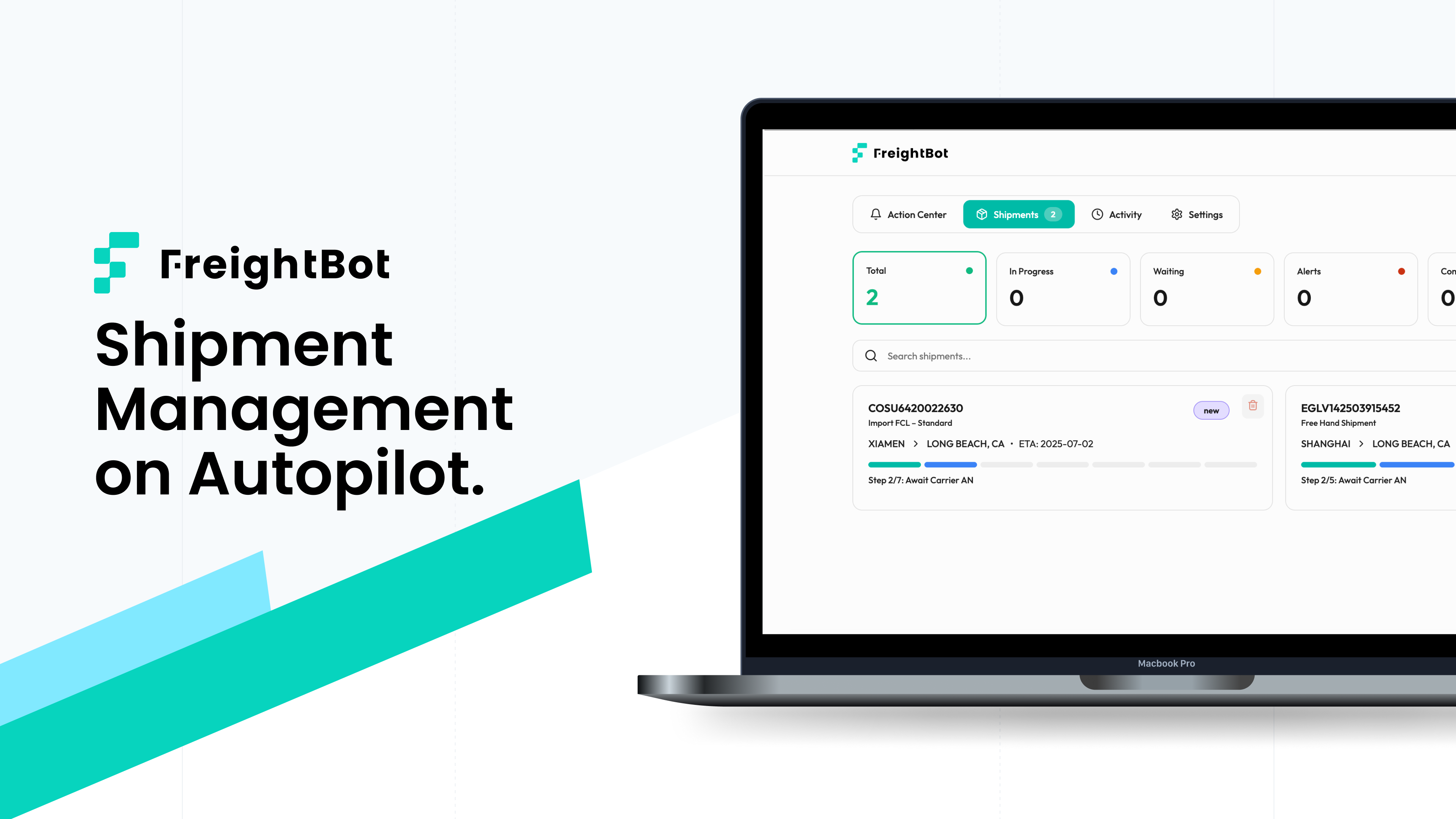
Project Story: The AI-Powered Freight Assistant
Inspiration
I currently work as a Product Manager at a freight forwarder, where daily operations rely heavily on Operations Specialists (OPs). An OP handles the entire lifecycle of a shipment—from container loading to customs clearance and trucking. This process relies heavily on manual email communication, which is time-consuming and prone to human error.
In this industry, errors translate directly into financial losses. For example:
- Arrival Notice Delays: Can lead to port demurrage fees ranging from $300 to $500 per container per day.
- Late Customs Filings: Can result in fines as high as $5,000.
The primary revenue model for freight forwarders is based on service fees and commissions. This is directly linked to OP performance. Even the most senior OPs average between $7,000 and $10,000 in annual fines. This product was built to improve this high-risk, human-dependent profit model.
What it does
Imagine a 24/7 digital OP. Upon receiving an email, the agent analyzes the intent based on pre-defined "agent skills." It parses the subject, body, and attachments to take action:
- New Orders: Automatically creates a shipment in the internal system based on attached files.
- Carrier Arrival Notices: Instantly generates and sends the forwarder’s own Arrival Notice to the consignee (preventing those late fees!).
- Customs Coordination: Automatically syncs data with customs brokers based on client documentation.
How I built it
I started by mapping out the workflows for different shipment types (Import FCL, Import LCL, etc.). I then designed a Permission and Responsibility Hierarchy, separating actions into "Auto-executable" and "Requires Approval" to ensure risk control.
The architecture positions the AI as a "Senior OP Assistant." I chose Gemini 3 for three specific reasons:
- Multimodal Context: It processes email text, PDFs, and images simultaneously.
- Long Context Reasoning: I can feed the entire domain playbook (e.g., MBL vs. HBL rules) into the system prompt.
- Structured JSON Output: It supports strict schema constraints, ensuring responses map to executable business logic.
Every output must follow a defined schema: $$Action \in {CREATE, UPDATE, ESCALATE, APPROVE}$$
Challenges we ran into
- Domain Ambiguity: Documents often contain both Master Bill of Lading (MBL) and House Bill of Lading (HBL) data. Distinguishing between them requires deep logic, not just field extraction.
- Alignment Issues: A single email might contain one PDF that covers multiple containers or several HBLs. The system must accurately "de-batch" these.
- Automation vs. Risk: We intentionally kept $20\%$ of the process—the high-risk "last mile"—under human control to protect the business.
- The "Demo vs. Reality" Gap: Real-world info isn't always in the email (e.g., a phone call update). I added a manual "Edit" function to allow OPs to patch information manually.
Accomplishments that we're proud of
- Accuracy: The model maintains a 95% confidence level in shipment identification.
- Efficiency: We reduced the average workflow time by 40%, with complex scenarios seeing improvements of up to 55%.
- User Feedback: Our first-line OPs gave us an NPS of 9. Management gave an 8, focusing on commercial scaling and liability.
What I learned
I learned to integrate business and profitability logic early. I calculated the unit economics from day one:
- LLM API Cost: $\approx \$0.01$ per shipment.
- Estimated Total Cost: $\approx \$2.00 - \$3.00$ per shipment (including 3rd-party APIs).
This led me to a "Charge per Shipment" model rather than a subscription, aligning costs directly with the value provided.
What's next for Freightbot
- Product Roadmap: Support more shipment types and implement an "Agent Browser" function for various FMS.
- Business: Move to GTM (Go-To-Market). I will start by onboarding our internal OP teams before expanding to external vendors.
Built With
- css
- gemini-api
- javascript
- pdf-parse
- react
- vite


Log in or sign up for Devpost to join the conversation.