Inspiration
As soon as we stepped outside when presented with our project, we were faced with a strong gust of wind. From here, we knew the direction we were going to take our design. Wind energy is becoming increasingly popular, especially in the Midwest, where the flat land enables strong wind (only about an hour north of West Lafayette there is a 42,000 acre wind farm with over 300 turbines). This strong wind is exacerbated by the fact that at Purdue, many buildings are positioned close together, creating a "wind tunnel" effect in many areas of the campus. We saw this wind as an untapped source of energy, and wanted to try and capitalize on it in order to save energy.
What it does
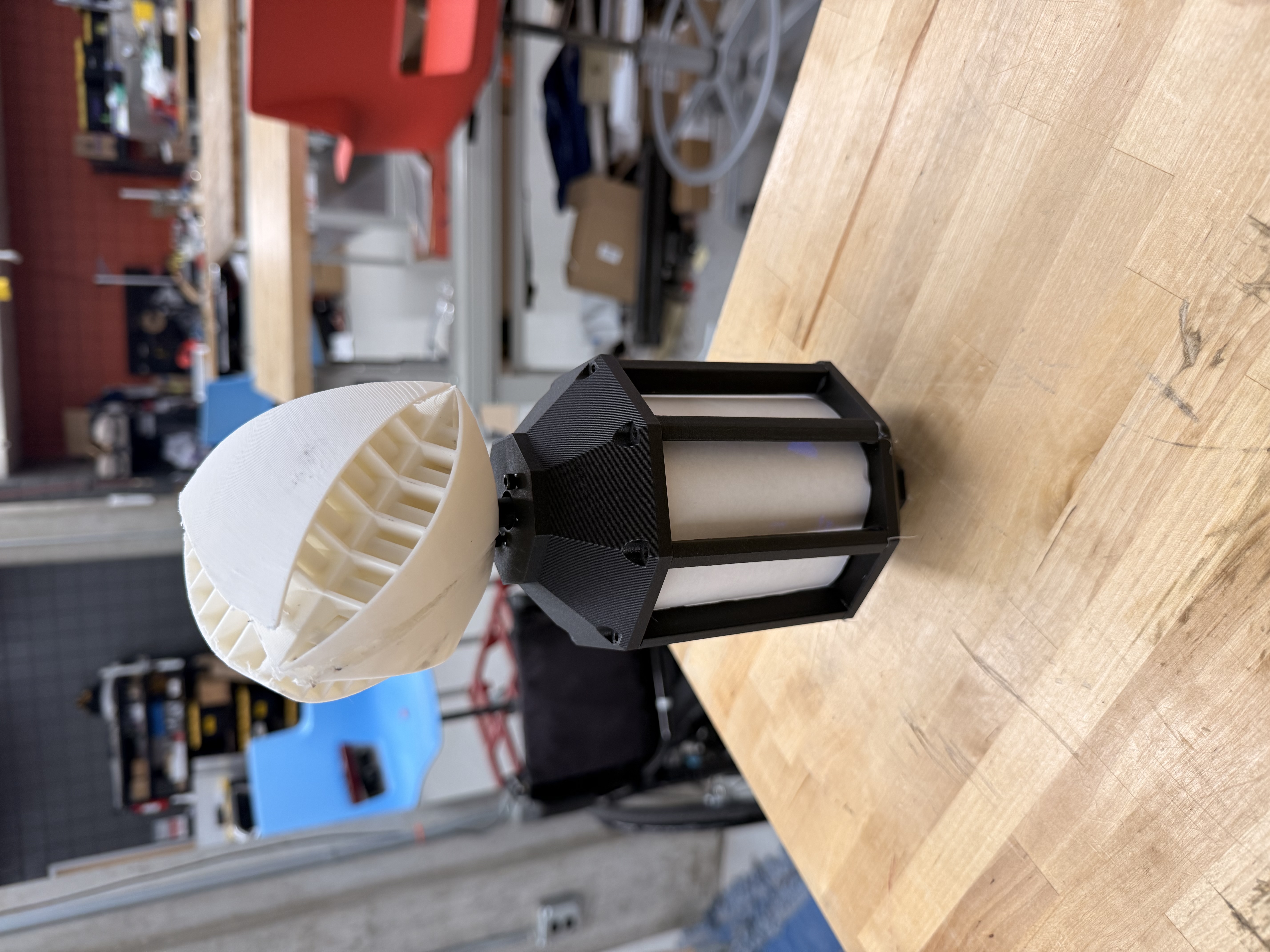
Our prototype, FreeLight, is designed to significantly reduce energy consumption in street lighting across the Purdue University campus. This is achieved through the integration of micro wind turbines mounted atop the existing lamp covers. The turbine system uses a dynamo to convert kinetic wind energy into electrical energy, which is then stored in a dedicated battery reserve. This stored power is then utilized to operate the street light, thereby supplementing grid-supplied electricity.
How we built it
The FreeLight prototype was created primarily using 3D printing technology. We created a 1:4 scale model of one of the lamp posts lining 3rd street at Purdue University. In addition to the lamp model, we utilized an already existing turbine design, developed by Lancaster University, called the "O-Wind." This turbine is able to spin from wind coming from any direction using a series of cleverly configured ducts. This turbine was connected to a dynamo attached to the lamp cover, which is the hooked up to a battery reserve. Using an ESP-32 microcontroller, we are able to control when the battery depletes its energy into the LED lights inside of the lamp. This can be controlled via mobile app and acts as a proof of concept for a more realistic timing system when fully implemented.
The Mathematical Foundation
To validate the feasibility of FreeLight, we looked at the physics of wind power. The power available in the wind can be expressed by the following equation:
$$P = \frac{1}{2} \rho A v^3 C_p$$
$P$ = Power output in Watts. $\rho$ (Rho) = Air density (approximately $1.225 \text{ kg/m}^3$ at Purdue’s elevation). $A$ = Swept area of the turbine blades ($\pi r^2$ for traditional turbines, or the cross-section for the O-Wind).$v$ = Wind velocity in meters per second. $C_p$ = The power coefficient (The Betz Limit dictates a maximum theoretical efficiency of $0.593$, though micro-turbines typically operate between $0.1$ and $0.2$).
Through our calculations, we derived that a single turbine unit would generate 175 kWh/year.
Challenges we ran into
The main hurdle was the reality of rapid prototyping. 3D printing large-scale, airtight ducts for the O-Wind turbine required dozens of hours of print time, leaving not much room for error in the assembly phase. Also, sourcing wind data for specific campus "micro-climates" was very difficult; while general West Lafayette data is available, the specific wind speeds within campus corridors are not well documented, requiring us to rely on general data to justify our power estimates.
Accomplishments that we're proud of
We are proud of the fact that we have a fully functional prototype created based on our own ideas from brainstorming. In addition to this, we are proud of the ESP-32 integration, as it allowed us to fully customize a lot of the software implementation for the prototype.
What we learned
This project showed us the importance of iterative design. Our first turbine mount was structurally unstable, but by allowing time for failure, we were able to reinforce the 3D-printed chassis. With iterative design, we can very quickly perfect a design and create something polished.
What's next for FreeLight
The next phase involves optimizing the dynamo's gear ratio to allow for energy harvesting at lower "cut-in" wind speeds. We also hope to potentially integrate solar film onto the lamp covers to create a hybrid wind-solar system, ensuring energy collection even on rare non windy days.

Log in or sign up for Devpost to join the conversation.