-
-
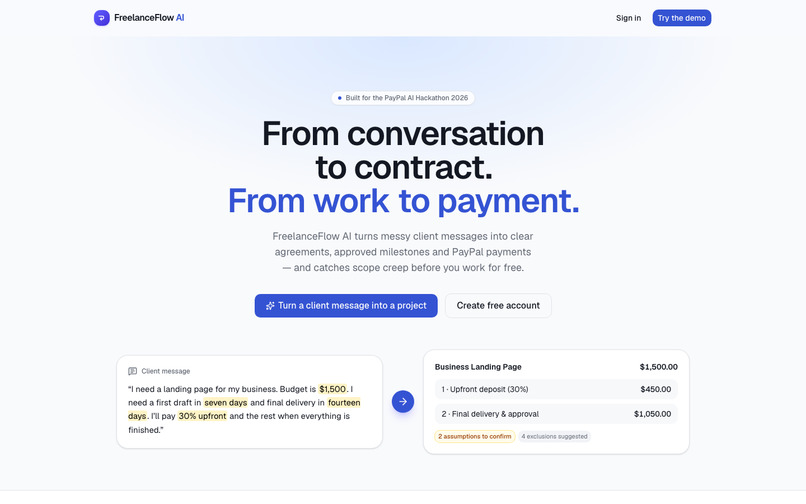
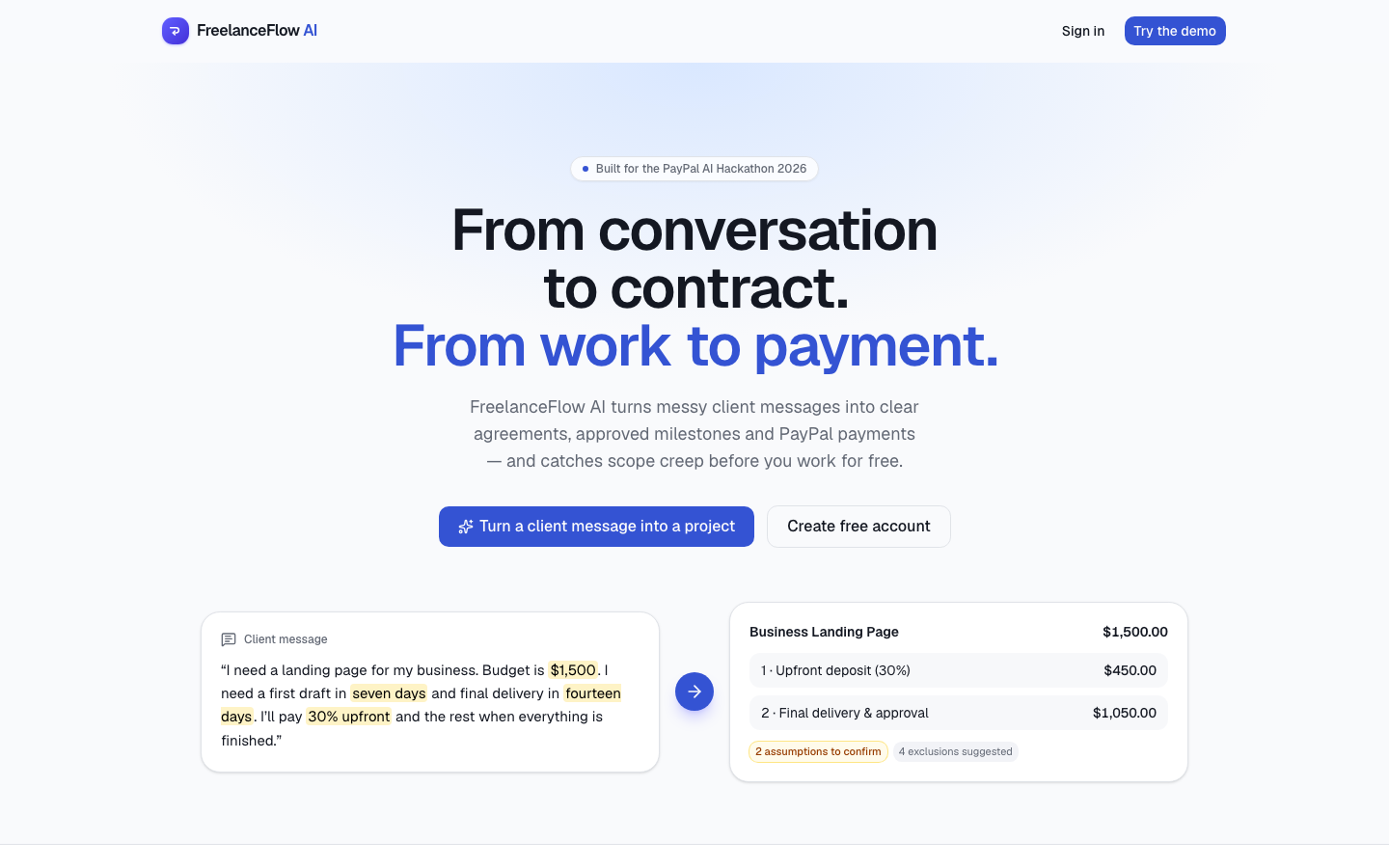
Landing page
-
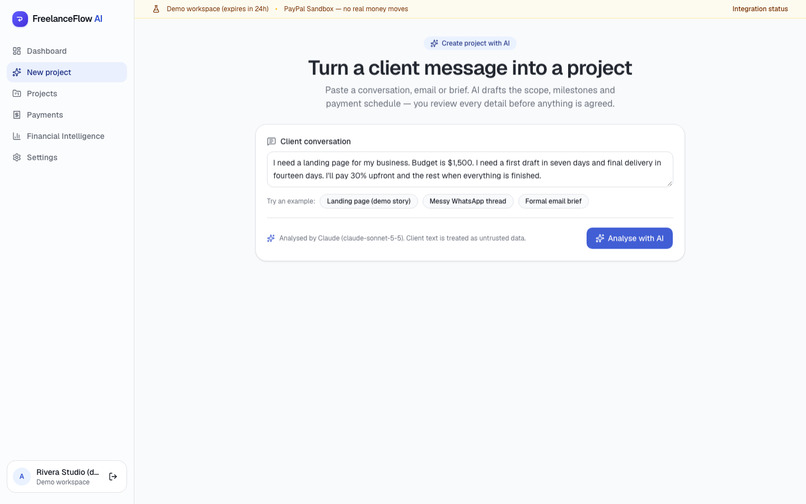
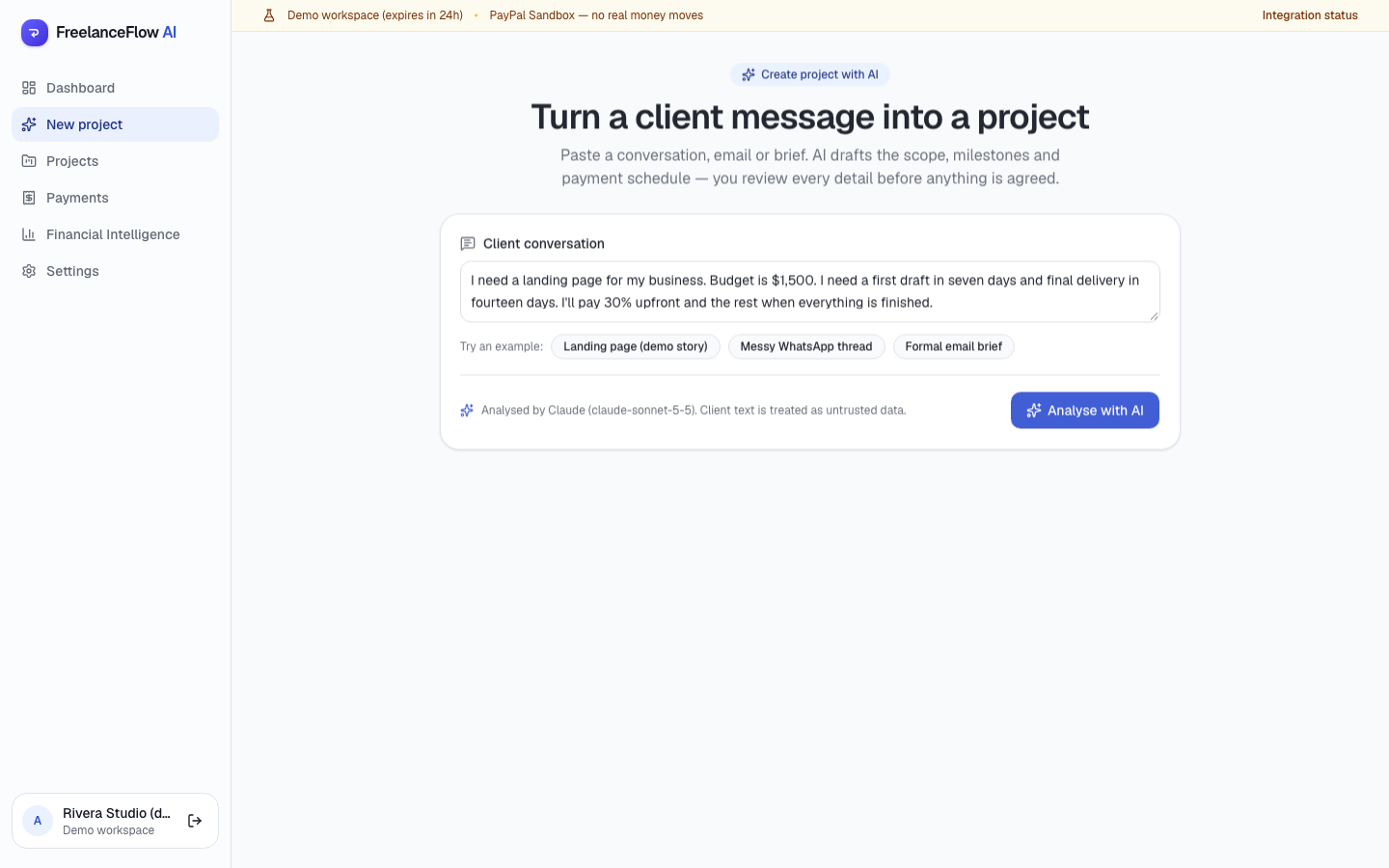
Client conversation ready for AI
-
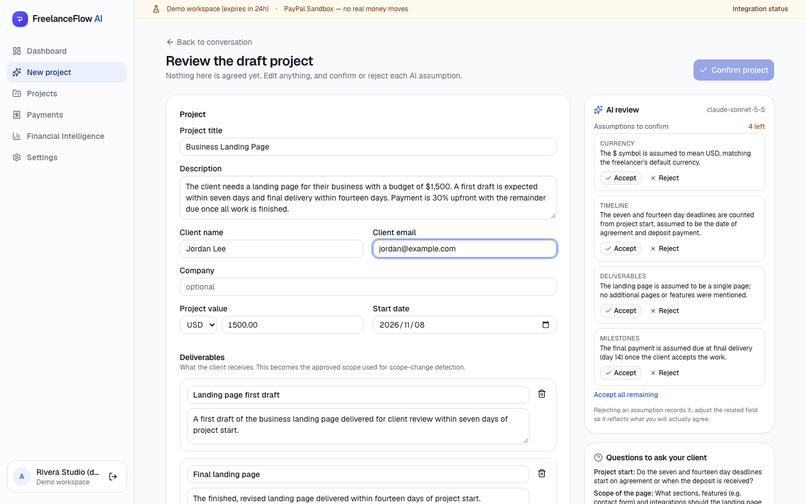
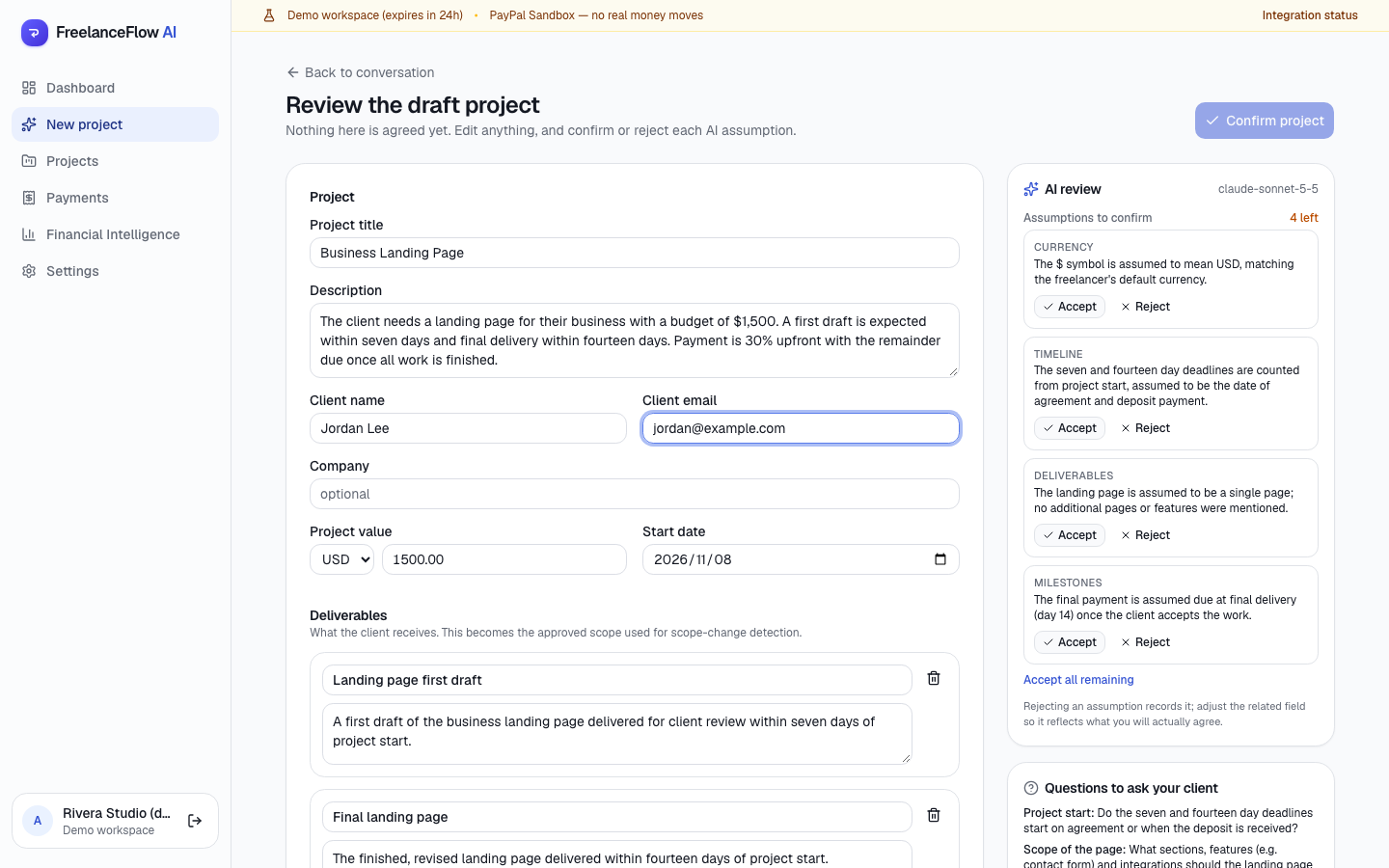
AI review: assumptions, milestones, reconciliation
-
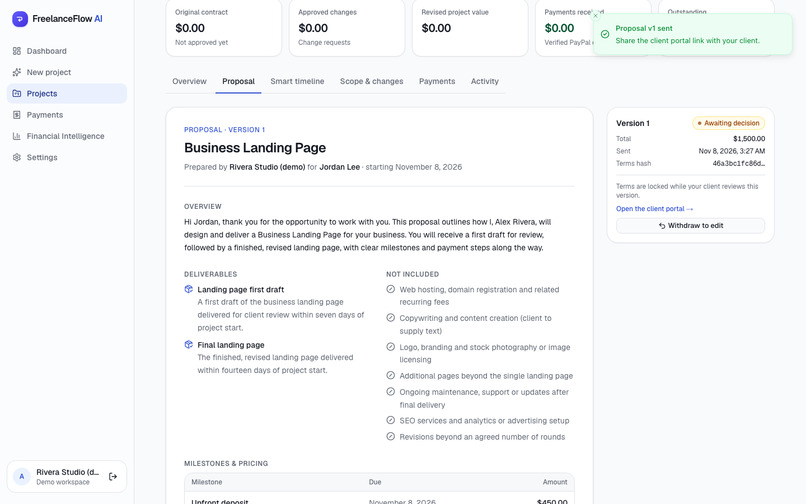
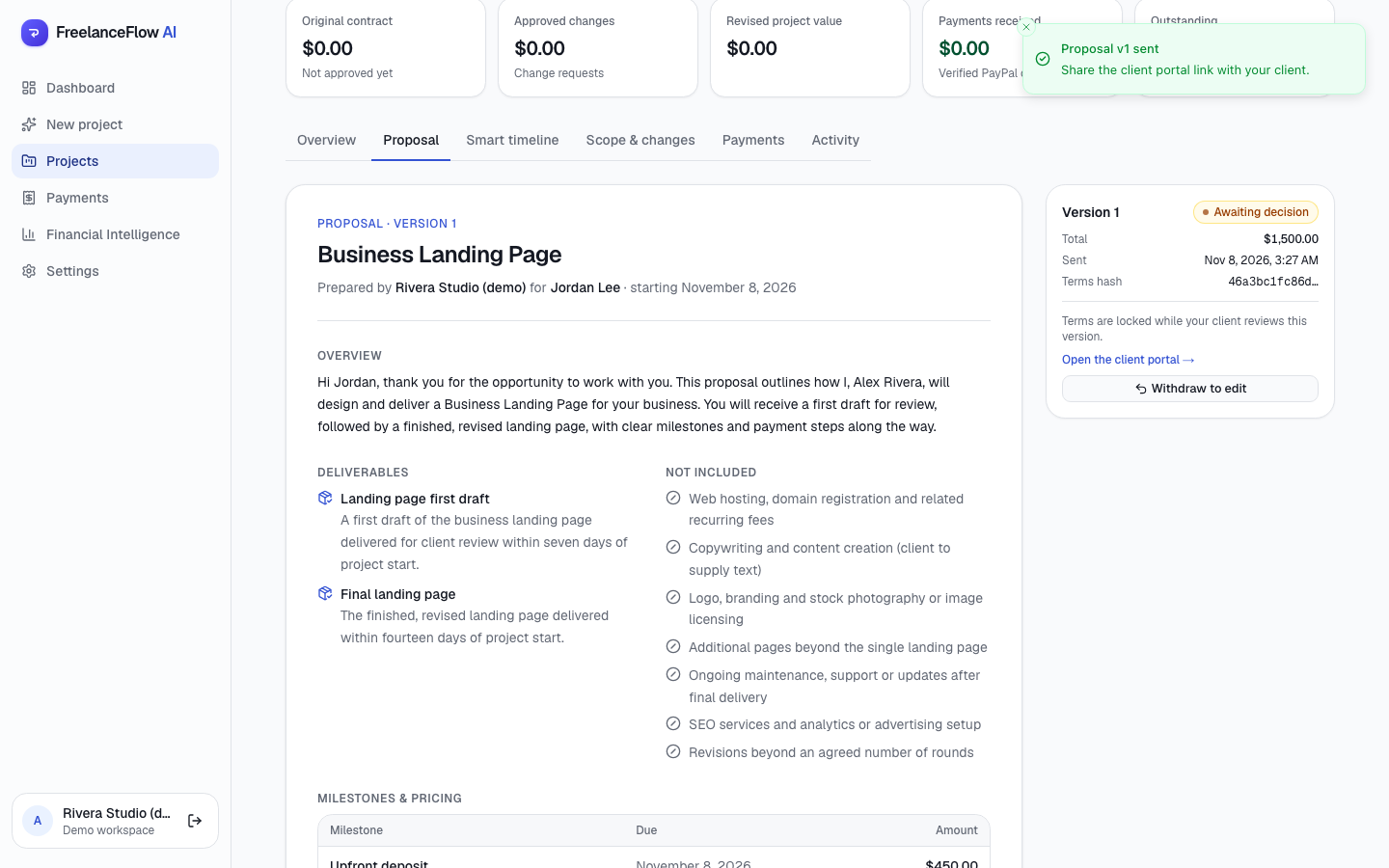
Proposal sent, immutable version
-
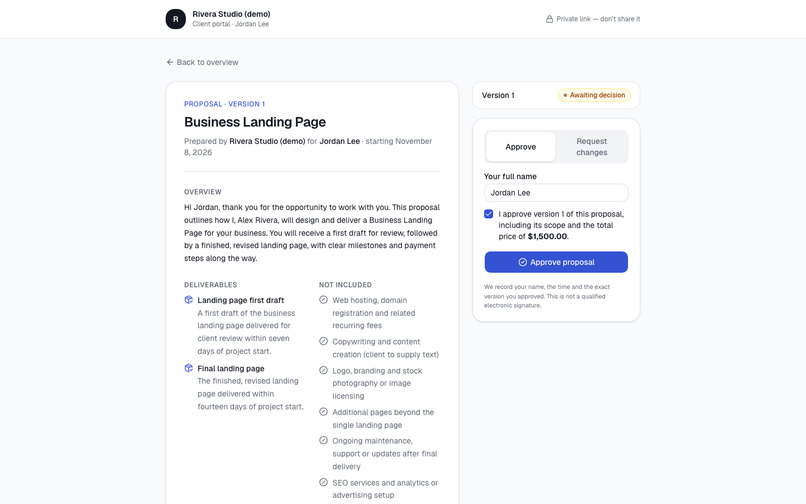
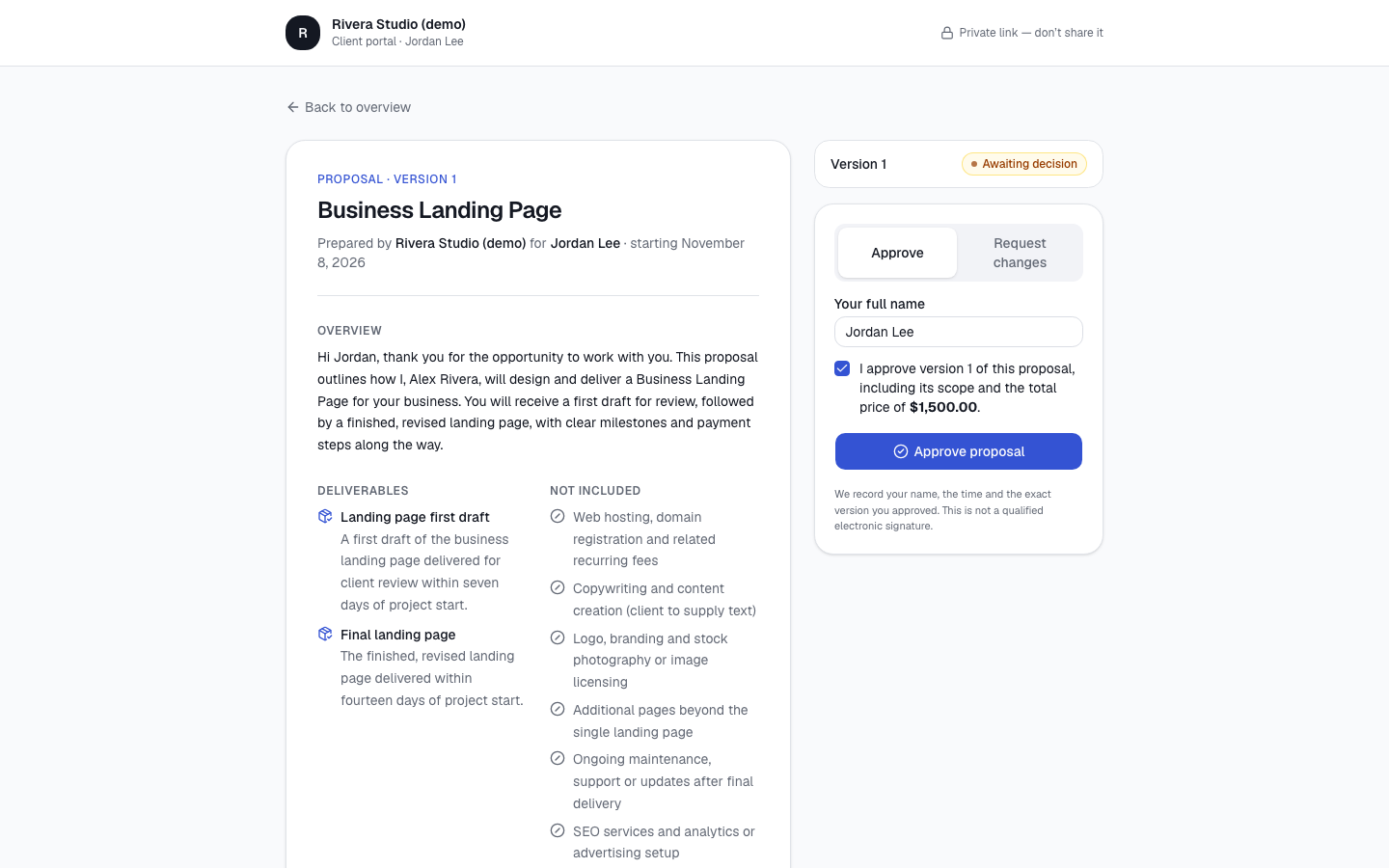
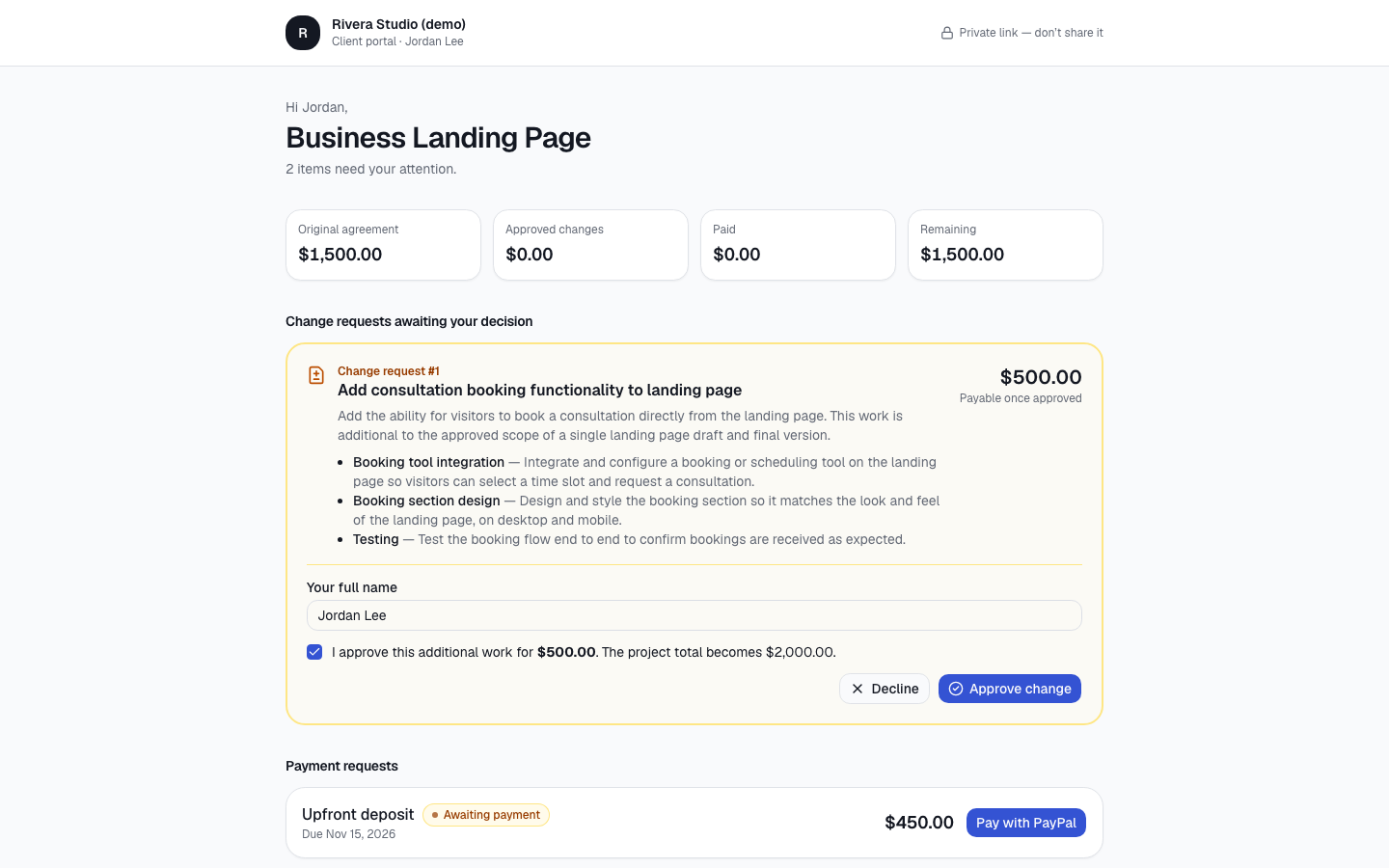
Client portal approval with consent
-
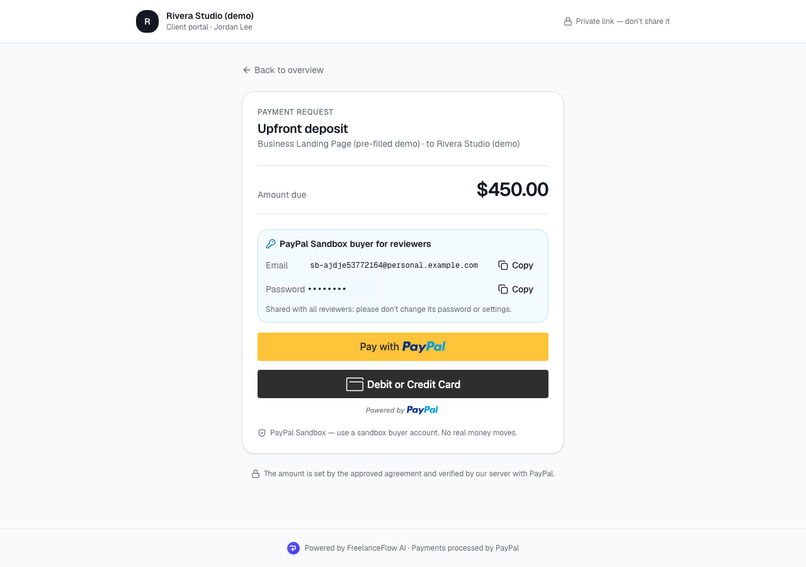
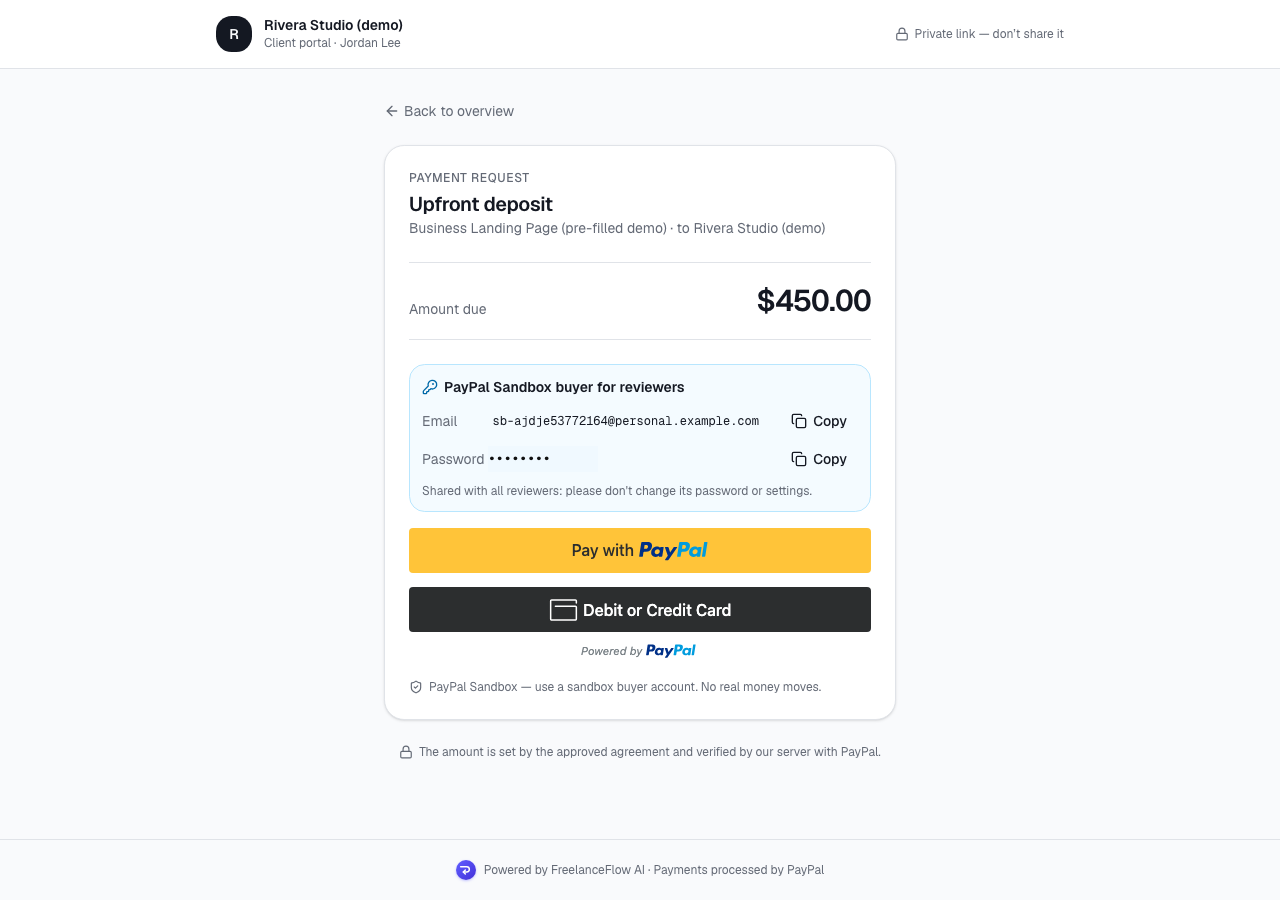
PayPal Sandbox buttons on the payment page
-
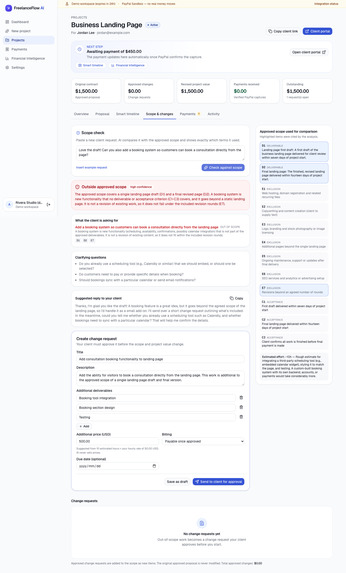
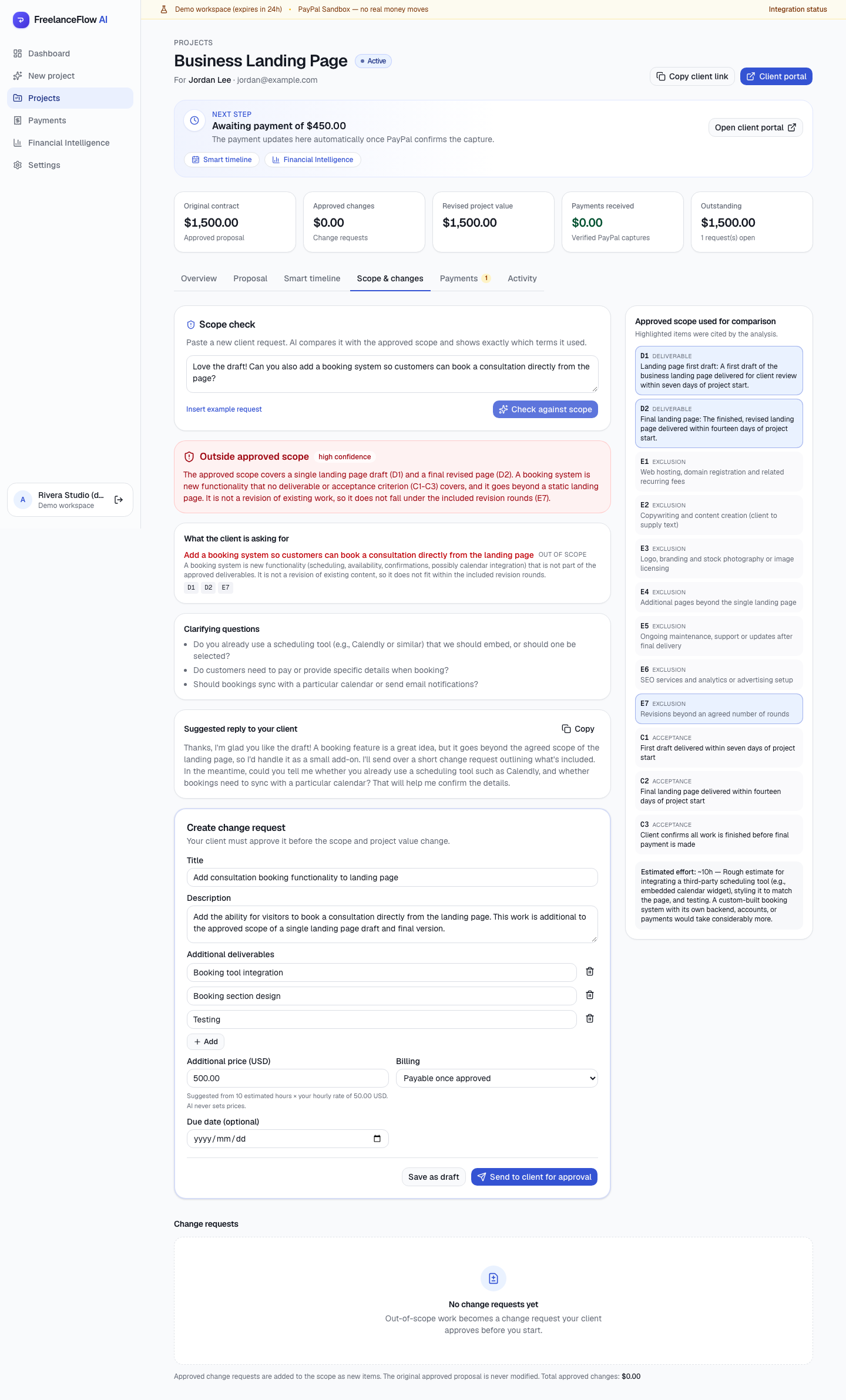
AI scope check with cited references and change request
-
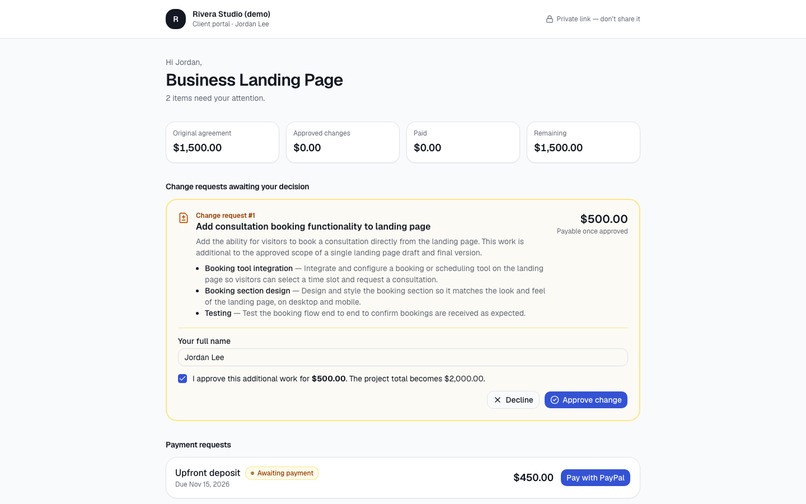
Client approves the change
-
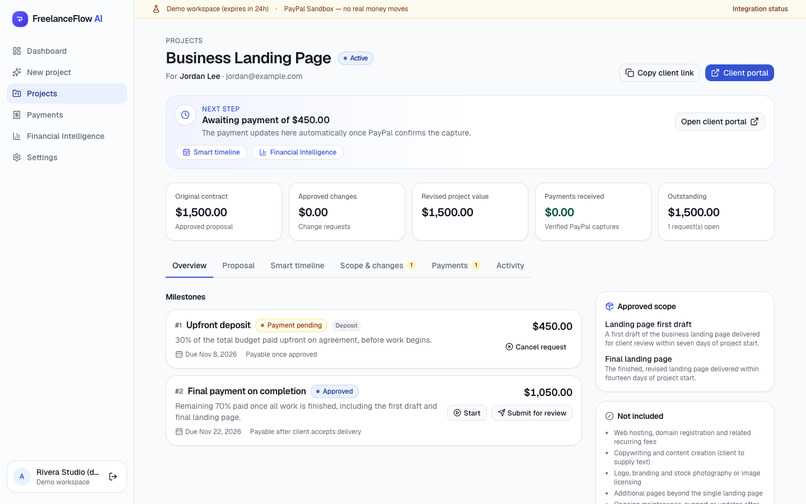
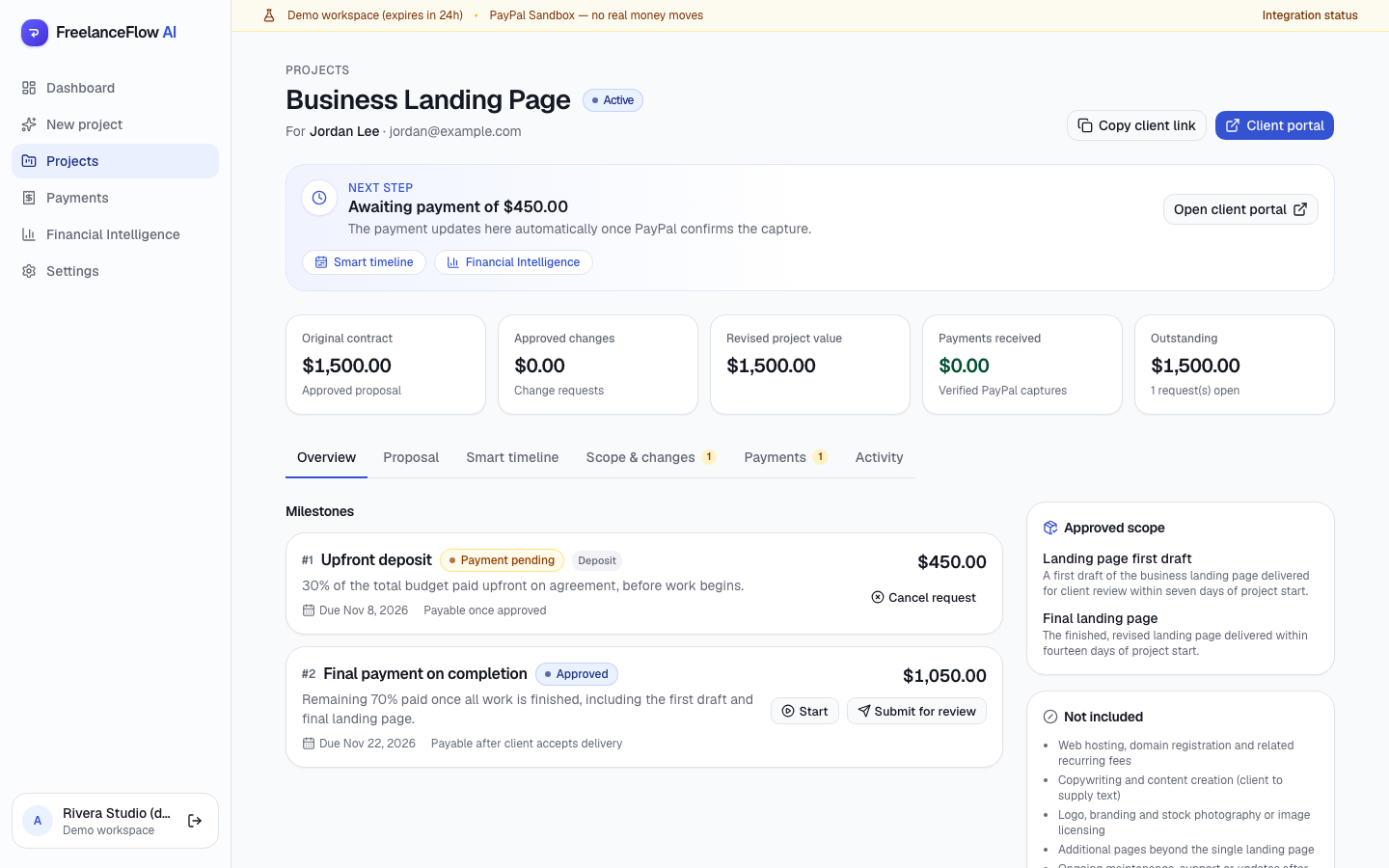
Updated totals
-
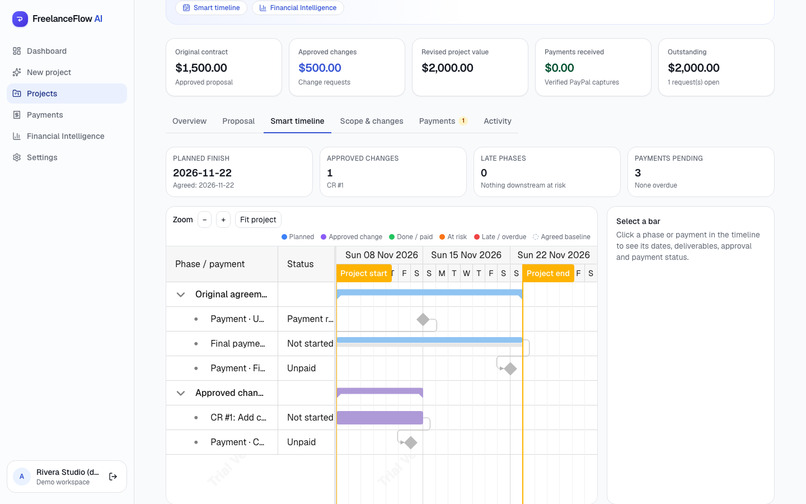
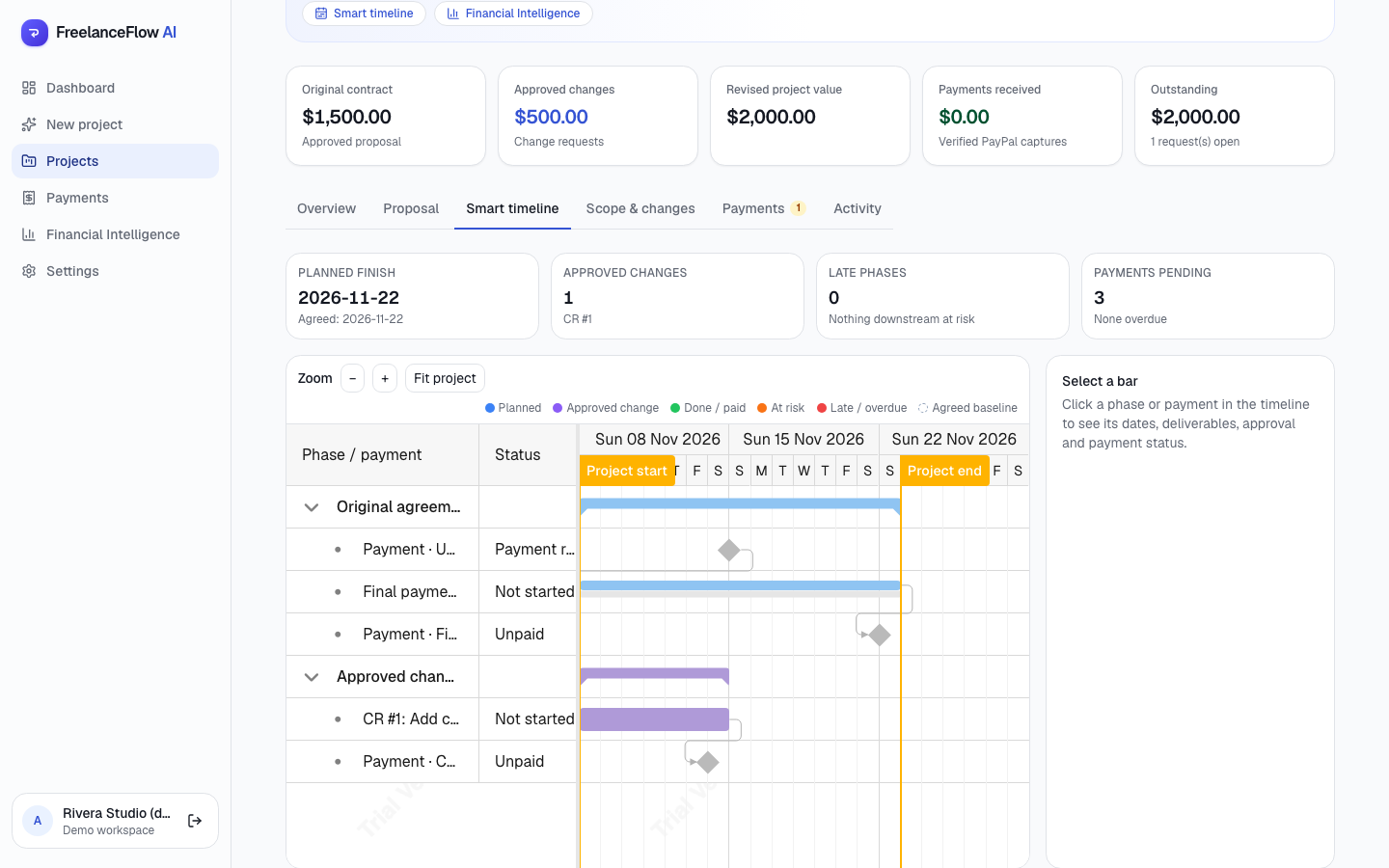
Bryntum Gantt with baseline
-
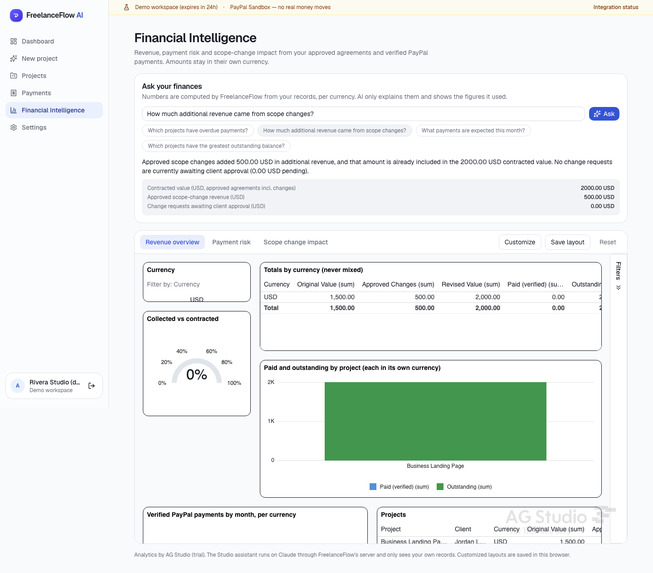
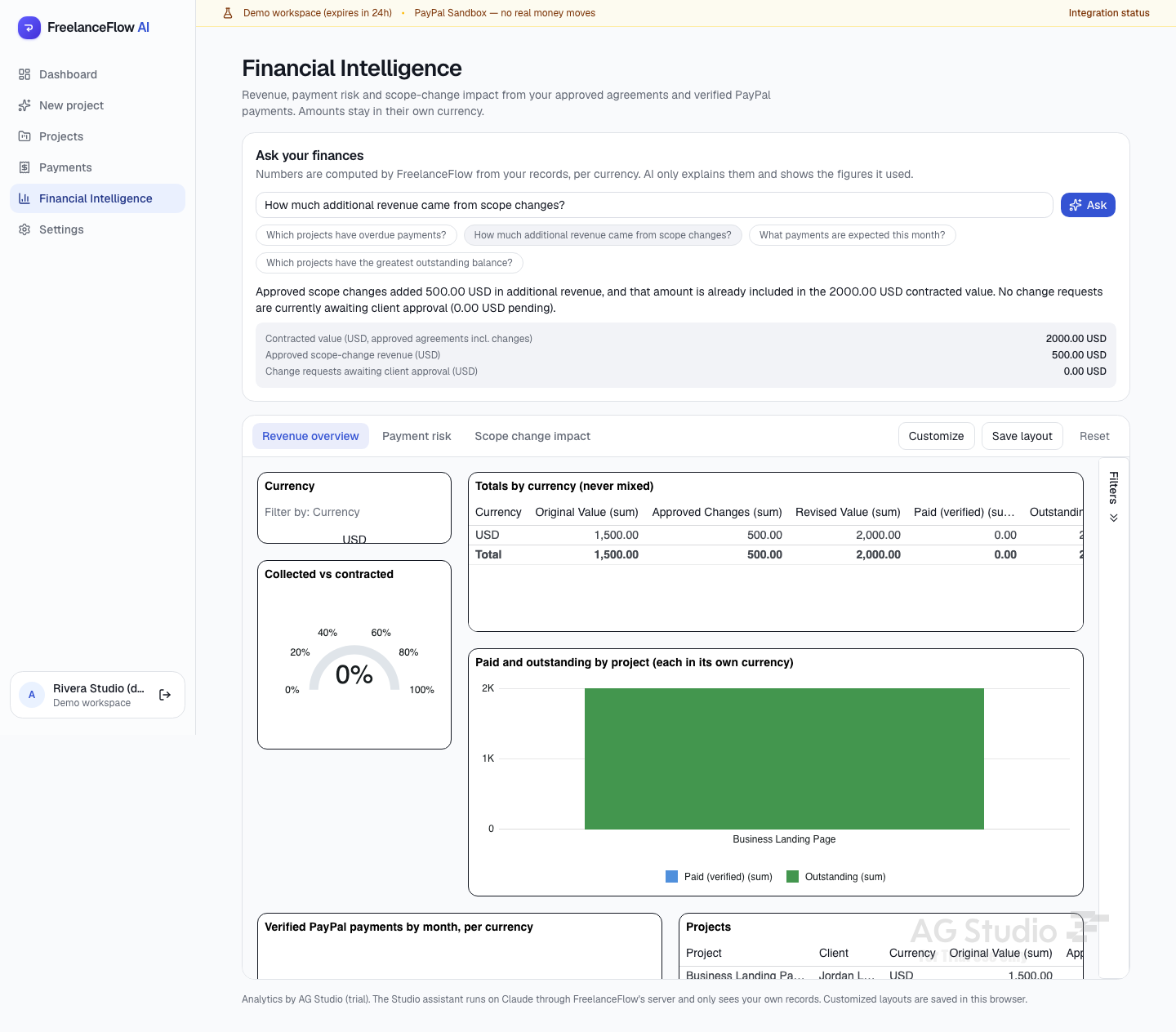
AG Studio dashboard and grounded answer
-
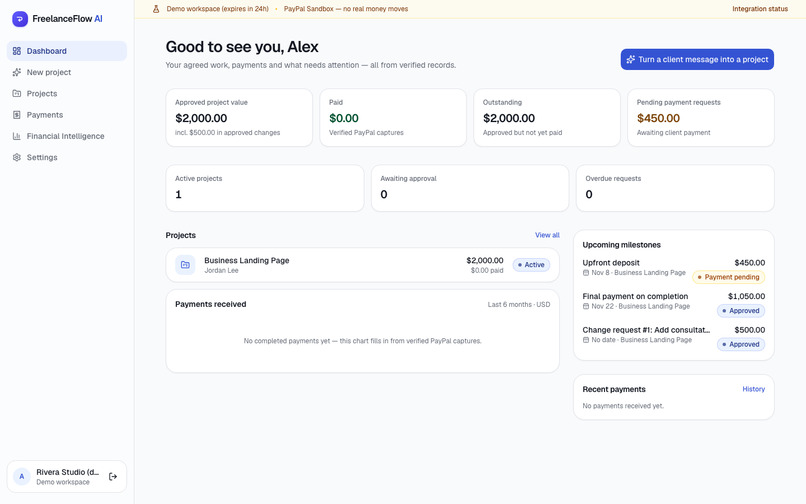
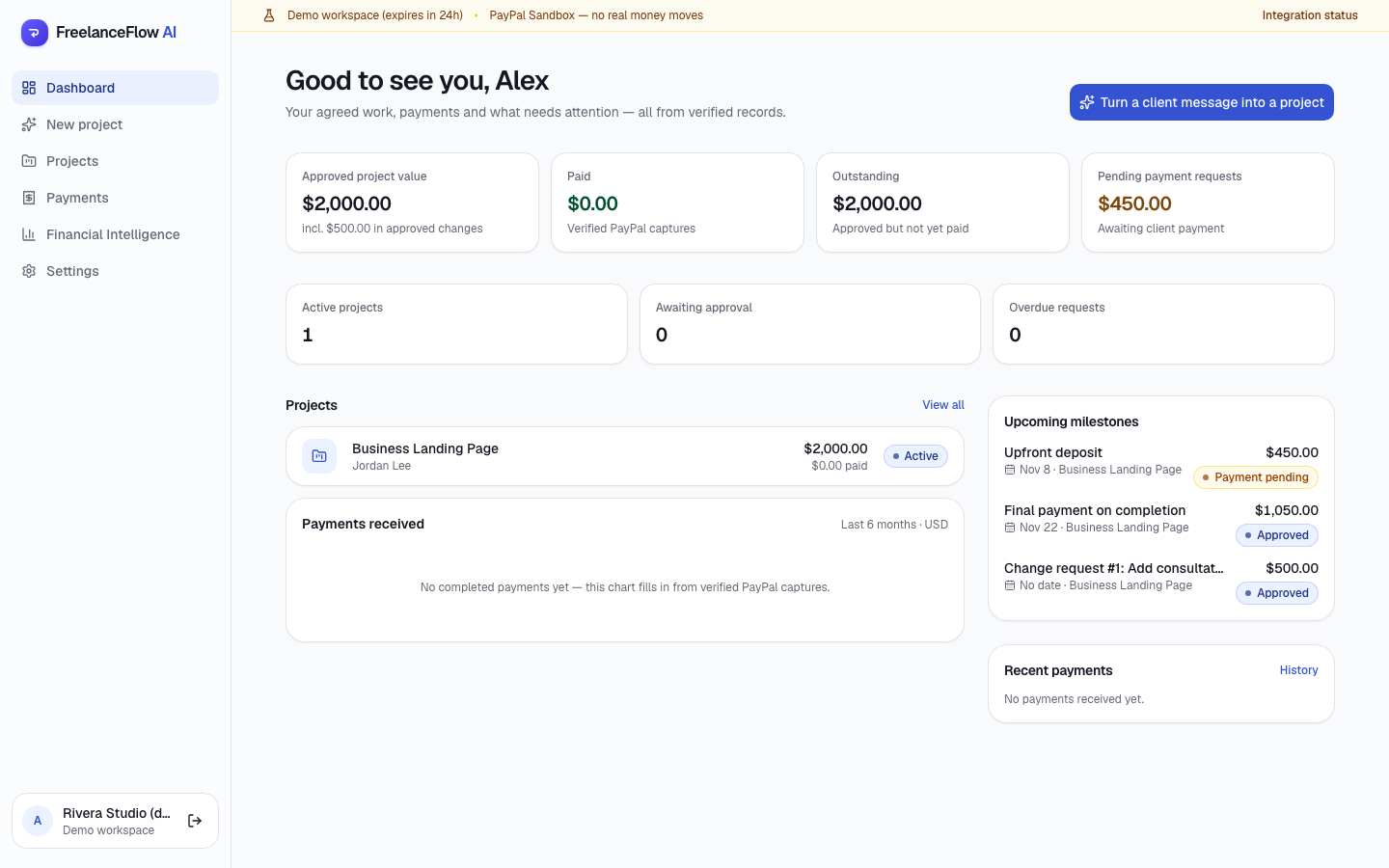
Dashboard
-
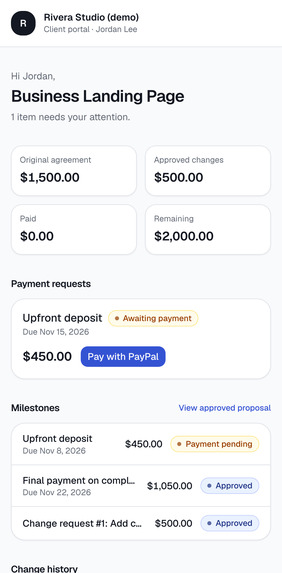
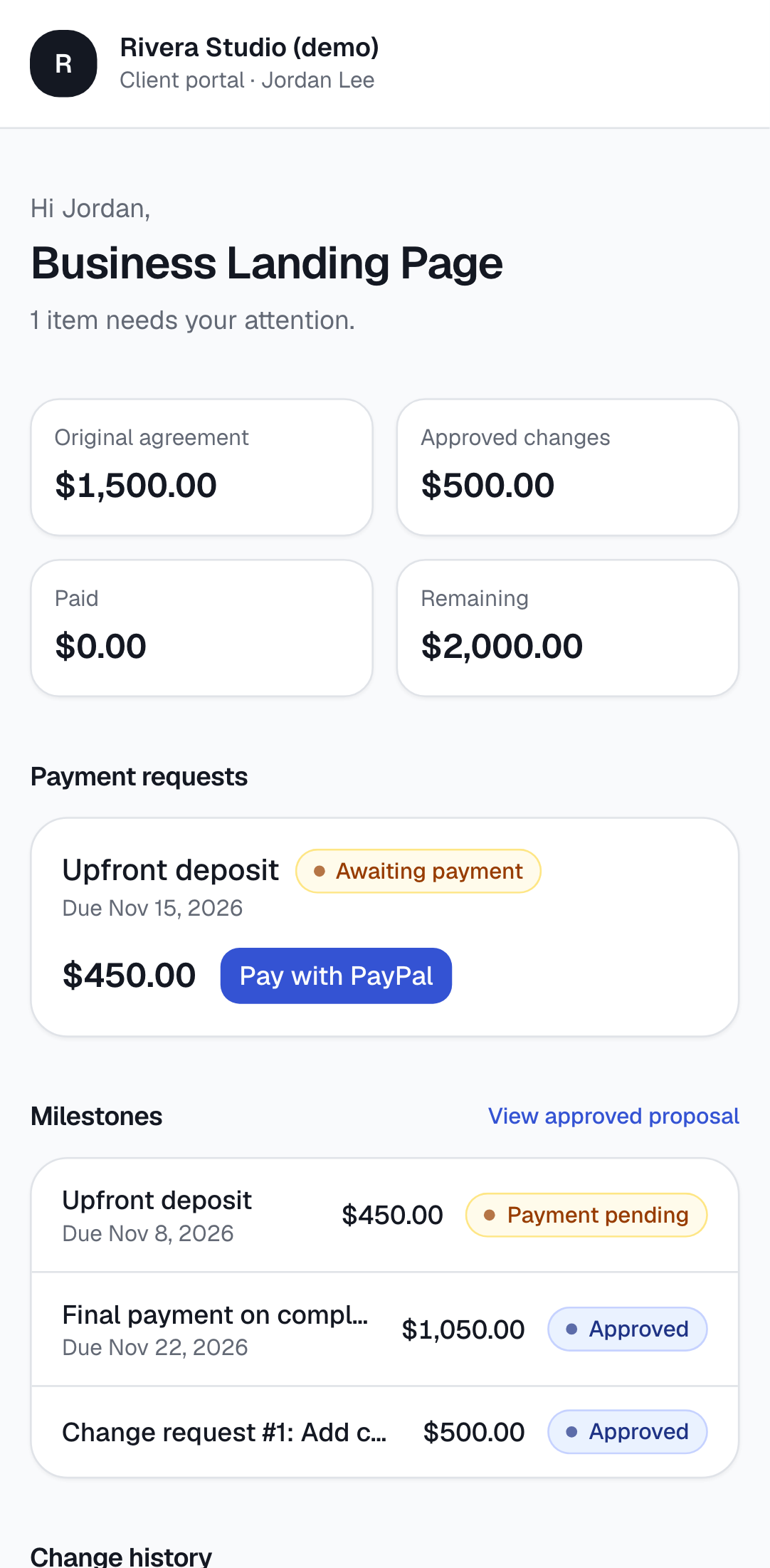
Client portal on a phone
Inspiration
Freelancers rarely lose money because they are bad at their craft. They lose it in the gaps: the budget agreed in a chat thread, the "quick extra" nobody priced, the final invoice sent three weeks late, the argument about what was actually agreed. Existing tools ask freelancers to re-type all of that into projects, invoices and payment schedules by hand.
We wanted the agreement itself to become the system of record. AI does the administrative work, while humans and PayPal stay in charge of commitments and money.
What it does
- Conversation → project. Paste a client message. Claude extracts deliverables, exclusions, budget, currency, timeline, milestones and acceptance criteria into a schema-validated draft. Every assumption the AI made must be accepted or rejected before the project can be confirmed, and milestone amounts are recomputed with exact decimal arithmetic.
- Proposal → immutable agreement. AI drafts the proposal wording but never the prices. Sending freezes the terms into a SHA-256-hashed version, and the client approves that exact version in a private portal. We record who approved, when, the hash and the amount.
- Milestones → PayPal payments. A milestone becomes a payment request. The server creates the PayPal order from the stored amount, captures it after buyer approval, verifies the amount, currency and reference, and records it exactly once. Signature-verified webhooks and reconciliation handle pending captures, closed tabs, timeouts, refunds and duplicates.
- Scope protection. When the client asks "Can you also add a booking system?", FreelanceFlow compares the request with the approved scope and cites the exact deliverables and exclusions it relied on. Out-of-scope work becomes a change request priced from the freelancer's own hourly rate: AI estimates hours, code sets the price. After client approval, scope and totals update and the original agreement is preserved.
- Financial truth. Original contract, approved changes, revised value, paid, outstanding and overdue, all derived from approved records and verified PayPal captures, and never mixed across currencies.
- Smart Milestone Timeline (Bryntum Gantt). A read-only Gantt per project, built from approved milestones, PayPal payment requests and approved change requests:
- the agreed plan as a baseline
- payments as dependencies
- late work or overdue payments flag everything downstream as at risk
- Claude explains the risk and drafts a client message, but never moves an approved date.
- Financial Intelligence (AG Studio). Embedded analytics over the same records: revenue, payment risk and scope-change impact, always per currency. AG Studio's built-in agents run on Claude through our server, and "Ask your finances" answers from figures computed by code and lists the figures it used.
How we built it
- Stack: a Next.js 16 monolith (App Router, Server Actions) with strict TypeScript, Prisma, PostgreSQL and Better Auth.
- Business rules: small pure modules (state machines, payment eligibility, financial derivation) that AI output can never bypass.
- AI: Anthropic Claude through a provider interface with structured outputs and Zod validation. Versioned prompts; client text is wrapped as untrusted. A clearly labelled heuristic fallback exists for offline development.
- PayPal: Orders v2 through the APIMatic-generated PayPal Server SDK (
@paypal/paypal-server-sdk), following APIMatic's Context Plugin skills (explicit timeouts, idempotent retries withPayPal-Request-Id). The browser uses the PayPal JS SDK; webhook signatures are checked with PayPal's REST verify API. - Integrity in the database: unique capture IDs and webhook event IDs, one active payment request per milestone, row-level locks, and a capture lock that rules out double payment across two PayPal windows.
- Hosting: one AWS Lightsail instance (Docker Compose, Caddy with automatic HTTPS, PostgreSQL) at https://freelanceflow.hayaix.tech.
PayPal integration
- Orders v2: create, capture and get, server-side, with idempotency keys, through
@paypal/paypal-server-sdk. - PayPal JS SDK: Smart Payment Buttons in the client portal.
- Webhooks:
CHECKOUT.ORDER.APPROVEDandPAYMENT.CAPTURE.COMPLETED/PENDING/DENIED/DECLINED/REFUNDED/REVERSED, each signature-verified. - Sandbox only: no real money moves.
AI integration
Claude (claude-sonnet-5-5) is used for:
- project extraction
- proposal drafting
- scope comparison with cited references
- schedule-risk explanations
- grounded financial answers
- AG Studio's agents, through a custom
AgLlmAdapterbridge
Prices, permissions and payment state are always decided by deterministic code.
Sponsor tools
- Bryntum Gantt: Smart Milestone Timeline (trial).
- AG Studio (AG Grid): Financial Intelligence dashboards, theming, and Studio Agent Framework on Claude (trial).
- APIMatic: PayPal Server SDK guided by the Context Plugin for PayPal.
Details and evidence: https://github.com/thosuperman/freelance-flow-ai/tree/main/docs/sponsors
Challenges we ran into
- Explainable AI rather than an oracle: the approved scope is tagged with reference IDs, the model must cite them, and any reference that doesn't exist is dropped.
- Exactly-once payments in an at-least-once world: refreshes, double clicks, timeouts after PayPal already captured, and duplicate webhooks all converge on one idempotent path.
- Keeping humans in control without friction: assumption review, explicit consent and immutable versions, while the happy path still takes about three minutes.
- Big sponsor bundles on a small server: building on the admin machine and shipping a slim Linux image.
Accomplishments that we're proud of
- The whole story runs on a public deployment with live Claude: conversation → approved proposal → PayPal deposit → AI-detected scope change → approved change request → updated totals, timeline and analytics.
- A real PayPal Sandbox capture was verified against PayPal's API, with signature-verified webhooks processed exactly once.
- 101 unit and integration tests and 5 Playwright end-to-end tests (desktop and mobile).
What we learned
The most valuable thing AI does here is structure and explanation, not decisions. Once prices, permissions and payment state are owned by deterministic code, the AI can be ambitious without being dangerous.
What's next for FreelanceFlow AI
- agency teams
- one-time-code confirmation for client approvals
- PayPal Subscriptions for SaaS plans
- automatic payment reminders driven by the timeline's risk flags
- a custom AG Studio payment-risk widget
Built With
- ag-grid
- ag-studio
- anthropic
- apimatic
- aws-lightsail
- better-auth
- bryntum
- caddy
- claude
- docker
- nextjs
- paypal
- paypal-js-sdk
- paypal-orders-api
- paypal-server-sdk
- paypal-webhooks
- playwright
- postgresql
- prisma
- react
- shadcn-ui
- tailwindcss
- typescript
- vitest
