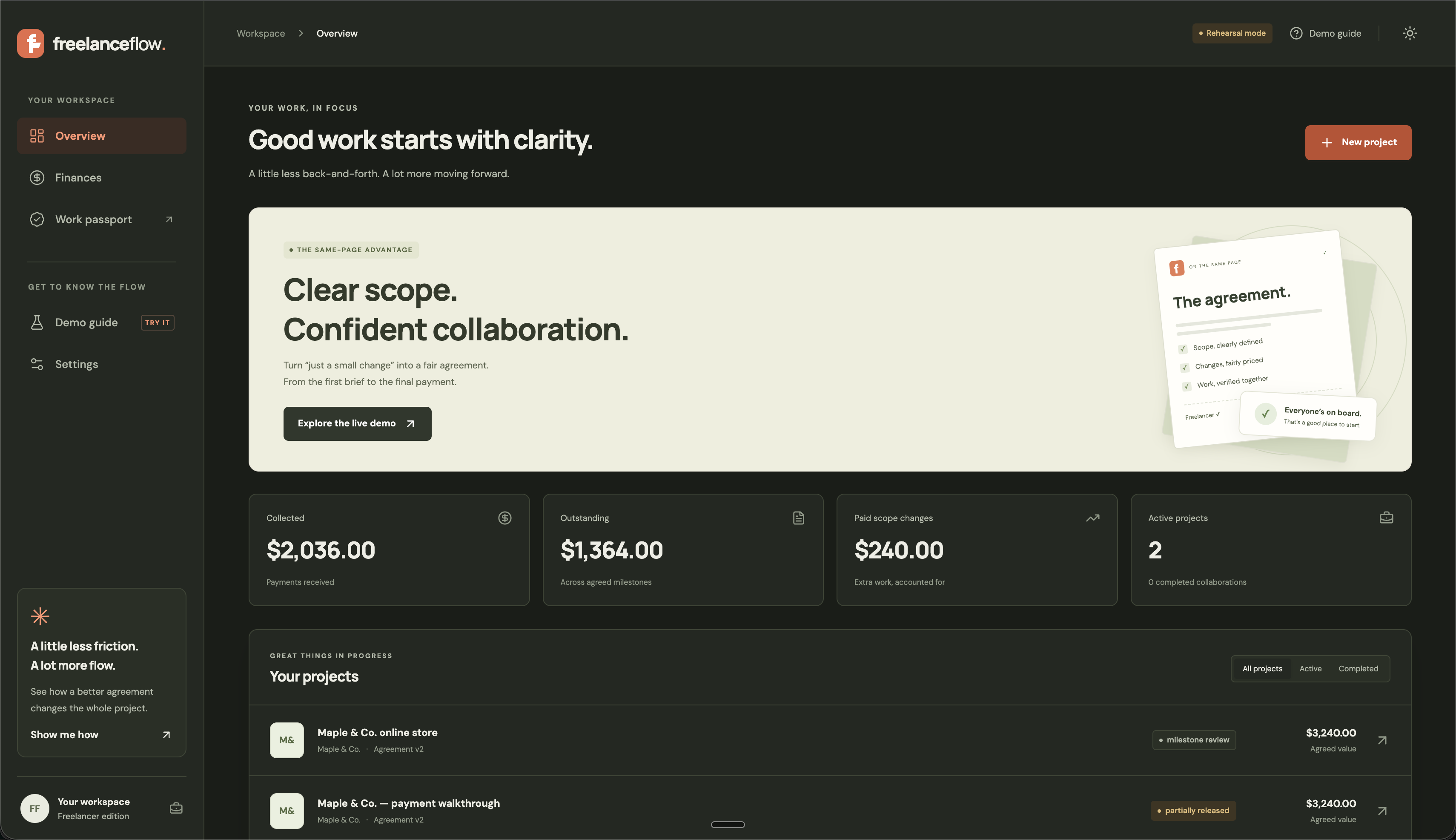
Freelance projects often start with a vague brief and end with a disagreement. What does “modern” mean? Is a wishlist included? How much should be paid when most—but not all—of the work is finished?
We built FreelanceFlow to help freelancers and clients answer those questions together.
FreelanceFlow turns a brief into measurable requirements, acceptance criteria, and a payment schedule. It flags unclear language before either party approves the agreement. When a client requests something new, it checks the agreed scope, explains the effort, and creates a priced change for both sides to review. Every agreement version and approval stays in the project history.
At delivery, FreelanceFlow runs acceptance checks against the delivered website and creates a proof receipt showing what passed and what needs attention. It recommends a proportional payment amount, while the client makes the final decision. A payment ledger tracks the results, and a shareable work passport brings together evidence from completed milestones.
The PayPal integration includes advance and change-order invoices, milestone authorizations, partial captures, and verified webhooks. The AI layer supports brief clarification, scope analysis, effort explanations, and acceptance-check generation. Prices and payment amounts are calculated by deterministic code; AI recommendations cannot move money.
Our two-person team built FreelanceFlow with TypeScript, React, Fastify, PostgreSQL, OpenRouter, and PayPal APIs, deployed through Docker on AWS EC2.
Current prototype status: the hosted walkthrough uses clearly labelled simulated payments and offline analysis. PayPal sandbox and live AI integration code are implemented, with end-to-end provider validation still pending.
Built With
- ag-grid
- aws-ec2
- docker
- fastify
- node.js
- openrouter
- paypal
- playwright
- postgresql
- react
- typescript
- vite
- vitest
- zod
